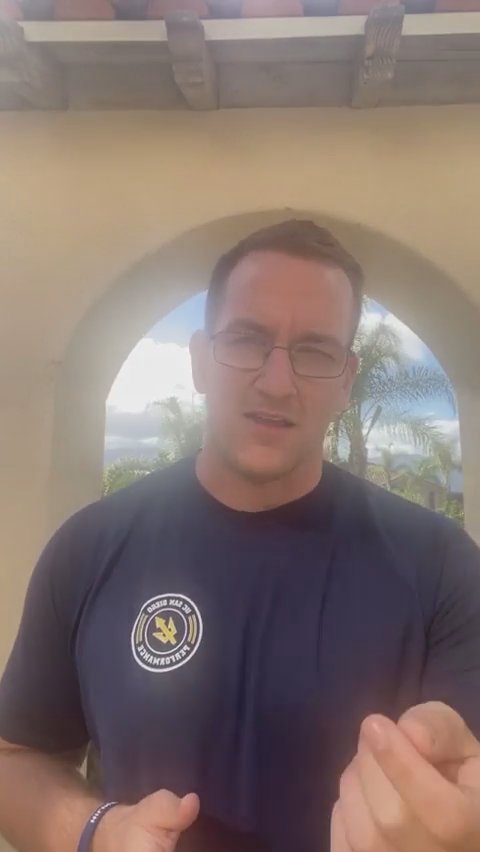
Come learn about how to improve your life and performance by identifying where you can allocate your focus.
Garrett Westerwell has a background in sport and performance psychology. His goal is to help people benefit from these principles. Controlling the controllables is a very powerful statement. It's easier said than done.
The phrase control what you can control is so powerful in that moment. A lot of times we focus on things that simply, again, aren't in our control. Do your job to the best of your ability is going to give you more opportunities.
And in this brief live today to start off your week right, I want to leave you with a quote from the great John Wooden. The more concerned we become over the things we can't control, the less we will do with the things that we can control. Enjoy the rest of your Monday and attack what you can Control.
What's up, Cadre? Happy Monday. My name is Garrett Westerwell, and if you've been following along, you'll know. If you're new to my videos, then I'll introduce myself. I have a background in sport and performance psychology, and my whole goal with all these videos and helping you on this app is just to help everybody kind of find out that they're all performers and they can benefit from these principles from sports psychology and help your mind work for you rather than against you. It's always the, the goal of my best videos and my content.
So today we're going to talk about one of my favorite phrases that I have in the entire world, which is control what you can control. Controlling the controllables, I think, is a very powerful statement. It's easier said than done. It's super simple in essence, but it's not easy. So I think a good analogy just to kind of start this discussion off is just imagining that or a parallel to fast food. So I want you to imagine right now, right here, now imagine your favorite fast food chain, your favorite fast food restaurant in the world, and you're super hungry.
So you go into this fast food restaurant, whatever it is, for you, and you only have $7. $7. So kind of limited with your money and your options that you have. But again, you're super hungry going into this restaurant, you might have your favorite menu on the item. You might be looking at the most filling item on the menu. And really with that, you're trying to, you know, make that decision utilizing your limited resources of only $7. And so you go about that decision, like I said, again, choosing maybe your favorite or maybe the most important thing that you can choose, and fast food is great and all, but I think that's really similar to how our attention works, because we're always with our attention, working with limited resources, and we have to find out what's important with that limited resource in order to use it most effectively.
So with our attention, again, it's limited. There's always things going on. Alex says, what if you don't like fast food? Well, Alec, I know you're a health nut, so maybe just imagining, actually your money doesn't go nearly as far then, because if you're going to a nice, healthy organic store, then $7 probably won't get you much. Maybe you can get a quarter cup of granola or something. All right? But if you do like fast food, that analogy still holds. And even if you don't, it still holds as well.
So with our attention again, it's limited. We can only do so much with it. And that's why that phrase control what you can control, is so powerful in that moment. A lot of times we focus on things that simply, again, aren't in our control and that is just a waste of our precious resource that we have in that moment. So again, I have my background in sports psychology. So I work with athletes at the collegiate, professional, high school, youth levels all across the board. And in terms of their perspective, they'll often find themselves focusing on things outside of their control that manifest in, you know, the weather.
Maybe it's a wet game and they can't handle the ball as well, and maybe it's the officials or the referees, they make a bad call. I think if we can all imagine how that might go, right? If we focus in on that, that tends to leave us frustrated, disappointing, angry, things like that. And we can't really control that. We might be frustrated by our teammates, whether it be their decision making or their opinion of us. Same thing with our coaches, you know, their decision making of, you know, I'm not a starter.
I'm so upset with my coach and their decision making. Well, you can't control that. What you can control, however, for athletes and for you as well, whatever you do in your life is your effort, number one, your preparation, your overall attitude, the goals you set, the overall energy and attention that you put forth in things. And that applies to athletes, that applies to you and anybody out there, it applies to. And like I said, it's really simple phrase of control what you can control, but I think it's super powerful and it's something that we can all gleam some knowledge from and kind of go about life a little bit differently.
So. And overall, it just promotes ownership of in a more solutions oriented approach. If you're really focused on the problems in your life or things that you can't control, then you won't. You're kind of, you're kind of losing that autonomy of having ownership over it. So doing your job to the best of your ability is going to give you more opportunities. When you focus on what you can control. There's a lot of great examples of that, that kind of manifest or kind of show what I'm talking about when I say control, you control.
And what I would challenge you all to do is think about what is affecting you right now in whatever aspect of life that you're looking to improve and kind of maybe make a list of things that are affecting you, things that you feel like are pulling from your focus and start to go down that list. After you brainstorm it, go down that list and circle some things that are actually in your control. Start to cross out things that are outside of your control. Really allocate that again, limited resource of attention towards those things that you can control.
Now that's my call to action for you. And in this brief live today to start off your week right, I want to leave you with a quote from the great John Wooden. He was the president, probably one of the best college basketball coaches of all time, if not the best, maybe coach K could be arguably in there, but he coached UCLA in the I believe sixties and seventies, coached some greats I think won eleven NCAA national championship. So pretty crazy statistic there. So I say that to say pretty good person to pull a quote from.
But he said this, and I quote, the more concerned we become over the things we can't control, the less we will do with the things we can control. I think that wraps up things very beautifully because again, attention, just like $7 at a fast food restaurant or Alec at a healthy store, if you don't like fast food, it's limited. Our attention is limited. So simply put, again, easier said than done. But control what you can control. Thank you all. I appreciate it and I look forward to hearing from you all soon.
Enjoy the rest of your Monday and attack what you can control.
Reactions and comments are for members. Joining is free and takes a minute.