If you’re someone who has struggled with depression, suicidal thoughts, low self-worth, or simply feel like you don’t belong, my hope is that this series will provide you with the wisdom of knowing why we stay alive, the compassion to understand our struggles, and the tools to radically be yourself.
This is the fourth and final video in my two part series, the courage to live. In this video, I'm going to talk to you about the tools required in order to experience true belonging.
Rachel: What we want is to feel safe, to be ourselves. How do we do that? The one thing that's required is vulnerability. We have to show up as ourselves. There is a whole lot of fear of rejection. I'm looking forward to another part of this series.
How do we experience true belonging? Hi, I'm Rachel Havikost, and this is the fourth and final video in my two part series, the courage to live. If you're just joining me, I invite you to go back to video one so you can have context leading all the way up to this video. They're really short videos, so it shouldn't take you too long to catch up. In this video, I'm going to talk to you about the tools required in order to experience true belonging. So in the last video, I asked you to think about what it is that you think is required in order to experience belonging, or what it is that stands in your way of experiencing true belonging.
If what we want is to belong, so that we can feel safe, to be ourselves, so we can be creative and experience joy, so that we can ask for support and know that we have a community to rely on, so that we know that who we are is celebrated and loved and appreciated. There are two things that have to happen. One, we have to show up as ourselves. Two, we have to show up and honor that. There is a whole lot of fear of rejection. How do we do that? What's required? The one thing that's required is vulnerability.
So what is that? How do you. How do we do that? How do we just be vulnerable? Right? Like, do I. Do I just show up everywhere I go and say, hi, my name is Rachel. I've been in therapy for 18 years. I've struggled with an eating disorder. And so, no, I mean, that's just not. It's not doable, right? And. And I have to ask myself some hard questions. I have to ask myself, what are the stories I tell myself about the things I've experienced, about the way I act, about the things I find funny or interesting?
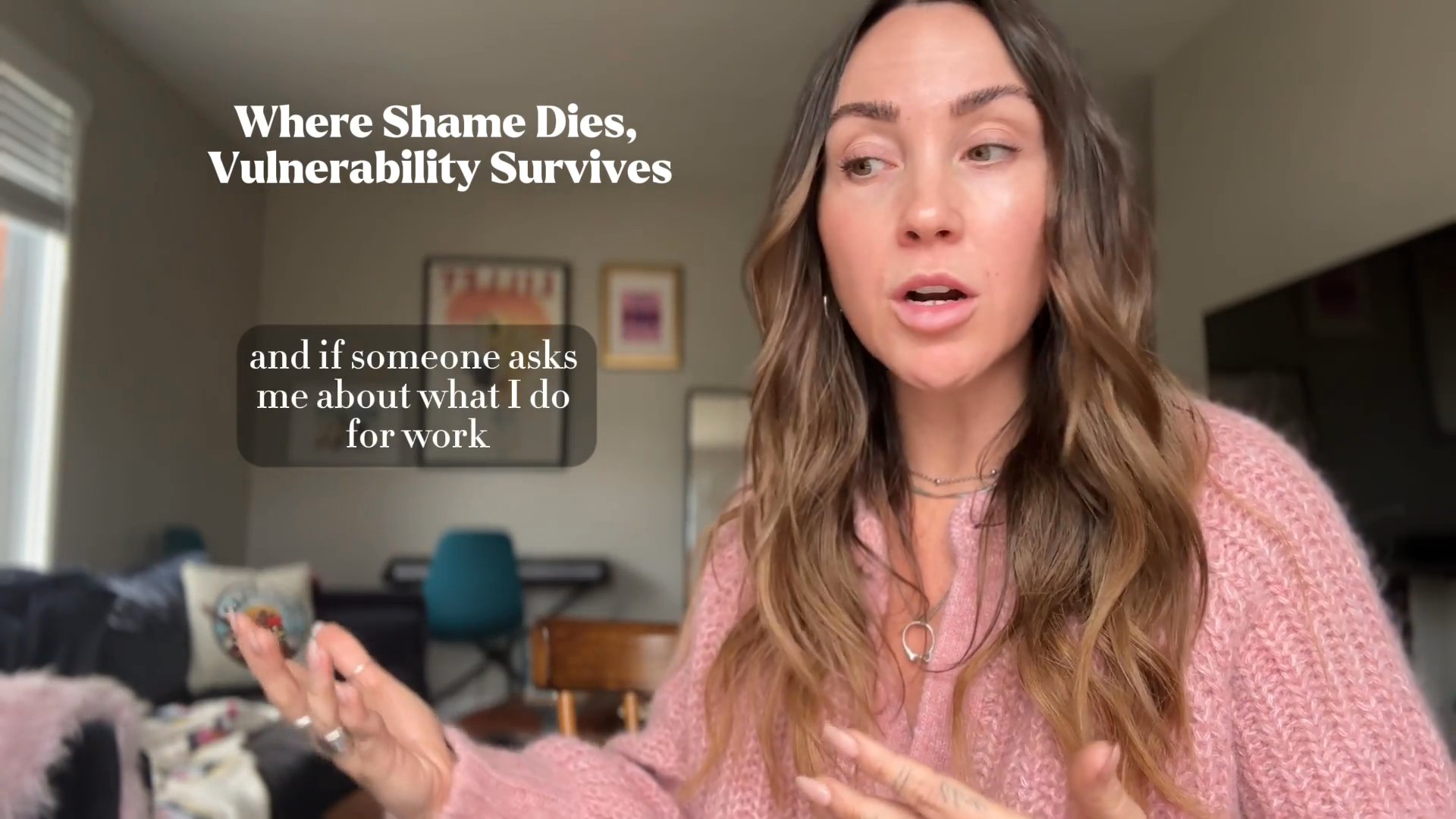
What are the stories I tell myself that create shame, and what do I feel shame about? And where does that show up in my life? So, for me, for example, I have no problem talking to friends, acquaintances, people I meet about my mental health, about my eating disorder. I've retold that story for myself in a way where I don't feel shame about those parts of my life, my life. And so I show up truly in a lot of scenarios. And if someone asks me about what I do for work, I tell them that I write about my mental health because I've experienced a lot of issues in my life with my mental health and I want to destigmatize it.
I don't feel shame about that. And it took me a lot of story rewriting in order to get to a place where I could reduce that shame. So I have to ask myself, where in my life do I still feel shame? And where in my life am I telling stories about that shame? One of those places is when I go on dates. When I go on a first date with someone and they ask me that same question, I get really worked up in my head about how to answer in a way where I don't have to reveal that. I've struggled with my mental health because I experience a level of shame around owning up to that, to someone that I have a potential intimate connection with.
Why? Fear of rejection. I'm totally afraid that this part of me will somehow be unlovable. And in that fear, I don't show up as myself. And what that means is that I'm hiding a part of myself that I feel shame about, rather than which I fully believe in holding on to something for privacy reasons. Right? So these are two things that can be true. At the same time, I can have something in my life or a story about myself that I don't feel shame about, but that feels private to me until I feel safe to share it.
And there can be things about myself that I feel shame about that I'm not sharing because I experience shame. So these are the ones that we're looking at. We're looking at the stories that have. Have shame attached to them. So I have to ask myself, what would it mean for someone to reject me for this story? Is that someone that I actually want to be in an intimate relationship with? Absolutely not. If someone is going to judge me for what I've been through and for the place that I've come and what I've done with my life based on those experiences, then it's not someone that I want in my life.
So how can I reduce shame around this and know that by sharing that I might be rejected, but that that gives me information about who this person is and whether or not I would actually belong, whether or not I would actually feel safe, whether or not I would feel free to be joyful and creative and also express my fears or my sorrow. So this is why we have to ask ourselves where shame lives. Because where we find shame, we find the stories we're telling ourselves. And we can rewrite those stories so that we can reduce the shame, show up as ourselves, and know that if we're being rejected, it's information that we can use moving forward.
And if we're accepted, then we get to experience belonging. Thank you so much for joining me on part one of this series. I'm looking forward to sharing part two with you, which will be another set of four videos. So make sure that you're subscribed to my profile so that you can see those when they come live. See you next time.
Reactions and comments are for members. Joining is free and takes a minute.