Find out how to overcome the inevitable obstacles and challenges you'll face when pursuing your goals. These strategies -- (1) understanding your commitment and (2) contingency planning -- can help you do beat any barrier in your way.
Research shows that the most effective goals are ones that are challenging. People often underestimate the time and resource and effort commitment necessary to achieve their goals. Today I'm going to talk about two main principles: how to understand your commitment to a goal and how to use contingency planning along the way.
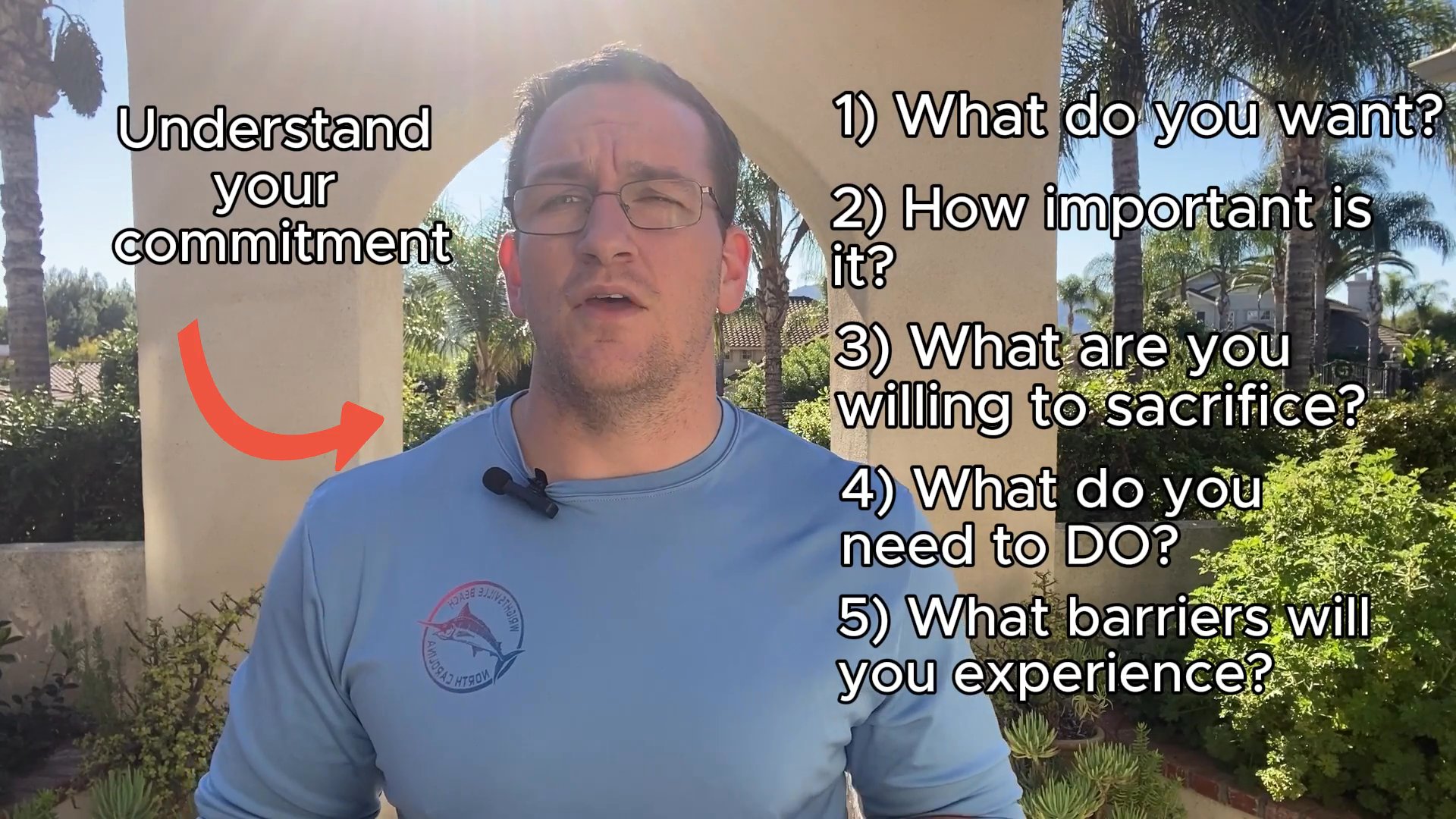
You need to understand your commitment to a goal on a deep level. There's a few questions that you can use to ask yourself about this commitment. Set process oriented goals as well as short term goals. What are some challenges or obstacles that you might face along the way?
The second principle of this video is contingency planning. All it really is is a way to self regulate in the face of challenges and plan a little bit ahead. It does three main things, all of which increase your probability of success along the route to reach your goals.
Are you sick and tired of setting goals at the beginning of the year and feeling like you never accomplished them? Feeling like there's so much struggle and challenges along the way that you're just not equipped or prepared to deal with? Well, guess what? That's the majority of people. And unfortunately, even though we might have the best goals set and the best goal setting process, if we don't envision the path along the way, including the challenges and obstacles, were not set up to succeed, have you ever considered what will be the hardest part about your goal pursuit?
Well, that's what we're going to talk about in this video today, which is visualizing the path to achieve your goals. This topic relates to the first video that I released in this goal setting series talking about the reasons why people don't succeed at goal setting typically, and one of those specifically being that people often underestimate the time and resource and effort commitment necessary to achieve their goals. Goal setting can sometimes be sunshines and rainbows where we think, oh, it'd be so great to save up for that greek vacation, or it would be so awesome to lose those 20 pounds over the next year.
But unfortunately, just like most things, it's easier said than done. Research shows that the most effective goals are ones that are challenging, and this is something I'll talk about in a later video. But because of that challenge, that's necessary. There's going to be frustration. There's going to be worry, resistance, fear, anxiety, all those emotions along the way. And you've probably heard this before, but if it was easy, everyone would do it. That's why today I'm going to talk about two main principles.
Number one is how to understand your commitment to a goal. And number two is how to use contingency planning along the way. Let's start off with principle number one. You need to understand your commitment to a goal on a deep level. There's a few questions that you can use to ask yourself about this commitment. And all these questions I learned from doctor Traci Statler. She's the mental performance coordinator for the Philadelphia Phillies and a longtime professor in sports psychology. I saw her speak at a conference about two years ago about this topic, and she talked about how her players for the Phillies use these goal setting principles in this process to ultimately reach the World Series.
Pretty cool, right? And the questions are great. So here they are. Number one is very basic and kind of gives us a good foundation, and that is what do you want? What is your gps destination? In other words, what is your outcome in mind, what is the end result that you want to achieve? Number two is how important is it? And honesty, just like in all the other questions, is really important on this one. You can even go about rating it on a scale of one to ten, and you can say you care about something, but you're truly going to see how much you care about it in this next question.
And that is, number three, what are you willing to sacrifice for this goal? What are some pleasures or distractions that are going to take away the time and energy needed for you to accomplish this long term goal? And number four is, what do you need to do to accomplish this goal? This is your traditional goal setting, and in this, you want to make sure that you set process oriented goals as well as short term goals. This is all kind of summed up in my recent video about the goal staircase. And just like that goal staircase, you don't want to just think about the outcome at the end of the finish line, but think about the process and the actions along the way.
Number five is what barriers will come up. What are some challenges or obstacles that you might face along the way? These could be internal, such as lack of motivation, which we all resonate with at times. They could also be external, such as lack of time, maybe lack of resources. Trying your best to anticipate those challenges and your responses to those challenges. But also note that sometimes they're just going to be unexpected. And that's why, rather than the challenges themselves, what's more important is how you're going to respond to those challenges.
Which all comes to relate to the second principle of this video. And that second principle is contingency planning. Now, what is contingency planning? You might be asking. All it really is is a way to self regulate in the face of challenges and plan a little bit ahead. They come in the structure of if blank, then blank scenarios. Or then what scenario? Now, let's try an example here to kind of illustrate what contingency planning is. Let's say you're trying to save some money for a nice greek vacation.
Sounds great, right in the outcome. But let's talk about the traditional goal setting that you might do along the way. First of all, how much money are you ultimately trying to save? That would be your outcome goal at the end, and also setting short term goals along the way, maybe at the daily level, maybe at the weekly or monthly level. Also, how are you ultimately going to go about saving that money? What's the process or actions that you're going to do to reach that goal after you've done your traditional goal setting.
This is where contingency planning can come into effect. So you want to think about what are the most difficult barriers for you along the way in pursuit of that goal. Maybe for you, it's eating out a lot at restaurants throughout the week. So your contingency plan might be, what if instead of eating out, I try to meal prep for three dinners out of the week? Or maybe it's shopping for you rather than eating out. So your contingency plan for that might be, if I go out shopping, then I'll wait one day before I actually go out and purchase the item.
So you can see in those two examples you're planning for the barrier and your response to that barrier, obstacle or challenge along the way. Now, this sort of planning takes a little bit of time. Okay, I'm going to admit that. But it does three main things, all of which increase your probability of success along the route to reach your goals. Number one, it increases your confidence to persist. Number two, it decreases that little bit of uncertainty that you have about the goal pursuit process. And number three is it limits practical and logistical errors along the way.
All of which, again, increases your probability of success. And in general, contingency planning isn't about being pessimistic about the goal setting process and goal pursuit process. It's more about being realistic about what challenges are going to be along the way and planning ahead to help you face those challenges effectively. Overall, it's helpful to sometimes think about goals as a big puzzle. There's a lot of moving pieces to get that complete picture. But every time you solve a barrier or a challenge and overcome it, that's one step closer to completing your picture of success.
And we can do that by, one, understanding your commitment, and number two, utilizing contingency planning and prepping for that goal setting process. So thank you for watching this. I hope to continue educating and exploring how we can set goals effectively and make 2024 a great year for us all. Thank you all.
Reactions and comments are for members. Joining is free and takes a minute.