Host shares a candid livestream about practicing feeling emotions, describes strategies and why allowing grief, anger and sorrow to be felt can help them pass, and models how sitting with hard feelings can lead to calm afterward.
Cadre: I apologize for being a little bit late. I actually just got news that my grandma passed this morning. She's been dying for quite a. Quite a while now. So I've moved through a lot of that grief already, so I feel okay to be here with you all today.
Heidi J. Kirkubee: Today, I want to talk to you about feeling your feelings. She says if you don't know how to feel your feelings, you are not the only one. Here's a couple of things that help her feel her feelings.
Cadre: It's really important to remind ourselves that we can through move our feelings. As much as it doesn't feel good, it does pass. If you are seeing this as a replay, feel free to leave me a comment and let me know if this was helpful.
Happy Wednesday, Cadre. I apologize for being a little bit late. I actually just got news that my grandma passed this morning. So I was on the phone with my dad and my brother. I'm doing okay. She's been dying for quite a. Quite a while now. We're close to end of life, and so it was not a surprise to get that news this morning. And. And I've already kind of moved through a lot of the grief, so. But I just needed to make sure that I was able to answer that call. So I apologize for being late, and I'm happy you're here.
Hi, Russell. Hi, Rachel. So today we are talking about. Hi, Luke. Hi, Jules. So happy to have you all here. If you're just joining, I was just letting folks know I apologize for being a little bit late today. I was just on the phone with my. My dad and my brother. My grandmother passed this morning, so I just wanted to make sure that I was able to be present for that phone call. So thank you for your patience. And I'm doing okay. My grandma's been. She's been dying for a long time now, and this week she was in hospice, so we were all aware that this was coming up.
So I've moved through a lot of that grief already, so I feel okay to be here with you all today. Thank you all for being here. Heidi J. Kirkubee and timely, because my plan today was to talk to you about feeling your feelings, which is something that I really, really struggle with. And I have spent a lot of my life analyzing my feelings, thinking about my feelings, talking about my feelings, but not so much feeling my feelings. And this has been very topical for me in the last couple weeks because I made a conscious decision with my therapist to try and actually feel my feelings instead of intellectualizing them or instead of talking about them or instead of avoiding them or drinking them away or eating them away.
And it's been a couple. It's been a time. And so I wanted to talk about it because it's something I've been practicing, and it's really hard and painful, and there's reasons that we avoid doing it because it doesn't feel good. And I'm. I'm now being reminded that when I do actually let myself feel my feelings, they pass. They don't last forever. And when I allow myself to feel them, I actually feel a sense of calm, peace and levity after feeling my feelings. So I first just want to offer to you that if it feels hard to feel your feelings, if you don't know how to feel your feelings.
If you avoid feeling your feelings, you are not the only one. If you are doing work in therapy and you still struggle to feel your feelings, you are not the only one. I've been in therapy for 19 years, and your girl still refuses to feel her feelings sometimes. So it's not a pleasant experience to feel sorrow, to feel grief, to feel anger, to feel jealousy, to feel these, what we call negative emotions. And the more we allow ourselves to feel them, the less we hold onto them and the less we suffer because we actually just process the pain instead of adding suffering to the pain.
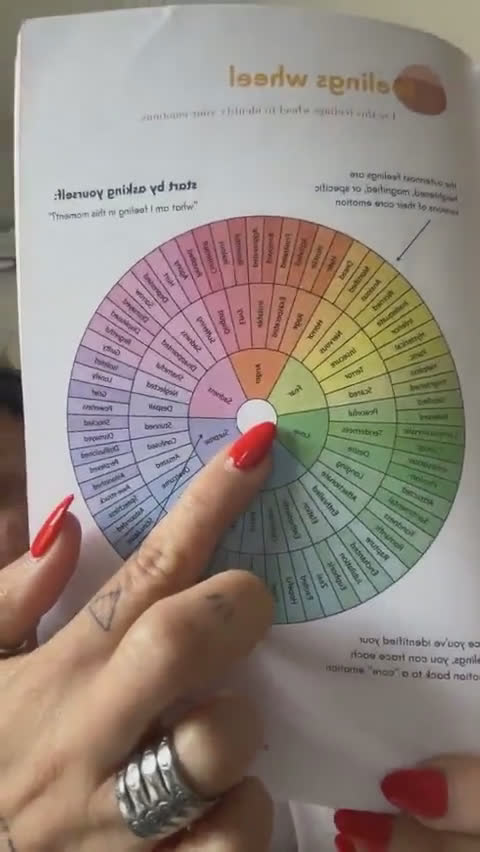
So here's a couple things I do, and I would love to hear if you have things that you've done in the comments, to feel your feelings rather than push them away or, like, analyze them or think about them instead. So, a couple of things that help me feel my feelings. So, the first one is just naming it, right? So I don't know if anyone has heard of a feelings wheel, but if you haven't, holy grail. So, a feelings wheel is essentially like a picture. You can just Google feelings wheel. So, a feelings wheel is literally like a wheel, and it has in the center, our core emotions.
And based on, like, different theories, there's different core emotions, but essentially core emotions are sad, happy, angry. How does my feelings feel? Say, hang on, let me get my feelings. So, the first time I ever used a feeling wheel was when I was an eating disorder treatment. And I remember they gave me one because they asked me in group, how are you? And I said, fine. And they said, it's not an emotion, Rachel. So they gave me a feeling seal. So, this is a feelings wheel. So I know. I know it's mirrored, but so in the center, there's the main emotion.
So we have joy, surprise, sadness, anger, fear, and love. And then from there, outwards, we have more specific emotions. So, for example, let's take anger and go more specific. So, from anger, again, I know it's reversed, but we have disgust, envy, irritable, exasperated, rage, hate, hostile, frustrated. Right. So there's all these nuanced ways that we can experience feelings, and the more familiar we can get with the language of emotions, and the more in touch we can get with our own emotions, the more we can understand what it is that we're actually feeling and then how to process and move through it.
So the first thing I do when it comes to feeling my feelings is I name it. And I name it out loud. So I might say I'm feeling. I'm feeling jealous. I'm feeling jealous right now. And then I might ask myself where I feel it in my body. So where do I feel jealous? I feel it. I feel it in my neck and in my shoulders and this one. This might be really weird and really hard when you first do it. Like, I remember when my therapist first said, rachel, where do you feel that anger in your body? I was like, what the f*** are you talking about?
What do you mean? Where do I feel at my body? Like, isn't it in my head or my heart? Like, aren't those the only places I have a feeling? And she was like, just guess. If you could guess where that anger is, where would it be? So I would close my eyes and I would ask myself, where do I feel this anger in my body? And, like, over time, the more I ask that question, the more I would start to notice, like, oh, yeah, there's, like, tension right there. When I think about this anger, when I feel this anger or when I'm feeling this love, like, oh, I feel, like, a softness or a warmth in my chest or, you know, whatever it might be.
And so the more I can start to identify a, the name of the feeling, and then b, where I felt it in my body, I noticed that once I started doing that, I started to actually feel something. So when I would say I feel the anger in my back or in the top of my neck, I would almost start to actually feel angry. And especially when it comes to feelings like sorrow or grief, oftentimes when we allow ourselves to actually sit with our bodies and physically ask ourselves, where is this emotion happening? The feeling will start to arise, and then the part comes of the actual feeling of it.
So a lot of times, this looks like crying. A lot of times, this looks like screaming. The other day, I got some bad. This is totally separate from my grandma, but I got some bad news, and I was furious. I was so angry. And I sat on my couch, and I had a little temper tantrum. I punched a pillow on my couch, and I growled in anger while I felt it. And. And I needed to do that to let out all of this stuff that was coming up. And once I did and cried it out and felt some of that anger and let myself physically move it through my body, I felt calm afterwards, and I could actually, like, think about what to do next.
But when we were experiencing a really heightened emotion, our whole bodies get dysregulated. And the ability for us to problem solve or take actions is pretty. Is reduced because our brains, our bodies and our brains are in a survival state of trying to just navigate whatever is happening. That's creating this really big emotion, which means we're not in a state to do, like, really analytical processing and figure out, like, what's the next step for me in this problem? So we have to allow ourselves to move through that intense feeling.
Obviously, we're not always in a situation where we can do that, right? Like, if I had gotten this news and I was sitting on a public bus, probably not a good idea for me to start punching the seat on the bus. So there are times where we do have to suppress or hold on to a feeling and hopefully allow ourselves to find space and time when we are in a safe space, to feel it later. And sometimes that means shutting our emotional state down and then returning to it at a time when it's safe to. And to return to it when we're safe, we can kind of move through that same process of sitting somewhere, being somewhere comfortable and safe, giving ourselves a moment to ground, get into our body, and then say, this is what I'm feeling.
Here's where I feel it in my body. And sometimes just repeating out loud, I feel angry. I feel angry. I am so angry. I'm angry because. I'm angry because vocalizing, saying it out loud and allowing our bodies to actually feel and move through whatever it is. Okay, again, I know it's not easy, and I know it's not fun. I don't like doing it, which is why I avoid it. And I know from practice and experience in times of my life, when I allow myself to actually feel my feelings, oh, boy, am I more regulated in the long run.
And, oh, my goodness, am I able to actually effectively problem solve and make choices that are in my best interest, in the best interest of others. Because I'm not reacting from an emotional state. I'm responding from a regulated state. Okay? So I think it's really, really important to remind ourselves that we can through move our feelings and that it's healthy and good for us and it's healthy and good for the people in our lives. As much as it doesn't feel good, it does pass. I think I read something one time that was like, and please correct me if I'm wrong, facts check me, please.
All the time is that an emotion lasts for 90 seconds. Like, 90 seconds is how long it takes for us to actually feel the arc and the end of an emotion. Just really not that long. And yet we will spend days and weeks avoiding it. I know I will. You know I will. So please know you're not alone if that's something that you do. I'm getting seeing a lot of comments that are like, that's so me. That's definitely true. For myself, the intensity doesn't last so long. Rachel says I didn't have feelings of fight.
I had constantly with many therapists. Yeah, for sure. Dream big. 30. This is so perfect. Thank you for sharing. You are absolutely welcome. My pleasure. So this is a good reminder for me right now just with things that I'm coping with in my life, and hopefully it's a helpful reminder for you as well. If you are seeing this as a replay, feel free to leave me a comment and let me know if this was helpful. As always, I would love to hear your feedback. m.. Pst. And I am just very, very grateful that you are all here.
Thank you for allowing me to show up as I am and I hopefully will see you next week as you are. Okay, bye. Cadre.
Reactions and comments are for members. Joining is free and takes a minute.