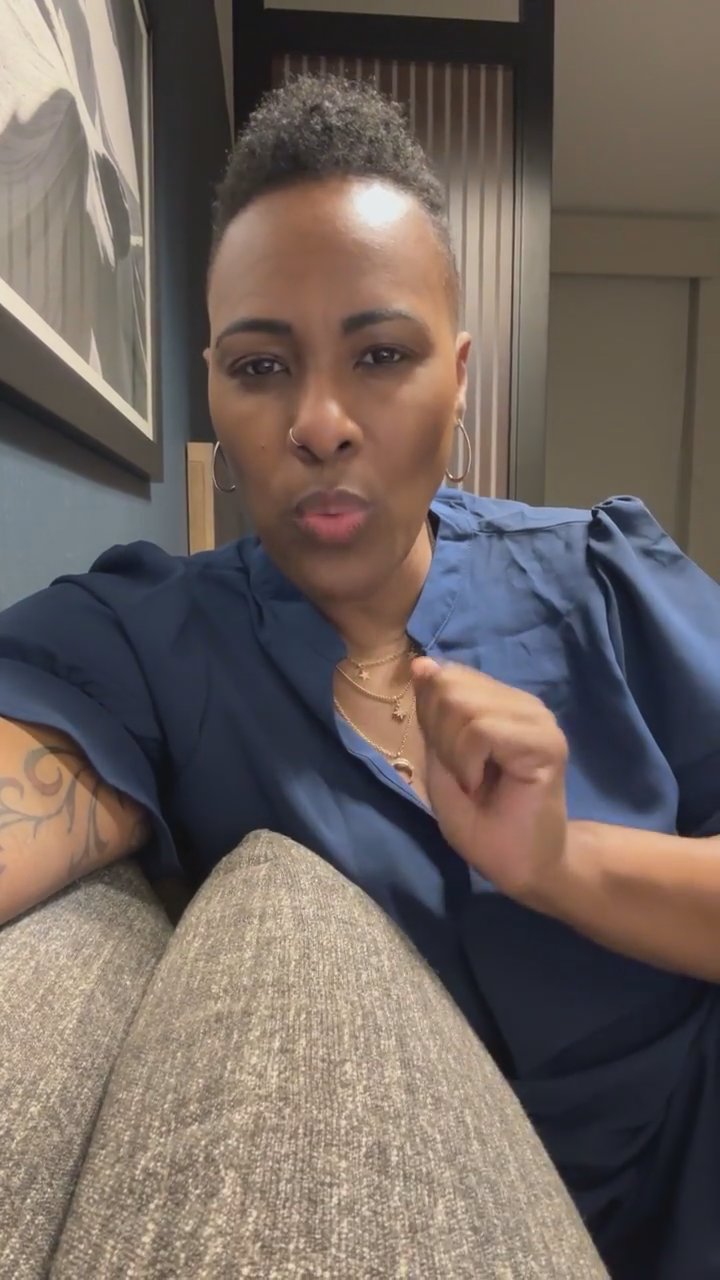
Whether it be weight stigma, health issues, or dysregulated eating, grief and loss can often be centered around the relationships we have with ourselves. “If My Plate Could Talk” explores the connections between food, weight, health, and trauma and frameworks for understanding the conversations we have with ourselves, thus begging the question: “If my plate could talk, what would it say to me?”
Khadra Sphere launches at 05:00 a. m. Here in Phoenix, Arizona. As you come in, I want you to take a moment and we're going to talk plates. Sometimes that's going to be a plate of food. Sometimes it's what's on your plate in terms of the activities.
What's one thing that is on your plate on Fridays on Cadre? It's centered around grief and loss. This is actually a perfect opportunity to talk about losses that aren't centered around the traditional grief. How they intersect with our brain, our trauma, our health, and our appetite.
There's a type of grief called shadow grief. It could be a loss of a person, but it may also be multiple other things. What are you putting on your plate as a means of managing that loss?
How is is my life circumstances and choices impacting the way I'm choosing to nourish myself? Accept your feelings with self compassion and without judgment. All foods fit in moderation. How can you nourish your body even in the midst of your shadow grief?
What is your physical plate of nourishment telling you right now about how you're really doing? Listen to your plate and make adjustments where necessary. Remember to be kind and compassionate to yourself because nobody else will have a good one.
Hello, Khadra Sphere. I hope you are doing well. m. Here in Phoenix, Arizona. I will be fully honest. I just rolled out of bed maybe about ten minutes ago, long enough to throw on some different clothes and be here. But I am super excited about us launching together because you're in this with me. If my plate could talk, we'll give everybody a few moments to be notified and find us. As you come in, I want you to take a moment and we're going to talk plates. Sometimes that's going to be a plate of food.
Sometimes that's going to be what's on your plate in terms of the activities, the responsibilities, all of those different dynamics. Hello from Canada. I love that this is just late enough that you can join. So I appreciate that. I can see that there are some of you who also join me on Wednesdays because you're letting me know where you are, which I appreciate. Good morning. So as you come in, I always want to anchor you in a thought. Let me know what's one thing that's on your plate and you decide where that goes.
But when you think about it in terms of responsibilities and dynamics or things that you're managing. Hello, Charleston. Hello, Virginia. What's one thing that is on your plate on Fridays on Cadre? It's centered around grief and loss. And so as I was looking for another moment and opportunity to come and connect with you, I thought to myself, this is actually a perfect opportunity to come and talk about the losses that aren't centered around the traditional grief and how they intersect with our brain, our trauma, our health, and our appetite.
So thank you for joining me, and let's get started. There's a type of grief called shadow grief. Shadow grief is a grief that is centered around a loss that occurs in your life. Those are the things, yeah, someone just mentioned they're ending their current profession and starting a new business. And while moments such as that can be something that you are like, hey, that's what I signed up for, I'm excited for this. I want to bring you guys a little bit closer. There's also a dynamic where that's still a loss of a sense of security, of something that you have done over and over again in order to frame what we're going to focus on.
I want you to also consider a current or recent loss that you're experiencing in your life right now. It could be a loss of a person, but it may also be multiple other things. And I just want you to hold that in your head. Hold that in your mind. You don't have to share it unless you want to, but we're going to use it to help frame this process. As you are walking through, the loss that you're experiencing could be a loss of identity, a loss of self, a loss of relationship, shadow, grief. Again, a loss in life.
Something that you felt was there, that you now feel it's gone. And sometimes it can even be something that you feel like, I really wish that I could get it back, and now I'm struggling to do so. And as you hold that in your mind, let's look at one how is that loss showing up on what's on your plate as a result of what you're experiencing in your life right now? What are you putting on your plate now? We're just talking lifestyle time. What are you putting on your plate as a means of managing that loss?
And I always want you to consider what needs to come off of your plate. Because in the whole dynamic of peace, of harmony, of balance, of being, well, it means that we constantly need to be looking at our plate and determining what did I allow to come on my plate? What is no longer useful and what is masking what you really feel? Because we keep a level of productivity, we keep a level of achievement and of accomplishment and effort, many times as a means of disconnecting from the things that we feel are outside of our control.
And in some small ways, that can be useful, but in a lot of ways, that can be overwhelming, because here's what happens to your brain in grief. It affects your memory, it affects your concentration, it affects your cognition, and it impacts the level of serotonin that's produced in your gut and how that fires and then speaks to the brain, it's going to impact your choices. So now, as you are considering one of your losses in life that are current right now, that you're experiencing and you're navigating and you're thinking about what you've been putting on your plate or maybe even ignoring on your plate as a result of it, I want you to hop to the other side and really think about what are you eating.
So we're going to do both. Health by Robin first, we're going to think about what's on your plate in terms of your responsibilities, your actions, your activities. And now we're transitioning to as a result of that and the grief that I'm in, what am I choosing to nourish myself with and know that that's never meant in a sense of shame, but it's always an opportunity and a dynamic to go. How is is my life circumstances and choices impacting the way I'm choosing to nourish myself? When I say nourish, I am talking about what you choose to give or not give yourself.
Because our bodies go two different ways when we're struggling. For some of us, we go towards emotional or compulsive or binge eating as our go to comfort, but others go towards restrictive eating or using compensatory behaviors such as over exercising laxatives, social detoxes, detox teas, laxatives. That's the word that I was looking for. So I always want you really looking at the two. Here is the loss, the shadow loss that I am dealing with right now. Life, what's ending, what's beginning, and how are you doing with that?
What are you putting on your plate in your daily life as a result of that? And how is that impacting the way that you are making choices with your body and the way that you are undernourishing or overeating in the sense of you're eating beyond your capacity or subtly choosing very small things grazing through the day. For those of you that are unfamiliar with my approach to food, I believe that all foods fit in moderation. We know that from science, from neuroscience, that you may have some specific things that need to be different for you.
Based on diabetes, based on autoimmune dynamics, based on food intolerances, that's another place. But as a whole, all foods fit in moderation. And we want to be able to compassionately and appropriately nourish ourselves in appropriate meaning, to whatever degree that you can that does not exceed your body's needs and cause consequence. I have said it before, and I'll say it again, you want to eat in a way that there's love on the other side of it. Sometimes we engage with food in the midst of our loss, in ways that once we're done or once we come back to our physical state, we feel ill, we feel sick, we feel guilty, we feel numb, we feel bad, and we've layered one grief for another.
And so, really, considering how can you nourish your body even in the midst of your shadow grief, in a way that will show compassion and honor the needs of your body? I want to give you three simple ways that you can focus on staying connected to your body and nourishing yourself well, even in the midst of shadow grief, in the moment grief that's not necessarily connected to the grief of a person. One, accept your feelings with self compassion and without judgment. I always give you something to reflect on.
Where are you in denial? Which is a stage of grief around your feelings and your feelings towards the area that you chose when we started. And yes, Audrey, I'm going to be talking about that one next week. Ongoing grief also has a term, but bring it all in, because that's very real. The in the moment. I'm grieving this right now, and it's hard and it's there. And it's so important for us to recognize these things, because ongoing grief in the moment, grief, shadow grief, can also be parallel to vicarious trauma.
I'm going to get back to those tips, but I just want to put that in there. A grief that we are presently experiencing in the shadows of our life. I want you to think about that in the shadows of your life, in the spaces and places that other people can't look at you and see that this grief is there. But, you know, this is what's on my plate. I'm gonna bring a visual when I get back home next Friday that I will encourage you to use each time we connect. It's super powerful. I'm not gonna try and describe it right now, but it's really gonna take the concept of what's on, on your plate, metaphorically and in terms of nourishment, to a really incredible place to give you a framework of understanding.
But also know that your ongoing griefs, your shadow griefs, what you're experiencing right now in life, will impact your mind, will, whether it's through temptation or actuality, impact your choices in the way that you nourish yourself and can be a form of vicarious trauma, which are those little t traumas that are like a drip, a hole in the ceiling, that if they keep coming, you feel like the ceiling is all going to come down. But we're here. What I love about this live experience and these moments is we're all in here together, listening, talking, and sharing, and a reminder that we are all grieving something.
But you are not alone. Three tips I gave the first one, accept your feelings with self compassion and without judgment. Two, express your feelings in a way that is helpful to you. Don't stuff your grief. Find a space and a place and a way to express it, and express it in a way that's helpful to you. Because sometimes that moment of expression could be you need a compassionate conversation with another individual, and your tone is soft. Other times, you may need to move through that often avoided stage of grief around anger.
And you need to yell and be mad and go, I'm mad at this situation, even though I realize it's no one's fault because that exists. You know, my mind is going to, if we're managing and navigating a person and we're losing them to something like Alzheimer's or dementia, that that is something that is an in the moment shadow grief that is hard. And we think we can't get angry, but we can get angry at the situation, at the disease. And sometimes we need to express that. So expressing your feelings is just as important as accepting them, because acceptance shows that you can express them freely and you know that you deserve and you are worth the time, the energy and the space to do so.
And then the third one is find the balance between sitting with your grief and sharing it with others who are open. So sitting with it and sharing it. Because if you sit with it too much and overly internalize it, that's a problem. That's where we see that digestive nervous system. Nervous system that's in your gut really start to counteract and come into play. And by autonomic automatic habit, those are the moments that then encourage us. I need to soothe, and the fastest thing that we can soothe with is food and alcohol because those are the things that most immediately register in our brain.
However, they can't always be your go to. Too much or too little of anything typically leads us into in a place that is not ideal. So I want to leave you with this question, and it's probably a question I'm going to leave you with almost every time. If your plate could talk, what is it telling you? What is your metaphorical plate telling you about the level of thoughts, habits, patterns, responsibilities, pressures, issues of life that you are holding and carrying? What is your physical plate of nourishment telling you right now about how you're really doing?
If you're doing well and you feel like you're nourishing yourself from a place of compassion, are there any quiet places of struggle that you're noticing, you're wanting to do things that are different? And outside of that, is it hard to look at your plate this week? Are you eating? Are you eating all the time? And you feel like you can't get full? And right now there's nothing to do with it other than go back to those three mindful, grieving tips. But I want you to stay aware because awareness is always the first and longest and most necessary step to healing.
Listen to your plate and make adjustments where necessary as you go throughout the rest of the day. Continue to check out the other Cadre creators that will be lined up today waiting to share with you some other wonderful conversations around grief, and I will see you next week. Have an amazing, incredible weekend and remember to be kind and compassionate to yourself because nobody else will have a good one. Bye.
Reactions and comments are for members. Joining is free and takes a minute.