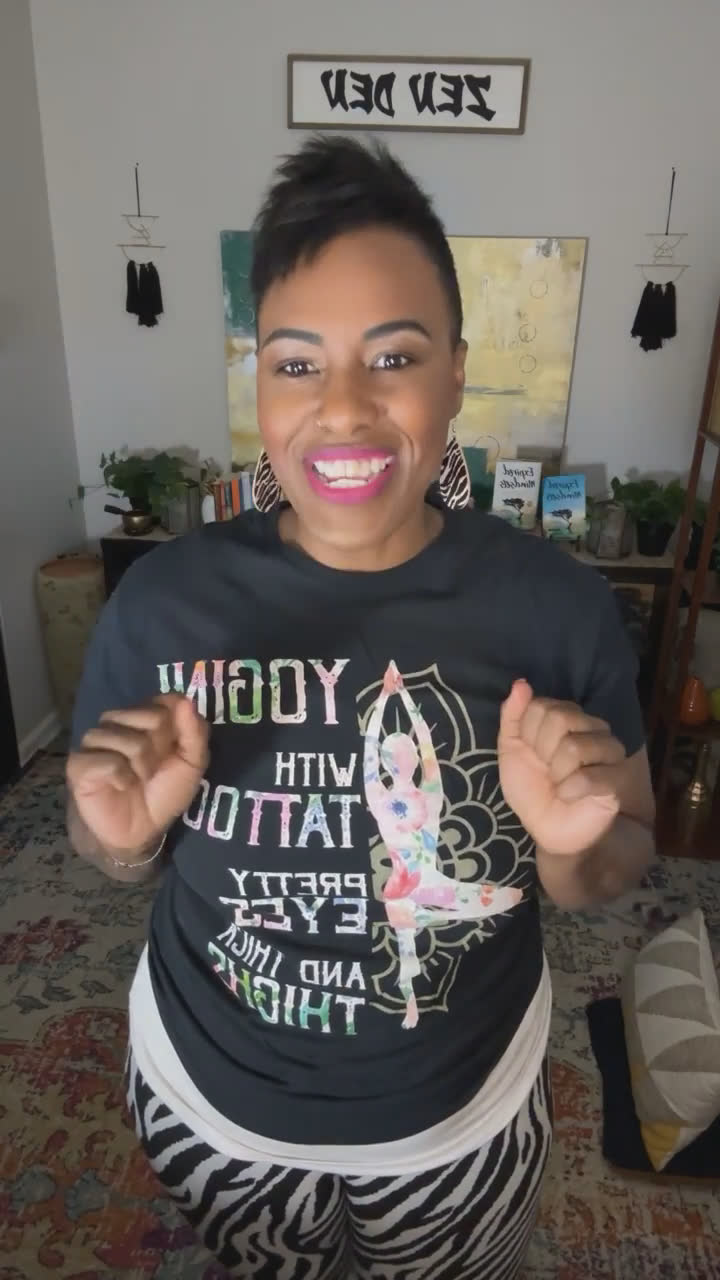
Whether it be weight stigma, health issues, or dysregulated eating, grief and loss can often be centered around the relationships we have with ourselves. “If My Plate Could Talk” explores the connections between food, weight, health, and trauma and frameworks for understanding the conversations we have with ourselves, thus begging the question: “If my plate could talk, what would it say to me?”
If your plate could talk, what would it tell you? Here on Cadre on Fridays, we focus on grief. But we're looking at the shadow griefs, those hidden griefs that sit on our body and impact our life. What are you noticing about what you've been putting on your plate?
Sometimes even the good things that are on our plate get heavy. We're taking a moment to acknowledge. Here's something that is on my plate that I have to manage. Kind of unpopular areas of loss is loss of autonomy. But always know that you don't have to come away with everything.
Loss of autonomy is anything in life that prevents us from feeling free to honor our needs and our wants. Here's some common ones. There can be a loss of autonomy around our responsibilities. Where have you potentially lost some freedom, and why is that important?
When we grow up feeling like there's a loss of autonomy, we go one of two ways. One response is we either become people pleasers, become consumed with what other people do and think about us. The other side is your temperament may go into, I refuse to be what anyone else wants. Either place is still really struggling to find center.
Today is centered around grief and loss. Being present in your life also creates a loss of freedom. Food is a messenger. It is a symptom. What is on your plate that needs to come off so you can regain some autonomy?
What's up, Khadra Sphere. We're back. It's Friday morning. If you're listening to this live, but whatever time it is when you listen to this, I'm glad that you chose to come and show up so that we can talk about if your plate could talk, what would it tell you? We always come in the way we do, which is saying, hello, good morning, good afternoon, good evening, whatever it is, based on your demographics. We come in repping where we live and where we are in the world just because it creates community.
And it's so powerful to honestly be able to look and see the reach of the quadra sphere that we are creating together. Sometimes I have you start off with a win, but I have a little something different for you this morning. Good morning, Lindsey. Good morning, Beth. Good morning, Melissa. So good to see you. I think I saw Rachel come in a little bit earlier. Hello, Steph. So good to see all of your faces. And good morning from Virginia. Usually I have you come in and start with a win, but I'm going to have you come in a little bit different.
I want you to take a moment. I'm going to tell you now. You know, on Fridays, I'm hype. I am so like, oh, I feel like whatever I'm coming to share on Fridays has been sitting with me for so long that it is about to just bubble up. Hello from charlotte. So thank you. I figured I would switch up from the red. I actually do own other colors of lipstick. I hope you had a good run. Audrey. Hello, Charleston. I want you to take a moment. Let's see you guys. Don't knock my lack of drawing skills. Thank you for the sweet comments.
I want you to take a circle. Oh, that was pretty good. And split it in half. This is our symbolic plate for today. We're going to do this just real quick. 60 to 90 seconds as people are coming in and get comfortable. On one side, I want you to put life, and on the other side I want you to put food and take 30 to 45 seconds on each side. And I want you to write in here all of the things right now in life that are on your plate. And then what have you noticed this week about what's been on your plate in terms of how you're eating?
The premise behind if your plate can talk. If this is your first time here. Hello. Welcome. I'm Doctor Charace Johnson, licensed clinical mental health therapist, mindfulness practitioner, and author. But more importantly, I am here to guide you through the whole dynamic of life and loss and how it can often intersect with our traumas and our relationship with food and our body. Because here on Cadre on Fridays, we focus on grief. But, you know, I'm out of the box. So we're not just looking at the grief that's centered around the loss of an individual.
We're looking at the just shadow griefs, those hidden griefs that we don't talk about, that sit on our body and impact our life. So, again, you could do this in your notebook, take a little circle. Life and food. What's on your plate in life? What are you noticing about what you've been putting on your plate? Hey, and don't cheat yourself. If you put just the things here that are nice and sweet, you have missed an opportunity. And I want to start you immediately with coming and knowing that you're here and you're going to find value over the next 20 minutes.
If you choose to do what we call lean into the process. And I don't necessarily want you to go into length with this. This is a great thing to do on a regular basis. But now that you've had a moment while I've been talking, hopefully I want you to pop in the chat. One thing that has been on your plate, or that is on your plate that you wish wasn't there. So we're taking a moment to acknowledge. Here's something I wish I could lose. Here's something that is on my plate that I have to manage. And while you may accept that you have to manage it, it doesn't make it easy.
So what's on your plate right now that is challenging or you wish it could come off, but you don't really see a way out. And I'm going to stop for a moment for an opportunity for us to share, because that share that vulnerability is an important part of going, wow, I've been going through the week and running on autopilot and didn't even really stop to realize, man, there's a lot going on in life right now. And here's something that even might be a good thing, but it's on my plate. So sometimes even the good things that are on our plate get heavy.
And I want you to be able to acknowledge that. I want you to be seen in this moment. Love this cup. It was a gift from a beautiful friend that is from South Carolina at an event says trust the process and it matches. I didn't even notice that, but I wanted to use it today. So our focus for today, as we've talked over the last couple weeks, about four types of shadow grief. Kind of unpopular areas of loss is loss of autonomy. Loss of autonomy. I'm going to try to help you organize everything that is about to come out of my brain.
It's going to be a lot. So eat the meat, leave the bones, you take the pieces that are helpful for you, and you hone in on those. But always know that you don't have to come away with everything. Let's talk first about what loss of autonomy is. And I think as I look through what some of you are sharing around parents health, overthinking in a friendship, a kitchen renovation. Good, but disorienting. Teens trying to grow into their independence, and us trying to figure out, well, how does that work for the way that we typically work together as a family.
Those things, in some ways, can also create a loss of autonomy. So classic definition of loss of autonomy is anything in life that prevents us from feeling free to honor our needs and our wants. When you think about that very broadly, anything in life that prevents us from feeling free to honor our needs and our wants. Someone mentioned a renovation, which we think, hey, we signed on for that. But at the same time, it changes our ability to feel free to go into that area and do whatever we want.
So we have to change our routine, and then that's a loss of routine, and then we have to figure it out. And so again, while it something that we welcome in the long run, in the moment, it can still be disoriented and impact the way we feel settled. So consider that for yourself. Loss of autonomy. Here's some common ones. Health. I'm nursing a shoulder injury. I want it to be cute so I don't have my sling on. I'm gonna be real. But there's a loss of autonomy there. That is here on the level of my frustration, because here are all of these things that I used to be able to do without thinking about it and very easily that I can no longer do, and I can't do anything about it.
But wait, that's hard. Finances. A change in your finances, you might have to help take care of someone else, or the people in your life need you more. You had a job change, or a job loss, or the cost of living has dramatically gone up, or you had an unexpected bill or something cost more. Finances are a huge aspect where we don't often equate that with a loss of. Wow. Now that this has changed, things feel tighter and you don't feel as free to do the things that you want to do without having to think about every moment.
Responsibilities. There can be a loss of autonomy around our responsibilities. Someone mentioned a parent's health. I don't know the level of that parent's health, but that's a very common dynamic where we'll have an older parent, sometimes not older, but we'll have a parent or even a child that has some kind of change. And as a result of that, we have to provide them with more care. You could even have somebody in your life that has a mental health issue, and as a result, that creates a loss within that relationship, but has also changed your level of responsibility.
Feeling trapped, feeling like you're in a situation and you don't see a way out. You are thankful and grateful for the job that you have. But there's also a lot of moments where it feels like too much, but it's what you need financially, so you're not able to do what you want, really think through what's on your plate. And as a result of what's on your plate, where have you potentially lost some freedom, and why is that important? So we talked about what loss of autonomy is, and let's intersect it with trauma, right.
With how it can sometimes connect to who we are based on our unwanted life experiences, the things in our life that came too much, too fast, too soon. All right, let's say, for example, that as a child, you lived in a home that was decent ish. But as you got older, you realized a few things. You realized that there was a power play in the house, which meant in order for you to get some level of your needs met, you had to perform live up to listen to or enmesh with that family system, your needs were met as long as these things were happening.
When that happens, that creates in us a loss of autonomy. Here's who I would be, but my parents would have never been okay with it. Here's what I wanted to do, but I wanted to make my family happy. Here's who I really am, and I know that about myself. But there were people in my immediate or extended family that I knew wouldn't accept that. So I pushed, suppressed that sense of autonomy in a broad way. And then it can come out in two different ways. So when we go through experiences where we grow up feeling like there's a loss of autonomy because we were smothered by overly loving, semi codependent parents, or we were manipulated by slightly emotionally narcissistic parents, we go one of two ways.
There's a loss of autonomy there because we're really not free to be who we are and what we want fully, and we have a response. One response is we either become people pleasers, become very consumed with what other people do and think about us, and we learn to adapt to the environment. So when the loss has landed in that way, the loss of autonomy has landed. You learn that survival means I have to become whatever anybody else wants in order to stay in relationship with them, because that's the message that you received growing up.
Or the other side is your temperament may go into, I refuse to be what anyone else wants. So you become hyper independent. You create this really tough veneer that isn't really there, because you don't want to need anybody. You don't want anyone to feel like they can manipulate you. You probably even consider yourself confident, and I do what I want, and maybe a little controlling. I'm gonna sit there. But either place is still really struggling to find center. Someone mentioned not having parents, but in essence, even not having parents.
Being present in your life also creates a loss of freedom. There's some loss in there that we all naturally experience. So you have to explore what that looks like for you. Because if you have a loss of a parent and you don't have that safe place to land, you're forced into hyper independence. You're forced to present stronger than you may really be because you have no choice. There is no anchor, really look and figure out what that looks like for you. So here's where I want you to take that again.
If you're like, hmm, how can I put this together? Loss of autonomy overall, looking at areas of your life right now, in the moment that you feel like, yeah, because of this dynamic, whether it's a good one or not, I don't feel as free to do x, y, and z. And I grieve that even if I don't say it, I would never say it to anyone that having this responsibility has taken away my freedom. But I need you to acknowledge that for yourself and then trace it. Does this connect me with any similar loss or similar feelings of loss that I experienced growing up or in friendships or in relationships or in job roles?
Because sometimes we don't realize that there's this really big, strong connection that's anchored there. So loss of autonomy, how it may have shown up in our family of origin or relationship experiences, and then recognizing in present day, how am I eating that loss? How does that loss impact the way I see myself, my self esteem, how comfortable I am being in spaces and in rooms? Or how much I try to pretend that I'm super comfortable in my body and overcompensate so that people really don't know I'm self conscious and anxious.
That might be you. How much truth is in the way that you present out into the world. Because remember, as we move towards food, we did autonomy trauma. The intersection of food and body food and how we engage with food is not the actual issue. Food is a messenger. It is a symptom. It helps us get to the deeper root. Are you in a place right now or have you historically been in moments where you eat? Your loss, where you recognize, oh, when I feel trapped or like I have a loss of autonomy. Q. Food.
I choose not to eat. I restrict because I can or I choose to emotionally eat or give myself certain excesses for no reason in particular. Because. Because food then becomes the place where you get to exercise freedom. Although it's a false form of freedom, whenever we turn to something outside of us to help settle and ground something inside of us, it is a false form of freedom because really, we've just become dependent on something else that can't actually do the job. Yeah. And again, that's not going to be for everybody.
You find where you fit in this moment, maybe your moment, and all of this is you just need to look at what's on your plate that you don't want to be there and how that's creating loss in your life and for others. This trail is in all of the above, as Joel said, what is on your plate that needs to come off so that you can regain some autonomy? There are some things that are on your plate that you cannot do anything about, but there are often things that are on your plate that you put on there. And in order for you to get through this season and hold your center and not eat your feelings, you need to make some adjustments.
So I want you to consider that for your application piece. Walk through this. This is one that I would encourage you to listen to again and then go, what needs to come off of my plate so that I can rebalance my plate based on where I feel a loss of freedom. And where do you need to acknowledge that you are working to use food as your primary coping skill? And if you're in a place that that is not your story, bravo. Stay there and notice if there are other ways or other substances that you are using in order to balance what's on your plate.
Because I always want you to consider, if your plate could talk, what would it tell you? But also remember that you choose what's on your plate. And you choose what comes off. There are places in your life where you have choice. See your power, use it, fight for it, but do it from a place of healthy motivation. But you have to stop and look at it in order to be able to acknowledge it as you go throughout the day. Today is centered around grief and loss on Cadre, and that can seem sometimes like, oh, that's a really tough situation, but it's so important because we don't really love talking about hard things all the time.
But sometimes it's necessary. So I definitely encourage you to tune in throughout the day or go back to other days around self care, around personal development, around well being, around business, and find what you need in this space. But remember, we're here. You don't have to do it alone. And you can come back to this space as much as you need to, to get support, to find what you need. That's part of what makes it great. As always, thank you for choosing to come and be here with me in this moment.
I never take it for granted that you choose to come. Whether you're listening live or you're coming back for the replay, I'm glad that you came, and I can't wait to see you next week. Have a great weekend. Bye.
Reactions and comments are for members. Joining is free and takes a minute.