Anila shares lived mental health experience and describes an exercise she used during her breast cancer journey to shift from fighting to dancing. She discusses core values and how aligning actions with values supports leading with love.
Anila is one of the co founders of Habit aware in Minneapolis. She is coming to the Cadre sphere with lived mental health experience. One of the exercises she did during her breast cancer diagnosis helped her move through the challenge faster. She hopes this will help others realize that life is a dance, and every challenge is something we should look at with love.
Robert Greene: What are your core values? He says family, kids, travel and adventure, creativity and spirituality are important. He says values are important because it helps you build boundaries. Greene: If there's anything that resonates, share it in the comments.
values really helps us align our life, our actions, with what's important to us. When we do that, that means we are living and leading with love. And so this idea, values, helps you drive your actions.
So I hope this chat was helpful for y'all today. I would love to know what your core values are. Once the live recording is complete and live, it'd be great to know how folks are leading with love. I will leave you until next Wednesday where we will talk about Coulda, woulda, shoulda.
Am I live? I think I might be sorry. This is the second Cadre event that I am doing, and second time, forgot to put it on the schedule. So sorry, folks. My name is Anila. I am one of the co founders of Habit aware in Minneapolis. This is our very faded logo from my teacup, and I am here in the Cadre sphere, coming to you all with lived mental health experience. I could probably spend the entire 15 minutes with you talking about all of my mental health conditions that I've been diagnosed with. I have trichotillomania, which is compulsive hair pulling.
I have premenstrual dysphoric disorder. I probably had postpartum depression. I've had alcoholism, depression early on in, like, my college years. Hi, Shannon. Hi, Andy Hatz. Hi. And I'm just. I saw a bunch of other folks, so welcome, welcome, welcome to leading with love. Hi, Alec. So, yeah, I am coming to you all with lived mental health experience. Hi, Jaycee. Good to see you, too. Um, which. The laundry list is just off the. Off the charts in terms of my mental health conditions that I. That I get to pack around, carry around with me.
I can smile about it now because I am learning to lead with love. With love, which is the title. Thank you, Luke. And to learning to be okay with all that baggage. And just by being okay with it, that baggage is lighter. Additionally, I come to you with as a cancer dancer, if you will. So, not only did I recently have a fun dance competition with breast cancer, which I won, dancing with the stars. Dancing with the cancer. And I was the champion, full bill of health, but also in my twenties, in my teens, rather.
I watched my father go through leukemia, and that was not a dance. That was a fight. And that's sort of looking back, that's sort of how I've come to this conclusion, at least for me. And hopefully, maybe it will help others that life is a dance, and every challenge is something we should look at with love. Invite it in for tea. Dance with it for tea. And dance with it. Let it lead. Take the lead. Go with that flow, because it makes the experience, again, lighter, easier. Not saying I didn't, you know, you definitely would have found me crying in the shower post surgery after my breast cancer.
But somehow the attitude shift from fighting to dancing, I think, helped me move through the challenge faster. I think it helped my body heal faster as I wasn't stressing it, as I think others, you go through all of that stress, and I think, looking at the mental health world, it's the stress that's making us sick, it's all intertwined. So Ana from Cadre sent a note out to all of us live leaders with a hot tip to really talk with you, not to you. And so I was hoping today we could do one of the exercises that I did during my breast cancer diagnosis.
I was doing very well in my mental health during that time. And then, boom, the breast cancer came. And again, I think a testament to why I came out of it so strong was because I was working with not one, but two mental health treatment professionals at the same time during the height of the breast cancer diagnosis. And one of the things that really worked for me was an exercise that we did around identifying my values. So in terms of that. Awesome, Andy, glad that you are finishing your project.
That is so good. I hope you are dancing with whatever challenges are coming up in that project so that you can move through it with more ease. And even identifying your values is something that helps you move through life with more ease. Because when you have your core values, that drives your decision making, which drives your actions. It's kind of like the cognitive behavioral triangle of your thoughts, impact your feelings, impact your actions. So your values are like your thoughts. They're what's important to you, and that drives your feelings of what's important to you and your energy to act with intention, to, like, solidify those values and to, you know, values being a very intangible thing, but to make those values real.
Right? And so this was the exercise that I did with my therapist during my breast cancer scare because. Because I invited the breast cancer in for tea and said, what do you want from me? Why are you here? What can I learn from you? What can I. How can I use you? Right? You know, we talk about. We hear often people, oh, that person used this person. And you see it in the business world, too, where there's, like, these nefarious little, like, manipulation of people. Right. In that term of use. Well, you know what?
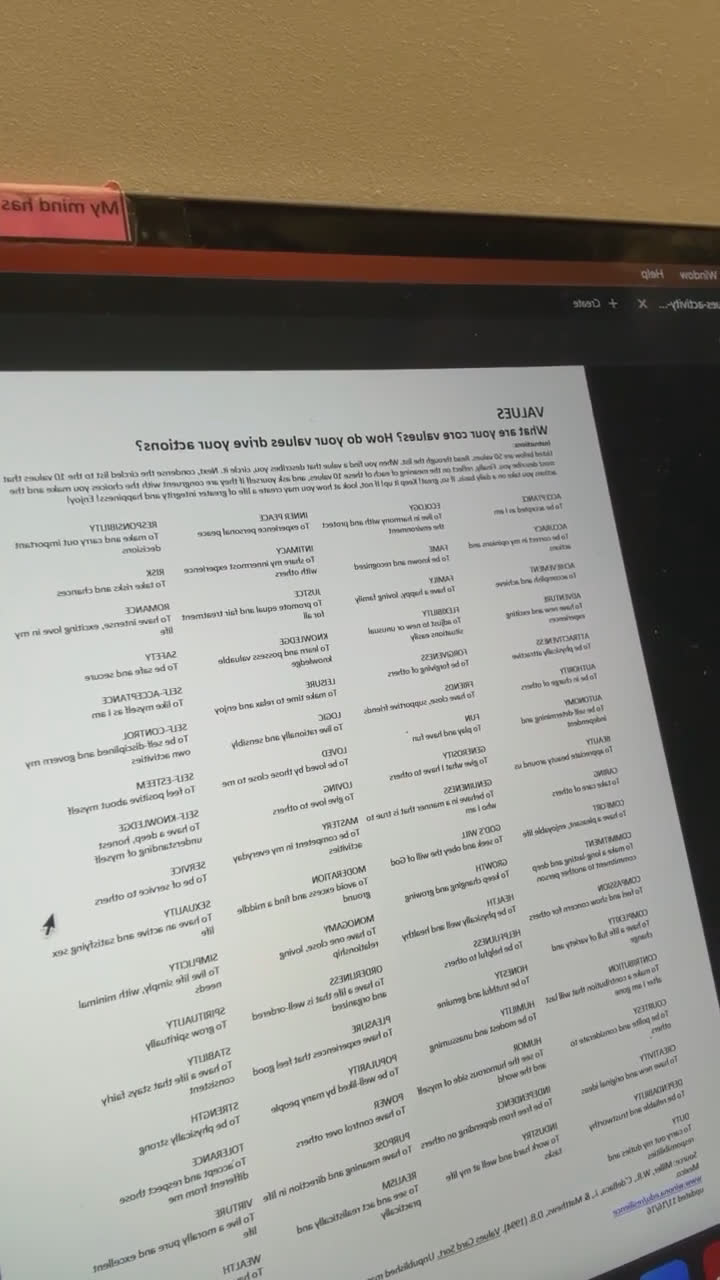
We should be using our pain and our challenges. That's what. That's. That's the best way to get something out of it. Let's. What can I get out of you? Breast cancer. And so that's what I did. And I was hoping I would be able to flip my camera so that I could show you this, but instead, I will manually flip it. So let's see if you can see this. So, this is the document that I used that has probably about 50. It says right there, it has 50 different values that I went through, and I shortlisted and I won't spend too much time.
Here you are on your amazing, magical phone. So you can simply flip up and go to your favorite browser and type in list of values and find any document and take a look and go through. And really the goal is to take whatever list you find. It may have 50, it may have 100, it may have. Hopefully it doesn't have more than that because decision fatigue. And narrow it down to your top ten and then look at your top ten and try to. What I did was after I looked at my. Hi, Robert. When I looked at my top ten, I tried to kind of group them a little bit so that I could whittle it down to a top three or maybe a top five.
And then from there I had my top three, which are my family, my kids, travel and adventure, because I just, that's just something I love. And creativity and spirituality, which I put together. Because usually when I go into that creative zone, it is that spiritual, the universe working through me kind of flow, and my BFRB, that's body focused repetitive behavior. Community, that is the main mental health issue that I focus on in my work at Habitaware, helping people with compulsive hair pulling, skin picking and nail biting.
So if it's not those four things, this is why values are important, because it helps you build those boundaries. When someone calls and asks me, hey, can you, you know, as a well known and respected founder in the Twin Cities, can you come and speak at this entrepreneurial event? I used to say yes to every single one of those. And now I am a little more intentional because it's not one of my four core values anymore. I think when my kids are older, they're ten and seven right now. When my kids are older and they don't need me as much, then entrepreneurship and supporting that community with all my heart and soul will come back to play.
But right now, for my health, for my mental health, for my physical health, for the health of my family, for the health of my business, for the health of my happiness, I gotta just focus on these four. And these four are my boundaries as well. And these, whatever, the three, four, five values that you identify for yourself are your boundaries for you. So when opportunities arise, when questions arise, you can look back and you can say, well, does this fit with my values? And then you can generously say no and happily say no, knowing that you are doing the right thing for you and knowing that that other person on the other side of that ask is going to find the right person for them, that the universe is working that your no is not a hindrance.
Your no is actually freeing space for someone who has that thing on their value list to get connected, if that makes sense. So I'm hopeful that this, this strategy works for you. And if anyone has taken that moment to do that Google search for a list of values, I'd love to see if any are starting to resonate that could be potentially on your list. I do think it's more than a quick five minute scan of a list to identify something that is going to affect your entire life and your boundaries and your lifestyle.
But if there's anything coming up as you're looking at a document, I would love to hear it in the comments, to see it in the comments so we can maybe talk through a couple. And I'm going to flip around again and show you these in case maybe, ah, trying to get that angle right, if there's anything there that might pique interest for folks. So when I use this one, family was one of them. There's a lot around, like how you want to be perceived by others, like acceptance, to be accepted as I am, a lot of like peace and calm type ones, to experience personal peace, to like myself as I am, to be safe and secure.
So I see those like to be, to experience personal peace, inner peace, safety, those two, to be safe and secure is kind of very similar. And so that's kind of the nuance a little bit that allows you to kind of group them a little bit so that you can reduce that list, if you will, so you can start seeing where some of the overlap to keep that list a little bit tighter. And so, yeah, so that's kind of what I wanted to share today, this idea of how values really helps us align our life, our actions, with what's important to us.
And when we do that, that means we are living and leading with love because we are not saying yes to things out of guilt, out of, oh, I should really go, I should really help. I should really do this. I should, I should, I should, I shoulda, woulda, coulda. And that's next week's chat. It shoulda, woulda, coulda. But that we are leading with love. We are doing the things that we have self proclaimed are very important to us, or things that we love or people that we love, or missions that we are connected to in a way that makes it just so easy to show up for those actions rather than feeling the guilt and the drudge of, oh no, now I've said yes to this, now I gotta drive there and I gotta do this.
There's so much work on my plate. And then you walk into the room with that deflated energy. Right. That. That. That's not. That's not living by your values. That's not leading with love of yourself or. Or the other people in the room. Right. And so this idea, values, helps you drive your actions. And the interesting thing is, in the online community that habitaware runs for the body focused, repetitive behavior community, we actually did a spin on the values identification as it relates to the mental health condition and to taking control of the mental health condition.
And so you can do that. You can say, these are my values for my life. These are the four things that I've identified. But as it relates to this piece of my life, what are my values? You can do it for your business. Right? For as it relates to habitaware and the work we do at Habitaware, service is probably at the top. That service mentality for me is at the top versus something like financial security. And so then that really leads the offers that we give people or the offerings that we put out there.
We do a lot of free things for kids, for example, because we want to make sure that kids are getting access to each other so that they can not feel so alone. And access to someone that's in a little bit older than them that's gone through it and can really guide them through the process of healing. So things like that ladder up to my values at Habitaware as well. So this system, it's such an easy, like, mind blowing thing, but nobody knows. It's such a good trick to lead with love. So I hope this chat was helpful for y'all today.
It was wonderful to see Jules and Luke and Andy, hats and Robert and JC and oh, and Shannon. And I think there was a. And Alec and I think there was a few other folks that joined that I can't see anymore, but. Steph, Erwin, thank you so much. I really appreciate you being here and I would love to know what your core values. Feel free to send me a message or add in the comments. Once the live recording is complete and live, it'd be great to know how folks are leading with love. And with that, I will leave you until next Wednesday where we will talk about Coulda, woulda, shoulda, and how we can move away from those negative thought spirals.
Thank you. Wishing you all love, strength and awareness. Bye.
Reactions and comments are for members. Joining is free and takes a minute.