I’ll share Step 2 of How to Stop Living in Survival Mode: Say it Out Loud
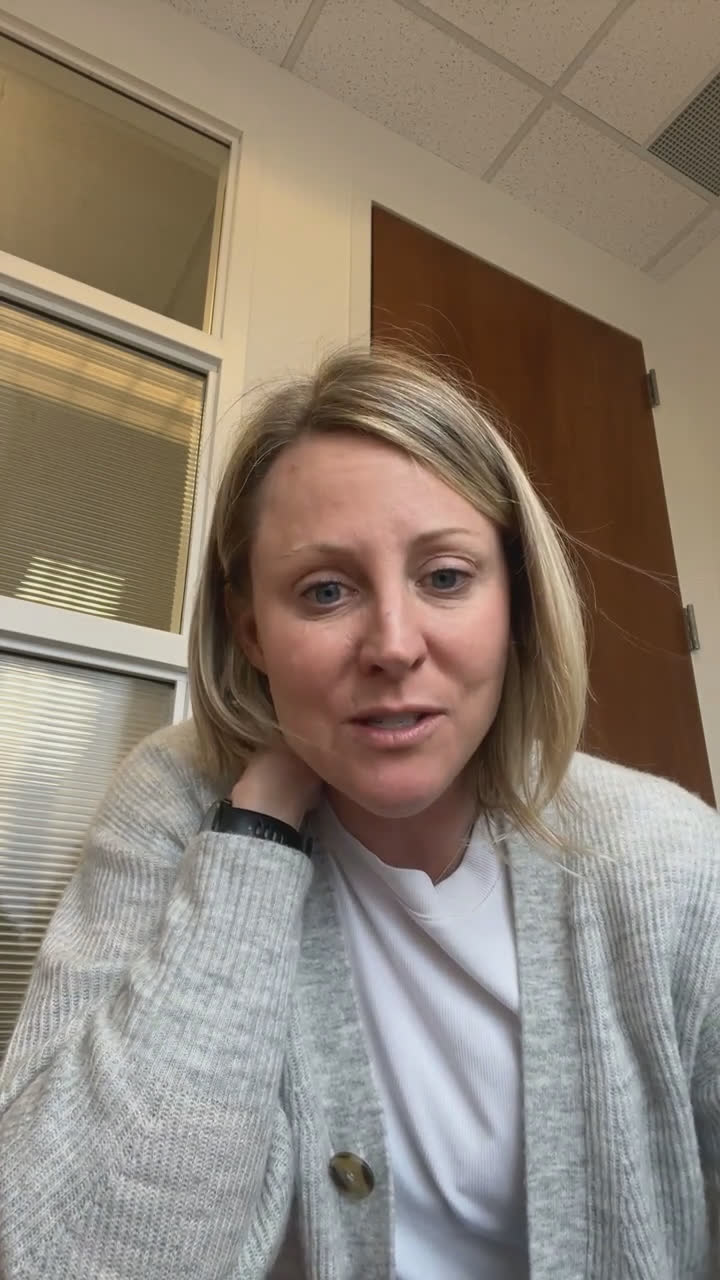
Cadre. Happy Friday, everyone. I am in an office. I'm gonna be at a weird angle, but hopefully that works for you.
Shannon is part of the Cadre team. She has generalized anxiety disorder and CPTSD. She talks about family estrangement. New contributors coming on to talk about grief and loss from a hospice perspective.
Step one is to know that something isn't right for you. Step two is to say it out loud. Once I was able to say out loud that my mom wasn't the mom I needed, it was my first step to heal.
Today is grief day on Cadre. To say you said it out loud to yourself is a step to healing. Know that you're not alone in hard relationships. Join us for the rest of the day on grief day.
Cadre. Hello. Happy Friday, everyone. I am in an office. I'm gonna put my phone down. I'm gonna be at a weird angle, but hopefully that works for you. I am today here with the Cadre team here in St. Paul, Minnesota, with one of our new content contributors. I'm moving this back, forgive me. Coming on, we're going to have some new contributors coming on to talk about grief and loss from a hospice perspective. So we are here today with that team, which is super exciting. So for those of you who don't know me, my name is Shannon.
I am part of the Cadre team. I am not a clinician. I am not a mental health professional. I'm a human being who has lived experiences parenting a child with special needs. I have generalized anxiety disorder, and I also have something called CPTSD. What is CPTSD? It's relevant to today's grief day conversation for me. I talk about family estrangement. And if you joined me last week, I began to share with you the eight, not the eight things, what I learned, the tools that I gained in therapy. I've been in therapy for eight years and how I am using those tools to manage those family relationships that are not healthy for me.
And so I think you can apply this. I think this can be applied, excuse me, to any kind of relationship, honestly, any relationship where you realize that the relationship that you're in isn't great for you. So if you joined me last week, I talked about step one, which was to know that something isn't right for you. And you can certainly go back and watch that. The briefest recap of it is that you know in your body that the relationship you're in is not in alignment with who you as you are as a person and your values.
So today I'm going to talk about step two again. It was my therapeutic journey. What do you do with it? Right. So once you know it, once you know it in your body, once you know it in your. In your soul and in your mind, that who you are on the inside and the values you hold aren't in alignment. When you're in relationship with someone, whether it's in your family or a spouse, whoever that is in your life, what do you do with it? So the next thing you do, the next thing I did, in my experience, was I said it out loud, so I knew something was not working for me, and I said it out loud.
Saying something out loud feels like not that big of a deal, right? You can say something out loud at any moment in your life, you can walk down the street and you can open your mouth and you can say something. And so it feels like the bar is really low when it comes to saying something out loud, and it feels like it's not that important. But I'll share, again, my own personal experience, purely for illustrative purposes, with my mom, and a challenging relationship that we had for a number of years.
And what happened was I didn't have a great relationship with my mom for a number of reasons. But this point came in my therapeutic journey where I remember saying, okay, I know this is true in my body. And when I first tried to just say out loud that my mom wasn't the mom I needed, I couldn't do it. I truly, this feeling would overtake my body. It was very much like, oh, my gosh, this is taboo. This is against this system. This is against my family system. It's just not something that is said in my family.
It's not something one says. And what I learned over time and what I learned in the process of being able to say it out loud, and the first time I said it out loud, it came out. I said it. And then I think I had to stop for a while and sit with it because it felt almost like poison. Honestly, it felt like this thing that was so anti everything else, the 40 years I had spent living in a certain way, that it just felt wrong to say it. But the truth is, is that once I was able to say it out loud and start to own that for me, my mom was not the mom I needed when I was growing up.
It was my first step to start to heal. So I'm going to break it down a little bit as to how that helped me. So, first and foremost, it took the shame and the blame, the self narrative that I had in my head of something is wrong with me and I am inherently unlovable. It took that away because it's just saying I needed a certain sort of mom. I needed a mom that looked like this and behaved like this for me, what I know from my own body and my own emotions and system, I know I need this. This level of support, and I know that my mom just wasn't able to give that to me.
So it takes away, and I know I talked last week or the week before about sort of like this, us and them mentality. And oftentimes, in my experience, in family estrangement, it can be like, you are wrong and I am right, and this is, you know, this way is the good way, and this way is the bad way. And what I really learned is that that's not the case. Right. No one's right. No one's wrong. My mom wasn't wrong for not being able to show up the way I needed her to, and I wasn't wrong for needing her to show up away.
Right. That's who we are as humans, and that's how it manifests for us. But taking the time to say it out loud and put it out into the world started to change the narrative for me. First, I could say it to someone else. I said it to my therapist. I put it in the world. Someone else heard it. So immediately, my narrative switched from, I'm not good enough. I am unlovable to this situation exists. Neither one of us is wrong or right, and it's still sad. And there is so much grief that comes with it.
It's the beginning, honestly, for me, it was the beginning of my grieving process. But it was also that first step and a pathway into a new narrative that I could tell myself. Jules, you said when you said yours out loud, you were shocked that you said it. Yes, yes, and yes, and lots of time to process it. I will tell you, I first said that out loud about my mom probably five years ago. It took me three years to say it. Really, what would happen in those moments when I was in the room with my therapist is I would say, I think I might be able to say it today.
And then I couldn't, and I'd have to sit with it and say, you know, I'm not ready, and it's okay. It's okay if it takes three years. That is sort of the other piece that I've learned is, you know, if you live a certain way, and I don't know, Jules, how old you are, but anyone who's on Cadre has lived a couple of decades, and if you do something away, if you have a story in your head for a couple of years, it's going to take time to then walk back. It's going to take time to see something different.
And so my offer to you today is, if you say it just to yourself, by the way, you're still saying it to yourself. That is progress. That is a step forward, because you notice something wasn't working for you, and you said it, and you're saying it, and you can say it in a silent room to yourself, and it still holds space. And as you grow over time, you might be able to say it to someone else, and then you might be able to start to even and I'll talk about this next week. What sort of my next step was in my healing was to sort of sit with it then and say, like, okay, if this is true, then what does that mean?
Is different in my life. If the truth is my mom wasn't the mom I needed, it actually creates space for me to start to love myself, heal myself. It creates space for me to look at my mother in a different light. And not an us them versus mentality, but rather, you did the best you could, and I did the best I could, and I think it's hard. And the grief. Today's grief day on Cadre, the grief in that process for me and honestly continues to this day. I'm now 48 years old, so I've been on this journey with my mother in this new way for eight years.
I still grieve that I didn't have the mom I wished I would have had. I still grieve that there are days when I wish I had a mom. I wish I had a mom that hugged me. Right. And she does hug me. And so it's, you know, it's all. It's all in the details, but that grief is a process. But I will say that being able to say it gets you started in that process. And so, Jules, I just want to honor you and the work you're doing, to say you said it out loud to yourself, and that is process. That is. That is a step to healing.
So, a recap. Number one, this is the tools that I learned in eight years of therapy. Number one is, notice something's not in alignment for you. So, for me, it was a relationship I had, and it wasn't working for me because it was inauthentic. Number two is I said it out loud. So my offering to you today is, if there's some relationship in your life that you know isn't working for you, maybe just think it right. If thinking it is a step, thinking it is fantastic. If it's saying out loud to yourself in the car or a silent room, that's beautiful.
And if it's starting to say it to a person, if you want to look at the screen and say, play this tape. And actually, I will sit here quietly for a moment to receive that. If that's something you need right now, I want you to see and hear that I'm a human who understands what you're going through, and whatever you need to say out loud is received here. It's received for you. And so I want you to know that it is just what you need. And there's nothing wrong with you. You guys are doing a great job.
We're all doing a great job. On all sides of family estrangement, on all sides of tough relationships. I do believe everyone goes into it with their best intentions. So give yourself grace and love. Know that we're here for you. Know that you're not alone in hard relationships, and join us for the rest of the day on grief day on Cadre. Just know that we're all processing things in life just like you. So I hope everybody has a great weekend. I will see you next Friday for step number three, which is now we've said this thing out loud, what if we start to actually live like it's true?
Alright, guys, thank you so much. We'll see you soon. Bye, Jules. Bye, JC. Bye, everyone.
Reactions and comments are for members. Joining is free and takes a minute.