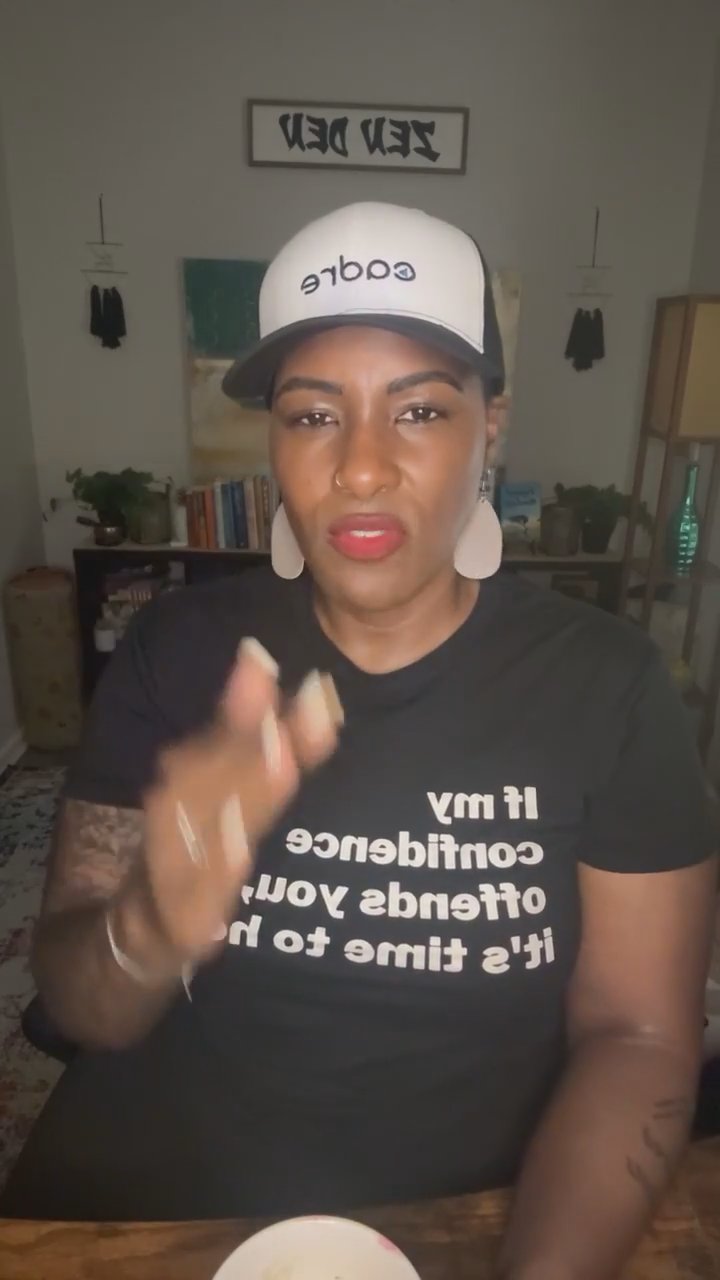
Whether it be weight stigma, health issues, or dysregulated eating, grief and loss can often be centered around the relationships we have with ourselves. “If My Plate Could Talk” explores the connections between food, weight, health, and trauma and frameworks for understanding the conversations we have with ourselves, thus begging the question: “If my plate could talk, what would it say to me?”
Doctor Charryse Johnson: At any given point, we're all grieving something. Sometimes there are subtle things that we are grieving that we don't even recognize. Johnson: Your shadow is any part of yourself that you have disowned, rejected, or that you intentionally keep in the dark. She is still working on trying to pare down what she shares.
Jules says it's important to show empathy for the parts of yourself that give you grief. She suggests three things to do when you're feeling frustrated with how you're showing up. Slow down, reprioritize and find a balance.
So my challenge to you is for you to embrace every part of who you are. Take the next few days to fight, to bring in joy. Because it is the antidote for those moments of life that are hard and that are overwhelming. Have a great weekend and I'll see you next week.
Hello, Kaja Sphere. It is Friday, and welcome to if your plate could talk, where we get into the intersection of grief, life trauma, and the relationship with ourself. Because at any given point, we're all grieving something. But it doesn't mean that your grief is gone easy or even sometimes immediate. Sometimes there are subtle things that we are grieving that we don't even recognize. Other times, we are fully aware of all of the grief and loss that sits before us. But either way, or wherever you find yourself, I'm glad that you're here.
Hello to all that are joining. Hello, speak, wonder. I hope everyone is having a good week so far. Hello, Jules and Audrey and all the good people. It's a coffee morning, not a. Not a spicy coffee morning. I'm not feeling punchy necessarily, but there's a little rain and I want a little warmth. Look at you guys. Already know what we're doing today. Talking about where you are. Hello, California. What's up, South Carolina? Audrey, you are joining us from your freshly painted breakfast nook. Hello, Pennsylvania.
So for those of you who are here for the first time, you're like, why are you saying hello to states? Part of what we do when we join in together is we talk about, where are you in the world right now? So that we all recognize that we're part of some collective goodness. So, greetings to you from North Carolina. I'm Doctor Charryse Johnson, a licensed clinical mental health therapist, mindfulness practitioner, and author. But more importantly, I'm part of the Kaisersphere, just like you. What's up, philly?
I. My mind, I'll be honest, is going in so many different directions. Part of it is I get so excited about what to share, and I am still working on trying to pare it down and not give you all so much information. No one has told me not to. What's up, northern Minnesota. But it's just something that I am working on doing. Hello, Buffalo. So here's what I think is most predominantly on my heart. Robert Augustus Masters is a psychologist, a huge, phenomenal insight leader and thought leader. And he talks a lot about shadow work.
And if you're familiar with me in other ways, you may have heard me mention his name a little bit before. So your shadow is any part of yourself that you have disowned, rejected, or that you intentionally keep in the dark because it's either too much for you. In many ways, you might feel like you can't handle it, or it's just parts of yourself that are frustrating. I don't know about you. I can only speak for myself, but let me take a sip first. When I think about my own journey through grief, whether that's the grief of a parent, whether that's been the grief of opportunities, the hidden griefs of this is how I thought things were going to be, and they weren't.
Something that I consistently notice, whether, again, it's with me or people that I work with, is when we're going through moments, whether we recognize how present grief is or not. There are often parts of who we are that we feel like, not now. Like, why are you showing up in the way that you're showing up right now? I'll give you an example. I'm a neurodivergent. I have complex adhd. Don't think that surprises anybody. Which is why it's always hard for me to pare down information. And in some ways, that is extremely helpful.
It makes me really great. In a session when people are going all over the place and their story is not linear, I am following. I am loving it. It is goodness. But it is very challenging on a daily basis because I lose things. Even though I try to be a little hyper organized, when grief is heavy, when something in my life is weighing on me. So I want you to think about grief not only from the sense of a loss, but like a grieved spirit, aggrieved body, aggrieved soul, when life feels heavy and overwhelming.
My neurodivergent is. Divergence appears to me to be even worse than it is on a regular basis. So my ability to manage that part of me is even more challenged. So I'll be more forgetful. I can be more paralyzed when it comes to getting things done. Like, I spend a lot of time sitting and in holding before I can get activated. So when we're in that state, overwhelm. Life is too busy, life is too much. Even if we recognize it or don't, our shadow can be very loud, and we can be very frustrated with how we're showing up in the world.
If you've ever had a moment like that, tell me. I can relate, because it's important for us to know where we can relate with each other. So I want to focus on what does it look like for you to learn how to show empathy for the parts of yourself that give you grief? Right? Like, there are actual parts of ourselves that we're like, ugh, I love myself, and I wish I wasn't like that. Because our strength can also be our struggle. My mouth can be a strength my mouth can also be a struggle given the wrong situation or too much stress and too much overwhelm.
So let's spend, like a few minutes talking about having empathy for the parts of yourself that frustrate you, that grieve you, that make you sad, because you literally feel like, why does it show up now? Why am I like this? Will this ever go away? And I want to say this after a sip, you are wired just the way you are for a reason. And even though it might be really difficult at times and really frustrating to manage in whatever ways you have to manage it, that wiring is also special and unique to your purpose in the world.
And so what would it be like the next time you're like, oh, I wish I didn't do that or say that, or I'm frustrated with myself, or I wish I could change this part. Part of me. For you to find a space of empathy that says, this part of who I am right now is a challenge. But I also wouldn't trade this part of who I am for anything. To be in a place that is more accepting of who you are and how you operate and the importance of continuing to grow in that area and notice it and aware it. I'm not saying to ignore the parts of yourself that grieve you, but what I am saying is you want to find this balance between this is who I am, this is what life has molded me to be.
And I'm still working on it, I'm still navigating through it. But I'm not going to beat myself up because it's wild that in our most difficult moments, we put so much pressure on ourselves, we expect ourselves to show up in the same ways that we would show up if life wasn't lifeing the way that it is. And that's just simply not realistic. So if we learn how to empathize with those parts of our shadow that often come to the surface and grieve us when life is stressing us out and adding pressure to us, that radical acceptance of who we are will allow us to step back and be more compassionate towards ourself and go, okay, I see myself back to the analogy I gave, okay, I see that I am losing things more, that I'm misplacing things, that I am not getting things done at the same pace that I normally would and being okay with saying that's okay, but what do I need to do?
So here are three things that I have found helpful and encouraged other people to do in those moments where they feel very frustrated with how they're showing up. And here's the. Here's the thing, too. You may be showing up to the rest of the world just fine. The rest of the world doesn't have a clue what you're internally navigating. But you know, you know that the sound of your voice is different. You know that your pace and your ability to stay focused is very different. Yeah, Jules, it's so hard to forgive ourselves, but it's so important for us to be able to say, this is all I have today, and it's enough.
I actually want you to stop for a moment and say that to yourself, this is what I have today, and it's enough. But here's three things that you also want to try to do when you're in that space. Space. One, slow down. When we are overwhelmed, when our physical nature, our spiritual nature, feels grieved and heavy and there's too many tabs open and there's too much going on, it's not always time for you to rise to meet a pace that is already outpacing you. Sometimes one of the best things that you can do is slow down.
Number two, re prioritize. Because we often come into a day already having a set of priorities based on what we think is possible. Then we get to that day and go, whew. Today's harder than I thought. There's more going on than I thought. I'm more physically exhausted or mentally exhausted than I thought. The situation is bothering me more than I recognize. My family needs me more than I thought. My vocational work needs me in ways that I didn't expect. This context of life has changed, and the pressure is there.
So reprioritize what is necessary. Notice I didn't say, reprioritize what is important, because you're going to think everything is important. It's all important. I've got to do it all. Says, whoa. Reprioritize what's necessary by asking yourself things such as what has to be done today without having an impact on someone else. That's one of the most powerful questions you can ask yourself while you're balancing the grief of life, the stress of life, and the grief around the parts of yourself that aren't showing up the way that you want.
Show yourself empathy by slowing down, by reprioritizing what's necessary and asking the question, what needs to be done today day so that it does not have influence on someone else. And number three, make time to bring in joy. And that is going to make you go, wait, what? Because grief and overwhelm can coexist with joy. It's necessary. Joy is the counterbalance to the overwhelm, to the criticism that we have. It pulls us away from ourselves, makes us laugh, makes us smile, connects us with other people, and makes us go, okay, yeah, it's still a little rough, but there are good things that are happening.
So you want to fight, because sometimes it is a fight to bring in joy. That might mean that you have to really push yourself to get out the house. That means it might mean that you really have to push yourself to turn on your favorite music, your songs that you love, and just let your body go away with it. That might mean that you have to fight to put your to do list on pause and stop working long enough to allow yourself to come in. Oh, yeah, Audrey, that is funny. For those of you that can see the chat, Audrey says, I love it when people unexpectedly laugh at funerals.
Thank God for laughter at funerals. My husband is one of those people who just has a way of making you laugh without trying. But at the exact moment, we were actually doing a funeral for his godfather a few months ago, and he said things that brought us to tears, but also said things that made us laugh. Deep belly laughs so hard at the same time. But that's necessary, because what happens is, when we're low, when we're overwhelmed, when we don't feel like we are showing up in life the way we want, there's this part of us that's like, come on, I gotta push through.
Let's go. That's one avenue. And I don't want to take any avenue away from you, but that avenue can exhaust you. That avenue doesn't always work, and that avenue can create another layer of guilt when you feel like, okay, that's not even motivating me. And usually it does. And from a stand, you know, from the stance of neuroscience, also, the brain actually is not motivated by pressure. It is motivated by success. Enjoy. And dopamine, and by the things that left you. So wherever you find yourself today, be sure that you are being compassionate and empathetic to the parts of you that you feel like aren't showing up the way that you want to right now.
There's a reason, and even if you don't know the reason, you don't have to know. Well, why do I feel this way right now? That's irrelevant. But what you can do is you can slow down, you can reprioritize, and you can bring in joy to lift you back up to the baseline where you want to be. And most importantly, I want to say it again. You're exactly where you are because it's where you need to be right now. You're exactly who you are because that's who you need to be for your intended purpose. Even the parts of yourself that you don't love and care for have value and have merit, even in the moments that you can't see it.
So my challenge to you is for you to embrace every part of who you are. To be more compassionate towards yourself, to be more forgiving of yourself and really take the next few days to fight, to bring in joy. Because it is the antidote for those moments of life that are hard and that are overwhelming. And if you are feeling a little low today or just navigating the land of grief, continue to come back throughout the day. Listen to all of the other incredible providers and creators that are here to spend time with you.
That's one of the things that I love. That at any given moment, on any given day, I can come on and find someone who can speak to my soul, who can speak to my heart, that can speak to my mind, that can share life. Because that's what the Khadr sphere is all about. I hope you have an amazing, amazing weekend. You are enough. You've always been enough. And if you're in the middle of a really hard moment, know that every storm eventually clears and it won't be this way forever. Have a great weekend and I'll see you next week.
Cheers.
Reactions and comments are for members. Joining is free and takes a minute.