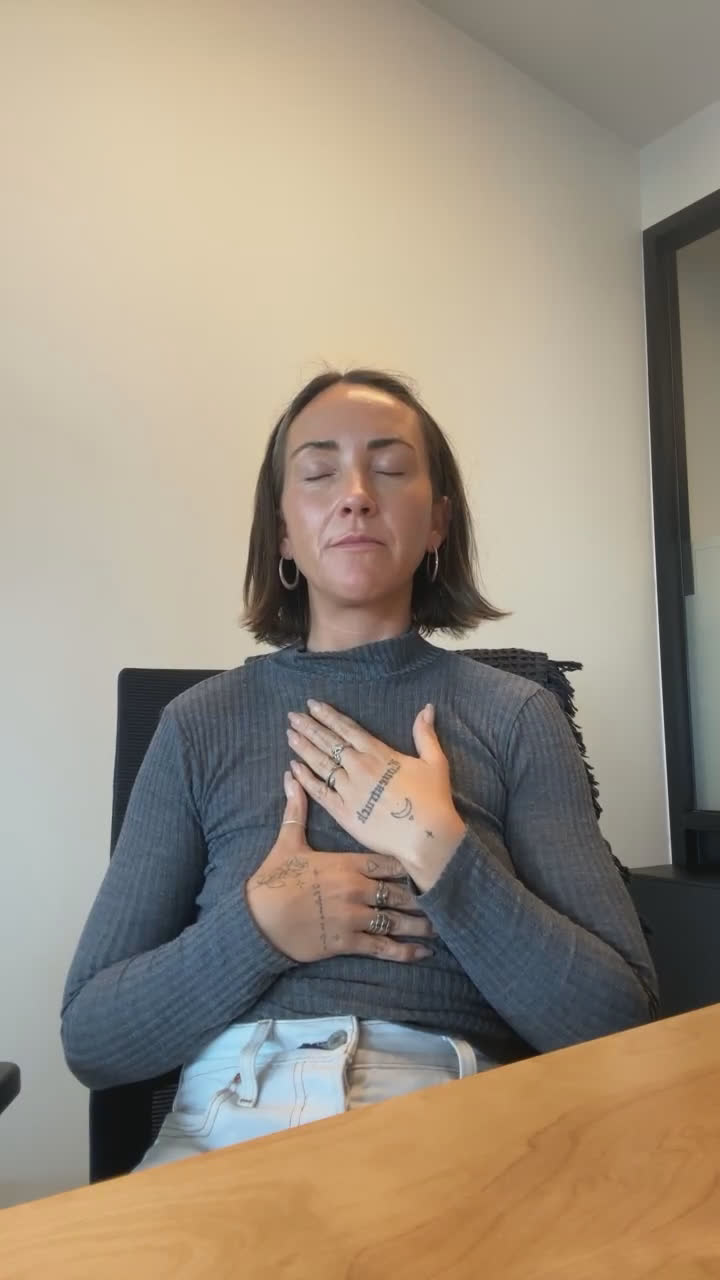
A midweek check-in session that guides a short grounding practice and invites listeners to notice body sensations, energy levels, thoughts and emotions while pausing from work to reflect and reconnect.
Happy Wednesday, Cadre crew. How is everyone doing today? It is kind of a cloudy day in Seattle, and Milo and I. have been absolutely loving our co working space. It has been so nice to be around other people while we have our work day.
So today I just wanted to do a check in. I think sometimes, especially midweek, we can start to either feel low energy or maybe a little bit lost. I wanted to create some space for you all to take that pause, have a little check in this week.
Jewel: That conflict between knowing what we want and need and not being able to get it is painful. She says sometimes we also ignore our physical cues. Multitasking is a myth, she says. In the long run, it makes us less productive.
Well, I am so grateful that you all came today and that we had this little check in. I might try and do these once a month because I'm here every Wednesday and I usually like to have a specific topic. If there are any requests you have for video, please let me know.
I hope you have a fabulous rest of your day. Don't forget to check in with yourself often and when you can. And I will see you same time, same place next week.
Happy Wednesday, Cadre crew. How is everyone doing today? It is kind of a cloudy day in Seattle, and Milo and I. Milo, say hi, Milo, say hello at our co working space, which we have been absolutely loving. It has been so nice to be around other people while we have our work day. So it's been truly great. I am just gonna give folks a few minutes to trickle in and then we will start. So today I just wanted to do a check in. I think sometimes, especially midweek, we can start to either feel low energy or maybe a little bit lost or, you know, maybe some of the.
Maybe some of the lack of motivation we felt early in the week starting to pick up. And so we feel like we have an overwhelming amount of energy that we don't know where to put. And so I find that midweek is always a really nice time to pause and check in. So I wanted to create some space for you all to take that pause, have a little check in. Hi, Russell. Hi. Speak wonder. We are just getting started. I was just letting everyone know that today I just wanted to give us some space to do a little midweek check in.
Hi, Vanessa. I think that it's really valuable for us to carve out time either during our day, during our week, or during the month, to just to take some pause and to reflect and to ask ourselves, how are we doing? How am I doing? How's my body feeling? Have I had enough water today? Have I eaten enough today? Have I taken a moment to take. To just, like, stop and breathe and get outside, touch some grass? Have I had a moment to check in with people that I love and let them know that I love them?
And, you know, I think that oftentimes, especially during a work week, we can just get really inundated with tasks and productivity and we forget to give ourselves those moments to pause and check in. So. Hi, Rachel. And so I just wanted to carve out some space for us this week to do that. So I'm going to invite you to do a small check in with yourself right now. So maybe that means I'm crossing your legs. Hi, Jules. And getting comfortable where you're sitting and just taking a moment to ground your feet.
Hi, Maria. Feel your feet on the ground. Feel your back against the chair, whatever you're sitting on. Or if you're walking right now, maybe taking a moment to stop and pause and look up around you and see where you are. Maybe naming a few things in your environment that you can see. I can see a plant, my coffee mug, my laptop. All of you just taking a moment to pause and just get grounded first. And then once we're grounded, just checking in, right. We can do first, like, a physical check in of like, how does my body feel?
Do I feel tense anywhere? Fluttery? Lethargic? What are my energy levels? Checking in with our brain, asking, what's the quality of my thoughts right now? Are they racing? Are there a lot of them? Do I feel sort of thoughtless or brain dead? Mushy, brain foggy without any judgment, just observing and noticing? We're just observing right now, asking how our heart feels. Maybe tender, open, hopeful, scared, yearning? Again, no judgment, just observing. And then once we've done this sort of environmental and internal scan and grounded ourselves, then we can kind of check in.
Then we've created space and presence with ourself. As if to say, I'm here sitting with you right now. I'm here sitting with you right now. And there are no other distractions. And I just want to know how you're doing. I just want to know what you need and check in with yourself. Maybe you need water or a snack. Maybe you need a hug or a good cry. Maybe you need to laugh or go play or do something silly. Maybe you don't know what you need. And that's okay. You're checking in with yourself and giving yourself the space to pause and just be.
If you close your eyes, feel free to gently open them. And I would love to know if anyone would be willing to share in the comments, what came up, maybe what you found you needed. Maybe if that was really difficult or painful, and let's just chat about it. Rachel says this doesn't feel so good. Okay. Okay. Tell me more about that. Is it. Is it the physical act of grounding? Is it the acknowledgement of what it is that maybe you need once you check in and recognizing that there's some pain that needs some attention or love, sometimes it doesn't feel good to check in with ourselves.
Sometimes. That's why we run around all day long doing everything we can to stay occupied, to stay busy, to stay distracted. Because once we pause and check in, we realize we're hurting. And once we realize we're hurting, we have to face that pain, and that's really, really hard. Maria says, sending you a hug. Thank you for sending Rachel a hug, Maria. Maria says it felt good to just be. Yeah, I think sometimes, especially if we have a History of Trauma. I mean, this is true for, for a lot of folks, but especially if we have a History of Trauma or chronic stress and our systems are on overdrive or hypervigilance, we avoid just being, especially in our bodies.
It can feel very scary to be still. It can feel scary to have our eyes closed. It can feel scary to be calm, because that's the opposite of what we're adjusted to and used to, which is being in survival and being alert and on edge and hyper focused on lots of things at once. I just wrote an article about this, about what happens in our brain when we're constantly stressed or when we're constantly in survival mode, and how that impacts our ability to be focused or to be still. Because we think that we need to be focused on everything all at once.
We think we need to be prepared for any possible danger, which creates this sort of hyper vigilance of I need to focus on everything, which makes it hard to focus on one thing. And so it can be really scary to just be and really wonderful. Once we start to feel safe, to be like, once we start to feel a little bit of calm in just physically being or being still, that's a very long overdue welcome feeling that so many people struggle with and that so many of us deserve to feel. So I'm glad that it felt good to just be Maria.
Rachel says, it makes me sad. I know what I want, need, but have no access to it. Yeah. That conflict between knowing what we want and need and not being able to get it is painful. There's grief there. That's something to grieve, especially if, you know, if that's what we need or what we want is not in our control. God, that's so hard to be in that dissonance in that space. And we have to grieve that you get to grieve the fact that what you want and what you need is not something that you can get and that can be really, really painful.
Jewel says, I feel good. I need water. Lots. So do I. You're reminding me, I'm gonna drink some. My water was my tripod. I think everyone could probably use water. But isn't that wild how sometimes we also ignore. We ignore our physical cues? I read something one time that was like, because I'm a. I have this. This problem. If I have to pee, I wait until there's an emergency to go. Like, I will. I will finish an email that takes me 30 minutes. And the whole time I have to pee because I'm like, I can't stop this in order to go to the bathroom.
And I read something a couple years ago that was like, he's a. He's a sex and marriage therapist, and he was saying if you ignore your. He's, like, ignoring your physical body cues is. What did he call it? He said it. I don't think he said it was a form of self harm. I don't think that was the language he used, but he kind of described it as, like, that's one way that we abandon ourselves or one way we ignore our own needs or one way that we tell our bodies that we don't trust them. Right. And so, for me, as someone who has a history of an eating disorder, I have a long standing history of creating an untrusting, unsafe relationship with my body where I don't trust my body's cues.
My body doesn't trust me to feed it when it's hungry or sleep when it's tired. And so by not using the restroom when I have to pee, I'm reinforcing this lack of trust and lack of connection. And so it kind of was this interesting process, thought process of, like, oh, I wonder how many times in my life I'm ignoring my body's cues, or I'm just not listening and I'm enabling that mistrust and disconnect. So I've now started to try. And, like, when I have to pee, I just get up and go. Or if I feel a little bit of thirst, I drink water.
But it's amazing how many of us will go throughout the day and ignore those cues. We ignore hunger cues. We ignore thirst cues. We ignore cues that we need to rest or close our eyes or have human connection. These are massive things that we, I think, oftentimes really minimize, and they're really, really important. Speak wonder. Multitasking is a myth. Multitasking. It makes me so sad that this is something that we glamorize in our culture, because it's so. It's. I mean, I don't want to scare anyone.
Like, you're not. It's not gonna significantly damage your brain, but it's so it's really bad for our nervous systems to multitask. It is essentially training our brain to be in survival mode, which is not good for our systems at all. So it's a shame that we sort of glamorize it and look at it as, like, a really amazing skill to have because it's so damaging, and in the long run, it actually makes us less productive. So, like, when employers, like, are you good at multitasking? Like, okay, great if I am, super.
But the quality of the singular thing I'm focusing on is going to be such crap compared to if I had really good singular focus. Like, I think we should be looking for people that can focus on one thing for like a duration of time and put quality into that one thing because that's going to provide such a better outcome than being kind of focused on lots of things at once. Jules says, sending hugs and prayers to all that need and want it. Thanks, Jules. So true. You're so used to deprivation and wait until something is an absolute necessity.
Yeah. Yeah, it's a shame. And it's something I'm still working on. Like, I probably should go to the bathroom right now, like. And I, you know, I just. I'm so adjusted to putting my body's needs last. I put my body's needs after everything else. And I still am working on putting my body's needs before other things. And it's hard, especially because it's been decades of me doing that. So unlearning that and relearning how to prioritize what my body needs is difficult. Definitely difficult. So. Yeah.
Well, I am so grateful that you all came today and that we had this little check in. I might try and do these once a month because I'm here every Wednesday and I usually like to have a specific topic. And I think that having these check ins is really valuable. So if it feels valuable to you, please let me know in the comments. If you're watching this as a replay, I would love to know what came up while you checked in. And as always, if there are any requests you have for video, please let me know.
I can always think of things for us to talk about and videos to make for you, but if there's anything that you want me to speak on, I'm so happy to take that into consideration. Marina, it was so nice to meet you too, Rachel. I'm so glad that you were here and I'm glad that it helped. Thank you for showing up. It really means a lot. Okay, Jules. Sounds good. Yes, I will try and do these monthly. I love it. Okay, my dears, I hope you have a fabulous rest of your day. Don't forget to check in with yourself often and when you can.
And I will see you same time, same place next week. Ta da. My legends.
Reactions and comments are for members. Joining is free and takes a minute.