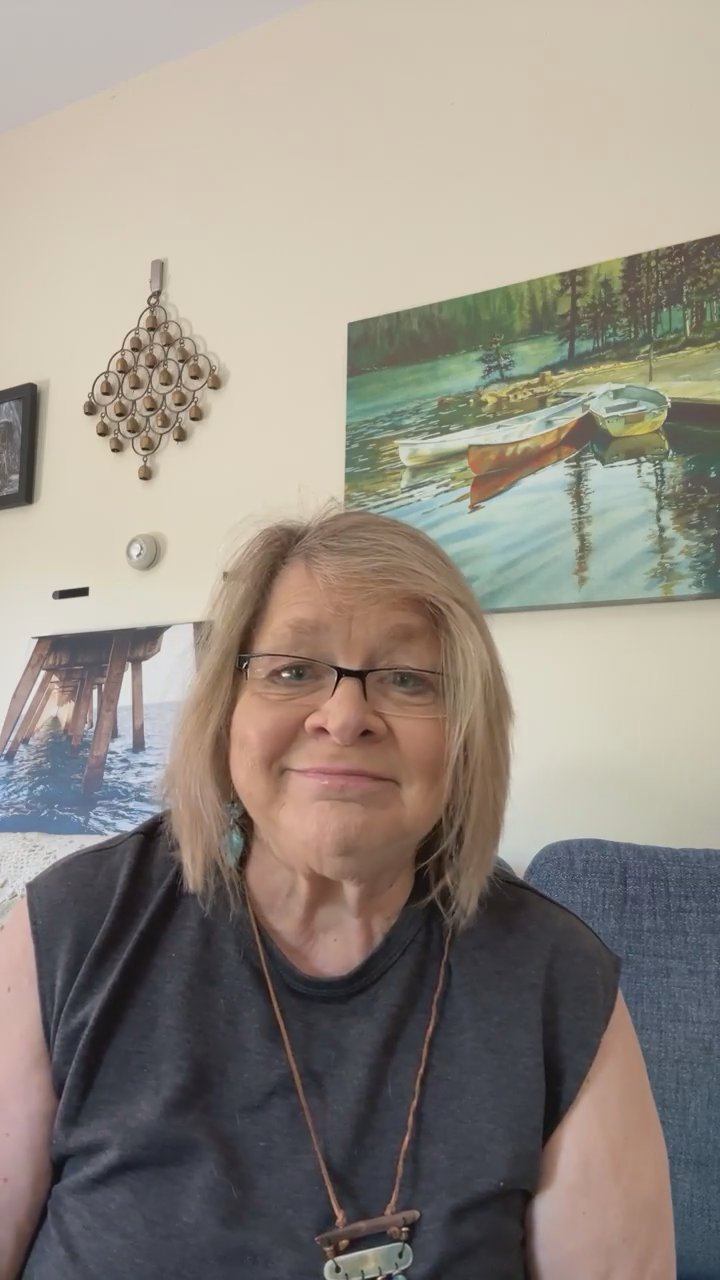
Kathy joy: I'm Kathy joy, and my handle for Cadre is speak wonder. She loves all things boats and harbors. Why do I love Cadre? Because it's a lot like radio. We're here to encourage one another.
This is caregiver day. Peggy Drexler is the emotional caregiver to her 93-year-old mom. After she retired, she went on a physical wellness journey. She will share some of her poetry with you today.
Today is caregiver day. I want to talk about harbor pilots. A harbor pilot is someone who's very keen about their local harbor. In the weeks to come, I'll be sharing other types of people in your life with nautical terms.
My mom went into a sharp decline physically and could no longer live independently. Now I'm her emotional caregiver. It's very much as time consuming and if I can say, as draining as hands on. That's where harbor pilots come in.
Who's the anchor in your life? Who is your anchor? I invite you to identify this individual and send them a thank you note. A tugboat is your accountability person, the one who gives you a nudge when you need it.
Kathy Joy: There are so many things in the harbors that represent life and that dovetail nicely with caregiving. Later on, you'll be hearing from Shannon Paul and JC Lippold. I'm having one heck of a time translating Minnesota time to Pennsylvania time.
Okay, I'm back. I did a little test drive, and here I am, everybody. So, I'm Kathy joy, and my handle for Cadre is speak wonder, and I'm so glad to be here, so if you could send me some love. There's Jules. Hi, Jules. Ah, yeah, a little speed bump starting, but here I am, and I'm so happy to be here, you guys. So happy, so excited. I'm so grateful to have discovered the Cadre community. Quick little bit about me. I'm from Erie, pa, so I'm coming to you live from lake Erie, and I love all things boats.
You might see in my background, there's some canoes moored at a dock. Looks like a wonderful camping scene. I've got some more boats behind me, some other pictures of boats and harbors, and as we continue forward, I'll show you some more pictures of sunsets on Lake Erie, types of things like that. So I'm a nautical girl. I love all things harbors, and my topic, or my theme is harbor pilots. So I have several homes. One of them's in Denver area, Colorado, where I did radio for 22 years back in the day.
I've not been in radio in the traditional sense in a long time. I've had chances and opportunities to do presentations and to speak into the world, as it were, but not as a dj, which was my very favorite job of all time, and I miss it. So why do I love Cadre? Because it's a lot like radio. My general manager at the station in Denver, he said a couple things that really stuck with me, and they're informing me now as a Cadre creative. And the two things were, he said, first of all, this is not about you, and I've heard this many times on Cadre, which is why I love the community, because we're here to encourage one another, not really to promote ourselves, but to be a part of a community.
I love that, and that's what radio is, speaking to the listener. And that was the second point that Jack made. My general manager back then, he said, you're not speaking to the multitudes. I want you to lean over the fence like you're talking to a neighbor or lean over the table like you're sharing a coffee with somebody. And that's so winsome and so personal and so organic, and that's why Cadre speaks to my heart. So glad to be here. So, I'm a widow. My husband died from a heart attack in 2008.
So I've been on my own for a long time. So I live by myself, except I have my little sidekick. Her name is Gracie, and she's a 22 pound corgi, and she's full of p*** and vinegar. She's a funny one. She's out on the porch right now, enjoying the sunshine. I decided to stay in here because I get distracted really easily, and I wanted to focus on you today. I put makeup on for you. Just want you to know that. Yeah, I did that. I had two bivocal surgery. Not bivocal, what do you call it? Cataract surgeries.
And so now I'm in between, where I actually do need prescription lenses, but I'm wearing readers, so I'm gonna do what one of my professors used to do all the time, and it drove me nuts. When I was in college, he'd have these on his head, and then he'd go to read something and slip them down. I am there now. That is my demographic, wearing these readers. I'll be taking them on and off, depending on what I'm telling you and what I'm trying to relate. And I do have just a few notes here, but just going super flying by the seat of my pants today, my debut.
I love words. I love pithy statements. I love poetry. I'll be sharing some of my poetry with you as a caregiver, and this is caregiver day. I am the emotional caregiver to my dear, sweet, 93 year old mom. Her name is June, and her closest, dearest friends call her Juney bug or June Bug, and that's something they love to call her where she is at the care home. So I'll explain. Emotional caregiver. I think you know exactly where I'm coming from, but I'm gonna flesh that out in a minute. So I also love being retired, you guys.
I love being retired. February 2 of 2022 was my last day at Human Services here in Erie, Pennsylvania. And working for the Department of Human Services really informed me about wellness and mental health. As a clerical person and a receptionist answering phones, I went on a big learning curve about getting well, about people struggling with addiction, about children and youth who are in homes where addiction has taken over, and it's such a struggle, and getting well is no picnic. And the wellness journey is something I got to see.
I had a front row seat to that, and it developed in me a deep, deep empathy. How could I know that? It would also inform me, as a caregiver, for someone who's in a decline and whose wellness and mental health is sometimes compromised because of her age and her challenges, and her grief and her losses. So all that to say, I loved that job. I loved radio more. Always thought I'd get back to it. However, life is about pivoting, adjusting, and finding your why. And so after I retired, I had to find my why.
I had to refocus, and I very quickly realized I needed to go on a physical wellness journey. So I got rid of 60 pounds. 60 pounds, you guys. That is the weight of a kayak. Yeah. I had my picture taken at D***'s sporting goods here in Erie next to a kayak so that I could, by comparison, see what I had taken off of this body. It carries me into the world with more lightness. And my why is my grandchild, who is two and a half years old. And my purpose for getting fit and eating well is so that I can sit on the floor with her and play legos and read books.
And in the winter, we can make snow angels. She's a pure delight, and she is my why for getting myself fit. I like to walk every day, and I eat good stuff, and feeling confident is better than anything tastes. I went on a brief ride where I fell off the wagon and made friends again with sweet things. And that was bad because my joints started aching. And so I'm back on track. Back on track and feeling well. Those are some things to tell you a little about myself. Why did I live in Denver and come back to Pennsylvania?
Good question. Another day, you know, that's for another day. Today is caregiver day. And I do want to talk about harbor pilots. I'm going to tell you what they are, and I'm going to talk to you about anchors and tugboats and the friends who take those roles in your life. A harbor pilot is a real job. I looked it up, I googled it, and, hey, Jules, love this. Thank you. Thank you for the Lovins, you guys. A harbor pilot is actually someone who's very keen about their local harbor. And they go on this small little speedboat, usually out to the larger vessels.
Now, typically, the vessels coming in are freighters or cargo ships. They could be tourist boats, but very likely the harbor steering the ship, not the harbor. The pilot, the guy with the white hat and the spiffy outfit, or the gal steering the ship is not familiar with that particular harbor. So we have them in Erie. A harbor pilot goes out there, motors out to the big ship, and their job is just beginning. This person gets out of the boat, right? And they climb up this rope ladder. It's actually called a Jacobs ladder.
They climb up the side of the larger vessel, they hop in and they take control of the wheel, and the pilot stands back and defers to the harbor pilot who knows the waters. So how symbolic is that for our lives when we sail into something unknown, like caregiving, as I did a few years ago, and as I'm still learning, we come into waters that could be choppy, there could be trade winds that we're not familiar with, sandbars, rocks, unknown things that somebody who's a native and who has lived there and works there and experiences it every day.
That's your harbor pilot and friends. You've got some. So I'm going to invite you today to identify two of your harbor pilots. There are several. And in the weeks to come, as I get to share with you again, I'll be sharing other types of people in your life with nautical terms, I should say. Okay, so here we go. Today we're talking about anchors and tugboats, two very different types of friends or support. Support people in your life as you are caregiving somebody. I told you, I'm emotionally caregiving.
My mom, I was hands on very much until she went into a sharp decline physically and could no longer live independently. So before that, I was helping her with her, you know, her personal needs, her meds. I am her POA, which means power of attorney. So that means I represent her and advocate for her for medical decisions and financial ones. And I was her go to. It began to take a toll on me. My back began to hurt. Remember, I was heavier also when I started caregiving my mom at her home, in her home.
And I would travel every weekend from Erie about an hour and 20 minutes each way to be with mom. So I would stay for the weekend, and I was headed for burnout. And I did experience it, and it was difficult because I was navigating unknown waters and hadn't yet identified the friends who were going to tell me to slow my role and that what I was doing was adequate and I didn't have to do more to be worthy, so important to learn these lessons in the caregiving journey. So as mom began to decline and it became apparent to me and my siblings that she needed to be in skilled nursing care, my role changed.
And now I'm her emotional caregiver. And it's very much as time consuming and if I can say, as draining as hands on. Why is this? Because even when I'm not with her, holding her stories, listening to her holding her grief and her joy, even when I'm not physically with mom in her lovely home, which she shares with her roommate, Clara. I'm advocating for her. I'm doing her books, paying her bills, taking care of her expenses, talking to the head nurse, talking to the social worker, conversing almost every day with the PT and OT people.
And so emotionally, I'm tethered to mom and I'm her caregiver, and I take that super seriously. But I also am aware of self care. That's where harbor pilots come in. So as the harbor pilot comes in and steers your boat into safe waters and moors you safely at the dock, am I okay for time, you guys? I think I'm still good for time. I was told not to take too much too long getting to the nuggets now. Okay. As that harbor pilot climbs up the rope ladder, takes over your wheel and helps you into safe water.
So it is that there are things present in these waters that you are navigating that are your supports. One of them is the anchor. Who's the anchor in your life? Hi, Colleen. Who is your anchor? I invite you to identify this individual and send them a thank you note. Wouldn't that just be so cool? Say, hey, you know what? Going through this particular situation, I've been at it for a while, and I find that you're my anchor. And thank you for that. An anchor is somebody who is stabilizing, somebody who is great grounding in your life.
Does someone come to mind? Somebody who kind of says, you know what? You've done enough today we're going to drop anchor here. It's time to rest. You're enough. You've done enough. And we're going to sit tight for a while and regroup. He's your anchor. She's your anchor. How about the tugboats that you see in the harbor? Did you know this? Fun fact, I'm a geek about research, and Google is my friend. Did you know that a tugboat can pull or push? I really didn't know they could push, but I watched it.
I watched a video. And these tugboats are little work monsters. They. They look small, but they're mighty. And they can take a big vessel and pull it away from harm or push it towards safety. They can nudge it out of the small harbor area into the wide open sea or pull it back in. Who is your tugboat? That one can have a little ouch to it, because a tugboat is a mentor. That is not your golden retriever who thinks you're wonderful and wants to slobber all over you. A tugboat is your accountability person, the one who gives you a nudge, gives you a nudge out to open waters, gives you some accolades when you deserve them.
But when you need a swift kick and kind of pulled back in, that's your mentor, that's your tugboat. Who's your tugboat, and how might you put that into a thank you note? You know, just something real simple. Thank you for being my tugboat. You nudged me out and you applaud me, but you pull me in when I need it, and that is so winsome about you. And you're my tugboat guys. There are so many things in the harbors that represent life and that dovetail nicely with caregiving, and I can't wait for our next session.
I'm a poet, so I might subject you to some of my poetry at some point. And I am your comrade in caregiving. My name is Kathy Joy. My Cadre handle is speak wonder, and I'm here for you, and you're here for me. Now, I heard from Shannon this morning, talking about inside jokes. I don't know if you joined the live, but that was. That was really good. It was about plunging into the joy in the midst of the pain and loved it. Play the replay. Play the replay. Colleen, the unexpected when things go haywire.
And right at the end of her live, her family came home. She's like, whoop, gotta go. So, Colleen, you're so cute, and you're a radio girl like me. Do the replay. Later on, you'll be hearing from Shannon Paul, also JC. JC Lippold, my friend. And now I can say one of my colleagues in the team here at Cadre, they're all my colleagues. And so you can check the schedule for their times. I'm having one heck of a time translating Minnesota time to Pennsylvania time. I seem to get it backwards. So I'm amazed that I showed up for my live eastern time when I'm supposed to.
There was a little speed bump there at the beginning, but I get it now. I have to push the stop button. This has been lovely. Thank you, everybody. It.
Reactions and comments are for members. Joining is free and takes a minute.