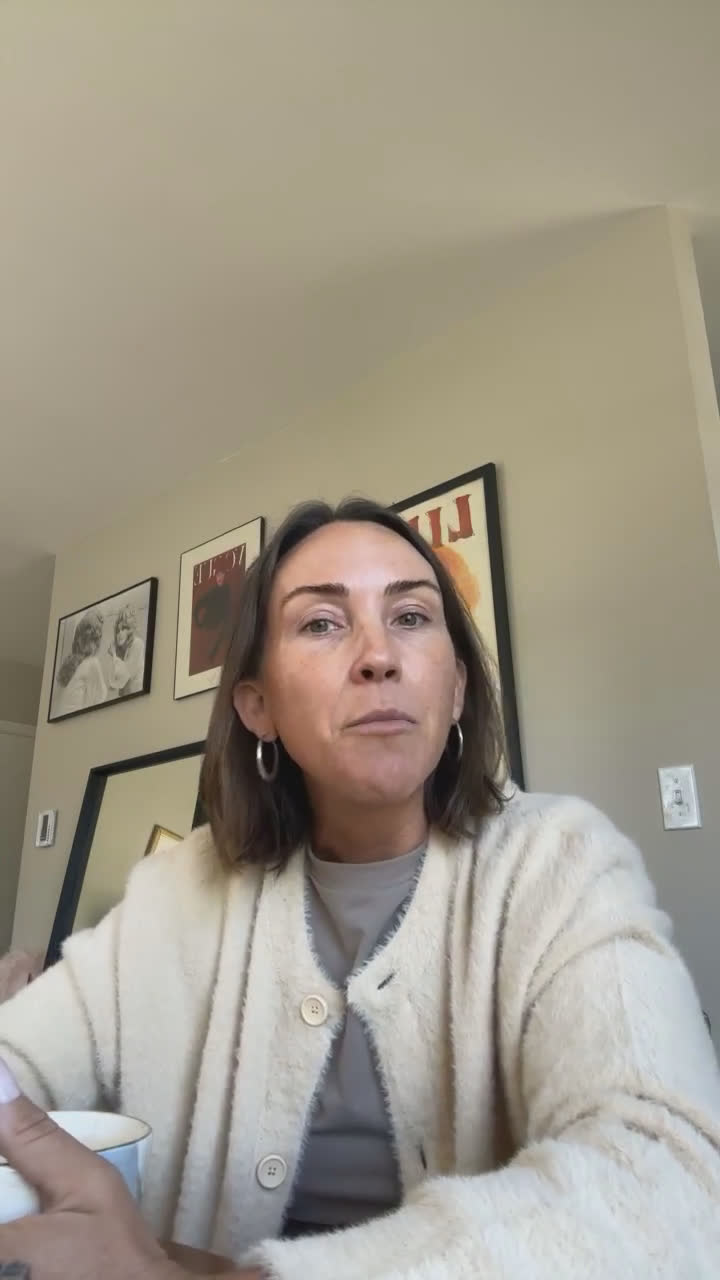
Rachel reflects on insights from a recent therapy session, discussing feelings of apathy, people-pleasing, struggles with eating disorder validation, and questions about parenting and therapy approaches while sharing personal updates and audience check-ins.
Hello. Happy Wednesday, Cadre crew. Hello, Juan, Shenita. Nice to see you. What was that? What is that? Milo? I'm gonna give you all a second.
In the comments, I would love to get a check in. Maybe one word to describe your feeling, your emotions in this moment, and maybe an emoji to go along with it. Stephen is going to Europe on Friday for two weeks. He is giving a talk at a crisis summit about suicide prevention and better crisis care.
Russell: Today in therapy, I was talking to my therapist about this concept of apathy and feeling a little bit like I've lost my career. A lot of my caring was really people pleasing and insecurity disguised as caring. How do I really deeply care without abandoning myself?
Rachele: I've always struggled with feeling that my reasons aren't enough to have caused an eating disorder. That was a really big hurdle for me to get treatment in the first place. What type of therapy would you like to work with your daughters?
Next week and the week after I will be in Europe. So my time zone is gonna be whole whack a doodle. Make sure to look out for my live because it will be at a different time. Be on the lookout for a different schedule for my lives.
Hello. Hello. Happy Wednesday, Cadre crew. What was that? What was that, Milo? I'm gonna give you all a second. Hello, Juan, Shenita. Nice to see you. I'm sitting, folks, a minute to peel in. It is the lunch hour here in the Pacific Northwest. I'd love to know where you all are, and maybe in the comments, just. Hi, Lynn. Hi, Steph. In the comments, I would love to get a check in. So maybe one word to describe your feeling, your emotions in this moment, and maybe an emoji to go along with it. Hey, Rach.
Hi, Stephen. My current emotion is excited, and the emoji I would put if I were commenting with that would be the little suitcase emoji. I'm going to Europe on Friday for two weeks. I am giving a talk at a crisis summit about suicide prevention and better crisis care in Amsterdam. So I'm really excited because I decided to go for a little bit longer so I could turn it into a trip, because I've never been to Amsterdam, and so I'm also gonna go to Berlin and Budapest. So I'm real excited and just also excited to go, to go to the summit and see what people are doing in terms of crisis care.
So that's me blabbering while I wait for y'all to do your check in. So, yeah, Rach, you get a nickname? Lynn says, productive and little sparklies. Ooh, love that. Steven. I have two young kids. School's out for the summer, so that's amazing. Mine is horror with the laughing emoji. I. Hey, that says it all right there, Stephen. That says it all. That is so funny. Rachel says, I finally watched that movie on YouTube. Oh, the documentary. That's awesome. Yeah. So for folks that don't know, I attended a documentary screening in Salt Lake for moving America's soul on suicide, which is free to watch on YouTube.
And I gave a little talk before the screening about my experiences with suicidal depression and crisis care. The documentary is phenomenal. It was really moving and really well done. And. And so the same organization is hosting a summit in Amsterdam alongside this whole kind of big, longer summit, I suppose. But they're doing, like, a specifically crisis one in this mental health summit, so that's why I'm going. But, yeah, if you have a chance to watch the documentary, it's quite long, and it is difficult at times to watch, so I recommend watching it in pieces.
But I do think it's a really valuable documentary. Okay. Rachel says, feeling blah, but creative, but that's an interesting combination. That's a nice little both. And there. Amazing. Laughter always helps. Agree. Agree. So today I'd like to share with you because I had therapy this morning. Normally I have therapy on Fridays, but I therapy today because I'm leaving on Friday. So I thought today in my life I would share some things that came up in therapy and some discoveries that I thought might be, might be helpful for at least one of you.
So thank you all for your check ins. If you're watching the replay, I still would love your check in in the comment. So today in therapy, I was talking to my therapist about a lot of different things, but one of them is a topic I've frequently spoken about here, both in my lives and in recorded videos, is this concept of apathy and feeling a little bit like I've lost my career. Like where has my care gone? Where has my passion gone? Where has my zest for not life? Because I have a zest for life, but where has my zest for a hobby gone or a curiosity or passion in my work?
And I was talking to her about sort of this feeling of guilt around not caring as much as I used to and also recognizing that I grew up as a massive people pleaser. And a lot of my caring was really people pleasing and insecurity disguised as caring. And so there was a lot of unlearning I had to do in therapy over the years, especially in my twenties, around, you know, parsing out what is people pleasing versus genuinely caring about someone and wanting to do something nice for them and, hey, Russell.
And. And sort of understanding the boundary between how do I make sure that I'm taking care of myself and have the energy to take care of others? And is it coming from a place of fear that if I don't take care of them or don't do things for them that are kind, that they're going to leave me or abandon me? So there was a lot of, I did a lot of work in therapy on that. And so today, what I was talking to my therapist about was this fear I have that I've. That the pendulum has swung too far. I have a fear now that I've swung so far into the not people pleasing that I'm doing the opposite, that I'm actually, in fact, p****** people off, that I am an actual.
That actually, in fact, I'm a horrible human being, which, of course, is a story I'm telling myself. Right. And it's not these huge extremes. And I'm noticing myself having a desire to enter back a little bit into this space of really deeply caring and asking myself, how do I really deeply care without abandoning myself, without letting go of my boundaries and taking care of my own needs, but also doing it from a place that feels really genuine and, like, a true desire to care? So, this is a conversation we were having, and one thing that came up that I found really interesting, which was a really good reframe, was she.
I was telling her. I asked her, if you let me know if you all have heard of core values and values exercises, because I was talking to her about. I said, I wish there was an exercise, like a core values exercise, where I could, you know, go through a list of interests and determine what my passions and my interests are like based on that. And she was like, what? Like, she was like, well, don't you have, you know, like, beliefs? Like, aren't there things you believe in? And I said, that's the other thing.
I was just thinking about this this morning on my walk with Milo. I fear that I have no beliefs. I fear that I have no convictions. And I'm okay with that. Like, I'm okay with being someone who is willing to see both sides of a story. I'm okay with being someone who is open to learning or having my mind being changed. I like that about myself. I like being flexible. But I said to her, you know, I worry that, like, you know, because I don't have any strong convictions or beliefs, like, I have nothing of interest.
I have nothing to talk about. I have nothing to speak on, because I have no opinion. And she said, well, isn't seeing things both ways an opinion? Isn't being flexible a conviction and a way of looking at the world? And I was like, oh, d***, ma'am. Like, you got me. Like, yes. Like, I. Because I do firmly believe in seeing things in the middle and seeing things as gray, as trying to understand both sides of a coin, to seeing the both and. And to recognizing the duality of life and that multiple things can coexist that might maybe seem in contradiction.
And so it was just a really, really great reframe for me to kind of get out of this. Like, oh, well, me not having a conviction or a singular belief or such a strong opinion means that I don't believe in anything. No, actually, I do believe in something. It's that I believe in duality, and I believe in contradiction, and I believe in flexibility, and I believe in the gray, and I believe in both. And. And that was just, like, such a great reframe that was so needed for me because I had been feeling really bad about myself.
Like, I've been really, like, beating myself up for not having strong beliefs or, like, not feeling like I care about things when in reality, like, I'm adding a story to something that doesn't need to be there. So I thought that might be helpful for somebody. If not, let me know. I'm gonna just try and catch up with comments here. So Lynn said, oh, I really needed this. Thank you. Okay, cool. Rache says, that is something I've always struggled with, though, feeling that my reasons aren't enough to have caused an eating disorder.
So I don't have a reason to be depressed. That is something that I have had to work on a lot in therapy, especially my first time in treatment, not thinking that I had a traumatized enough childhood or that not enough bad things happened to me or that there was no one singular event to, like, trigger my eating disorder, and therefore, I didn't deserve. Deserve help, or my eating disorder was somehow not even real because there was not a good enough reason for it. That was a really big hurdle for me to get treatment in the first place.
And it was a big hurdle for me to recover, because I didn't believe I had something to recover from. I didn't believe that I deserved to recover from something that was self inflicted, that I had done to myself because there wasn't an external, in my mind, an external reason. And it took a lot of therapy for me to understand that there's not necessarily always one singular event, nor is it rooted always specifically in childhood. A lot of it has to do with our. Just our culture and the systems that we exist in, whether it's our schooling or religious places, spaces we go into, or what we're exposed to in the media.
Like, there are a plethora of external inputs that create different ways that we experience ourselves in the world that are absolutely good enough reasons for us to struggle with being alive. So it's, you know, it's really, really complex and complicated, and it's not usually rooted in, like, one specific thing, although sometimes it is. Let's see. Lynn says, if I would like to work with someone, and my 18 and 20 year old, 21 year old daughters, too, about this pleasing and moving through to see how to reframe for self care priorities, what type of therapist or therapy does that?
Oh, great. Great question. Yeah. So if you're looking to work through things like people pleasing and how to have good self support, self care, and good boundaries, these are all. Those were all skills I learned when I was in a program that was based in DBT. So Rachel actually commented CBT or DBT in the comments. I think both would be good. I prefer DBT because it combines a lot of different therapy modalities. So you'll learn things from CBT, which stands for cognitive behavioral therapy. So it's all about kind of reframing your thoughts.
DBT stands for dialectical behavior therapy. So it's all about holding two truths at the same time. So you'll hear me use the word and a lot or both. And so it really honors this idea that two opposing ideas can exist at once. So it really helps us create a lot of flexibility in our thinking. But within DBT, you're also going to learn some of these cognitive behavioral therapy skills on how to reframe certain specific thoughts and beliefs. But I really liked DBT because it really helped me learn how to have good boundaries, how to recognize people pleasing, how to recognize when some of my behaviors were rooted in fears of abandonment or being rejected.
And so it really created a lot of self awareness as well as building skills and tools after getting that self awareness to make changes. So a therapist that is skilled in DBT I think would be really incredible. Embrace the and yes, I love that. Okay, my ooh, I love getting a little foam on the lip. I'm gonna shine off. So next week and the week after I will be in Europe. So my time zone is gonna be whole whack a doodle. So make sure to look out for my live because it will be at a different time.
I just don't know yet. Based on the time zone, what will make the most sense? I have a feeling what I will probably do is try and go live at some point during my late afternoon, which would be morning time for most people on this app in the north american areas. m. and it might be on a different day of the week depending on what days I'm traveling. So I will do my best to pre schedule that so that you're aware of it and to make a post in the community posting just so you kind of get more notifications.
So next two weeks, be on the lookout for a different schedule for my lives and then we'll come back to regularly scheduled programming. Okay, my loves, I hope you have a wonderful rest of your day and I will see you next week. Goodbye.
Reactions and comments are for members. Joining is free and takes a minute.