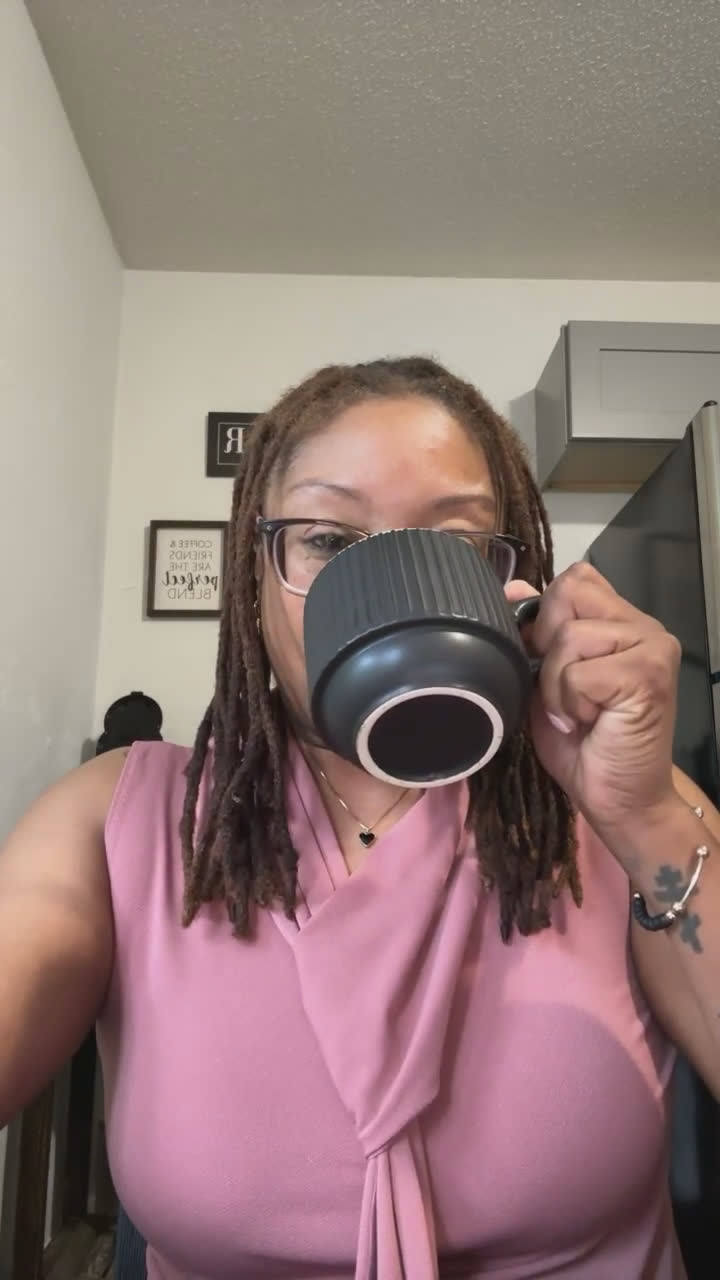
"It is raining where I am, which I enjoy, the rain. It's really relaxing, but it also makes me a little sleepy and unmotivated sometimes. So the coffee definitely helps. "
I will be part of an anthology called Voices of Women that is managed by Brenda Dempsey in the UK. There are 22 women in this book, and it's so amazing. It'll be available on Amazon on July 22.
Today I want to talk about how we need to use our voice when we're in a relationship. When we feel like maybe our boundaries are being crossed or when someone has hurt us. Consider your background. In someone else's family, that behavior might be completely acceptable or unacceptable.
The power of your voice is not necessarily about changing things. We need to speak up in moments where we're hurt so we can stop the cycle. Speaking up is an opportunity for you to change directions. It's a choice that your partner gets to make once things stop.
Hello, Cadre. What's going on? I got my coffee today, and I definitely need it. It is raining where I am, which I enjoy, the rain. So I love the sound of the rain. It's really relaxing, but it also makes me a little sleepy and unmotivated sometimes. So the coffee definitely helps. So I'm gonna take my sip and wait for y'all to come in. So today I want to talk about some things that can happen if there's some anxiety in your relationship. And it's hitting on this topic of, you know, the power of our voice.
And before I get into that, I do want to shout out a book that's coming out really soon. Welcome. I will be part of an anthology called Voices of Women that is managed by Brenda Dempsey in the UK, and that will be released on July 22. And there are 22 women in this book, and it's so amazing. I can't wait to see it myself because I want to see all the stories of these amazing women and their stories of leadership and resilience. So keep an eye out on that. It'll be available on Amazon, I think, barnes and noble so far, but I'll give you guys more updates once we get closer.
So, two weeks to go. July 22, voices of women. But today I want to talk about how we need to use our voice when we're in a relationship and when we feel like maybe our boundaries are being crossed or when someone has hurt us. And I want you to think about a time when that has actually happened, when your partner or family member or friend has hurt you and you didn't say anything. And maybe you even told yourself, well, they should just know. They should just know that what they did is hurtful. Isn't that common sense?
And so you might be walking around and thinking, well, I'm right. You might be thinking, I don't need to say anything because it's just common. For whatever they did, you're just not supposed to do. But I want you to consider your background. Right. There are things that we consider to be normal or common sense because that's what our family does or what our culture is known to do. But in someone else's family, that behavior might be completely acceptable or unacceptable. So, for example, I'm going to make this just off the cuff.
I'm going to make something up here. Maybe it is appropriate. And I like using time boundaries. In your family, after 09:00 you're not supposed to receive any phone calls from people that are outside your family. Right? There's a boundary in there. So if you're dating someone, if they call you after nine, then that is totally unacceptable. And if they do it, you get offended. But you might not say anything where the person that's calling you might come from a background and their family seems it's appropriate to call at any time.
Like, if you're on that person's mind, why can't they just reach out and give you a call? And so if they hurt you in certain ways, they crossed your boundary, but you didn't say anything. You might be walking around offended, and you might be feeling anxious in the relationship. Like, why don't they understand me? What's wrong with them? What am I not doing right? So they don't, um. Why aren't they respecting me? Right? And so we walk around and tell ourselves, well, I don't need to say anything, so let's get into the power of our voice.
All right, so why should we speak up for ourselves? And you might even say, well, if I say something, it's not going to change it anyway. So have you ever spoken up about something that hurt you in a relationship? And maybe you've said it more than once? Maybe this person has repeatedly hurt you in the same way? Even when you told them that what they did hurt you, maybe you've told them, you know what? I don't like when you do this. And a couple months go by and they do it again, and you tell them, hi, Jules.
You tell them again, I don't like when you do this. This really hurts me. I don't like when you do this. This really hurts me. And you just keep repeating that. And so you get to a point where you feel like, well, maybe I shouldn't say anything at all, because what's the point? It's not changing anything. And so I want to challenge your thinking about that. The power of your voice is not necessarily about changing things. We need to speak up in moments where we're hurt so we can stop the cycle. Speaking up interrupts the cycle.
So I want you to think about this. If there is a spinning top, you know, those. Those old toys, I don't even know if they make them anymore. But you spin the top, right? And just spins and spins and spins, and it goes all over the place and it feels out of control. You don't have control over where it stops, where it lands. It's kind of like that in a relationship that is toxic, where it's just spinning, right? And there's movement and there's energy behind it, and it's and then you are the person that feels out of control because the person hurting you is spinning and spinning and spinning.
You're like, whoa. I keep saying the same thing over and over, giving more energy to the situation, but it's never really stopping. And so you speaking up is where you put the stopping point. You interrupt the spinning, you stop it so you can change. You speaking up is an opportunity for you to change directions. It's a choice that you get to make. It's a choice that your partner gets to make once things stop. So speaking up isn't the change. Speaking up is the interruption. So keep that in mind.
And how does that show up for you? Right? And I can think of some times when someone that I was dating hurt me and I had to tell them, you know what? I'm. I'm tired of you doing this to me. And then that stopped the hurt, that interrupted the pattern, that interrupted the cycle that we were in, because the cycle that I was caught up in with this person, it would happen every couple of months, and it was like clockwork. Like I could feel it coming. And that happens, too, with the cycle of abuse. You can feel the tension building up.
And then something happens, and there's a honeymoon phase, and I'm sorry, I won't do it again. And then that keeps going around in circles. Right? That's the cycle I'm talking about. About. And it's not until I decided. So I had to make a decision for myself. I'm going to speak up this time, but this time I'm going to make a different choice. I'm not going to let that person hurt me anymore. And I had to decide to either leave that relationship, or I had to change and be different with that person in order for that cycle that we were in together to stop.
So me speaking up was an interruption. It wasn't the change. Is that making sense with y'all? Y'all drop a little coffee chat for me if that is making any sense to you. And this came up with a client that I was working with this week where she asked herself, well, I don't feel like I need to say anything to this person I'm dating, because they should just know better. Like, they know they're hurting me. Well, maybe they don't. And we have these boundaries that are crossed all the time that the other person has no idea that the boundary is there.
So speak up. Use your voice. You know, you can't sit there in silence and suffer in silence, expecting the person to change when they don't even know what they're doing, and they don't know that you're hurt. So I don't know if you guys have ever done this, but I know I have where I've been hurt, and I've kept it to myself, and the person had no idea that I was in pain because I was able to mask it. And sometimes we can mask our pain so well that we're just walking around like normal. We're going to work every day.
You know, we're still hanging out with our friends and family. We're doing our daily things, but we're still hiding pain. Like, maybe we're crying at night, or maybe when we have, like, a quick little moment in the car, a tear drops down our face, right? But then we wipe it off and just keep on moving because we don't want that person to see that we're hurt. You guys ever feel like that? You don't want the person to know that you're hurting? Why? What's gonna change? So speak up. Interrupt your pattern.
Interrupt that negative cycle that you feel like you're getting caught up in, and then make a choice to pivot, to change, to do something different. And I hope that helps with your relationships, whether it's friends, family, a romantic partner. But I do want to thank you guys for tuning in today. I don't think anybody else has lined up today. I was looking at the lineup, and I noticed mine wasn't even scheduled. So if you guys got a late notification, I apologize for that. I did not look at the schedule soon enough to get this scheduled earlier in the day or even earlier in the week, so I will do better about that.
But if you guys want to comment, if you're watching the replay, please drop a note and let me know if this is resonating with you. But, yeah, that's your challenge for the week, is interrupt the cycle by speaking up. All right, you guys have a wonderful day, and don't forget your coffee.
Reactions and comments are for members. Joining is free and takes a minute.