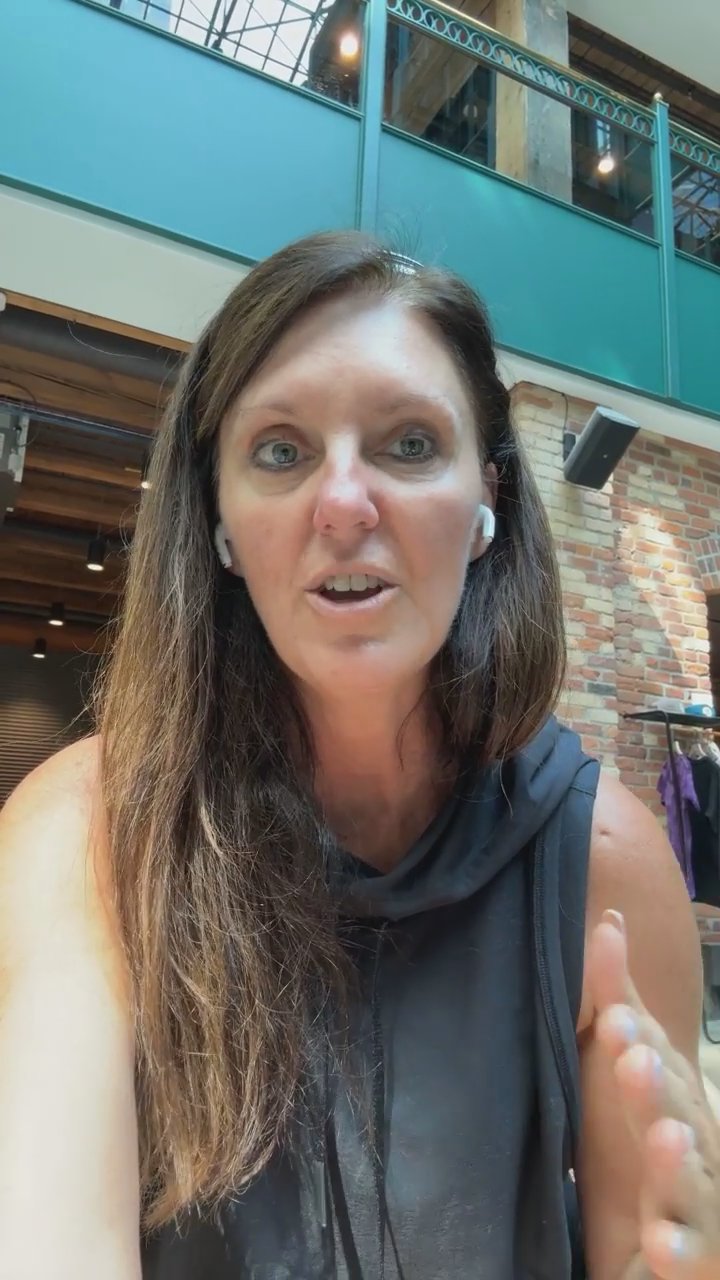
Jean leads a short guided breathing pause and invites reflection on how back-to-back or remote meetings affect the body, offering prompts for starting meetings more mindfully.
Jean: Unofficially, it seems that oftentimes when I come into this fragment coffee shop where my coworker major joins me on our daily walk, it's not uncommon for me to see someone from Cadre here. Happy Monday with my trusted advisor major.
Jean: How might we when we kick off a meeting with our teams? If you're working remote, you're on all the time. What impact do you think that has on your body? Feel free to type any comments in the chat if you're listening on replay.
Jean: What was the worst meeting that you ever attended? And for the person I, Jean I, who doesn't really need a lot of structure for things in meetings. So happy Monday, everybody. I'll be back on Mondays for leading with authenticity.
Hello everybody, this is Jean. I'm calling in from the Cadre meeting place. Unofficially, it seems that oftentimes when I come into this fragment coffee shop where my coworker major joins me on our walk, it's not uncommon for me to see someone from Cadre here. Just the other day I got to see Luke and it was really such a treat to see him in person, live, having a conversation. Hello, everyone. Welcome, welcome. Happy Monday. I have my trusted advisor here with me today and I like to call this, as I mentioned as I started quickly, this is the unofficial Cadre meeting joint.
It never fails that maybe once every few weeks I'll walk in. Happy Monday with my trusted advisor major. He walks straight up to the counter that's just right over here. And he sits down and he orders one dog biscuit and I order one matcha and I'm pretty certain everybody's more excited to see him than they are me, and I'm okay with that. But last week I got the pleasure of seeing Luke here in person as we randomly went on our daily walk and stopped on in. And it was just so exciting to see him in person and to be together in person.
So I'm going to ask you guys a question today, on this Monday, if you haven't been with me before, my name is Jean. I am an executive coach. I'm a consultant for change leadership and communications. I take organizations through big transformations. I co own an indoor cycling studio and we're planning our eight year anniversary for this weekend. And I do a lot of sound baths and meditation. So I do a lot of things. But what I'm going to ask you or invite you to do right now, now is to take a pause, breathe with me.
Big inhale, big exhale, and maybe do that one more time. Then I'm simply going to invite you to see how that felt in your body. If you want to type in the chat, you're welcome to if you're not driving your hands on the wheel. But when you just take a hot second coming into a meeting or a conversation and you take a couple of slow, long, deep breaths, how does your body feel? For me, the first breath, I feel a little anxious. Why am I doing this? Do I have time for this? The second breath, I actually can start to feel it in my body and I can feel my body start to relax.
And usually I like to do things in threes. And by the third one, I feel my heart rate start to drop back down and I'm a little bit less amped up for flipping from one meeting into the next. So when you find yourself on Mondays, Tuesdays, any day of the week, flipping between meeting after meeting after meeting, what impact do you think that has on your body? Now, I ask this in our leading with authenticity conversation because I challenge all of my leaders the same way. I'll create an invitation for you.
How might we when we kick off a meeting with our teams? Because so many people are virtual and so many offices are kind of coming back. But if you work more remote or you've been designated as a remote worker, that's a lot of screen time and that's a lot of lack of consideration in your meeting invitations. And I say that very specifically because the expectation is when we're working remote, and this has been a trend since COVID and before. If you're working remote, you're on all the time. And if you're jumping from meeting to meeting to meeting back to back, why can't you be on time?
My invitation is often how might we schedule a meeting that starts five minutes after the hour and ends five minutes before the end of the hour? Assuming you're doing a 1 hour meeting, what if we gave everyone five minutes to stand up, stretch their bodies, grab a glass of water, use the restroom, grab a quick snack, and gave everybody that chance to breathe before they come in and that chance to breathe at the end? If you had a schedule like that and you were scheduling meetings for people, how do you think that might be received?
Feel free to type any comments in the chat if you're listening on replay. I always go back and listen again to see what you guys have commented on. But I have found in the last six months, I've been very actively doing that with meetings that I schedule, coaching sessions that I'm doing with my teams, and conversations I've been having with the team that I lead at co lead, and my consultants, my consulting clients. And the conversations are interesting because some people really like to use those first five minutes to just catch up and see how everybody's doing that day.
Some people like to use those first five minutes as a way to just dive right in and they feel like if they don't dive right in right away, they feel a little lost. How do you feel, manger? Do you like to dive right in? He says yes. Actually, he says no. He's the one that helps me to pause and breathe a lot. Do you have fur babies? You might find that they do the same for you. They have their own agendas. They can sense when we're anxious and when we're not anxious. But when we do that, when we allow people the natural chance, we give people permission, we give ourselves permission to take those five minutes to just do whatever we need so that we can prep for whatever comes next.
It helps our brain to reset. It can allow us to get off of a call that might have been a little bit more intense into the next call that we might need to lead. So it's really about creating that whole opportunity, that whole experience. And if you are the one who is setting the meeting or you're driving that conversation, how might you build that into your agenda? Or even the other question is, when you're sending out a meeting notice, are you sending an agenda? So I would offer the invitation for us to consider what our best meeting ever was, the best meeting we ever led, and the best meeting we ever attended.
I don't ever think about meetings that way. I know I don't typically, but if I think about what sets me up for success when I go into a conversation, it's knowing what my responsibility or my role is. As I mentioned, I'm a consultant, so there's a lot of meetings I just need to sit and listen in on. And I'm listening for behaviors. I'm listening for questions. I'm listening to see where there might be gaps where people don't understand so we can help fill in the gaps. Or I type the person leading the message to say, hey, maybe you should ask this question, because we have a gap.
So I spend a lot of time really listening, but I know that that's what my role is. But I was on a call this morning with a colleague of mine, and I'm coaching her, so she invites me to come to meetings with her. So then afterwards, we can debrief to see how she's doing and offer techniques and ways she could engage differently. But again, I know my role, and it was interesting, and she also wants me to, if I hear something that was missed, to come off mute and then ask those questions, because she learns from me when we interact this way, that's the agreement that her and I have always had, and it works great for both of us.
But on this call, one of the individuals was like, why are we here? And then asked a few questions, and then we explained a little bit more, and they said, wow, that would have been great to know before. Cause I would have done x, Y, and z, and it got me thinking. We missed that one. When we sent out the meeting invitation, we missed. We didn't set the expectations, but when I went back to the meeting invitation. I looked, and we actually did. We put all of the information right there in the email body for this person to have.
But what often happens is when we get a meeting invitation, somebody will click it. They'll say accept or reject based on their calendar or maybe based on the title of the invitation. And then when they get to the call, they may not have ever read the body. So in these instances, right where we're taking that little extra time, how might we set people up for even more success? How might we send an email in advance that says, hey, as a reminder, we're meeting today? Here are the couple of things that we're going to go through, or send it a week in advance or a few days in advance so that people understand and know.
Now, that might take more time for us, but it also might help us set other people up for success and build that collaboration. So today, I kind of diverted in and jumped right in. We took some breaths and we talked about how we can come together and be more effective when we're meeting together, not only to get our needs met, but also to help meet the needs of the people that we're having conversations with. So when we are leading with authenticity, we are asking for what we need to. How often do we do that?
How often do we raise our hand and say, I need to know the agenda before I go to that meeting, or I need to know my role so I can have those bumpers set up? Or if you're working remotely, how might we ask our teams, our managers, to help have more consideration for the fact that we are remote and maybe we need a little more time for human connection, or maybe we need more time to take a pause in between each and all of the meetings. And what are those ground rules? All of these things are super important to help us continue to stay mentally and emotionally healthy in our work day, for us to feel as if we are contributing at our best.
So when I think about, again, what is the best meeting I've ever been to, for me, I got to hear from my team what was bringing them joy or even what was draining them, because it's important to have a space to be able to share both because not every day is perfect. And at the end of the meeting, there was a clear understanding of what was needed from me or anybody else on the call so that we continue to move whatever work it was that we were doing forward. And sometimes I like to get a recap, but I don't always need to have that.
But some people do. So for me, those are the perfect meetings. Clear, understanding. Everybody gets to have a chance to speak. I can do a check in to see how everybody's Athenae where everybody is so it feels human again, high relationship orientation for me, that's important. And then we get into the tasks so that we make sure that everybody, that's high task orientation, they get what they need to. I can also ask the conversation on the flip side, what was the worst meeting that you ever attended?
And for the person I, Jean I, who doesn't really need a lot of structure for things in meetings. I like structure. I like when somebody else creates structure, but I like structure because it helps everybody stay aligned with what it is that we're trying to do. So sometimes we can go to the opposite spectrum and we can say, okay, what is that worst meeting for you? And we can list out why it was horrible. Maybe it was no conflict resolution. Maybe everybody just came in a bad mood that day. Whatever that was, it makes that real for you.
So that as we move forward to continue to build those connections, continue to lead our teams, whether or not we're a manager, leading doesn't equal manager, leading doesn't equal hierarchy. Some days we're the ones setting up the meeting, and that just means that we are the ones who are hyper conscious of what the experience of that meeting needs to look like to have the greatest outcome and for everybody to feel like they're coming together. Even if the purpose of the meeting is to solve conflict, we can still facilitate through that in a way that helps everybody feel up to them.
So happy Monday, everybody. I know there's another talk at two, so if you have a few minutes, you have 15 minutes between now and two to stretch your legs. And if you have time to pop in and listen to the next conversation, that would be amazing. I'll be here on Sunday for a little me time. I'll be back on Mondays for leading with authenticity. And today's little chat was really around how we can show up and hold space when we have to go to different meetings, and a lot of meetings back to back.
So thank you for hanging out with major and I today, and we'll talk to you soon.
Reactions and comments are for members. Joining is free and takes a minute.