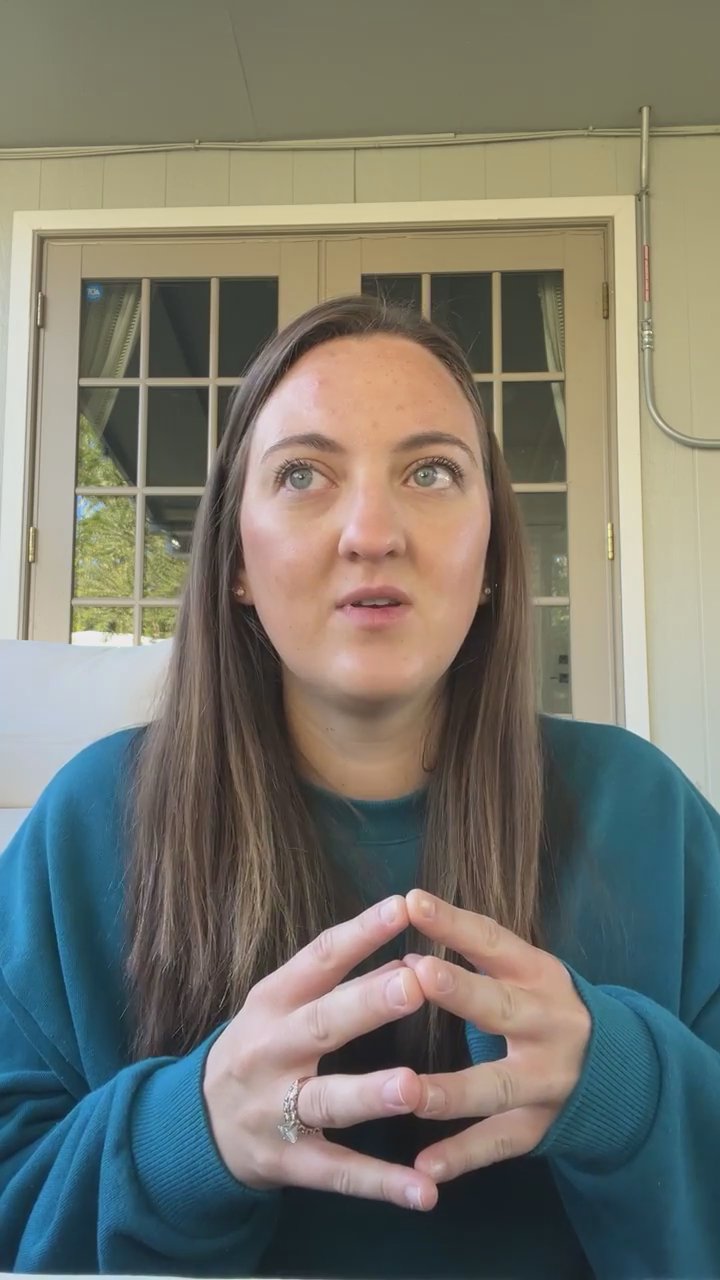
The speaker explores normal versus normalized eating, defining normal eating as responding to hunger, sometimes eating preemptively, choosing foods for need and enjoyment, and eating with mindfulness; she discusses emotional eating and missing hunger cues.
Good morning. Happy Saturday, friends. I hope you guys are enjoying a cup with me or whatever you drink in the mornings. I love interacting with you guys. Hopefully some people pop on.
It is a beautiful day here in Colorado. We are finally hitting fall ish weather. Jules, what are you up to this weekend? We're about to hike after I log off here.
A lot of things that may not be health promoting are normalized. What does normal eating look like? Permission to eat in response to an emotion. It's trusting your body.
Jules: What do you do when you don't have hunger cues? She asks: Is this normal or normalized for that person? Is it coming from a place of flexibility and adaptation or one of the hallmark features of normalized, maybe disordered eating?
What is normalized in our culture that maybe isn't as health promoting? When we're ignoring our hunger, that can often lead to overeating or binging. Normal eating is eating in a way that is intentional and mindful. Next week, I don't know what we'll talk about.
Good morning. Happy Saturday, friends. I have my coffee with me. I hope you guys are enjoying a cup with me or whatever you drink in the mornings. Hopefully some people pop on. I love interacting with you guys. It is a beautiful day here in Colorado. We are finally hitting fall ish weather. Not quite fall. It still got up to, I think, 90 yesterday, but that's better than it has been. So today, I wanted to. Good morning, Jules. Happy to have you here. Jules, what are you up to this weekend? We're about to hike after I log off here.
That's our plan. Okay, so what I wanted to talk about today is this idea of normal versus normalized when it comes to eating. And for me, this is something that I work with pretty frequently. I work with eating disorders, disordered eating primarily. And often when I'm challenging what shows up as an eating disorder behavior for that person, I will hear a client say, well, I've always done this, or, well, my whole family does this. This is just how we eat. Daughter has a tournament. Ooh, what kind of tournament?
What sports are fall? Soccer? Tennis. I feel like I should know the answer to that. Let me know what kind of tournament? But what was I saying? Oh, yeah. Oftentimes people will say, well, I've always done it this way, or, this is just how we do it, and kind of aim to dismiss what could be something concerning. And that always brings up this conversation of normal versus normalized eating. And in the world that we live in, with diet, culture, with social media, with all the things, a lot of things that may not be health promoting are normalized.
And so I just want to talk about that a little bit. Volleyball. That makes sense. I don't know why I was thinking. I don't know. I danced, and that was all the time, so I wasn't. I never knew what sports or what season, except lacrosse. I know that's the spring. Cause I almost did that. Although boys lacrosse might be in the fall. I don't remember. Anyway, I hope the tournament goes well. I hope your daughter wins. Cause that's always fun. So what does normal eating look like? Normal eating is eating when you're hungry, stopping when you're full, sometimes eating preemptively when you're not hungry because you know you won't be able to when you are.
Sometimes it's eating past fullness because you're enjoying it. Normal eating is choosing foods based on what you know your body needs, but also choosing foods that you truly enjoy. And not just choosing foods because you think you should. Normal eating is giving yourself. Permission to eat in response to an emotion. Happy, sad. We all go out to eat. Not all, but a lot of people go out to eat to celebrate a job promotion or a birthday. And those are positive emotions. In the same way that maybe people eat ice cream when they're sad, right?
That age old trope wallowing flashback to Gilmore girls there, the wallow. It's eating in response to those emotions with mindfulness and intention rather than compulsion. It's leaving food on the plate because you're full, knowing you can have more later or choosing to eat it all now because it tastes good. Normal eating involves food taking up some of your time and attention, but not taking over your life. It's trusting your body, and it varies in response to your hunger, your schedule, your food available, your emotions, and even your phase of life.
Jules, what do you do when you don't have hunger cues? That is a really common thing, and I think for every person, it's a little bit different of how we've kind of gotten to that point. You know, in general. That's kind of where this is common in people who have ADHD and also people who have, you know, for whatever reason, hunger hormones registering in the brain doesn't happen. For those people, I generally say, and ideally, I'd be working with you one on one, so I don't know enough information, but, you know, let's create a schedule of eating that works for you, right?
Based on what your body needs, based on, you know, your activity for the day, and really kind of setting your body up for success. Because I also think hunger cues, and I, this is something I, you know, I was working with you, I would ask you, when you say you don't have hunger cues, is it you don't have the stomach cook, growling hunger cue, or do you have no hunger cues? Because other forms of hunger cues involve irritability, inability to focus, headaches, even just thinking about food, more fatigue.
Right. We don't have energy. We start to fatigue. What else? I mean, dizziness, lightheadedness, those are like the extremes, but that's something I would look at. And normal eating, I think, you know, for someone who has ADHD, I'll use that as an example because I'm working with someone right now where that's the case. m. in the evening. And that brings up my next point, is the one of the main differences or kind of the key aspects that I look at when I'm helping someone differentiate, is this normal or normalized for that them?
Is. Is it coming from a place of flexibility and adaptation and with the intention of providing your body with nourishment or one of the kind of hallmark features of normalized, maybe disordered eating that is there but isn't super health promoting? Is intention behind that is often very rigid and restrictive, and it comes from a place of fear and guilt. So for someone who has ADHD and has to set alarms to eat, to remember to eat, even though they don't have the hunger cues, but coming from that logical side of, I know my body needs nutrition to function, that is coming from a very intentional place of supporting their body throughout the day and giving their body what it needs for them to get through their day, do their job, play with their kids, be present, you know, all of those things that are demanding of us every day for someone else, setting alarms and only eating when alarms go off, that could be disordered.
If the intention is, I can't have that food until this time, or I can only eat in this timeframe. Right. That's that rigidity piece. So I think that's where kind of the nuances and criticisms of using normal versus normalized can come in. Gastric bypass several years ago. Yeah, I think that's another really great example, because part of that is, I guess, depending on which type, but you're shrinking the stomach, so your hunger cues will be altered in the sense of who won the first game. Tell her congrats.
Just like, physiologically, that stunts a little bit when we're removing a piece of the stomach. So you don't have quite as much of that feedback, and oftentimes it is kind of that mechanical eating. What you're saying is I have to see what time of day it is and know when to eat. And I think that for you, right, if the intention isn't like, oh, I'm intentionally not eating, that's a very different case, right. Oh, I'm looking at the clock. I know that logically, maybe I'm not feeling it, but I know my body needs nutrition despite what size my stomach is, because it doesn't mean you don't need energy.
So I think in all of those, right, everyone is so individual. There's so many unique cases, and that is something that you just kind of have to consider, and it might change if it's been there for a couple of years, it might not. And continuing to be mindful of, you know, maybe I find days where I'm not eating as much because I don't look at the clock. I move on with my day. I'm really moving really fast. I don't think about it intentionality around, you know, what nutrients can I include? Because I know that my overall intake has been lower.
That is still normal, right? Because the intention is how can I nourish myself versus how can I continue to eat as the least that I can. Hopefully that helped. I rambled a little bit. It is really hard. Like I said, I don't know you personally, although I feel like I do, but there's so many factors that go into it and finding a way of the goal is finding your normal, and that is eating in a way that's going to support your body, your life. So hopefully that helped a little bit. So what is normalized in our culture that maybe isn't as health promoting?
One of the things that, and these are things that I see frequently in my practice. So I've had clients come in, we've talked about this. I've also seen these on social media. Skipping meals and saving up calories so that you can go out to dinner or, you know, maybe it's a holiday. I think that that is very normalized. And I. It very intentionally goes against for a lot of people, I'll use those hunger cues. Jules, I know maybe not something you experience, but when we're ignoring our hunger, and I've talked about this in the past too, that can often lead to then overeating or binging.
Another one is exercising to make up for food that you've eaten. Kind of playing this like, I mean, in the eating disorder world, that would, depending on the severity, kind of classify as a type of purging. So exercising to purge your body of the calories that you've eaten. And because if that is coming from a place of punishment, we don't ever want exercise to be punishment. I think I already covered this one, but only eating at certain times. For some people, that could be normal. For other people, it's very rigid and it's very much a control piece.
Drinking fluids to suppress your appetite. Again, kind of pushing off eating with the intention of eating the least amount that you can. Unnecessarily cutting out entire food groups. Again, for some people, if you have food allergies, your celiac, that's one thing. Again, that comes from a place of intentionality and adaptability of supporting your body versus fear and rigidity and guilt, and then anxiety and stress around maybe eating out or going to a friend's house or a holiday party and not knowing the ingredients of the food that's there.
Again, for some people, if you have allergies, that could be terrifying. In lieu of that, you know, you should be able to. Going back to that word, flexibility and adaptability. Part of normal eating is being able to flux and flow and have resiliency, both emotionally, mentally, and physically, so that that one event doesn't rock your world, doesn't shake all of the progress down to its foundation. So those are things that I see that I think are very normalized and are not necessarily normal. And I think one struggle that a lot of people can get wrapped up in is comparisons, and especially because we never know anyone's full story or what they're.
What they're currently going through. So I like to add kind of to the. To the top of this, that normal eating is eating in a way that is intentional and mindful and supports your overall health, which is kind of where the name behind my live stream came from. Nourish with intent. We're nourishing our body with intention rather than listening to the noise, rather than compulsion, rather than restriction. It is very intentional. And everybody's intention will come from a different motivating factor, and that's okay.
And how their nourishment shows up with that intent is going to look different for everyone, and that is okay. So that's what I have for you today. Um, next week, I don't know what we'll talk about. I usually decide, like, the day before, based on kind of what I've seen throughout the week. So if you have any topics that you want to request, let me know. Jules, I feel like you always have good questions, so, um, yeah, it was good to see you. Thanks for popping on, Jules. I hope the rest of the volleyball tournament goes well and they win and no one gets hurt and everyone has fun, all the things otherwise.
I will see you guys next week on the 21st, at the same time, probably same place, have a.
Reactions and comments are for members. Joining is free and takes a minute.