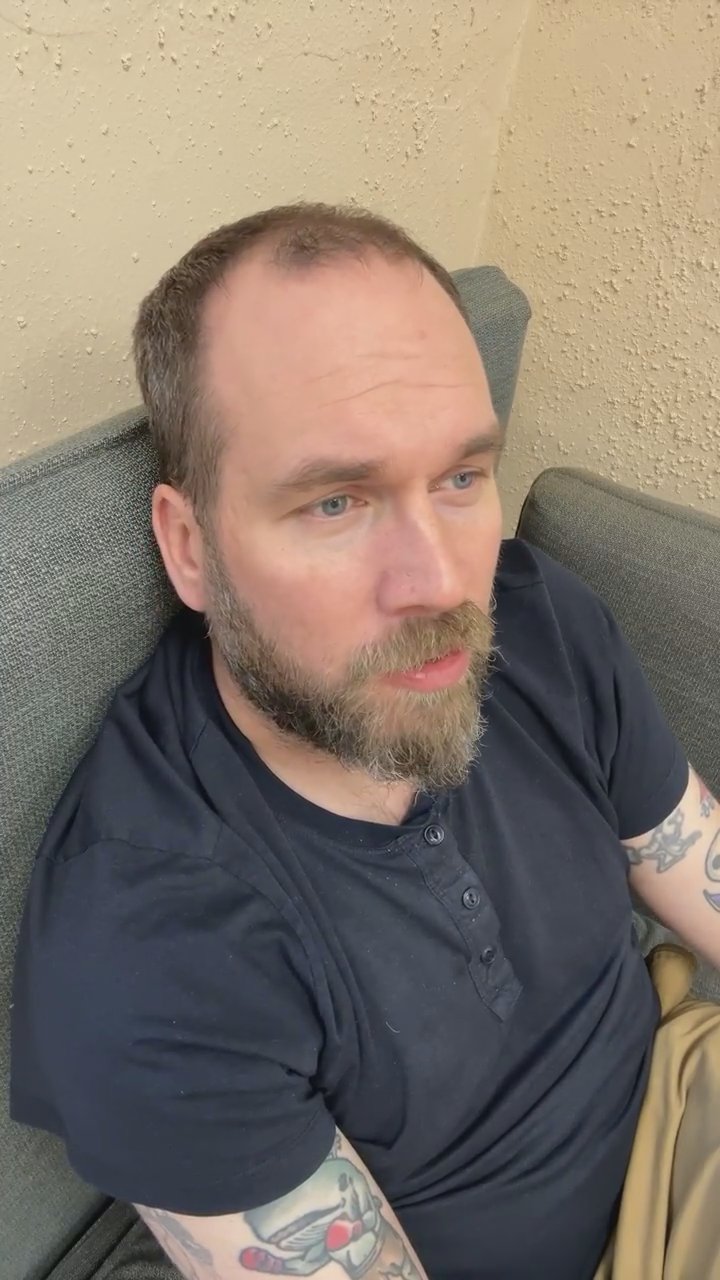
Pastor Seth Perry reflects on balancing ministry, addiction recovery and bipolar disorder while urging listeners to give themselves permission to slow down, rest and ask for time to recuperate when facing illness or burnout.
Pastor Seth Perry is a pastor who is also in recovery from addiction. He also has bipolar disorder type 1. Perry brings all of these things into his weekly livestream, Talk Stigma.
A lot of people push themselves too hard. Then you end up getting more sick. I'm really proud of myself this week for putting the brakes on things. And maybe it's not a cold. Maybe it's some other thing that you're facing in your life that we can talk about.
I decided that I needed some time to take a nap, to take fluids, to chill out, to stay at home, and to recuperate from a cold. And I'm really happy that it worked that come Sunday, when it came time for me to preach. Have you ever felt like you needed to ask for time to recover?
Are there places in the corporate world where people push themselves for profits at the cost of their own health? In the home, it's important in the home to offer people respite, relaxation and rest time to recover. It'd be really good in the Corporate world if we had more people offering solutions to people's weary bodies.
Have you ever felt like you needed to ask for time to recover in a spiritual space? There is always the possibility for burnout for the very reason that I just mentioned. And it really actually is transferable to all institutions where spirituality is practiced.
Seth: Have you ever felt like you needed to ask for time to recover in a spiritual space? Jules: I could have burned myself out this week preparing for confirmation. Seth: But I took as much rest this week as I could so that the confirmation service could have gone very smoothly.
Have you ever felt like you needed to ask for time to recover? I've really enjoyed my time being sick. Just simply asking for a little bit of space to recover is what a lot of us advocate to do in our own lives here.
Hello, everyone, and welcome to Talk Stigma. My name is Pastor Seth Perry. I am a pastor. I'm also in recovery from addiction. I'm in active addiction recovery. I call myself an addict in recovery or say I'm an alcoholic, do all sorts of stuff like that. I'm also, you know, I have bipolar disorder. I have bipolar type 1. And so I also, you know, let people know that for the last 14 and a half years, I've stayed out of the psych ward. I've managed my mental health condition successfully for that amount of time.
And that's how I see the world. Um, you know, that's. That's. That informs the work that I do as a pastor. So again, I'm a recovering addict, I'm in mental health recovery, and I'm a pastor. And all those things I bring into the weekly livestream that I do here at Cadre, and I'm grateful to be here on the Cadre sphere with you all. So I have a story, you may be able to hear it in my voice that I'm a little bit ill today and I've been battling a cold. Started with aches, started with a sore throat.
I was coughing a little bit and certainly felt it coming on. And now it's kind of in my nose. As you can sort of hear, I'm a little bit nasally. So what I said was, hey, you know, maybe I need to put the brakes on a few things this week. Maybe I need to slow things down just a little bit. Maybe I need to take a nap. Maybe I need to take more fluids, take a half day of work. Maybe I need to just let people know that I'm battling something and I don't want to get more sick. And that's something that I see a lot of people push themselves too hard.
Then you end up getting more sick. You get, you know, a more aggravated deep chest cough, or your throat gets so sore that you lose your voice, all sorts of stuff like that. Because sometimes some places in this world, they tell us to push ourselves through stuff like that, like a common cold. Push yourself through the cold and push yourself through getting sick. And I have done that before, and it's not ended up really benefiting me in any way professionally, hasn't benefited my time. Well, and I'm really proud of myself this week for putting the brakes on things.
And that's really what I want to be talking about today, putting the brakes on things for our own recovery. And maybe it's not a cold. Maybe it's some other thing that you're facing in your life that we can talk about. So I want you to consider this. So here's the big question for today. Have you ever felt like you needed to ask for time to recover? And that's what I did this week. I decided that I needed some time to take a nap, to take fluids, to chill out, to stay at home, and to recuperate from a cold.
And I'm really happy that it worked that come Sunday, when it came time for me to preach that I hadn't lost my voice, I still just had a little bit of a cough. It would have been a lot worse this week. And it was a Sunday that I could not miss. It was confirmation Sunday. We confirmed 11 kids and we had over 200 people at our 9:30 service. So it was a big Sunday. And I have really pushed myself before big Sundays and been worse for wear because I pushed myself. So I didn't let the pressure of my job get me to a point where I sacrificed my own health.
And that's what I want to talk about. So let's talk about that in the corporate world. Are there still places in the corporate world where people push themselves for profits, for performance, and for all the other metrics out there in the corporate world at the cost of their own health? And I would say yes. Yes, we hear people talk about these sorts of things here on the Cadre sphere because the whole point of this platform is for us to be sharing and helping each other in a way that can allow us an outlet to talk about how we can be embracing wellness at work.
And I'm going to cough right now. I still have a little bit of the cold going, but I'm glad that it's never gotten too, too bad. So. And another thing about the corporate world, are other people setting unhealthy expectations of us? Do we feel like we're getting the squeeze from our management? Has anyone felt that who's watched this? Let me know if you have because that certainly still exists. Right. But to flip that a little bit, are there avenues in the corporate world that allow us to be empowered to say, hey, you know what?
I do need time to recover. Please would you allow me this in my life so that I can get well? And I think there are some places where I see that more and more and more people tell me about HR being able to provide them special considerations even with just the most minor illnesses. Right. And that's the kind of world that I envision for people out there where we can, you know, talk to people that are, you know, really integral in running our day to day lives at work. And just say, I need time for myself, I need time for my own rest and wellbeing and myself.
You know, I manage staff here and that's something if anyone needs time away, if someone needs time to rest up, to grieve anything, you know, I'm very quick to say absolutely, anytime you need time for yourself here at this church, all the employees, if they need that, I will advocate for them to do that. I'll also offer it to them. It'd be really good in the corporate world if we had more people offering solutions to people's weary bodies. Right? So if anyone that's in management or sees someone in need of some respite, some rest, anything like that, it's okay to offer that need for recovery.
But let's flip it to the family system a little bit for a moment and just think about does that exist in our homes? And that's something I wanted to bring up. So in home, at, at home, there's a lot of different things that people, you know, need to do that is labor. There's all the stuff that makes a home run. So it's important in the home to just offer people respite, relaxation and rest time to recover. Because the tasks at home can wear down the body. If you're not listening to your body, if you're saying, oh, I'm getting sick, but I have a list of five things to do.
I want my home to be a place where people are able to just sort of be like, hey, look, this is what's going on with me. And what was really interesting with my wife and I, before I got sick, she got sick. So she came to me and said, hey, look, I'm not feeling well, so we are not going to be doing this, this and this. And I would also say, hey, are you sure that you want to do this? Like, we had this planned, can we cancel that? And maybe, maybe we can just chill out and just relax. And yeah, there was a lot of times where I'd be like, okay, well we were supposed to go out to a restaurant, but you can't taste food.
So she's saying, yeah, we're not going out to the restaurant, we're not even ordering in. It's not worth it. And so that's something to think about, how there's labor in the home. We can run ourselves down in the home. And it's something that we should be thinking about. So have you ever felt like you needed to ask Time for recovery at home and finally, in my world, in the spiritual practice space. And there's all sorts of sacred places that people from all walks of life embrace, nourish them. And those places are sacred spots that we all go to.
They could be a mosque, they could be a yoga studio, they could be a church, it could be a synagogue, it could be a temple. All sorts of stuff out there, all these religious institutions or related enterprises that are places for people to embrace their spiritual practice. But a lot of those places come along with a fair amount of labor, a fair amount of work. So have you ever felt like you needed to ask for time to recover in a spiritual space? And that's an important question that I want to bring up, because in my line of work as a pastor and for all the volunteers that work in a church organization, there often was an attitude that this work was so important.
Spiritual work, religious work. It was so important that you should never take a break because you're doing it in service of whatever higher power that you saw out in your world that you envisioned, right? If it was a Christian God, Muslim God, Jewish God, non denominational God, whatever, that that was so important that you should never take a break, right? And, you know, I grew up in the 80s. I saw a lot of volunteers get burnt out. I saw a lot of pastors get burnt out. And it really actually is transferable to all institutions where spirituality is practiced.
There is always the possibility for burnout for the very reason that I just mentioned. The work is so important that you need to sacrifice, right? So have you ever felt like you needed to ask for time to recover in a spiritual space? And Jules, welcome. I'm glad you're here. I'm just talking about how I was sick this week and how I gave time for myself. And I'm asking the question, have you ever felt like you needed to ask for time to recover and, you know, to just quickly review? Sometimes people need to do that at their job.
Sometimes people need to do that in their home, and sometimes people need to do that where they are spiritually nourished. So, Jules, I'd love to hear if there's any place in your life that you've had to ask for time to recover either, you know, could be mentally, emotionally, physically. Because I am very proud of myself this week, and. Oh, my gosh, you just finished your goddaughter's confirmation. Jules, my goodness, I just confirmed 11 kids here at my church, so there was 200 people at our church.
I'm really glad that we're both on the confirmation train. And honestly, I could have burned myself out this week preparing for confirmation. Instead, I just had faith in my own abilities to just be like, okay, Seth, I get it. You're getting sick. You've got this, you have it planned, and so go ahead and just rest up and the rest of it is going to sort itself out. I got as prepared as I needed to be, but it took as much rest this week as I could so that the confirmation service could have gone as best as it could.
And it really did. It went very smoothly. So again, very proud of myself and Jules, why don't you answer the question? Have you ever felt like you needed to ask for time to recover? Because what has happened this week is I've really enjoyed my time being sick. That's the last point that I really wanted to make. It's kind of. It's kind of bizarre. I've had family in from out of town. My mother in law is visiting, and I love it when she visits. And I've explained to them. And the best part of this whole thing is that I was like, okay, look, I'm getting sick.
I have a job where I speak. It's like four days away. I don't want to lose my voice. I don't want to be completely run down on Sunday morning. And my wife and my mother in law were like, we get it, right? That's another really important part to this whole thing is that I had support from my own family where they just said, look, Seth, we get it. We get that you're tired, you're sick. We hear how sick you are. And, you know, when I took my half day on Tuesday, I had aches and pains and everything.
They were like, what do you need to take? What can we give you? You know, do, do you need Advil? Do you need Tylenol? Do you need tea with honey in it? Do you need lemon? Do you need to gargle with salt water? It was just like, they weren't taking care of me, but they were offering me ways that I could really recover, honestly. So Jules says in the past, I've taken the day off during the school week so I could have the house to myself. And I even told my hubby not to come home for lunch. Wow. Okay.
You know, and I think that you're. You're thinking along the same lines as me, and that's great because just simply asking for a little bit of space to recover is kind of what a lot of us advocate to do in our own lives here. In the Cadre sphere. And I'm always encouraged when other contributors here and on Cadre talk about how they take care of themselves very openly and also just pretty much like, this is part of life. And I say this because it's so important to me, because I know people that don't take the time to recover.
I see the other side of this, being a pastor, being someone with addiction and mental health. In my family, you know, I see people who are not willing to just say, I need time to recover or I'm willing to take time to recover for myself. Because to be honest, the opposite of seeing someone get worn down, to see someone get off center and struggle, that's tough for me to watch. It's tough for anyone to watch. But seeing so many people here on Cadre work in the affirmative and say, these are the ways that I embrace recovery in all its forms is awesome.
And I'm grateful to be a part of this year. Jules, you've been great to talk to a little bit today and I'm looking forward to a wonderful week here on the Cadre sphere. I'm always grateful that I get to share moments with you on Sundays at 1:00 and also just to check in throughout the week. So I'm going to go, I'm going to take another nap today because I still feel a little bit tired and all that. But again, I'm grateful that I've had support this week as I've been ill and that I've been able to not get too sick, but, but, but to embrace recovery in this aspect.
So again, this has been great. I went for 17 minutes today, a little bit longer than my 10 minutes I normally do. But I'm certainly grateful that Cadre is here for myself and for all of you. So have a wonderful Sunday and a wonderful week. Signing
Reactions and comments are for members. Joining is free and takes a minute.