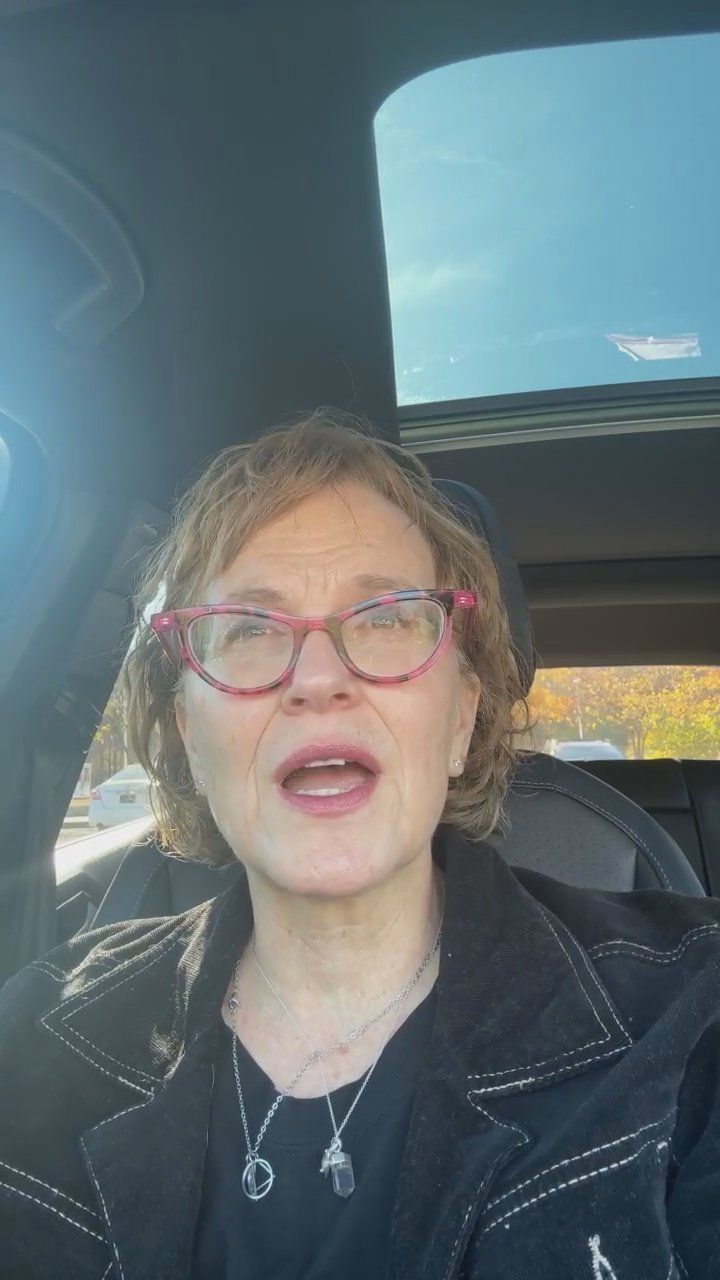
Host records from the Biden Welcome Center while driving from Philadelphia, sharing personal guidelines about attending communal rituals — especially "go to the funeral" — and reflecting on mentor Judy Porter and connections.
Biden: I want to say hi to everybody and welcome and I'm very glad you're here. If you are here, let me know. Number 22 on my guidelines is go to the funeral. Judy Porter was one of my beloved mentors who passed last week. I'm gonna try and get through this.
Shannon: My guideline number 22, go to the funeral. She says it applies to weddings as well. The places we come together to observe rituals as a community matter. Shannon: I am so glad that I went and I learned the hard way.
Lukewarm supporter of Harris Walls went to see Bruce Springsteen in Philadelphia. The concert was electric and very powerful to be there. Luke is doing his Cadre live stream from the Biden welcome center in Delaware.
Luke: If you're ever on the fence about whether or not to go to a funeral, go to the funeral. He says you will not regret it, but you will probably regret not going in. Luke: Cadre, you can let me know in the app if you want to just give me a number.
Well, good morning, Cadre from the Biden Welcome center in Delaware, USA off 95 South. Why am I here? You might ask yourself. And I will get to that in a minute because it has to do with the topic today. But I want to say hi to everybody and welcome and I'm very glad you're here. If you are here, let me know. I know there's some challenges with letting folks know you're here on Cadre that we are working through. And if you can let me know, let me know and then I will acknowledge you and be grateful that you're here.
But if you're watching this later, I'm grateful that you're here later. This is coming at you. Whatever. Whenever you get here in time is on time. I don't exactly know what that means, but I feel what that means. Somebody said it to me once. Well, good morning. C. C. well, hello our stigma. I am grateful you are here as well. Thank you for being here. C. from Philadelphia. Why was I in Philadelphia? Well, funny story. One of my rules of engagement, it's actually more one of my guidelines. I have two lists.
I have the rules and then the guidelines, I guess is what I'm calling them right now. And it's not clear to me which list whichever one belongs on. But number 19 on my guidelines is people are a good use of time. And number 22 on my guidelines, which I learned the hard way, is go to the funeral, meaning go to the funeral, go to the wedding, go to the communal gathering of whatever sort it is that happen with unpredictable regularity. You know you're going to go to weddings. You know you're going to go to bar mitzvahs, you know you're going to go to funerals or what have you.
In this case, I was. Sunday, I drove up immediately to the house of one of my beloved mentors who passed last week. Her name was Judy Porter. Hi, Speak Wonder. Thank you very much for saying so. And I hope you are drinking coffee. I'm going to get some when I'm done here. One of my and Steph T. Welcome. I'm glad you're here. Judy Porter was her name. I'm gonna try and get through this. I'm not gonna try to not cry, but I'm gonna try and stay vocal since what's the point of a live stream? I don't think it would be lovely to sit here and just watch me cry.
So Judy Porter was married to Jerry Porter. Jerry Porter was my father's college roommate. And he and Judy were dating the whole time that Jerry was in college with my dad. So Judy and Jerry were at my parents wedding. I have photos of Judy and Jerry at my parents wedding. And I've known them my whole life in that context. And I ended up going to Bryn Mawr College, which is outside Philadelphia. And I didn't go there because Judy was a sociology professor there. But it turns out the spring of my first year of college, my friend Lewis told me about this great class that Judy Porter was teaching.
She was amazing. I loved Lewis. Lewis loved Judy. I took this class, and my life has never been the same. It was the Sociology of Poverty. And she talked about the structural. You know, the ways. Sociology. Right. The ways we set up the world in groups and how we interact with each other in groups and what that means for who we are as a community, et cetera, et cetera. And I just understood some things about how the world was set up that were hard to understand about how the world was set up. When I went to Wayzata High school in the 80s, living in Minnetonka changed everything.
I thought about how the world worked and how it was set up and what it meant, everything. There would be no Mayor Hodges without Judy Porter. So when I, her husband Jerry, put on Facebook that she had passed, it wasn't a shock. She had had Alzheimer's. It was a surprise because I didn't know it was going to be this week, but. Or last week, but it was a week ago yesterday, Monday. So I immediately. The first thing I did was call my dad to let my dad know. And my dad called Jerry immediately. My dad, I guess, was one of the first people to call.
And I waited for a little while, and then I called Jerry and talked to him. And I said, look, if there's going to be a funeral, let me know. And he said, well, there's not. The funeral is going to be just family. I said, okay. He said, but Bryn Mawr College might do something to honor Judy, and I hope that they do, so I will keep an eye out for that. But then the Philadelphia Inquirer did this really amazing. Good morning, Ms. Shannon. The Philadelphia Inquirer did this really amazing write up about Judy.
She was a force to be reckoned with. She taught what I think was the first course on AIDS and hiv, social science course on AIDS and HIV in any college in the country. And I was in it. It was me and Louis. He had graduated, but he was getting his master's. And so she taught this graduate level seminar and I was in it to learn everything that we knew in 1991 about AIDS and HIV. And I wrote my senior thesis on the racial differences and attitudes towards AIDS and HIV at the time, et cetera. And she went on to teach that class for years.
And she had a service component to it. She did needle exchanges in Philly until she couldn't anymore for like 30 years. They did this write up and at the end it said, you know, the family will be sitting shiva on Saturday From I think 2 to 8 and Sunday from 12 to 8. And I had stuff I needed to do on Saturday. I was speaking at a democracy fest in dc. So I drove up on Sunday to sit shiva even though I was nervous, even though I didn't quite know, you know, I am not Jewish. I have. I have sat shiva maybe one or two times before, but I still didn't know what all the protocols were and did they really want me to come up and.
But I remembered my rule of engagement. Well, my guideline number 22, go to the funeral. Like, because I chose that as a sort of way to live my life a few years ago. I just didn't question it too much. I asked, one of my besties is a rabbi. Hello, Mel Meyers, Welcome. I asked for his input on what I needed to know. I am still in my Shiva clothes two days later. And I just drove up and I drove straight to the house and they were delighted to see me. And there were people there I got to talk to who knew Judy after I did.
And there were people who knew Lewis who also passed away a few years ago. I'm the only one left alive from that class that Judy taught in 1991. And I got to talk to Jerry, and I got to talk to Jerry, you know, their daughter Rebecca, who is my age. And I am so glad that I went and I learned the hard way. I'm not going to tell the story, I'm not going to say what funeral I didn't go to, that I learned that I should go. It wasn't somebody that I knew well. Thank you for the heart. It wasn't somebody that I knew well.
This was maybe 10 or 15 years ago, but to this day I wish I had gone to that funeral. And I chose not to go for reasons that made sense at the time, but I should have gone. And so I haven't missed a funeral since. But it applies to weddings as well. I made an effort this summer to go to My cousin's wedding or this fall to go to my cousin's wedding, because that sort of thing matters and community matters. And the places we come together to observe rituals as a community matter a great deal. And they help us feel connected to other people.
You know, I'm not Jewish, but sitting yeshiva is the morning ritual of many of the people in my life. And so I got to figure it out and go, I'm not a practicing Christian. I'm a cultural Christian, but not a practicing Christian. But going to Christian weddings, you know, confirmations if I get invited, or baptisms or whatever, that. That all matters. So that's my rule of the world. And people are a good use of time. And that's a weird thing to combine with go to the funeral because the person most at issue there is with us in corporal spirit anymore.
But the people who are also there, being in the community of people who loved that person or respected that person or cared about that person, really matters. A couple years ago, my uncle died. My uncle Kneester, down in Arkansas. This was two and a half years ago now, maybe. And he was my dad's best friend. They were closest in age. They were in college at the same time. So Jerry. I talked to Jerry about my uncle Kneester. On Sunday, I took my dad to Newport, Arkansas, a tiny little town in Newport in Arkansas, to go to that funeral.
It was the last time he traveled. I'm guessing it'll be the last time he traveled in his life. Last time for sure. He went to his hometown. I drove him to the house he grew up in and have a picture of him in front of there. And he asked me to drive him to various places in Newport. It mattered to him to go to my uncle's funeral. Go to the funeral. I'm the one who told my dad to go and made all the arrangements and sort of met him there and made sure that he was okay there. And I see our stigma. I agree with you.
There's something about people coming together. I feel that way about voting, people coming together to make a decision about who we are as a community. But when you have those communal gatherings, it really, really, really matters a lot. And yes, honoring the person who has passed honors the people who lived after they are gone. So that's what I'm doing now. I was going to drive up yesterday morning, but another funny thing happened. This is on a positive note. I think the world and the universe are a very magical place.
And for me, the music of Bruce Springsteen is very magical. I have many magical stories about Seeing and hearing Bruce play music, and this is one of them. I had asked a couple people I knew if maybe they could get me entry into the rally that happened for Harris Walls last night, because Bruce was playing. And I'm not trying to be political here. This is not me being. I mean, I'm, you know, I'm a supporter of Harris Walls. You don't have to be to understand that it would be great for me to see Bruce Springsteen play live in this arena.
And I kind of. When I found out Judy died, I remembered that I had asked people. I didn't follow up with anybody, nothing. And Sunday night, after I was sitting shiva and I was staying with one of my best friends from college, I get a note. It's a longer story than this, but I basically get a note saying, hey, you're in. You can go to this rally in Philly on Monday night. And keep in mind, I'm there on Sunday already anyway. And Amy's like, you can stay as long as you want. And I did not bring clothes for a rally.
I went to this rally dressed in black, But I went. And it was electric, as Travis Kelsey would say, it was electric and very powerful to be there. And the songs that Bruce chose, if you don't know them, Promised Land, Land of Hope and Dreams. And then, of course, Dancing in the Dark. But Promised Land and Land of Hope and Dreams, in his acoustic version, the way he sings them there or sang them there, very powerful statements about where we are in our country right now. It was very moving to be there, and I was very glad that I got to go.
So the universe is funny. I was already in Philly. I had a place to stay. I could arrange my life to go and then drive back today. But hence doing my Cadre live stream from the Biden welcome center in Delaware. You know, I'll get. Grab a bite to eat before I get back on the road, so. Hello, Luke. Happy Tuesday to you, too. Happy Tuesday to you, too. So in terms of rules of engagement, if you all are ever on the fence about whether or not to go to a funeral or a wedding or a graduation party or whatever it is, but especially the funeral, because those are harder for us to get ourselves to go to, I think, because they're funerals and death is hard, please have my voice in your head saying, Rule 22, go to the funeral.
Just go. Unless, you know it won't be safe or, you know, it's a family situation where it's not good for you to go be with those folks for Whatever. You know, there are reasons not to go, but absent those reasons, go to the funeral. You will not regret it, but you will probably regret not going in. It's not like there's a do over. It's not like there's another opportunity to go to that particular funeral. So go to the funeral and probably we can talk about this some other time. I also make the point of going to the funerals of people my people care about.
You know, a beloved person. To me, her mother died this past spring. I went to the funeral. You know, one of my best friends from high school, his mother died, I went to the funeral. If you can, that really matters as well. So I love me some Luke back. Luke, thank you so much for that love. I appreciate it. So, you know, Cadre, you can let me know. I think you can let me know in the app if you want to just give me a number, basically between 1 and 30. You can just. We'll randomly select a rule of engagement and we can go from there.
That would be pretty fun. But I love doing this every week with y'all. It was really fun to have a reason to get off the road. I'm gonna get some gas. I'm gonna get some beverage and some snack and get back on the road. So thank you for spending part of your Tuesday with me. I look forward.
Reactions and comments are for members. Joining is free and takes a minute.