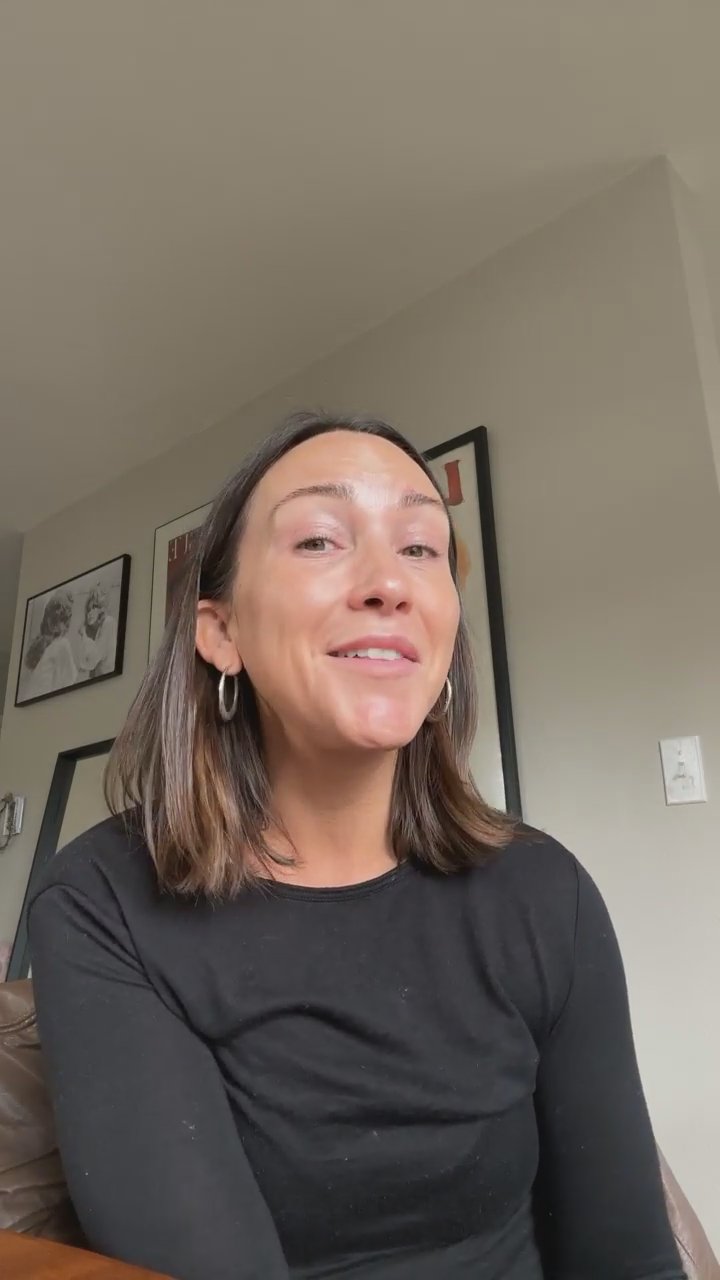
Jules discusses navigating eating‑disorder urges after recovery, validating their commonness and sharing strategies like calling a support team, practicing extra self‑compassion and releasing perfectionistic expectations.
Cadre crew. Happy Halloween. I'm very excited because I actually got costume this year. So I'm gonna be Mia Wallace from Pulp Fiction. I love dressing up. I need to make sure that I plan better.
Jules: Someone asked me to talk about eating disorder urges after recovery. Navigating those urges even after having been through treatment or going to therapy. She says the first thing she does when things are getting bad is call on her support team.
Be extra, extra gentle on yourself. There's no right way to recover. Treat your brain like it's a little child that's learning how to be in the world. As always, if you have a request for something that you'd like me to talk about, I'm always open to that.
Hi, Cadre crew. Happy Thursday. Happy Halloween. Happy Halloween. I don't know if y'all are doing anything for the holiday, but I'm very excited because I actually got costume this year. I, for the last, like, several years, have done a very poor job of planning for Halloween. And every year. And I love dressing up. Like, I love, love, love dressing up. I have since I was a kid. And every year, Halloween rolls around and I'm like, how come I didn't, like, plan next year? I need to make sure that I plan better.
And this year I planned well enough so I have a costume. So I'm gonna be Mia Wallace from Pulp Fiction, which I'm very excited about. I have these, like, fake little bangs, and then I got, like, the white button up shirt, and I've been practicing the dance so I can do, like, the little dance, which I'm excited about. So today's live was a request. Someone asked me to talk about eating disorder urges after recovery and nav. Navigating those urges even after having been through treatment or going to therapy.
Good afternoon, Jules. Nice to see you. And this is something that I've had to navigate for almost 10 years. And I've been in eating disorder treatment twice. The first time I went was 2015, and the second time I went was 2022. So I'm very familiar with the process, treatment and recovery and understand deeply the challenges that come with existing in the world post recovery as someone who is actively working on staying in recovery for an eating disorder. So I first just want to validate that urges for, like, eating disorder urges after going through recovery are so, so common.
It is not. It does not mean that you are not doing recovery right. It doesn't mean that you're regressing. It doesn't mean that you failed. It is absolute common. And I have not met anyone who has been through recovery who does not experience urges after going through recovery. I think one of the biggest lessons I learned the second time I went to recovery was that I was trying to recover perfectly. So that perfectionism that was so wrought in my eating disorder was also part of my recovery. I brought that perfectionism into my recovery, and I expected this perfect, recovered version of myself to exist, which is unrealistic.
That doesn't exist. There's no such thing. Because there is no perfect definition of health or wellness. And we ultimately have to decide for ourselves what the picture of health for ourselves, health and wellness looks like for ourselves, because everyone is unique. So I think as soon as I was able to let go of this idea that recovery was going to look perfect or be perfect or that I was going to be perfect in my recovery. I started to really have a lot more self compassion for myself when those urges did come up.
So I absolutely, despite having all of the tools and all of the knowledge about triggers, about coping mechanisms, about, you know, the, the impact that engaging in eating disorder behaviors will have on my, my life, on my mood, on my relationships, I still have urges and sometimes I still give in to them a lot. It's, it's so much better than it used to be and it still happens. And the difference now between when it used to happen is I have so much more grace for myself. I don't beat myself up when that happens.
I don't, you know, I don't go into a spiral of shame or self hatred. Instead, I recognize that like that's, it's, it's gonna happen sometimes and it's okay. I think what, what is really the hard thing is how do we manage those urges or those behaviors if they, if we give in to them when it gets to the point that it's actually disrupting our lives again, when those behaviors become more like symptomatic components of our eating disorder and maybe signals that we might need a little extra support.
So I have found that some, you know, some of the things that really help me, you know, in those times when it starts to feel like it's getting bad again, that's kind of how I like to describe it, is I absolutely have to call in reinforcements. So as much as I have resisted this in the past, it is absolutely 100% the thing that helps me the most, which is having people on my team. So for me, that's my mom, that's my best friend, that's my therapist, and it's social media. I have a lot of folks that I interact with on social media who have been through recovery, who understand mental health, who get those, those kinds of things maybe more than people in my, my day to day life might.
So anytime I feel like things are getting bad, the first thing I do is I call on my support team. So that might mean I call my mom on the phone and say, hey mom. Like I'm really, I've been struggling a lot more recently with eating disorder behaviors or urges. You don't have to do anything or fix anything. I just need somebody else to know. And having somebody else know, it's like significantly brings down a lot of the anxiety or panic I have about it getting out of control or getting bad because then I know that there's somebody there supporting me.
Then I know that I'm not alone trying to fight this. Even if that person can't do anything physically or emotionally. Having some. Just having somebody on my team and knowing that they're there has really, really, really helped me. This also means, like, in times when things are getting hard, like maybe up my therapy sessions, right? So instead of going every other week, maybe. Maybe I start going every week again, knowing again that it might not eradicate those symptoms or behaviors right away.
And it's a. It's an effort for me to show up for myself, to bolster the support that I have in a time that is clearly difficult. The other thing I will say is, you know, there's a lot of different urges that come with recovery, you know, and without being incredibly explicit, explicit, there's a lot of different types, right? So it's not necessarily always about food. And it can be really challenging sometimes when we're in this culture that promotes a certain body type, a certain kind of movement, a certain kind of diet, and people around us are engaging in these sort of.
In, you know, in diet culture and fitness culture, wellness culture, in ways that can kind of be counter. That can counter what we've learned in recovery and what's best for us. So sometimes, you know, it's. I find that the. What can be really challenging is how to sort of navigate those urges or those thoughts when the people around us are kind of reinforcing a lot of disordered eating or disordered movement or disordered behaviors or disordered talk about bodies and physical appearance. And it can just be.
It can be really difficult to navigate when everyone else in our lives is not doing it with us. And it can feel very lonely and isolating. So, you know, I. For a while after I went to recovery the first time, I had to set some pretty hard boundaries around the kinds of people that I was spending time with and the kinds of places I was spending time. So that meant that for a little while, like, I might. Like, I might not go to workout classes with friends or yoga classes with friends, because I needed to separate myself from the dialogue that I knew was going to be present in those spaces while I was still feeling very vulnerable and needing to sort of rewire my own brain.
Now I can go do that kind of stuff all the time because I have no problem saying to somebody, like, for example, if I go to a workout class and the instructor is having us do something that I know is going to be too hard for my body, I just don't do it. And I have no worry about hurting the instructor's feelings or looking like I'm not trying that hard. I don't give a s***, because I know what's best for my body. But if I had done that coming out of recovery, right away, I would have felt immense anxiety or pressure or I would have felt a lot of guilt for trying to do something the way I needed to do it or set those boundaries in that moment.
So I needed to remove myself from those places until I felt solid enough in myself and what was right for me before going back into the spaces and being able to set firm boundaries or just say, this is not. This is not for me right now. Same thing is true, like, when it comes to, like, going out for dinner or having family meals or, you know, knowing when you're going to be around people or in spaces where there's going to be food talk or food conversation, that can be really triggering. Initially, after recovery, I had to remove myself from those places or set really, really hard boundaries for myself around.
Like. Like, for example, if it was Thanksgiving dinner and I knew my family was going to be talking about portion sizes or their bodies or anything else that might kind of bring up, like, these are. These are things I'm trying to rewire for myself. I knew that I needed to set internal boundaries around, you know, just making sure that I had a plan for myself in terms of what I was going to do that evening for that meal. Whereas nowadays I can sit down for a meal like that. And if someone says. Makes a comment about food or body or asks me why I'm not eating something or eating something I like, it's easy.
A lot easier for me now to say, this is really what I want to eat right now. It's what my body wants. Or, yeah, I'm going to have seconds because it's delicious and I love it. There's not an emotion attached to it now, but right after coming out of recovery, there's a lot of emotions, emotions attached to these changes we're trying to make in our brains. So sometimes having those sort of harder boundaries can help us when it comes to those urges. Because I think oftentimes we don't realize that when we're trying really hard to rewire our brains and reorient the way we think about something, even if we're moving towards that direction, if everything around us is not moving in that same direction, a lot of times it can actually trigger us to.
To really go back to our old behaviors, because it triggers A sense of like, I'm not doing it right. I'm not strong enough, this is too hard. I'm never gonna be able to think or act the way other people do. And it can kind of create this narrative of like, I'm not good enough, which can send us back into those behaviors. Even though the thing we're trying to do is the recovery oriented thing. So sometimes it's helpful for a time period while we're rewiring that part of our brain to just remove ourselves from those situations that can make us feel like that.
Hopefully that makes sense. Okay. I hope that was helpful. I think, you know, the holidays are a really big time when this comes up too. So be extra, extra gentle on yourself. You're doing great. There's no right way to recover. There's no perfect recovery. It is so common and so normal to have urges after going through recovery. It does not mean you're doing it wrong. It does not mean you're going backwards. It does not mean you've regressed. If anything, it just means that there's still these parts of your brain that are, that are used to doing things a certain way and they're the ones that are operating the fastest.
Right. And so we're teaching our brains after X amount of years of doing something one way to try and do it a completely different way. So it's going to take time. It's going to take time and repetition. And you have to treat your brain like it's a little child that's learning how to be in the world. And if you can think of it that way, like a little baby, like learning how to walk, like, I'm not going to yell at it if it can't walk the first time. And if it walks and it falls, I'm not going to say, oh, look, you fell, you don't know how to walk.
No, it still walked a little. It just, it couldn't go that much further. And so we're gonna say like, you did a really good job with that walking. And I know you fell, but you'll get right back up again and then soon the baby will walk a little more. So it's the same kind of thing. Like, we have to be super, super gentle with our brains while we're rewiring how to think and how to be. Because it's a lot of time that we're rewiring. So be really gentle with yourself. And you're not alone. I'm still, I still struggle with this stuff all the time.
So keep going. I'M proud of you and thank you for the request. As always, if you have a request for something that you'd like me to talk about, I'm always open to that. You can leave a comment on one of my videos or send me a DM on Instagram. Either one of those works just fine for me and I will see you next week. I hope you all have a happy Halloween and enjoy some candy. And if you dress up.
Reactions and comments are for members. Joining is free and takes a minute.