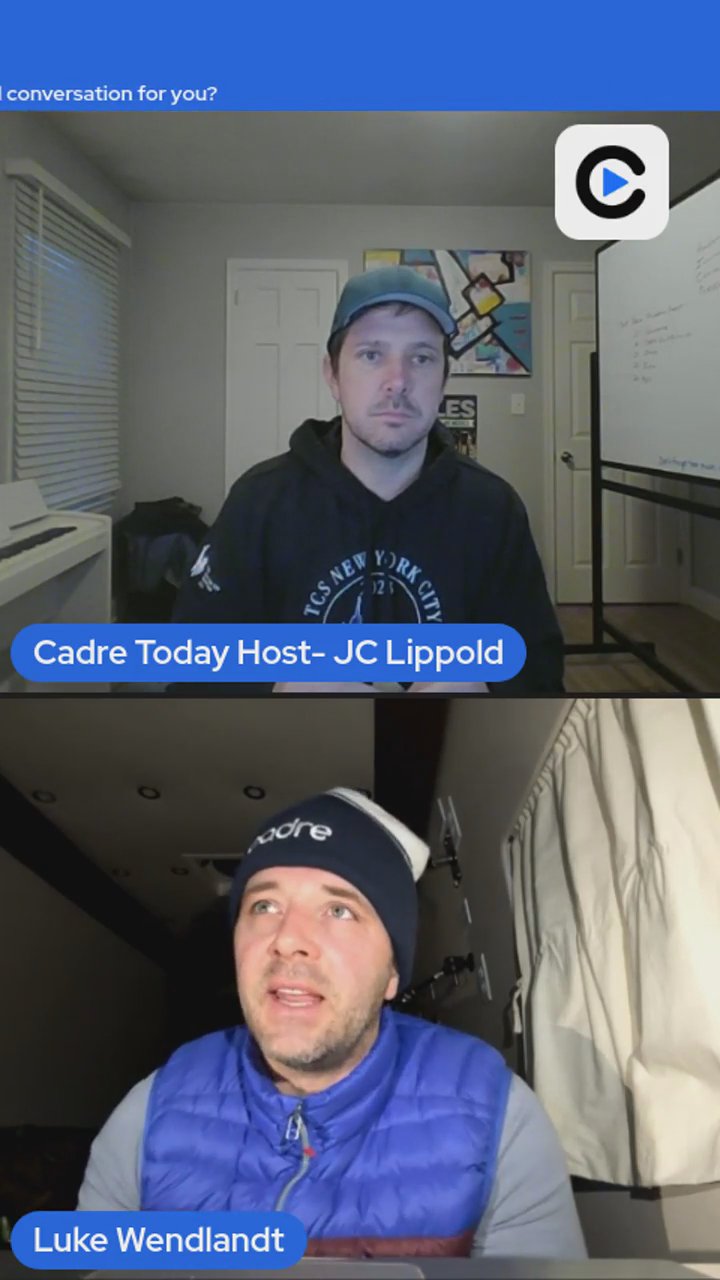
Join Cadre Today host, JC Lippold as he gives you a unique look into your favorite Cadre Contributors. Within this interview, you'll experience folks being real, folks caring about you and others, and folks fostering space for beautiful nuggests of insight and inspiration to appear. This week we welcome, Luke Wendlandt as we talk about Making Hard Decisions.
This is a Cadre Today interview. We bring in one of the Cadre contributors to engage them in a conversation face to face. Today's guest is Luke Wetlandt, the founder of Cadre. Happy Monday.
Luke: So we're out of the podcast van. This van is if you're living in Minnesota or, I mean, actually it's been in California, Florida, Texas. It's a full podcast studio in here, and we love to interview individuals. It also kind of doubles as a home office. We love it.
We always start by asking our guests this question. Who are you? What do you do, and how do you feel whenever you're asked these Questions. And that often creates a big mental health or anxiety nervous system response. We try to create those little morsels that can nourish your soul and direct your mind.
Luke Wendtland: Who am I? I am a loyal husband, dedicated father, I believe a phenomenal colleague. He says it took him a while to be comfortable in his own skin. Now, he says, he wants to help people see a bright life.
Luke: Some of us struggle with being in the buckets that the world puts us in. If you ask me the bucket I feel most confident and comfortable in, it would be the bucket of an individual living with generalized anxiety disorder and panic attacks. Are you a person who doesn't even know what bucket the world wants to put you in?
Luke: There's beauty and growth of stretching yourself into that comfort zone side and making hard decisions. leaning into those hard decisions stretches yourself into this space of kind of the unknown. What's hard for you? And what do you need in order to move it forward?
Every year dating back to 2019, Luke has pushed himself through this one life changing experience called a masogi. This year he's going to do a three day event right here in White Bear Lake. Has so much meaning to him and there's so much deeper meaning than you'll ever know.
Luke: What's the one thing you want listeners to take away from the 19 minute conversation? Stephen: You can do whatever your heart desires in this world, you can do it. Luke: Do not wait, do not wait. There are many individuals out there right now that don't have the choice of tomorrow.
We have a double shot of Cadre Today interviews this week. The one only, Betsy Hodges coming to the live stream on Wednesday morning from Washington D.C. Luke, thanks for the rest of the. Thanks for your time this morning.
Well, good morning, Cadre. Happy Monday. If you're watching this live, if you're watching this at another time, we are so glad that you are here. C. lippold, and this is Cadre Today. We are here seven days a week in the morning. So whether this is your first time in the Cadre sphere or the thousandth, this is your friendly reminder that you have the opportunity to start every day exactly where you are with what you have. And to honor the that you're probably seeing two faces on the screen right now, because this is a Cadre Today interview.
Every once in a while, about once a week, we go and bring in one of the Cadre contributors to go ahead and get to engage them in a conversation face to face, rather than through livestream or prerecorded content or through the community feed. So today, my guest here in the Cadre Today interview seat is the one and only founder of Luke Wetlandt. Luke, how are you doing? Amazing. C. my name is Luke Wendtland, the founder of Cadre. Honored to be here, brother. Thanks for doing this. Awesome. And we have a special guest today, and it is in the form of the location where you are, Luke, where are you going live today?
So we're out of the. The Cadre van. So we're out of the podcast van. And this. This van is if you're living in Minnesota or, I mean, actually it's been in California, Florida, Texas, you name it, but it's the Cadre van. It's a full podcast studio in here, and we love to interview individuals and also kind of doubles as a home office. So it's. It's great. We love it. It's the Cadre van. It gets a lot of play and airtime, too. Yeah, I love it. There's. There's the amount of people I know who send me messages throughout the day, like, oh, you just saw the Cadre van.
I just saw the Cadre van. So. Or I get the pictures. I get pictures. And it's like, where was the van today? So I love it. Oh, I love it. So. Well, our kind of format for these interviews, just like everything else we do here, is efficient, right? We create these models of if you have a couple of minutes in your day to engage in your mental health wellness journey, we try to create those little morsels that can nourish your soul and direct your mind. So we always start by asking our guests this question.
Who are you? What do you do, and how do you feel whenever you're asked these Questions because culturally, we so often put people in the buckets of who they are and what do they do. And that often creates a big mental health or anxiety nervous system response. So, Luke, talk a little bit more about who you are and what do you do, and whenever you have the chance to answer that question, how does it make you feel? C. thank you. My name is Luke Wendtland. I am, I'm just a guy from middle of Nowhere, Minnesota.
Hutchinson, Minnesota, call it 12 to 15,000 people that were there as, you know, friends. Everyone kind of knew everybody's name. But really, who am I? I am a loyal husband, dedicated father, I believe a phenomenal colleague. Most, most colleagues, I think, would say that about me. A best friend, loyal. And I feel as though I was put on this planet to try to help every person see a bright life, bright light that could they can be in their life. Like, there's, there's something bright about each of us, but I think sometimes nobody, like, individuals don't even know it about themselves.
Yeah, like, they, they don't. And how does it make me feel? Honestly, sometimes it depends on what era my life I was. If I would have been in my 20s, I would have been embarrassed to answer that question. Like, everybody's so much further along than me. And I'm in my seventh year of college, and I don't know what the h*** I want to do, you know, and then I'm in my 30s, and I'm, I'm proud. I'm a business owner, I'm an entrepreneur. You know, I'm some. This and, and, and today, answering the question with peace and total gratitude is like, I'm a, I'm a, I'm a, I'm a father, I'm a husband, and I'm here to try to impact lives.
And I'm, I'm proud to say that. And, and I really put like, my flag in the ground and mean it. Like, I am super proud to say that today, years past, I, I would, I mean, even like going to a wedding and having somebody answer like, well, what do you do? And then either having to try to explain or already, like, have my answers prepared. Well, I'm still in college, but because I don't know what I'm doing, and I'm this. And I can, I want to. And so it just, it took me a while to be comfortable in my own skin.
And so that's what I'm most proud of. C. yeah, Luke, that's awesome. I mean, talking about the journey of you know, that question being ever changing, ever present, but also, you know, I think for a lot of our Cadre listeners today, you know, like, some of us struggle with being in the buckets that the world puts us in. You know, like, again, you can go husband, father, colleague, or husband, colleague, founder, or I'm a business this or business that. And we go, okay, we know what bucket the people are going to put us in, but then how do we feel in that bucket where I know a lot of other people.
And Luke, maybe if you want to talk about this for a bit, we don't know either what buckets we belong in or number two, there just aren't buckets. You know, like, I always, when I answer that question, I start by saying that I'm a homemaker. Why? Because I look at what I do and I make. I try to make people feel safe and at home. So those of you who are listening at home, like, are you someone who knows what buckets you fit in, and maybe your journey is feeling comfortable in those buckets, or are you a person who doesn't even know what bucket the world wants to kind of put you in?
And you. And. And that's your struggle. So, Luke. Yeah, that's. That. That's. C. and I'd say if. If you were to ask me the bucket I feel actually most confident and comfortable in, it would be the bucket of an individual living with generalized anxiety disorder and panic attacks. Like, if you. If you ask me anything, like, how to start a business, started a couple of them. How to be a good father, how to be this. Like, if you ask me any one thing that I could say I'm an expert in and through my lived experience, it would be dealing with anxiety.
Dealing with anxiety and panic attacks and leaning into alcohol and all those other things. Like, I would say, like, that's my true lived experience expertise, Malcolm Gladwell, and you know the thousand hour rule. Well, that's a million. I mean, not a million, but you know what I mean? That's my life. Dealing with it every second of the day for years and years and years until you learn, like, how do I cope with this? You learn cbt, you learn this, you learn this. You try a bunch of different CBT's.
Cognitive Behavioral Therapy, by the way, you learn exposure therapy, you learn what works. You learn cutting stuff out of your life. You learn about total truth, honesty, not only to yourself, but others, like, all of it. And that's. That's helped me with my anxiety. Do I still have generalized anxiety disorder. H*** yeah. Like, that's never not going to be there for me. But back to your point is living through those things and identifying as such. Like, I now identify as a person I'm proud to be.
Like, that's, that's me. Like, I'm proud to be me. I can't, I couldn't say that always. I love it. So a couple shout outs from the crowd this morning. Jules, Ms. Shannon, Paul, Colleen, Steph, I, Steph T. AJ12, thank you all for tuning in this morning. And Luke, a little, a little props from the crowd. Colleen says you are indeed a phenomenal colleague. So the crowd is chiming in this morning. Hey, let's go to our middle question. You know, I always ask people whenever we're getting ready to jump into a Cadre Today interview, hey, what do you want to talk about?
And Luke, you said making hard decisions. Why is this a front of mind conversation for you? I, I believe that the way for, you know, there's, there's this picture. I'm sure a lot of people have seen it. It's this circle and then it's this other circle. It's like comfort zone and then stretching yourself outside of your comfort zone. And I'm not saying, you know, I'm, I'm, I'm a, you know, 50 mile an hour, 50 mile runner week guy every week and da, da, da, da, da. That's not what I'm here to tell anybody.
Like, please, nobody take it that way. But I do believe there's beauty and growth of stretching yourself into that comfort zone side and making hard decisions. And whatever those hard decisions may be for you, somebody's hard decision might be, I'd like to try and start a business. Somebody's hard decision might be leaving a relationship, a toxic one at that. Somebody's hard decision may be driving from here to Duluth, Minnesota. It's a two hour driver. C. right. And getting in the car and driving, because that's a hard decision for them because they're anxious behind the wheel.
So leaning into those hard decisions, I believe, I believe stretches yourself into this space of kind of the unknown. Right? It stretches yourself into the unknown. I mean, jc, did you have any clue what you were going to be doing at Cadre a year and four months ago outside of saying yes? One part of me says yes. Because the way that I operate as someone who trusts, you know, again, like, like my hard decision is, is, is to walk in, to sit down and have a cup of coffee with someone where my easy decision is to say yes to being a part of an organization that I don't know anything about.
So the funny thing is, y'all at home, I'd love to know what your hard decisions that you're making are, because again, from the outside, people may be like, JC, how do you. How. How would you say yes to being a part of something you don't know anything about? I go, that's easy for me. I do it all the time. The hard thing for me is walking in and sitting down and having a conversation with someone that I don't know yet. So again, people may go. It's like, oh, my gosh. The thing for you that's hard is easy for me, and the thing that's easy for you is hard for me.
So to the point, like, Luke, you're opening up, I think the can. The beautiful can of worms that people exist with. And that is step one, what's hard for you? And number two, what do you need in order to move it forward? Morning. Let's just use holidays right now. Let's just use holidays right now. There is a holiday party coming up, and an individual at work knows that alcohol, just using alcohol in their life has been hard. They have social anxiety. There's a party coming up, and they know going to that party, there's going to be alcohol, there's going to be this, there's going to be this.
And they're. They're there four months, you know, post sobriety recovery, and they're wondering, like, what do I do? You know, this is, you know, making a hard decision. Like, what do I do? Do I go to the holiday party and put my self at jeopardy, at risk? Do I. Do I not go? Do I. Then do I feel I'm out of the culture? Do I do whatever? And. And I would lean into. If I'm talking to that person or coaching that person, I would say, like, make the hard decision. And if. If the. If the hard decision is not going and sending a message to your supervisor that says, hey, I want to let you know this is, you know, going to put this.
And I'm worried. And why do I say that is because you'll actually turn authentic and vulnerable. Like, you'll be yourself. Like, you'll be yourself. You'll be your true self. You'll push an email across, you'll push a conversation across that says, you know, I'm not ready to go there. I'm not ready to go there. I'm not able to do this. And that could be a hard decision for somebody. And so I would love to just normalize that. Not only a supervisor, boss, colleague, you name it, but in the workspace, there's a variety of different hard decisions coming to somebody picking up the phone and saying, hey, I just want to let you know that that performance yesterday, I struggled with where you went.
And you know, that's a hard decision. You want to know the easy one is talking s*** about them and going to another colleague the next day and saying, did you see what they did? That was horrible. That was a tough. That's the easy way out. The hard way is to lean into that hard conversation. So as colleagues, I always try to show up that way as teammates so we can have those hard conversations with, quite frankly, I believe, grow out. Like we just grow and grow and grow so quick and so fast when you do that.
Yeah. And you know the reminder right here in Cadre, we're never going to tell you, here's the right pathway versus here's the wrong pathway. We're actually probably going to make your life even more complex than you were maybe wanting it to be. Why? Because. Because your life is complex. Right. The way that Luke sees hard decisions, the way that JC does, or that any of you who are tuning in today look at this conversation, hopefully what you walk away from your moments in the Cadre sphere with is, huh, I have a greater clarity of who I am uniquely and from that space, then you can start moving forward.
So, Luke, I know you teased this in the community feed yesterday that you are going to share something special in your life called a masogi. So first of all, what in the heck is a masogi? And second of all, what's yours? Yes. So every year dating back to 2019, I have pushed myself through this one life changing experience called a masogi. So it's this Japanese ritual. I started it actually from a gentleman by the name of Jesse Itzler. I was joined a group called the BYL are Build you'd life resume.
And Build you'd life resume. One of the key cornerstones of it is setting up a musogi or a life defining, challenging moment one time a year. Right? So, for example, one year I did the 4 by 4 by 48 where I ran with an individual by the name of David Goggins out in California. And so we went from like the Santa Monica pier all the way down and finished in San Diego, right outside San Diego. That was an amazing experience. 6 miles. This would have been in 2023, May 27, left at 11:00, 11:59 that night and then took off for my birthday day is an experience I'll never forget.
And when you see and hear me talking about this, like I think you probably hear the joy that I have and love in my heart and my life because like these are moments that nobody can take away from me. And the experiences I had in the life changing experience of it of, of being maybe down, finding yourself up, finding a way to get like that 107 run. I wanted to quit 25, 100 times. But I, but I just, I didn't, I didn't do it and I just kept going. But what a musogi truly is is once a year you put something on your calendar that is a life changing, life defining moment.
It's supposed to be hard, whatever hard is for you. Somebody could put a 5K, somebody might put a hundred miles, somebody might put a podcast, somebody may put starting a business. It doesn't have to be an endurance challenge just so we're on the same page, right? It could be writing a book, you know, that you want to, you know, start and write a book. And it's something that every day you put a little bit towards this big goal and this big dream that you're trying to accomplish. So this year I'm going to actually it's a, it's a three day event for me.
It's the 26th, 27th and 28th of May, 26th, 27, 28th of May. And I will be doing, they call it the Ultraman. So what that is is you have a six mile swim in a 200 some mile bike ride and then a 52 mile run. And so it's like day after day after day. And I'm going to do it right here in White Bear Lake. And so I'll swim my six. So I just, I feel this, just my own feeling like paying 500 bucks and flying down to Arizona and all this other stuff to do this like does nothing for me. But what does do it for me is like nobody can take it away from me anyhow.
So I'm gonna just do it right here in my backyard in Minnesota. It'll be three days, 26, 27, 28. 6 mile run. And so I'll just continue to go around White Bear Lake, which Has so much meaning to me and there's so much deeper meaning to it than you'll ever know. Like, if you ever want to come by here sometime and just go around and read the legends of White Bear Lake and the why, it's not just like doing an Ultraman here. It's so much bigger than that for me. So I'm excited to go the nights and see if I can see some of the legends of White Bear Lake.
So look that, look that one up too if you have to. Perfect. Luke, it's always a joy to go and get to spend some time with you. As we're coming up on about the 20 minute mark, we'll wrap things up. We always say, you know, you spend some time in the Cadre sphere and you're always given a take home prize, you know, whenever you leave. So if you think about this 19 minute conversation connection you've been able to have this morning and pause. Steph T. Says, wow, that's awesome. Love the concept and your msogi.
Thanks, Stephen. So if you were going to think about the take home prize you're giving to Everybody from this 20 minutes of conversation that you've engaged in today, Luke, what's the one thing you would want listeners now or people who watch this later on today or tomorrow, what's the one thing you want them to take away from the conversation? I have two. Number one, you can do whatever your heart desires in this world, you can do it. There's lack of resources. There's individuals with all the resources in the world.
Those individuals that don't have resources. There are so many people in this world that want to help you see your goals through. I'm an example of that here at Cadre. Like there are so many people that are supporting and helping and behind the scenes, in front of the scenes, full time employees, interns, part time people that just want to see this dream and reality and vision come through. Without this group of human beings, Cadre doesn't exist. And I'm telling you that too. In your own life, right?
Like, like you can go do things and people will be inspired and want to help you to go get that college education, to go on and become an rn, to go move forward and be and, and live your dream through to become a pro tennis player. I'm just throwing some things out, but whatever it is that you're focused on, go get it, go get it. And I just want to say my other one is don't wait. Do not wait, do not wait. A month from now six months from now, a year from now. You just never know. You never know.
Speaking out to the Cadre sphere, shout out to you, Mike, Hugo, you know, an individual diagnosed with glastoblastoma in brain cancer, right? Every day he has today is God's fortune that he's still here, right? The next day and the next day and the next day. And so there's an individual that's out there, and there's many individuals out there right now that don't necessarily have the choice of tomorrow or the planned choice of tomorrow. So just go. Go do it for not only yourself, but for them too.
I love it, Luke. No better way to to finish a Monday morning as you get ready for your week, everybody, we have a double shot of Cadre Today interviews this week. C. 8:30am Central Standard or Eastern Standard Time. But 7:30 again right here in the Midwest and then again. You'll see my face every other morning for the rest of your lives, y'all. Luke, thanks for the rest of the. Thanks for your time this morning. I hope you have a great rest of the day. And Cadre, we will see you soon. Bye. Y'all have a good one.
Take care, you guys. Bye. Bye. See you, Luke.
Reactions and comments are for members. Joining is free and takes a minute.