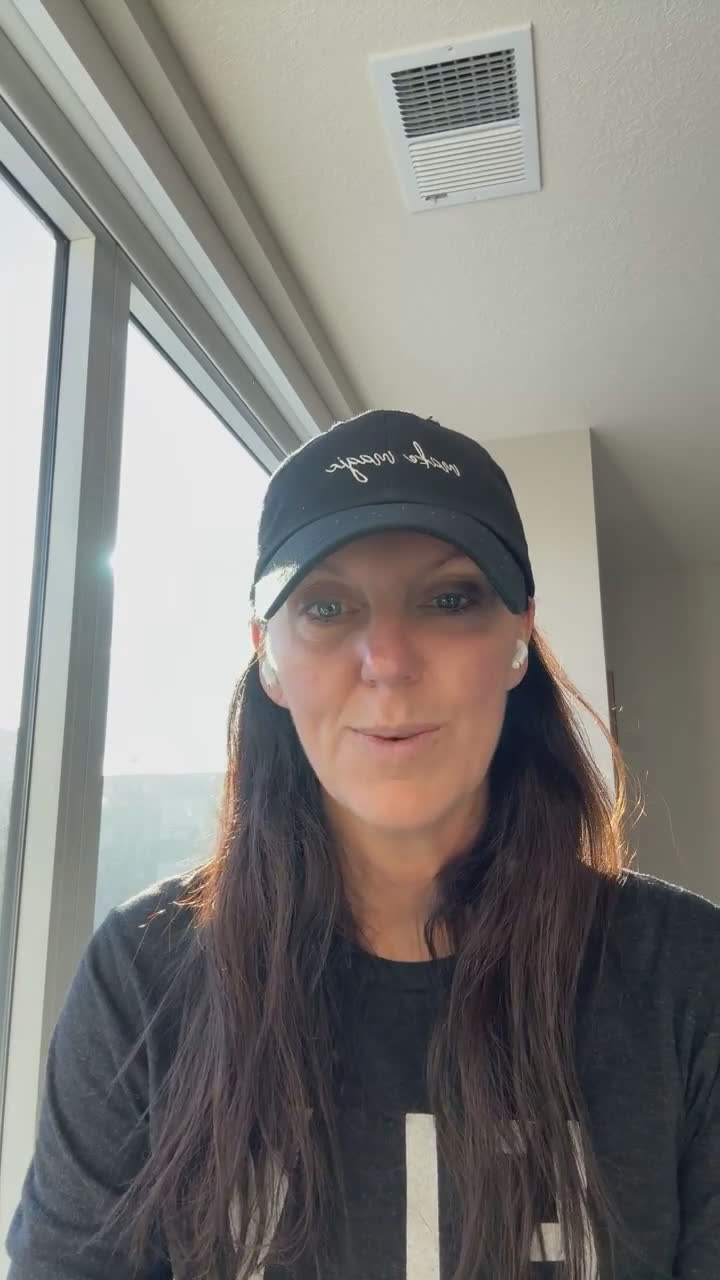
Jean Nichols explores how shifting perspective can change workplace conversations during organizational change, drawing on ideas from the book Think Again and practical tips like using post-it notes to tailor messages to different receivers.
Jean Nichols: It's a beautiful day. It's got a late dusting of snow outside. My perspective is that if it's going to be cold, it might just as well have snow. H. Dayton: Training for a marathon.
This morning on Professional development Day, I wanted to talk about perspectives. How might we start to shift our perspectives in conversations? This topic is becoming more and more relevant as organizations are going through a lot of change. If you want to type in the industries that you work for, that would be great.
A lot of organizations are going through transformation that might impact people. We are making changes without giving people the full landscape of why we're making the changes. In a world that's changing all the time, there isn't a lot of net new. How might that shift how I communicate differently?
My challenge to you is to think about perspectives in the work that you do. Maybe even look at it from the perspective of the receiver. Post it notes of different types of people and adjust some of my messaging accordingly.
So with that, I hope you have a great Monday. If you have other perspectives, other tools that you use to create community and connection through your work, I would love to have you chat. I always jump back in later in the day to see what conversations are out there and add insights.
Good morning, everybody. Happy Monday in the Cadre sphere. My name is Jean Nichols. I'm calling in from Minneapolis, Minnesota. It's a beautiful day. It's got a late dusting of snow outside. My perspective is that if it's going to be cold, it might just as well have snow. Hello, H. Dayton, how are you doing today? Where are you calling in from this morning? So my name is G. Nichols and I am in Minneapolis, Minnesota. And we have a small dusting of snow today. And I'm very excited about that because in my perspective, we should have snow if we're going to have cold.
I got the joy and perk of going for an outdoor run. Oh yeah. So you know, I got the joy of running an outdoor run this weekend. Training for a marathon. First of all, I think I didn't really think it through when I signed up for a spring marathon that I'd have to run in the winter. And it was chilly. It might have been a little less chilly had there been snow, but we'll get there. So this morning on Professional development Day, I wanted to talk about perspectives. I have been reading this book called Think Again by Adam Grant.
And what I love about reading in general is it just helps to shift my mind and perspective. I have a bunch of audio audible credits for books to listen to, but I find that there's something really great about the tactile nature of physically reading a book. I am one of those people. I am guilty as charged for having a highlighter or some post it notes and going out and highlighting or dog earring pages that I think were really great. So when I do those books, I end up keeping them for a long time because I feel strange paying forward what resonated with me that might not have resonated with someone else, but what I'm really appreciating about this book is perspectives.
I think I've talked about this before, but how might we shift our perspectives? Good morning, Jules. Welcome. Happy Monday. How might we start to shift our perspectives in conversations? And I'm finding that this topic is becoming more and more relevant as organizations are going through a lot of change. And I don't know what organizations you work for, if you wanted to type in the chat, the industries that you work for, that would be great. You don't need to write any specific companies, but across all industries we're starting to see a lot of changes occur.
2024 seemed to be a year where people pull back a lot. And as we lean into 2025, we're starting to see in the industry, companies investing again. However, they're investing differently. 2024 has been a year of a lot of restructures in a lot of organizations. I don't see that discontinuing in the future. But what I do see continuing is the need to enhance our leadership skills. And what I do see continuing is our need to enhance our human skills. And what I like about this book, Thinking Again, or Think Again it's called, is it's helping to shift the perspective of the mindset of some of the day to day things that we might go through.
For example, in one of the chapters, it talks about scorecarding and it talks about scorecarding employees and giving people a high, a low. Right? And it also uses the same scorecard to start to talk about types of presentations or types of work or activity. You know, is it a positive, negative, is it shallow, is it deep? And trying to give us just a different level of purpose in the work that we do. Thank you. H. Dayton Medical Research Nonprofit and Development. Oh, that sounds exciting. Jules works in the EMS and LE field.
Amazing. For anyone dialing in replay, feel free to type in as well what it is that you have or what where it is that you work. Not the name of the company, but the type of work or the type of company. So when we think about changing our perspectives in the future landscape, so approaching 25, 2025, we always look at years as kind of a benchmark or a milestone, right? And realistically, when you wake up on January 1st, it's not going to feel a lot different than December 31st. It's just a new day.
However, we do a lot of planning and goal setting around that. And if we're thinking about perspectives and looking at things differently, looking at the outcome of a decision as maybe positive or possible improvement, looking at a decision process as was it a shallow process or a really deep process that we went through and then trying to identify how might we make it more impactful when the same decisions or new decisions come up in the future. So shifting our perspectives. A lot of organizations are going through transformation that might impact people.
And what I've seen in the last year with my consulting work and my coaching practice is there has been kind of a disconnection between the human connection. We are making changes without giving people the full landscape of why we're making the changes. We might be letting people go from positions and in some organizations, that doesn't feel good. How they're doing it, they're doing it in ways that are based on Technicalities, because that's what's best for the company, not best for the human. So we're seeing a lot of patterns and trends and different types of behaviors.
So my invitation to you and to all of us is as we're going into anything, whether we're going into a decision making process for our team, whether we're crafting a PowerPoint presentation, maybe to get investors, or we're reaching across to do some research on individuals, or we're connecting to patients or to doctors, insert whoever the other side of the equation could be for you, how often do you take before going into those conversations with those individuals and try to sit in their chair? Maybe not physically going into their desk and sitting in their chair.
If you work with them, that might be a little creepy. But what if you looked at the world through their lens or tried to perceive what that lens might be? How would you approach a meeting differently? How would you approach a presentation differently? How might you approach just a simple conversation when there might be a point of conflict differently, if you flipped your hat and looked at a different perspective or tried to look at it through their perspective? In a world that's changing all the time, there isn't a lot of net new, right?
There's not a lot of net new development, there's not a lot of net new ideas that are happening or net new improvements to phones or cars. Maybe it's different in research field, but most of the time what I'm finding is everything that's new coming out is an intersection point of ideas and concepts coming together to create something new. And so when we think about perspectives, we can look at a few different things. One, what was the original ideas and what was great about them, or the approach?
And then the intersection point, what new problem are we solving for and what new opportunity are we creating? And then if I layer in my perspectives, thinking, what are common ways in which people are interacting today? What are common issues people are concerned about today that they might not have been concerned about five years ago? And how might that shift how I communicate differently? How might that shift how I present differently? I'll give you a personal example. Last night I hosted an event, it was a Women's Circle event to bring women together to identify some change, but also to just create an experience where people could connect.
And as we were doing some of our group shares in that circle, one of the ladies said that she still feels that she's hanging on to emotions from when we were in the pandemic, when we were forced to disconnect and separate from everyone. And they. She has, as did a few others, a really strong connection to create community and to be more authentic in how they choose that community. And it was a really authentic share and it was super vulnerable. Cherry. And so I asked a few questions just to the group to not put this person in the hot chair.
But what it got me thinking is, in business today, how are we approaching our work differently today than we did before the pandemic? The simple answers to those questions would be, we're working from home more, we're on teams calls more, we're interacting through some sort of digital media more. What was it like before? Do we remember? What I'm finding is a common thread in all of it and why and how perspectives ties into it is I'm finding more and more people, whether it's the circles that I'm facilitating, the groups that I'm.
I'm leading, the client work that I'm doing. We are striving more and more to find more human connection, but not just to fill in the void of what was before. Because before the pandemic, what I keep hearing is that things are so busy and there wasn't real connection. And what I'm hearing now is it's not that people are looking to fill the void of the connections that are lost. They're looking to build communities with more authentic connections. So saying yes to more things with purpose or intention and not saying yes to everything.
So when I think about perspectives and I think about building presentations or bringing it back into our workplaces and looking at perspectives, some perspectives are still having that strong yearning for connection. So if we're building out content to share, what if we threw out a hand to a colleague of ours and brought them into the story and ask for their perspective, what would they do differently before you finish your final product and in those moments, start to connect again, start to hear another person's story, start to learn something different.
Now, will that change the grand landscape of all of corporate America or nonprofit America or any of the work that we do? And you can strip out America from that. I don't even know why I said that. Will it change any of that? No. We still have to do our jobs. We still have to execute and perform in certain ways. But if we can start to look at things from a different perspective and start to say, what was the impact of my presentation on the people that I presented to my audience? If we can ask different questions to say, okay, what's the perspective of my audience coming into whatever the Conversation is whether it's a one on one conversation or you and a large group or you facilitating something, what is the perspective or the impact of the people that are coming together?
Did I make a positive impact? Did I make a negative impact? Did I go shallow? Did I go deep with information or content? What was the right mix? And if you start to add in that new way of thinking and start to bring in the human element to it, the heartstrings As a change management practitioner, there's this little head, heart and hands motto that many change practitioners work from. But I know I take it to heart in pretty much everything I do. So what is the information that's going to tap into the minds of the people that I'm working with or talking to?
What is going to connect into their heart, help them feel, feel connected, feel a change, feel empowered, feel passionate, whatever it is, that feeling, and that sounds a little squishy, but we're humans, so we can't control an emotional element that goes along with how we think. Just sits and then the hands is what are we tactically doing differently, more of less of differently as we move through. So when we're thinking about leading with authenticity, we're thinking about our own personal development.
My challenge to you is to think about perspectives in the work that you do and maybe even look at it from the perspective of the receiver. So when someone's presenting to you, how would you maybe have done that differently to be more open or inclusive? When you're looking to build connection or community, what perspectives can you bring in differently and how might you think through it in a new way? A tool that I like to use and I'll just drop this in at the very end. Here is sometimes I'll put post it notes, depending on what I'm creating, and I'll put different roles or different people on there.
So maybe I would use a perspective that would say, what would Oprah think about this content or presentation? What would the president of the company think? What would somebody that's brand new to the organization think? What would a college student think? Depending on what the target of my presentation or my work is, I might think they're different. Post it notes of different types of people and adjust some of my messaging accordingly so that I know that I can be really inclusive. So with that, I hope you have a great Monday.
If you have other perspectives, other tools that you use to create community and connection through your work, other ways in which you can think about perspectives, I would love to have you chat. Type that in the chat. I always jump back in later in the day to see what conversations are out there and add insights if that's needed or available. So please feel free to do that mostly. I hope you have a really great, great Monday. I hope you have an amazing rest of your week coming off of a holiday, and I'll talk to you all soon.
Reactions and comments are for members. Joining is free and takes a minute.