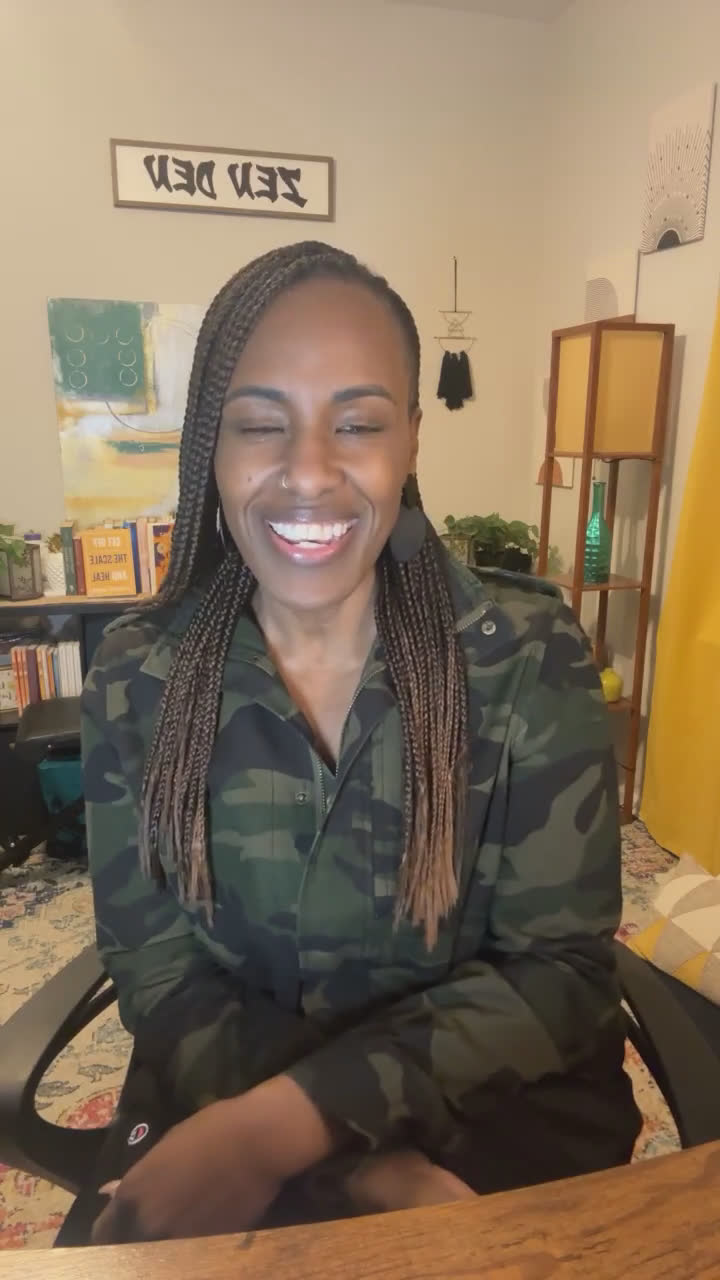
Dr. Charisse Johnson explores emotional intelligence, contrasting reacting with responding and the choice to shift mood, uses a plate metaphor for responsibilities, suggests a weekly action on consistency and offers an anchoring affirmation.
Caja sphere. Sometimes you just need to come in and be right where you are. You are ready to receive. And that's really all right.
How's your week been? If I think about my week, it has been productive. If you had to choose a week or a short phrase to encompass what your week has been like, what would you choose?
So come in, say hello, where are you, and what word would you use to really kind of encompass what your week has been like? My word is productive. Put your word of the week at the top of whatever you're taking notes on.
Dr. Charisse Johnson is a licensed clinical mental health therapist, author, mindfulness practitioner. This week, we're talking about emotional intelligence and how do we continue to level up our week. I try to keep things in between 15 and 20 minutes because I could go on and on.
The most important decision that you make is to be in a good mood. When we make intentional choices about shifting our mood back into a more balanced state, we're 50% less likely to struggle with anxiety and depression. Understanding how crucial that is to our well being.
When we are reacting to something that is typically through impulse. When I respond, taking the time to pause and put some space in between what happened. Five things that happen when we operate from a place of reaction, and then five things that we benefit from when we choose instead to emotionally regulate and we respond.
I want you to consider what's on your plate metaphorically, what responsibilities, what moods, what are you carrying, Right? And then also consider what needs to come off your plate. Make time to make changes you need to so that you can have a week that you desire and that you enjoy.
This week's action. Step your quarter. What went well last week? Give yourself credit for where you focused your time and your attention there. What is one way this coming week you can stay consistent or improve your consistency?
I want to end with your affirmation for the week. My emotions do not control the course of my day. Let this be your anchoring and centering time. Take time to look ahead. That's what this is all about.
Caja sphere. Hello. I hope you are here present. You are ready to receive. And that's really all right. Sometimes you just need to come in and be right where you are. How's your week been? If I think about my week, it has been productive, which I'm very excited about. Some weeks are more productive than others. We did this last week and I liked it. So let's do it again. If you had to choose a week or a short phrase to encompass what your week has been like, what would you choose? Thank you. For those of you.
Yes, Happy Sunday. Who are coming in and showing love through some type of reaction, that is always an option. And of course, where are you in the world? As you can see, I'm home in the Zen den, ready for us to get into all things. So come in, say hello, where are you, and what word would you use to really kind of encompass what your week has been like? My word is productive. Oh, steady. That's a good one. And if you want to, as I'm thinking about it, if you're the kind of person that comes in and hopefully you have something to write with, maybe even hello from Atlanta.
Put your word of the week at the top of whatever you're taking notes on. What it does is it allows you, over time, hello, Louisiana. To really see where have I been? It can also be helpful for us to look back and go, everything's not always hard. I love it. Shifting, transformative. Hello from Sacramento. My love goes out to Californians. All right now, regardless of where you are in proximity. Hello, pa. Love. Rescheduling and enlightening. If this, if this is your first time here. Welcome to if youf Plate could talk.
I'm Dr. Charisse Johnson, a licensed clinical mental health therapist, author, mindfulness practitioner, and I come into this space twice a week, at least for us to talk about all things life. Hearts to all of you. And so tonight I want us to continue our conversation that we've been talking about with emotional intelligence. Hello, Georgia and Minnesota. I am going to do my best to take a lot of information and keep it concise. I try to keep things in between 15 and 20 minutes because those of you who know me know that I could go on and on, but I want you to be able to replay and reflect as necessary.
So we started last week and if you didn't catch last week, it's fine, you can always go back. But if not, we're talking about emotional intelligence and how do we continue to level up our week, level up our life, level up Our year really getting a hold of those components of emotional intelligence and working them into our lives, both personally and professionally. Core thought for this week. The most important decision that you make is to be in a good mood. The most important decision that you make is to be in a good mood.
Now let's be honest. We don't always wake up in a good mood. Things happen even if we start the day in a good mood. And it can be a fight to maintain a good mood. But it is one of the most important decisions that we make. And the reason why that word decision is so crucial is remember that emotional intelligence is all about understanding the way that we are responding to ourselves and the way that we are responding to others. We want to always understand the power of choice. There's a theory within the realm of psychology that talks about choice theory.
We, we have the ability, someone used the word earlier to shift where our mood is. It doesn't mean that the things that are trying us aren't real, aren't frustrating, aren't overwhelming. All of that can remain true. And alongside of that, we can still choose a good mood. Understanding how crucial that is to our well being. I did some research, as I love to do, and one of the things that I found in comprehensive studies around mood and emotion regulation is when we make intentional choices about shifting our mood back into a more balanced state, we're 50% less likely to struggle with anxiety and depression, to name a few.
So that direct there is correlation between how we learn and choose to emotionally regulate then the type of mood that sets in. Don't get me wrong, you can go, I've been anxious all my life and I'm still a pretty happy person. Absolutely. But I still want you to understand the power of that choice and that intention. We talked a little bit last time and I said I would elaborate on reacting versus responding. And that's where I want to shift things today. Good mood. And a big part of that, in other words, emotionally regulating has a lot to do with our ability to respond versus react.
When we are reacting to something that is typically through impulse. That's limbic system, lizard brain. I'm just saying whatever I think doing the first thing that's on my mind, trying to avoid a situation, trying to get out of confrontation and not necessarily thinking it through. Whereas when I respond, taking the time to pause and put some space in between what happened, the stimulus and my reaction, and I'm working myself into that prefrontal cortex that allows me to make better choices. So if you're taking Notes.
You put a line down the middle of your paper. On one side put reacting, on the other side put responding. I want to go through five things that happen when we operate from a place of reaction, and then five things that we benefit from when we choose instead to emotionally regulate and we respond. So when we are in that core place of reacting, we're often filled with one, regret. We make a quick decision, say something impulsively. I have been there. Then we're like, oh, have you ever had a minute?
Give me some hearts. Don't let me be alone in this. If you've ever had a moment where something happened or somebody said something and literally before you could even give it a thought, something came out of your mouth and you knew the moment you got to the period in that sentence that you were like, oh, right. And sometimes it's not even that, you know, what I said was horrible. Like the core of what I said wasn't horrible, but the way I said it, the delivery could have been a little different given the situation.
Thank you for the hearts. Let me know I'm not the only person out here. And I'll be honest, how well I do in that area has a lot to do with my own level of self awareness, which is a component of emotional intelligence. And if in a moment that I'm not really tuned into how I'm feeling, boom, it happens quickly. So number one, regret. Number two, escalation. When we're reacting out of impulse, then typically things escalate. Let me also add as caveat, for those of you who may be avoidant, avoidance is reacting.
That's not a response. Avoidance is something's happening that I'm uncomfortable with and I'm shutting down and I'm not going to say anything. And people can escalate because we shut down. Or another word for shutting down is stonewalling. So if you're like, well, I just get quiet, that's still reacting because that's your default. Number three, delivery with the kids need to improve. Yeah, I'm thankful for kids with thick skin. I'm pretty good to them, actually. I think I'm pretty good now. My daughter, she has tested me in life, but I'm okay.
But I feel you. They can take us to a place so quickly. So third dynamic of what happens when we're in the mode of reacting is poor decision making. We may make decisions that are based off of our emotion, based off of very limited perspectives because we are just trying to do what we think is best and we haven't taken the time to calm down and give it some deep thought. Number four, increase stress. When we are reacting to a situation and we're feeling everything that's going on, it doesn't always resolve or help reduce our stress.
It can sometimes escalate it because then we've put ourselves in situations where we now need to go back and do some repair, and that can be really challenging and uncomfortable. And number five, missed perspectives. When we react too quickly, both personally or professionally, there's a possibility that we have not taken the time to go, can I look at this from another angle? What is this other person who is in connection with me saying without saying, is there more to this? Do I need to ask more questions and get more clarity before I react?
And that can happen a lot, especially because we all have different means of communication and I see this happen a lot when we're talking to people through nonverbal means. So email text often can leave a lot of context off. So really make sure that you are asking yourself, do I need more information? What am I noticing about how I react? And then for those of you that follow me and are with me on Wednesdays and we've been talking about the power of your thoughts, let's also acknowledge that sometimes our reaction may be rooted in our own junk, right?
It may be rooted in our own defense mechanisms, our own unhealed situations. Somebody else in some other part of our life is not treating us well and we react to another person. That has nothing to do with it because we haven't worked through what happens over here. That's why self awareness is so key. But when we respond, number one, it helps increase our self awareness. We take the time to go, what's wrong? What am I noticing about how I'm responding or how I want to react? What is that saying about what I need?
Does my reaction actually match the level of this situation? Number two, emotional regulation increases when we learn to respond instead of react. And Andrea, absolutely Include grown kids. My kids are 23 and 25. And the power of pause is something that I practice daily because life is complicated. So emotional regulation improves and our ability to regulate our emotions goes up drastically when we learn to slow down and move from reacting and choose a response, one that's based on what we truly want to see for ourselves and the level of integrity that we want to leave with out of that situation.
You. Number three, improve decision making. So when we can step back and decide how we want to respond, it gives us a chance to consider, I could react this way. And if I do. How is that going to make me feel short term? What is that going to make me feel long term? What do I need to consider? What's my relationship with the person that I am reacting or responding to? Or even when it comes to how you're responding to yourself, really looking at what that looks like over time and what you want to see so that you can choose a wise response.
Number four, we have better relationships. We're talking a lot about kids of all ages, sometimes people in our family, sometimes people that we work with. And regardless of the category, it is helpful to notice when we're like, I'm so activated right now that if I respond to you, it will not come across the way it should. So let me take some time and then we will come back to this. One of the things I love about my father, may he rest in peace, is that he would always tell me, there's nothing that you can't say, but it's all a matter of when you say it and how you say it that will make a difference.
And I've tried to keep that in mind and really live that out in very powerful ways. And then number five, alignment with your values. When we are operating from a place of responding versus reacting, it allows us to go, what do I value? I want to not choke this grown child, this young lady who has so much mouth that is getting under my skin. I want to be able to love her when this is over. I want us to be in good relationship. Sound like I'm talking to myself. No, she's great now, but we have some moments.
But you then have an opportunity to go, whatever I do, you want to feel a sense of integrity afterwards and make sure that any response that you have is in alignment with what you say you value or with the goals that you have for that relationship. So I'll go through those five again. When it comes to responding, increased self awareness to emotional regulation. Three, improved decision making, four, better relationships and five, in alignment with your values. Now, as we do each week, I want you to take time.
Whether you do it now or at the end of this time together. What's on your plate? I want you to consider what's on your plate metaphorically, what responsibilities, what moods, what are you carrying, Right? And then also consider what needs to come off your plate. What feels heavy that's on your plate, what has someone else put on your plate that you've allowed to stay there. For example, sometimes people put us in the middle of situations that really aren't hours to fix to Negotiate. It really belongs with those two people.
And so what would it look like for you to go, you know what? I'm going to release myself from responsibility for their dynamics because they have the skills and that's really their work. So what's on your plate that someone else has tried to pass your way, but you know it doesn't belong there? What feels heavy? And most importantly, are you on your plate? When you write down all the things that are on your plate, do you notice that you never put yourself do you never put things that bring you joy that's on your plate?
So I don't want you to consider what's on your plate just from negative, harsh things. I also want you to consider things that bring you joy, things that bring you rest, things that bring you peace, things that you're looking forward to. And then we always parallel that to, how is what's on your plate influencing your eating patterns? How is it influencing your sleeping patterns? How is it influencing your emotional patterns? Answer those questions. Don't let this just be a really quick conversation that you and I have.
You can gain so much valuable information. What am I noticing about how I'm eating me today? My eating was chaotic today. It was all over, out of the ordinary. And I paused and was like, okay, what is going on? This is out of your relative mode of eating. And that moment of self awareness allowed me to go, you have a big week coming and a lot of things on your plate that you're anticipating. So I'm going, I'm working on things, trying to get ahead, moving. And it took me a moment to go, whoa, whoa, whoa, you're gonna have to slow down.
You need to pace yourself. But it was what I was eating that helped me really clue in to how much the coming week I was anticipating. It was my sign. You're more anxious about everything you have to do this week than you think. And it's showing up by how you're nourishing yourself. And that was insightful and helpful. So now tonight I will have an opportunity to get a plan in place to really help me manage that. I'll pull in some accountability and go, here's what I'm noticing about myself. Here's what I want that to look like this week.
No shame in that, right? That's called life. That's called being human. Make time to make any changes you need to so that you can have a week that is something that you desire and that you enjoy. This week's action. Step your quarter. One goal, whatever it is, continue to work on identifying it. If you haven't yet, I want you to answer these questions or reflect on them. What went well last week? As you're working towards your quarterly goal, then each week you have a small goal that is helping you get to that quarter.
One goal. What went well last week? Give yourself credit for where you focused your time and your attention there. Second thing, what is one way this coming week you can stay consistent or improve your consistency? If you didn't do a lot towards that goal, it kind of got lost. And how can you improve that if you're like, no, I did really well with my, you know, micro goal for that quarter one goal. How can you stay consistent? Keep whatever goal you're working on in front of you. Don't lose sight of it.
I want to end with your affirmation for the week. You may choose or choose one of your own. My emotions do not control the course of my day. Of course they can influence it and make it a little challenging, but ultimately my emotions do not control the course of my day. I dare you to wake up every day and to say that to yourself multiple times and see how it pans out. As always, I'm so glad that you chose to come. Let this be your anchoring and centering time. Take time to look ahead. That's what this is all about.
You getting an infusion, you getting some clarity, you looking at things, you gaining some self awareness and some reflection and making a plan so that you can level up your week. I hope you have a wonderful rest of the weekend and I will see you soon.
Reactions and comments are for members. Joining is free and takes a minute.