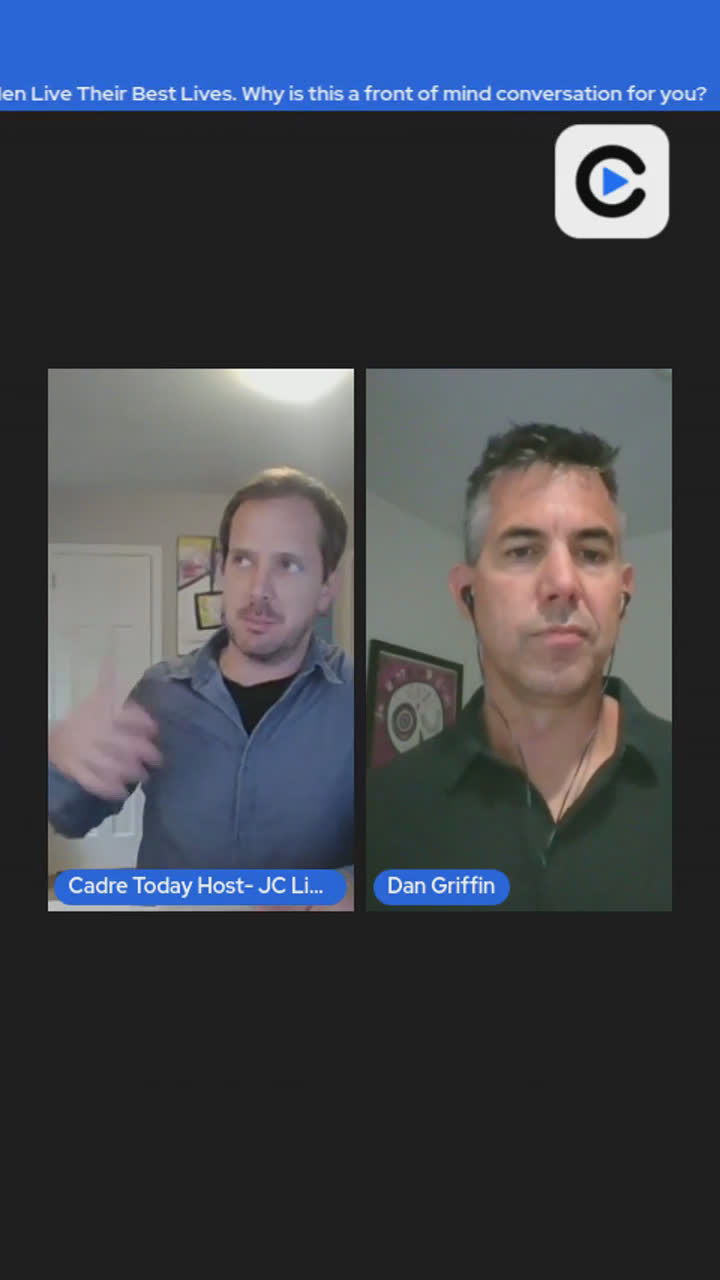
Dan Griffin discusses conscious masculinity, how men often define themselves by roles and money, and invites deeper self-inquiry into identity, gender conditioning, recovery and creative life.
JC: Happy Tuesday. This is one of our Cadre Today interviews, right? So we've been chatting in a different way with our contributors. Whatever you bring into this space is the fuel, is the play toy for this moment to go.
Dan Griffin is a contributor for Cadre. com. His most recent hats have been focused on men, what he calls conscious masculinity. He says men tend to define themselves by what they do, how much money they make. Griffin says there's so much more to who he is than a short answer.
For men, often who we are is the short, quick answer. Make sure you check out the Rusty website. I love that that y'all are recording original music. Throw in any questions that you have for Dan when they come on up.
Dan: My two books are A Man's way through the 12 steps and Learning to Love and Be Loved. Why is this topic front of mind for you? Dan: When you feel this pull to share something and speak on something, I think it's foolish not to see where it's going to take you.
Dan: A lot of men are not aware of their disconnection from themselves. And then there's the men who are aware of it. Are you seeing more individuals enter from different arrival points? Is that starting to play itself out as the volatility increases in the world?
Dan: The takeaway for me is that gender conditioning is the water in which we swim. It's the degree to which it influences you. When I find myself in anxiety, I can ask myself, what are the messages that I'm sending myself? Our next conversation is next Tuesday.
Dan: Check out rusty rustyband. com and dangriffin. com. I'm completely redoing my website so it's not down, but it will be a brand new website in the, in the next month. Have a great day and we will see you in the Cadre sphere soon.
Foreign. Well, hey there, Cadre. Happy Tuesday. Whether you are on the sunny west coast and the cold bitter Midwest or with the snow on the east coast, wherever you are, whatever is going on, we hope you are well. My name is JC if we've never shared time and space together before, thank you for the opportunity to spend some time with you right now. As we say every day, we hope you're great. But even if you're not, that's, that's okay too, right? Whatever you bring into this space is the fuel, is the play toy for this moment to go.
How am I? Where am I and what's going on? You'll notice I have a friend here today, Dan Griffin. Dan, how are you doing? I'm doing great. Love it. Right now in this moment. This is one of our Cadre Today interviews, right? So we've been chatting in a different way with our contributors. So you can tap into the conversation. So you can get to know our contributors in a slightly different way, but from the how are you doing, Dan? We'll jump into our conversation day. So we always start these conversations by asking one of those very simple humanistic questions, who are you and what do you do?
But then we add in the caveat of going, how does it make you feel when you're asked questions like this? So, Dan, go and jump on in. Okay, so who am I? I'm still trying to figure that out. I, I really do mean that. I mean I, I live into that question as much as I can and I try not to have it, have any periods at the end of the, at the, whatever I'm coming up with, you know, in any given moment. So who am I? You know, My name is Dan Griffin. I'm a contributor for Cadre. I've enjoyed doing this with Cadre.
I, I have avoided social media for most of my career and at least had a love hate relationship with it. But I really believe in the mission of Cadre. And you know, who am I? I'm a father of an amazing 15 year old. I'm a husband of 21 years. I'm a man in long term recovery. Celebrated 30 years and congratulations past May through the 12th step path. I'm in a band that is like one of the greatest joys of my life at 52. And you know, we're in the studio right now recording our first originals. com we gotta give a plug.
I was gonna say if you didn't plug the Rusty's band, I was gonna be like. And we'll put that in the notes afterwards. com and we're on YouTube. But I mean, I think, like, the message, like, for me, of, like, who am I? It's like it is unfolding. Like there's. I had an idea, like, five years ago that, like, the best had already come. Man, was I wrong. I mean, the best, I think, is really yet to come. I mean, my. So. So to me, you know, who are you? I think that should never be a short answer. Yeah.
Yeah. You know, and I. And for. For people for whom it is a short answer, I would say dig a little deeper or take a little time to. To really know, you know, what you are and what you contribute, you know, because it's probably bigger and more than you think. And what do I do? I do lots of things, you know, I. I'm not. I'm not one of those people. Especially for men, right? Men tend to define themselves by what they do, how much money they make, what they've done and all that stuff. And. And it's smoke and mirrors a lot of the time, right?
I mean, because it's not going to be that which ultimately I think gives us fulfillment. It can be wonderful. But so, like, you know, what do I do? I'm, again, I'm a musician. I. I'm athlete. I played pickleball competitively. I play volleyball competitively. I play tennis competitively. And when I say competitively, I just mean I'm very competitive. But, you know, like, I learned a long time ago in. In my recovery, like, I had a sponsor who was like, when you go to parties, don't ask people what they do.
See how long you can have a conversation with somebody before you ask them what they do or they ask you what they do. And if they ask you what you do before you're ready to tell them, then change the subject or do something different. And so, you know, so I'm kind of avoiding talking about what I do professionally. Not any reason other than there's so much more, you know, that I. That I do. I. I'm a regular meditator, you know, and what I do and who I am, you know, they're. They're interlocked, you know, and so what I do is I show up as a father every freaking day, you know, as best I can, with support from others, and I show up as a husband as best I can.
And. And all of that is connected to my work, which has been really wonderful. I've worked in the addictions and mental health field for 30 years, worn a lot of different hats. But my most recent hats have really been focused on men, what I call conscious masculinity and kind of helping men live. I, I, I say that trying to help men find the success in their personal lives that they're striving for in their professional lives. I love that. And I, as a result of the work I've done with men, I've learned a lot and taught a lot about trauma and specifically from a gendered lens, because most trauma attempts to be gender neutral or excuse, feminine and doesn't really take into consideration men's experiences, unique needs and issues.
And then that led me to fathers. And so I've done a lot of stuff around fathers. And then more recently that's led me to kind of doing some more provocative talks around trauma informed and what trauma informed truly is. Because in my humble opinion, it's become fairly diluted as it's become such a fad and buzzword. And, and so I do other talks as well. So I'm a public speaker, I'm an author, a consultant. I've got seven publications now. Most of them are curricula for treatment centers and organizations to use.
One's called Helping Men Recover. One's called Amazing Dads. The other is called Helping Men Heal. And then most recently, something I definitely didn't see coming, we're about to publish two new curricula for women. We found an Amazing Co author, Dr. Sophia Murphy, to kind of lead the we have Amazing Dads. And she took that and then wrote Amazing Moms. We have Healing Men's Pain. She took that and wrote Healing Women's Pain. So there you go. First of all, I mean, I always try to refrain from using like masterful language or expert language, but I want to share my gratitude for how masterfully you allowed yourself to lay out those questions because you raised it.
For men. Often who we are is the short, quick answer. What we do is where we try to puff and we try to find our worth and share our clarity with people. But, you know, we often raise that, that second question, how do these questions make you feel? We know so often they create the anxiety of, well, what am I supposed to say right now? And I think that's often the paradigm that when we don't have individuals like yourself opening up doorways to conversation and consideration for a whole gender of individuals, we know we often struggle with questions like this.
So make sure you check out the Rusty website. And, and I love that that y'all are recording original music. It's it's, it's those artifacts that really kind of allow you to live on forever. So check them out, everybody. A quick hello. Amniot, nice to see you, my friend. Anna, nice to see you. Others have scrolled on by. I don't see your names right now, but throw in any questions that you have for Dan when they come on up, but we'll move on. Dan to your. You know, I'm very mindfully vague about how I enter these conversations.
So when I say, hey, a contributor, would you like to have a conversation? If you say yes, I go, what do you want to talk about? Dan, you said, helping men live their best lives. So you've already kind of shared, you know, a. A little bit of the, of the context and the infrastructure of your work. But, but why is this topic front of mind for you? Well, I mean, there's. There's lots of reasons. I think, actually, you know, the way I'm doing Cadre, I think, speaks a lot to kind of how it's working for me in the sense that the first week of the month, I talk about conscious masculinity.
The second week of the month, I talk about conscious fatherhood. The third week of the month, I talk about conscious coupling and conscious couples. And then the fourth week I talk about conscious living. And so it's like they all go together. And, you know, I'm. I identify as male and as a man. And so from that perspective, it's really important because I know how even as much work as I've done, I know how much these internalized roles, this gender conditioning that I've had for years and years, I know how much it influences my interactions with people.
And I know the messages that I still have to notice and be mindful of as they come up in my interactions with people. And, and I know I'm not alone in that. Yeah. And I know that I've worked really, really hard on it. And there's some people who, they're not even paying attention to it. They haven't even noticed it. And I know what a difference it's made for me. And so I feel like it's kind of one of those things where, you know, when you. When you feel this pull to share something and speak on something and talk about something, when you feel it long enough, I think it's foolish not to listen to it and at least see where it's going to take you.
And I've been very fortunate. For the last 15 years, I've. I've had a lot of Success. And, you know, my two books are A Man's way through the 12 steps. And that was the first thing I ever published. And I'm trying to revise it right now. I'm in talks with the publisher about that. And then my second book was A Man's Way Through Relationships. You know, Learning to Love and Be Loved. That was, like, 12 years ago. And, you know, I go back and forth about that title. Right. Because every man is in relationships.
Yep. And every man is learning how to love and be loved. And yet, at the same time, that is not a title that men are going to hear or see and be like, that's the book that I need. Right. Because it scares the h*** out of them or it's just not even in their. Their. Their world. Right. And so, you know, but I really was adamant when I wrote that book. Naively so, or just maybe not thinking enough about marketing or whatever, but that I'm gonna write this book from, like, our best. Like our. Our best selves and kind of what I really believe men want.
Because I know from talking to them for, you know, years already, you know, what that really, truly is. And, you know, it's. And so it's interesting. I. I'm learning there's a. There's a. A rule. A golden rule in public speaking. Right. And I'm. That's one of my things. Right. I'm a public speaker and know your audience. Yeah. And then speak to your audience. And I think in times, you know, I have not necessarily known my audience well enough or spoken to them well enough, because I've been coming from where I've been coming from, not necessarily where they need me to.
And so, you know, it's all a journey. And I'm learning and really excited for where, like, because the two of the curricula that I talked about just got published last year, and the two women's. One are just coming out this year, so who knows where it's going to lead? And. And, you know, but I was talking to a friend who. I don't know, he was, like, reading one of my books, or I forget exactly what it was, but he's like, you know, Dan, I know you've been doing this for a while, but I can't think of a better time for your work.
Yeah. You know, and. And I think there's some real truth to that, because there's a deep confusion for men in this current disruption of society. And he said something that I think is really spot on with the MeToo movement. There was this Collective anger at men. And there was this collective criticism of men, and there really was no interest, for the most part from women in particular. But in society it was kind of like we don't really care about what you need or how you're hurting. And I think, as always happens, as the anger has turned more into other kind of emotions and kind of.
And opened up for more kind of, maybe even compassion, I think there's a growing kind of understanding that so much of men's unhealthy behavior comes out of our own suffering. And if we just point to the behavior, we're never going to end it because we're not going to end, you know, we're not working to end the suffering that drives it. Yeah, well, like Colin Powell has a great quote where he says, you don't deal with a mosquito infestation by running around going like this. You need to find. You need to find the nest.
And then once the nest is dissipated, then the mosquitoes go away. But, Dan, you're speaking about something that I think is so potentially tactical and practical for people who are listening in, and that is a lot of men are not aware of their disconnection from themselves. And then there's the men who are aware of it. And that's when all of the emotion and the curiosity and the courage and the fight and flight and all the reactiveness show up. So to the point of our current state of time, there are definitely more men who are entering the space of consideration, and it's providing them a space to be curious.
But then also, the thing that excites me about what you're doing, I mean, your friend is absolutely right. You know, anytime we put anything into the world, its ripeness may not be until sometime in the future. You know, earlier on you said, I really think the best times are still. Are still ahead. You know, again, it's like the work that you were doing. Yeah. May have been a little bit ahead of your time in the sense that not every. Not a majority of men were ready to be where you were and to move from that space.
But again, I love that you're creating scalable access points for male identifying creatures to go, huh? I've been wondering about, or I've been wanting to have a conversation about, or I've been wanting to be far away but still have resources to kind of start thinking about this myself. So I think it's pretty powerful that not, not, not only what you're bringing into the world, but the access points that you're creating for, for, for for people, are you seeing more individuals enter from different arrival points?
Like, like, like, like they're finding you from, from different pathways or with different intensities? Like, is, is. Is that starting to play itself out as the volatility increases in the world? That's an interesting question. I wouldn't say for me at this time, like, as I said, I'm not on, I'm not really on social media. I'm looking at doing some things differently this year around that I have not found a healthy relationship to social media for myself. And so as a result of that, it just, it feeds the wrong parts of my spirit.
And, and, and I'm not saying that that's the inherently about social media. It may or may not be, but, but I have a hard time kind of navigating it. So I haven't found that healthy space yet other than, you know, here with Cadre. And, you know, I have again, one of the things I'm looking at for this year, I've primarily targeted professionals. Most of my work has been like, with therapists. One of the mantras of my company is we teach you what you should have learned in school. Yeah. And the way that actually came about was because I just got so frustrated going to conferences and people, you know, like, I've been doing this for a while and just last year I was at a conference and I had like, I don't know, 1500 people in my, in my presentation.
And they, you know, the conference was not expecting the response that I got. Yeah. And so like, there were people sitting on the chairs, there were people sitting on my stage. And I was like, I was really blown away by that. But, but like, people were like, coming up and like, oh, this is amazing. Oh my God, this is like, so new and refreshing, blah, blah, blah. Like, I've been doing this for 15 years. This isn't new, you know, and, and, but part of it is because they're not learning it in schools yet.
They're not, it's not being taught. There isn't an institutionalization of it. And so, like, there is this kind of repetitive cycle of education. And so a lot of my conferences are professionals. In the past, I've done retreats for men. I've gone back and forth about coaching. I'm not really sure if that's, you know, kind of my path. But again, that's all stuff that I'm looking at for this year as I'm kind of looking at, you know, talking with different folks on my team about, like, you know, what makes sense and you know, how, how many directions do we want to try to go versus trying to do, you know, one thing really well?
And you know, I, and I also just believe, like you were saying, there's an organic process to this. Not everybody needs to be Brene Brown or Gabo or Mate, you know, and frankly, I don't know that it's necessarily any better in that space. But all I, all I can say is that I have very, I get interesting emails from people like, who are either finding my books or they're seeing my videos and, and it's triggering something for them. And, and the, the other thing that I'll say that I'm really trying to be conscious of is I know there are men who are going to hear what I have to say and they're just going to reject, reject it outright.
That's fine. You know, they're not at a place where they want to hear what I have to say. But I know that there are men who are living in what I would call a pretty unhealthy masculinity for whatever reason. Yep. Who could hear it if I said it correctly. And I don't put the onus on them to be able to hear it. I put the onus on me. Yeah. Understand and know my audience. And to think if I were a 35 year old guy who was feeling attacked by society, who was kind of trying to figure out what kind of man he wanted to be and was clinging to like this, this role in this concept of masculinity, that's the only thing he's really known.
Whereas like these other options almost are inherently rejected by that traditional role. So you can't consider them. How do you connect with those guys? How do you connect with those guys? If there's even the slightest crack. And I'll tell you, somebody who's doing it and doing it really, really well and my hat is totally tipped off to him. It's the Theo Vaughn. Yep. And, and he cares deeply about the guys. Now I don't. He's connecting with the guys. I don't really hear him challenging masculinity and some of the unhealthy concepts of masculinity.
But he is getting these young guys onto his, into his face. Yeah. That has them beginning to reflect. But I, I think, you know, jc, I think the biggest challenge still is that the majority of therapy and interventions and stuff, it's still not gender responsive. It's still not really, it's not, it's not saying to men, hey, your conditioning as A man is driving a lot of your suffering. They're saying, oh, you're struggling with p***, you're struggling with, you know, addictive substances, you're struggling with work.
And then we don't go into, like you said, the nest. The nest, yeah, the nest of it, right? The, the core conditioning that drives it. And, and I, I think, you know, that's, as a systems thinker, I'm, you know, I was trained as a sociologist and so as a systems thinker, like, that's, that's, that's what I want. But that's like, that's trickier. That's trickier. There's a lot of layers. Well, I mean, and like you say, like one of the systems that we live in, you know, in the mental health space, we go, oh, there's Brene Brown.
And we go, brene Brown has invented. Brene Brown is the source of. Brene Brown is in reality, Brene Brown is one of many. Because this connection between people and resources, again, like, like the beautiful thing about what I think, you know, Cadre is bringing in the world is it's bringing more entities that people can go, wow, like Dan, all this stuff you're saying to me today is brand spanking new. And you're going, I've been here shouting into the wilderness. How do we create access points for people to grasp a hold of?
And I think, and you're doing such a wonderful job of staying present into the vocation that you have into what you feel called to do and creating access points. So as we wrap today, if you think about the last 24 and a half minutes of conversation, the things you've shared, what's the take home price? If people are going to take one thing from this conversation and carry it with them today, what would it be? Well, I'll, maybe I'll talk about it this way. So we did our little pre. Kind of connection and I was a little, I was a little razzled, you know, I was, was running a little behind.
I was trying to help my wife find her contact lens and then wanting to be here, you know, on time. And so that just was creating some anxiety for me. And so when you kind of walked away to take care of your dogs and kind of get us ready, I just did some breathing. You know what I, what I've learned? You know what it's called boxed breathing, right? You breathe in for four, you hold it for four, you breathe out for four, and you rest for four. I just did several rounds of that. It took the same amount of Time as your countdown for us to start.
And it completely changed my level of, like, groundedness. Yeah. And so, like, when I talk about conscious masculinity or conscious femininity or conscious couples or conscious fatherhood or conscious motherhood or conscious living, period, like, that's, to me, that's what it comes down to. But the takeaway for me is that gender conditioning is the water in which we swim. You're in it. There is no, like, oh, I don't think it affected me. No, you're in it. It's the degree to which it influences you.
And over the years, I have just simply concluded it affects us much more than we tend to think because we assume we internalize these ideas. And then we say, oh, but that's me. That's who I am. Rather than stepping back and thinking, like, is that who I am? And that's what consciousness is all about for me. And so I think the takeaway ultimately for me is that when I find myself in anxiety, when I find myself in any kind of suffering, I can step back and I can ask myself, what are the messages that I'm sending myself right now?
And what are the messages that I am kind of feeling coming at me? And try to give them a voice, like, try to, like, say, what? What are they? You know? And Brene Brown does have a great line when she. She used to be pretty quite focused on. On gender, and I think she kind of moved away from that. But she said the messages and expectations that bring us to our knees are organized by gender. Yeah. Yeah, that's my takeaway. That's my takeaway in the sense of, like, what's the pressure you're putting on yourself?
Because now as adults, it's us. Right. You can. Oh, you can say it's society, but no, it's. It's ultimately, it's what you've internalized. Yeah. What's the pressure you're putting on yourself to be a certain kind of woman or to be a certain kind of man that you've never considered or thought about that you actually have a choice about? Yeah. That's powerful. Well, I mean, and like, you say, like, I love the water analogy because so often we acclimate to the water to the point that we forget that we're in the water.
So, again, to be able to speak to the awareness. And I love this pathways towards consciousness. And again, your accessibility point, you know, and I'll go ahead and share the box breathing steps within my recap post on this conversation as well. But again, those things that are simple or easy, we often go, ah, then it's not going to be enough. But it's like, no, like weaving together those, those things that you find yourself in I think is one of the most powerful ways to go ahead and walk into one's true self.
And Dan, you've provided a great conversation starter for a lot of people today. So, so as we wrap things up, I'll let you know. Our next conversation interview is next is next Tuesday, the 14th, 10am Central Standard Time with Paella Vu, another wonderful contributor based here in the Twin Cities. But Dan, when can people find you in in live stream each week? So I on Saturdays at 1:30 Pacific Time, 3:30 Central Time every Saturday. And again, first week is conscious masculinity. Second week conscious fatherhood, third week conscious couples and then fourth week conscious living.
And if there's a fifth, it's just a bonus round. I love it. I love it. All right, everybody, as we sign off today, Dan, thanks again for this wonderful conversation. com although I'm completely redoing my website so it's not down, but it will be a brand new website in the, in the next month. Awesome. Cool. All right, Dan, thank you very much everybody. Have a great day and we will see you in the Cadre sphere soon. See everybody but.
Reactions and comments are for members. Joining is free and takes a minute.