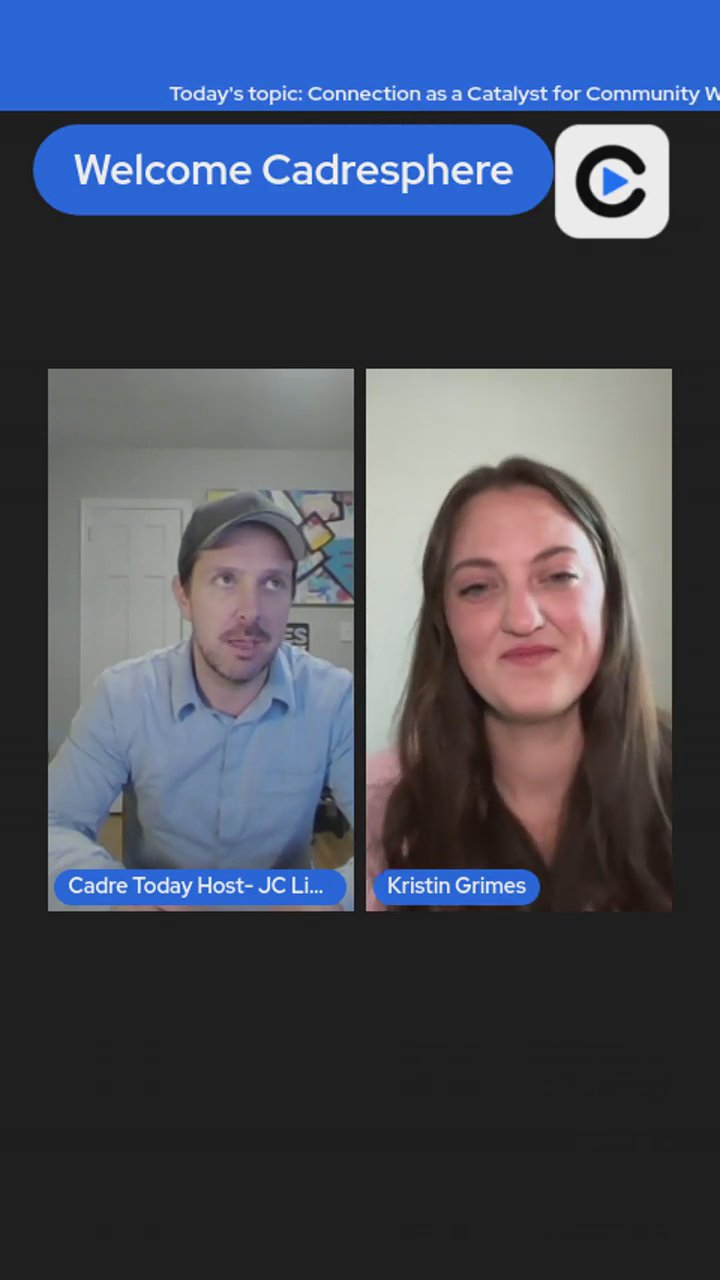
Cadre Today host, JC Lippold as he gives you a unique look into your favorite Cadre Contributors. Within this interview, you'll experience folks being real, folks caring about you and others, and folks fostering space for beautiful nuggests of insight and inspiration to appear. This week we welcome Kristin Grimes as we talk about using connection as a catalyst for community wellness.
"It's kind of happy hour everywhere. I have a Swoon pink lemonade. Love it, " she says. The show airs at 4:00pm Central Standard Time, 3:00 pm Mountain Standard Time and 5:00 Eastern Standard Time.
We are going live in streamyard for our Cadre Today interview. Where you are and what you're doing right now, Cadre, this is your Cadre today for today. Our hope always is anytime you jump into the Cadre sphere, that you feel a little bit better when you jump back into your real world.
Kristin Grimes joins the Cadre Today interview space. These interviews have three parts in. format: I ask Our person. How are they? What do you do? And how does it make you feel when you're asked those questions? If you have questions to say, everybody feel free to throw them in a chat.
A dietitian has a full undergrad degree at this point. It can kind of be in anything. As of last year, you also have to have a master's degree for any new incoming dietitians. We are legally allowed to give medical nutrition therapy to people.
Kristen: Dietitians work with humans, like all of them. Luke says he enjoys your segment on Saturday mornings so much and that he learns so much. The dietitian may want to talk about something that has nothing to do with dietetics.
Kristen, I want to talk about connection as a catalyst for community wellness. What it means is supporting your community and their overall well being through connecting with them, existing in life with them and sharing knowledge with them. It's something that I've been really feeling drawn towards over the last couple of months.
Kristen learned about this concept through connection in the community of, of being online. Most humans are deficient in. In community and connection. Providing those resources that for whatever reason they don't have access to before is building a connection with them and you're supporting their wellness.
Kristen: How is being a dietitian changed your own relationship with food and diet? She practice from an intuitive eating lens, primarily. Kristen: More compassion for myself is something I've learned through this career. And also empathy because I work with so many people from such different backgrounds.
Dietitians are so in the. here's what we know to be true and here's the intangibles of the unique human experience. Let's use connection as a catalyst of understanding to change the community wellness to the individual.
Is it a good idea to use apps at the grocery store that give alternatives to highly processed foods? Your intention is the most important thing to me when I'm working with clients. And I love that your intuition is most important driver to your decisions.
It is a good thing to be uncomfortable in community. If something feels uncomfortable, that usually means there's some growth there. Community wellness impacts individual health and individual health impacts community wellness. Great takeaway, great conversation, and everybody, the weekend's waiting for you.
Kristen, are you going live tomorrow morning? I am, admittedly, I totally forgot last weekend, so I was not there. But I will be live tomorrow. It's snowing in New Orleans. Check out Kristen's regular live stream Saturday mornings.
Well, hey there, Cadre. It's kind of my bedtime. I can't believe we're doing a live at 4:00pm Central Standard Time, 3:00pm Mountain Standard Time, 5:00 Eastern Standard Time. So it's kind of happy hour everywhere. And somewhere I got my Shaker bottle of water because I didn't grab a Mountain Dew or anything. But wait, what'd you have there, Kristin? I have a Swoon pink lemonade. Oh, swoon. Love it. Well, no matter where you. Where you are and what you're doing right now, Cadre, this is your Cadre today for today.
Speak Wonder Jules. It's nice to see you, my friends. I'll be letting Kristen know who's live since I have the Cadre here. And we are going live in streamyard for our Cadre Today interview. But before we jump on in, like I always say, we hope you're doing great, but if you're not doing great, that's okay too. Cadre's creating that space where it's not when I'm good or when I have energy or when I'm fired up that that's when I'm working on things. But if right now you're going, here's where I am and here's what's going on, that's a really great space to go ahead and consider how you are existing.
And our hope always is anytime you jump into the Cadre sphere, that you feel a little bit better when you jump back into your real world. So I am excited to welcome Kristin Grimes into the Cadre Today interview space. We started doing these interviews in Cadre Today because we realized that conversation is another way that we pick up information that we glean off the things that we need when we're looking and curious about our own wellbeing. So, Kristen, how are you, my friend? I am hanging in there.
In all honesty. Been a week, but I'm here. I'm happy to see you. I'm happy. The names you read off, I know. So hello to my friends. And they are throwing the hearts and they are throwing the. The high fives and the. Jules, sunshine has come to life too. So if you have questions to say, everybody feel free to throw them in a chat. If you're like, ah, I've been meaning to ask Kristen this question. You can derail this conversation. I don't think it's derailing. I think it's sending it in the direction it's supposed to go.
But these interviews have three parts in. In format. The first one is I ask Our person. How are they? What do you do? I don't. Who are you? What do you do? And how does it make you feel when you're asked those questions? Because we know the way that we have to signify ourselves in the world often creates a lot of anxiety. Well, Kristen, who are you? What are you doing? How do those questions make you feel? I'm gonna start with the last one of those. How do those questions make me feel? Unsure every time I'm asked, who am I?
You know, even, like, those questions that are, like, tell us a fun fact about yourself. You know, how do you encompass an entire human into that? But it does bring me a little bit of anxiety trying to, I don't know, like, simplify myself. Who am I? I'm a human that exists in Colorado. I really love my dog. I'm married. I'm learning how to be a better snowboarder. I'm a beverage person. So I will always have something in my hand, and usually it's not water, because I'm really bad at drinking water.
What else do I do? I drink a lot of coffee. I like to hike. I do it on a mat. And I work as a dietitian working with eating disorders, so. And I make content for fun. Bravo. On, on. And again, I've been so enamored with our contributors when I've asked that question, because most of them, I think pretty much all of them have gone into the things from first that they are. That they love, that they're passionate about rather than going, my job is. And I also love that you said I love my dog before you said that you're married, because that's the right order.
We should always talk about our animals before we talk about our humans. But I want to ask one more question, because again, you spoke about having to validate ourselves or almost monetize ourselves by when we answer these questions, like, what is my worth? And how do I say that quickly? But again, you shared your profession. Dietitian. Can you. For the world. Because I think we live in a world where dietitian or nutritionist or. Or nutrition coach, like, all these things. When it comes to what we consume, all the words kind of meld into being.
Oh, so you're kind of like X. But what is a dietitian? If you want to jump in there for a moment. Yeah. So a dietitian is also a nutritionist. A nutritionist is not a dietitian. So dietitian has a full undergrad degree at this point. It can kind of be in anything My undergrad is in nutrition. You have to go on to do a dietetic internship, which is 1200 supervised hours in a variety of settings, and then pass a board exam. And actually as of last year, you also have to have a master's degree for any new incoming dietitian.
Nutritionist. Anyone can call themselves a nutritionist. As a dietitian, I have to abide by state licensure. So I am like an official health care provider that can bill insurance and do all of those things. And we work with people in a variety of settings, from outpatient, long term care, inpatient, online, with pretty much anything you can think of. So general wellness, specific diagnoses. We are legally allowed to give medical nutrition therapy to people. Yeah. So in a very. Like the two things I want to bring up there that are really important.
Number one, or I guess one is a question. So you can have a Bachelor of arts or a Bachelor of Science, but your master's is a, is a didactic. Yeah. If you have an undergrad in something else. So really the core curriculum is a didactic program in dietetics and that can be in an undergrad setting. For me, it was in my undergrad that can also be in a master's program. So as long as you're completing the required coursework that is decided on to be in this program in whichever way you do that you can, you are eligible to then move on to the next step in the process.
Well, and the second thing that I heard that you say that I think a lot of people don't know that I was one of those people, is that dietitians work with humans, like all of them. Sometimes we go, in this world, it's like, once I have a problem, then I go to the X. You know, it's like, you know, in my ignorant world, it's like, oh, dietitians are for people who have diabetes and people have eating disorders. In other words, it's like we enter into the conversation about how do we sustain and support our livelihood.
Like, when did dietitian come into that conversation? It's when bad things happen, when in reality it's, it's, it's the opposite. Dietitians are supporting people in every phase of, of understanding how they, how they nourish themselves. Yeah. Yeah. Well, hey, Luke has jumped into the call too. And Kristen, Luke says that he enjoys your segment on Saturday mornings so much and that he learns so much. Oh, thank you. I always am like, I don't know what I'm going to talk about or if this is going to be helpful for anyone.
So that means a lot to me. I appreciate it and I second that. I love your Saturday mornings too. So the second thing that we talk about in these interviews as kind of the starter of the conversation is, you know, whenever I reach out to a contributor, I say, so what do you want to talk about? And I leave it that vague, that open because at the end of the day, guess what? The dietitian may want to talk about something that has nothing to do with dietetics. Because dietitians are also humans. Just like the counselor is a human and the human is also someone who has expertise, peer and professionalness.
All these things weave together. When I asked Kristen, Kristen said, I want to talk about connection as a catalyst for community wellness. So why is this a front of mind conversation for you? Why do you bring it up and what is it? Yeah, I did not invent this concept. I will preface with that. And it is something that I am still learning about myself. But I think it's to me what it means is supporting your community and their overall well being through connecting with them, existing in life with them, sharing knowledge with them and just generally being around them.
It's important to me. I don't know if you asked that, but I can't remember. I'm gonna, I'm gonna say why this is important to me because something that I have been seeing, I started making videos on Tick Tock and more recently Instagram maybe like I think it was like mid Covid just for fun, you know. And from then to now I've really seen an increase in like isolationist wellness. Like really seeking how to along the lines of this like biohacking of yeah, I'm gonna do these things and I'm gonna be at like my peak, which is fine and great and like good for you.
I'm happy if that makes you happy. And to me I'm observing that to be at times at a cost to the people around us and the people that we interact with on a day to day. Maybe your family, friends, random people you come across while you're doing life. And so that kind of push towards the more. I don't want to use the word selfish because I. That has a negative connotation and I don't believe that that's always a negative thing. But I think for like isolation, this is probably the best word that I can think of is it really is doing these things purely for me and I want to be able to push that outwards because community health impacts us.
Right? Like we don't exist as a single being on, on the earth. Everything we do is interconnected. You know, the resources we have, not everyone has. So in becoming more aware with the people of the people around you, and putting yourself in spaces where you can actually build a meaningful connection with someone, where you can share your knowledge and your expertise and your resources boosts the health and well being of our communities, which in turn benefits us. So to me, that's what it means.
Like I said, kind of a new concept for me, something that I've been really feeling drawn towards over the last couple of months and hoping that I can get some boots on the ground and figure out more ways to bring that to fruition in like real life, not just online, but also in real life. Well, because I would say it's like, like, Kristen, I've seen you do this for quite a long time, you know, and one of the ways I see you do it is by, you know, where a lot of kind of the wellness world exists in the binary.
We talk about this a lot. Right. Cadre is a place where we say there are many ways to wellness. You know, like, Kristen, you're so good at going like whenever there's a statement of this is right or this is wrong or this is the good or this is the bad, your response is normally, maybe for some people, but actually in the collective, let's look at the nuance of how all of these things fit together. So two things. Can you first let us know who you learned this concept from? Because I think there's a nice, a nice connection point there because even like you learned about this concept through connection in the community of, of being online.
Yes. So I learned this from my friend Carly, who I actually met through TikTok, which honestly has been a really big surprise for me to be able to make those connections on Instagram. Her name is the well being scientist and she is, she lives in Canada and is working on her PhD in like the science of well being, which I think is a really unique and to me unheard of path, which I think is really cool. So I learned about this from her. She's really kind of been pulling a lot of even just research into why this is really beneficial.
So she has some really great resources on a little bit more of the in depth pieces behind that. Yeah. So can, can, hi Carly, if you're out there, can you, can you provide an example of either in real time, boots on the ground, person to person, or online how you have put this into place? Because I see you doing It. So, so, so get. So give an example so people can understand what this looks like. Yeah, so a big piece of it for me, I think I was working on it this morning. I sent an email to my city mayor and asked if there was any sort of, like, city health and wellness event or even just like a random city event that I could put a booth up at so that I could talk to people and share the knowledge and expertise that I have as a dietitian in the health field to people that maybe wouldn't otherwise be able to get that knowledge, whether it's monetary resources, whether it's even just like, having health care or just like, not knowing that this is information that could potentially benefit someone.
You know, I think my. One of my good friends was like, I don't have. I asked, you know, if you were to teach someone one thing that you think someone should know more about. He responded, you know, this was Zach, Zach Anderson. And he was like, I don't. I don't have anything. I don't know anything that's, like, not Googleable. And my response to that was, everything I know as a dietitian is on the Internet. Like, nothing I know is new, but people don't always know to look for it or recognize that it could in some way benefit them.
And so to share the knowledge that you have is one way to. Right. Providing those resources that for whatever reason they don't have access to before or whatever, you're building a connection with them and you're supporting their wellness. And so that's. Hopefully. I haven't gotten a response yet, but I'm hopeful that I could do something like that in my direct community. Well, and Kristen, like, like you, you. You said it in a couple of different ways, but most humans are deficient in. In community and connection.
Just like we may be deficient in folic acid, like, and we can live deficient with deficiencies. We're an incredibly durable species, but we don't realize that community and connection is often the, the, the thing that makes other things soluble. It's like, yeah, I can find information, but I don't want information. I want someone to share that it's okay for me to be seeking the information. I want people to put it into my context. I want someone who looks like me validating my experience. I want someone who asks the questions that I'm asking myself, like, these are those things that bring us to life.
Ray Ray is tuning in. Hi, Ray Ray. Ray Ray has a question for you. Kristen. How is being a diet? I Love this question. How is being a dietitian changed your own relationship with food and diet? So often we think about, oh, someone has, like, a reason why they become a dietitian. No, but this question is saying, when you became a dietitian, where have you progressed since then? What have you learned? What have you seen? Yeah, so my pathway to being a dietitian was a little nonlinear. I actually. So I talked about how to become a dietitian.
I graduated with a degree in nutrition studies, which did not meet those, like, prerequisites. And I went on to be a personal trainer because at the time I got like, really into. What year was this? 2015, maybe there was a lot of, like, just women in the gym kind of blowing up on YouTube and social media. And I was kind of caught up in that and was like, this is really cool. Like, I want to be really strong. And my relationship with food then was very much like bro sciency, which is totally fine.
And like, is. There's some validity to it to a degree, but it is very black and white. And even in learning metabolism and like, biochemistry and those things are also very black and white. So a lot of your education in that process to become a dietitian is heavily, heavily. Here is the science, which science is science. And in all honesty, a lot of the application was very short. There was not a ton of emphasis on, here's how you apply this and work with people. And I practice from an intuitive eating lens, primarily.
That was not anything I learned in school. And so once graduated and actually working with people and learning that, okay, there could be five people who have diabetes and they are all in a different, you know, maybe someone also has the kidney disease where they also have. I don't know why I said the. But, you know, they maybe also have disordered eating. It really forced me to. Into that gray, right into that. We're not having these hard lines. We're going to live in the in between where it is uncomfortable and it is necessary.
And so I think that is the biggest shift that actually working with other humans in this career has done for me in my life as well. Because I said this a million times already. I'm a human. There are days where I have bad body image. There are days where, you know, I eat food and don't physically feel good. And being in this. In this career, I've in work talking this through with other people, like, that's okay and that's normal. And that doesn't mean anything one way or another. It is data. It is an experience and it is valid and we can just sit in it and it's okay.
So I think more compassion for myself is something I've learned through this career. More in between is something I've learned in this career. And also I think just like empathy because I work with so many people from such different backgrounds. Yeah, yeah. Speak. Wonder's got one here for you too. But before I reveal it, I'll say I love. I mean, I am adjacent to the dietetics community in a lot of ways in my life. And I love my dietitians because they are so in the. As you say, science is science.
They're so in the here's what we know to be true and here's the intangibles of the unique human experience. And these things together create not the take two of these and call me in the morning type of. Type of methodology. But hey, let's move together. Let's. Okay. And I just went back to your topic. Let's. Let's use connection as a catalyst of understanding to change the community wellness to the individual and change the individual wellness to the community. So I think your, your answer to Ray Ray is.
Is lovely. Speak wonders. Question. Is a good idea to use apps at the grocery store that give alternatives highly processed foods? Oh, what apps? I know, I'm like, oh, I didn't know that there's apps that are now shifting from highly processed foods. But also we could have a whole conversation on highly ultra processed foods. Yeah, non binary reality of that. Oh, yes. Yes, we can. You the honorary dietitian. Yeah, I, I'm not sure what apps you're referencing. I would say ultra processed foods in and of themselves are really, it's shouldn't be like emotionally charged.
And that's how a lot of the times it exists in our, in our world. When you're choosing foods at the store or if you've eaten foods in the past, I always encourage people to think about how do they make you feel physically? That's first and foremost. Also, is it out of a fear of not wanting to eat those foods? Is it out of something you heard online or read online? Obviously everyone has autonomy and I want you to have that. I would just want to make sure that you're doing that for the right reasons and it's being focused on.
I want an alternative to these Ritz crackers because I, when I eat them, I just don't feel great, you know, And I. That doesn't mean that you never eat Ritz crackers again in your life. Right? Maybe you buy an alternative. And if you're at a party and the crackers that are there are Ritz crackers, you're still able to eat them. But it's almost like informed consent of, okay, well now I know how these foods are making me feel. Yeah. So I always go back to, and I preach this with all of my clients.
Your intention is the most important thing to me when I'm working with, with honestly, I will say my specialty now is like medical conditions through the lens of disordered eating and intuitive eating. So we're killing a lot of, a lot of medical conditions. And the reality, as you were, you know, pointing out that I said, like there is science that we know, the reason that my field exists is that we treat different conditions with food. That's why I have a job and kind of the core of our profession.
And so your intention behind those decisions only you know the answer to. And I think Speak Wonder, if you ask yourself that question, if you're honest with yourself, that would be your answer. Yeah. And Speak Wonder says, it's a free app, they'll look it up. Speak Wonder also says, I love how positive you are. No shade on our choices. I mean, I'll also say as a non dietitian, as a human who's living in the world, who's looked at this industry, it's really easy as a consumer to go, wow, that person just told me this is good, this is bad.
It's really easy to go, sweet. I'm going to do what they say because they've already told me what is good or bad. The reality though is the complexity of your world. If you're listening to your intuition is bigger than that. Your intuition says no, but you're saying that this thing that is good or this thing is bad. I have a larger perspective or a more individualized perspective on goodness or badness. And I love that your intuition is the most important driver to your decisions. Like, like, I love that I may have paraphrased the end of that.
But I mean, like I'll, I'll quote you on that because at the end of the day we have a voice inside of ourselves that, that is on our side. But as we, because we could talk, we could talk for days. But the nice thing here in the country sphere is we don't have to because you can always come back. You can always find pre recorded content, you can always jump in the community feed and find those little morsels that are driving you. But the last question that we always ask is so we've been talking for 25 minutes.
If you're going to take a take, if you're going to give a take home prize to those who've been tuning in or tune in later. And also this take home prize will be shared in the community feed just in a little square. What are you taking from this conversation? Either from you, from the fact that we've been in dialogue and maybe something came to mind. What do you want people taking away from this that'll be sticky for them moving forward? Put me on the spot here, huh? Even like you sitting here, be like, I'm thinking it's so good for people to see that.
Yeah. I mean, like you said, you and I can talk for days. I think that the biggest thing that I would push people on as a take home price and intentionally make it sticky is it is a good thing to be uncomfortable in community. And I guess what I mean by that is like, for most people, it's uncomfortable. And if something feels uncomfortable, that usually means there's some growth there or that maybe there's a different perspective that you're not used to. Maybe there's something for you to learn.
It also just might be uncomfortable. And to some degree, that still is kind of growth for you to recognize the things that make you uncomfortable. It was something you said, and I can't remember how you phrased it, but you said something along the lines of like, community wellness impacts individual health and individual health impacts community wellness. Yeah. And to the point, like, I think everybody would buy in that. There's truth to that. But you're right on. It's like, it's a good thing to be uncomfortable in community because that, that is a sign of you becoming aware of things that are not in your regular mindset of your existing paradigms.
It's the reason why the same, like, the same reason why we pick up weight. Like, if we're gonna, we're gonna weight train, like, we pick up something heavy and we go, ooh, this is uncomfortable. Why is it uncomfortable? Because it's changing our awareness of our current capacity and. Or it's making us aware of our current capacity and inviting us to grow our current capacity. Progressive overload. Aggressive overload. Let's go for some trainers. So great takeaway, great conversation, and everybody, the weekend's waiting for you.
Kristen, are you going live tomorrow morning? I am, admittedly, I totally forgot last weekend, so I was not there. And I'm so sorry. Lovely. Like, that's what Shannon would say. We keep it real here. We keep it real here. Right. So if you missed Kristen last week, so did Kristen. It was. It was. Yeah, it was like we had a weird. I think Minnesota maybe did, too. And obviously all over the US has been a little crazy weather wise, but we had like. It was like 96 hours of negative temps, which is very weird for us.
And I just checked out of the world for. We were all. But I will be live tomorrow. It's snowing in New Orleans. I know. Yeah. And Houston. Houston, Pensacola, everywhere. Yeah. New Orleans put out there, like, first. The New Orleans weather office put out their first ever snow like winter warning or whatever the title is, which is crazy. Living in amazing times, everybody. All right. Well, as we wrap up, Kristen. Thank you. Check out Kristen's regular live stream Saturday mornings, 8:30 Mountain, 8:00am Mountain, 9:00am Central, 10:00am 8:30, 8:30, 8 30, 9:30, 10:30.
And we will keep on kicking here in the Cadre sphere 24 hours a day, seven days a week, every day of the year, y'all. We are here for you. We appreciate you, Kristen. I appreciate you. We'll see you later, everybody. Bye.
Reactions and comments are for members. Joining is free and takes a minute.