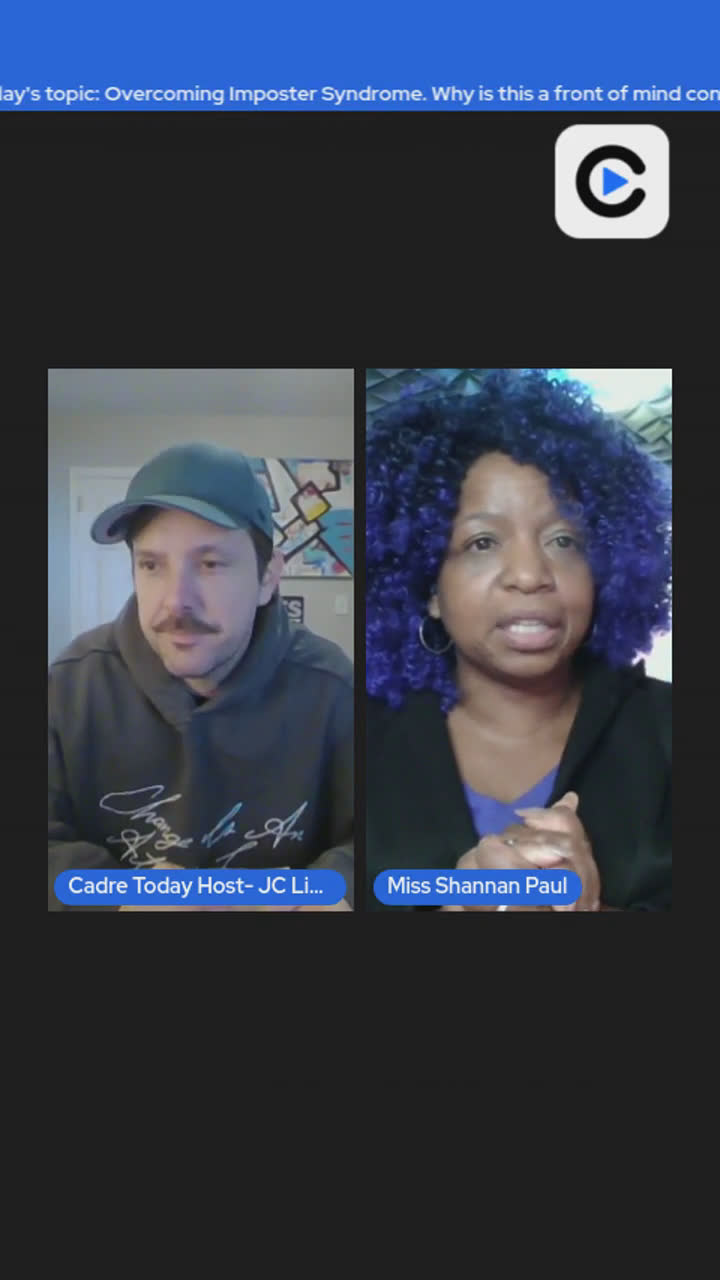
Miss Shannon Paul discusses code-switching, identity, and navigating imposter feelings while sharing how she frames introductions and encourages taking up space through storytelling and communication.
Good morning, Cadre. How are we doing? We hope that you're doing great. But if you're not, know that that is okay, too. It's okay to not be great and still think about how you can impact the world.
Cadre has the one and only Ms. Shannon Paul as our guest today. She says you don't have to be great today. Feel free to throw questions into the chat today, everybody.
Shannon Paul is a comedian, corporate speaker, voice actor, event emcee and benefit auctioneer. People's entry points into who you are as a human being is really broad. The definition of who Shannon Paul is is malleable.
The idea of code switching is the constant game. But to think of it as all of this is impermanent. My desire is to be known in this moment in a way that's going to be for the people around me to understand what they need to know. If we spend the time to slow down and get to know each human being on an individual basis, it's not very efficient.
"Most of the systems that are in place, those of us that feel that pervasive imposter syndrome, are correct in feeling it, because we are imposters in that space " "I actually figured out how to navigate this space and to do it well. That's something that you deserve to give yourself credit for "
J.C. Shannon: When I have a speaking gig, I bring along a printout of my bio. She says the worst is when people don't ask you for your intro. Shannon says this gives you more license to have a positive interaction with other human beings.
This world is craving for people to be who they are in general in the biggest of stages. Like, people want to know that the people that they're getting something from are people. People want to live in a space where the imposter reality is further and further away.
Luke says identity is an identifier, not a definer. Meaning being many of things is a beautiful thing instead of being known as, as one thing. It's interesting the things that we do to ourselves that get in the way of being authentic.
Ms. Shannon: The thing I want to leave people with is you deserve to take up these spaces that you are in. You're there for a reason, even if it's just, hey, I saw the invitation. Instead of going, I'm gonna figure out how to enjoy this.
Ms. Shannon, when, when can people find you in the Cadre sphere regularly? I am on Thursdays on our caregiver Thursdays, usually at 2pm Central. This week we're going to talk about how sometimes life throws you a mess, but literally it's what you ended up needing.
We have a second Cadre Today interview this week. We'll be heading to Boston for conversation with registered dietitian Jay Petruno. We talk about how to be a functioning human being settling into the reality. Have a great day and we will see you soon.
Who I could listen to that music walking down or floating above the street any day, y'all. Good morning, Cadre. How are we doing? We hope that you're doing great. Right? You hear it every single day from the squeaky wheel. We're hope you're doing great. But if you're not, know that that is okay, too. Not okay coming from us saying, hey, you're okay, but that it's okay to not be great and still think about how you're doing and think about how you can impact the world and think about how you can connect with those people around you.
Good morning, Chris Fortman. Good morning, Jules. As you can see, it is Cadre today interview time, and we have the one and only Ms. Shannon Paul as our guest today. Ms. Shannon, how you doing? I am well. I am well. And I love the concept of talking about that. You don't have to be great today. I don't know how your autofill works on your emails and everything, but, you know, whenever I write an email and it automatically wants to lend its assistance and have it end on have a great day, I tend to.
I back that up because I'm like, that's a lot of pressure that I'm putting on. Whoever this is, have a great day. Have a great week. I at least try to most days go, be well or have have a good good, I think is a lot more attainable sometimes than great every single day. Well, and. And again. And if the assumption is, hey, have a great day, meaning you should have a great day, we may desire that for ourselves. We desire that for people. Hey, Angel O Kid. Hey, Jules. Hey, Speak wonder. Nice to see y'all.
Absolutely. All of your friends. I know everybody's showing on up. Feel free to throw questions into the chat today, everybody, and I will relay them to Ms. Shannon. Speaking of, I say Ms. Shannon. And Shannon jumps in, hello, Additional Shannon and Shannon. So, but no, you're absolutely right. The way that we phrase things, even the end of the email, I always do a hey, hope your day is bright. The hope meaning here's what I would wish. But then I also want to write a whole, like, soliloquy afterwards.
But if it's not, that's okay. So for those who do not know, our first question is set up to allow people to get to know who our guest is and also how we often respond to questions like, Ms. Shannon just rose. So, Ms. Shannon, who are you, what do you do, and how do these questions make you feel? I am Ms. Shannon Paul. I am a comedian. Corporate speaker, voice actor, event emcee and benefit auctioneer. I focus in a variety of word related things and that's really what I am as a professional storyteller and communicator.
And I like these kind of questions because you asked it in a way that I have had to train myself to answer and succinctly, like, try to sum up the multitude of things that make me who I am and allowing myself to change those bullet points and going, well, this is what I focus on because there's some people that know me only as a comedian. There's people that know me because they've seen me on tv. There's people that know me because they're part of the autism community and they know that I do stuff there.
And people's entry points into who you are as a human being is really broad. And so you have to kind of go, well, for this setting, what do they need to know to be able to shorthand who I am? So I led with that because I'm going, well, if you're pinging into this in the subject matter that we're going to talk about over the next few minutes, here's what you probably need to know about why I would want to talk about this subject matter and where it comes from, but also allowing everyone to go, the definition of who you are is malleable.
Yeah. And malleable and broad. And you don't have to be a primary box of here's who you are and then stay with that. And you certainly don't have to stay with it for your entire life. Things change. And that's one of the wonderful things that in my particular mindfulness journey, like once I really was able to, to really encompass that idea of impermanence that actually freed me up a lot of going. This is a moment. It's not necessarily forever. It could be a good moment, it could be a bad moment, but you're allowed to just rest in that moment and then go, there'll be another moment that's going to follow.
Wow. I mean, first of all, like, that, that way of approaching, you know, so as, as a, as a gay man who also does lots and lots of different things, the idea of code switching is the constant game. But to think of it as all of this is impermanent. My desire is to be known in this moment in a way that's going to be for the people around me to understand what they need to know. So how does it make you feel to have to answer those questions in that way? Um, rather than just being able to go I am. However you would authentically root yourself.
I try to focus on the fact that at least when I am offered the opportunity to ask those questions that people are giving me the, the, the the a moment to describe and define myself jumping to whatever legacy definition they're already going to jump to. So at least they're not going by whatever that what that the way our brains work like a Pandora or Spotify playlist. I've met a black woman before. I've met a woman with blue hair. Maybe they already know one of me. Who knows? And that's the point is that they don't know me, but they could easily jump to the I think I do and trying to figure out what that means.
So I put that into my gratitude practice. Oh, at least they're giving me the opportunity to decide define myself right now and to go a little deeper than whatever that visual or physical manifestation of what they think I'm going to be is. And that I appreciate. And that's, that's I, I, I. It does make me feel grateful. I'm like, well, I get to explain who I am versus Nope. This is the expectation do this or go ahead and hit the, hit the hit the road lady. So well, and, and everybody who's listening.
I think this is one of those mental health, as Ms. Shannon would call hurdles, and that is living with the assumption that what people want from you is to have you know them in a concrete way. To go and say, oh, like this is this person and you're going, well, maybe that's, maybe that's your perspective of who I am or maybe that's how you're comfortable of knowing me within your life. But to put me in that box may not be the most loving and caring thing to do right now. Right. And it may not be the best thing for you either.
There might be a portion of me that actually works better with what it is that you need if you give yourself chance to go, well, this is how this actually works versus, I mean, and I know why we do it. I mean there's millions and millions and millions of human beings that you can run to in any time. And so we have a tendency to just go, how can we file through this as quickly and as efficiently as possible and get back to what we think is the priority of what we need to be doing. So if we spend the time to slow down and actually try to get to know each human being on an individual basis, it's not very efficient and it actually leads to A lot of awkwardness sometimes because we're not good at it sometimes.
So I think that's part of it. The reflex mechanism of just being able to put people in buckets works faster. Oh, absolutely. Well, and again, like Shannon in chat said, I appreciate the term legacy definition. And again, maybe culturally we often call that, like, hey, what's your elevator pitch? Or. Or if you can't say what you do, or within a very short amount of time, it's like, oh, you need to go ahead and get a coach and jump on your LinkedIn and, and use some AI to go ahead and help help them tell you who you are efficiently.
Right. And that process of, you know, I went through that as a, as one of those people that does a variety of different things that are in the same bucket. I kind of went through that process too. Because if you can't define yourself in a way that's like, something but different, then you're right. From a professional standpoint, it's very difficult to move forward. But it was for me, going, well, what. I get to decide what that title is. And, you know, so I sat down. The, the main thing I was focusing on back to our LinkedIn pages, is it would say multi dimensional event leader.
And, you know, I sat there and workshopped that with a friend of mine because I did feel that people knew me from one bucket. And if they knew me for one bucket, then they'd go, sometimes when they wanted somebody that was in an adjacent bucket, they knew that I probably did that, but they didn't know that. Oh, yeah. Because the entry point to me was they knew me as a comedian and now they want somebody that was an interviewer. But then people who know me from the radio go like, she's talked. She's interviewed Barack Obama.
She's talked to Nelson Mandela. She's talking. They knew that. And they're like, well, is she funny? And they're like, okay. And then they'd go. And then the people who knew that I were funny, they're like, hey, we're launching a podcast and we want somebody that knows how to, how to do that. And do you do that? You know, and you know, or I've had an actor friend of mine go, I need a benefit auctioneer. And our executive director said, they saw you do that. I didn't know you did that. And so there's so many layers that we all have because we're all amazing onions is that people don't have time to always un, you know, unspool all the different layers you have.
Or figure out what kind of onion are you? Are you yellow or purple or. Or all these other things. And so you have to do that for yourself sometimes and figure out what the shorthand is. Well, here's what you need to know quick. And then hopefully they get to know you well enough because you've known me for a while. And then it's still, every once in a while you're like, wait, you know, how. How can you know that? And I'm like, because I'm older than I look, that helps. But because you have a lot of time to absorb information.
But also going, well, we hadn't gotten to the point that I was gonna word vomit the giant amount of things that I've managed to do over my life, but when it came up, it was like, no, I do know how. I. I do have a background in that as well. Not in a way that minimizes what it is that you do, but I do say that there's a variety of different ways that we do. Which brings us back to why I end up working with people about imposter syndrome. Because the thing I. I think is most interesting about, if you look at the actual definition of imposter syndrome, like, from a.
Here a psychological standpoint, what do we do and why do we put ourselves in that space? It's absolutely valid because most of the systems that are in place, those of us that feel that pervasive imposter syndrome, are correct in feeling it, because we are imposters in that space. Yeah, you and I have spoken about that before. It's like, well, yes, of course. I feel like this space isn't made for me. It was not. It was a space that existed for whatever group. And instead of giving myself additional credit for going, you have figured out how to navigate this space with a plum.
You've come in this space and figured out how to make it make sense for you and to achieve. Instead, I'm like, oh, I'm in this space. And the skill set that got me here, the work that I did to do well in this space, instead I make myself smaller and I feel bad and go, well, they're going to figure out that I don't deserve to be in this space. I was like, no, I deserve to be in the space even more because I had to figure out how to get into it. I had to figure out how to get a skeleton key and unlock the door and then fit inside and maybe had to shimmy past a couple of drain pipes to get here.
But I actually figured out how to navigate this space and to do it well. And that's something that you deserve to give yourself credit for, not pick yourself apart because of. Well, and again, like, like if right now you're going, okay, like, like who's this? Like who's the space been designed for? Depending on which lever we're looking at what the task is, you know, like I always come back to the, you know, maybe seeming shallow or playful versus reality of like right handedness and left handedness.
Unless, unless you've ever really spoken to one of your left handed friends, you don't know what it's like to live in a right handed world. Right? Like the amount of lawnmower accidents in the left handed community versus right handed community is 20 is, is 20 times worse because lawnmowers like your lawnmower is a right handed lawnmower. Everybody runs out to their garage and they look at it and they go like, is there an R in the corner? Like, like, like is like a sock. It's like, no, but think about how it's designed, attempting to live in that space but now take it into something that's really, really like detrimental.
It's like, like are, like, are you living in a, you know, like, like yesterday I, I, I, I gave a keynote in a room that all 300 people are all very, very similar in most ways. Right? They did the world in which they live the way they do, family the way they do, love the way they do. And I was different. I had in real time go, first of all, it's like, is this a room I should be in? Like, do I belong here? And then second of all, how quickly can I go ahead and do that dance? Ms. Shannon, we have a couple comments in the chat here.
I'll go ahead and start with Speak Wonder. Speak Wonder says life hack for presenters. When I have a speaking gig, I bring along a printout of my bio because, because it's a crapshoot how they might introduce me. Yeah, I, I try as much as possible to actually email them my, my introduction. So I have a difference between my introduction and my bio. My bio is very robust because that is something that I'm giving to people so that they book me to the thing in the first place. Now do they need to go through that entire bio when I'm doing a keynote or doing a, a workshop?
Usually no. But I do tweak that based upon what it is that I'm doing and the organization that I'm at, where I'm going. Okay, this will tee me up for the subject matter that we're going to get to. Here's something that I think is relatable that I'll be able to use as an icebreaker or what's the theme like? I have a keynote that's coming up next month and their key, their, their overall theme is gratitude. So I'm changing the way that I, I focus my introduction to pull out the key points that I think are important for that and to lead them into it.
Because otherwise that is the worst. Like, I don't know if you know it's so. It's such a first world problem, but anybody that does professional keynotes, the worst is when they don't ask you for your intro and you see some poor executive up there struggling and reading your entire like thing. When you're going, Mary, you don't have to. Mary, I, I always want to stand off to the side and go, Mary, you don't have to read that whole thing. That's, you know, just. I know that your admin pulled that from my website, but I.
No, just tell them here's all they need to know. The rest I will get to. They don't need to know the whole thing. It's so awkward and so just I feel bad for him. Plus, I give myself a lot of credit. I think I came up with a good bio. It's this long and, and, and it's already. Because we've said that we're layers upon layers upon layers. So a lot of times our bio is. Since we need to do this, no matter how much I put in my bio, there's still been times and when I do my first advance meeting with somebody, they're like, your bio doesn't do you justice because you don't, you know, there's like, oh, you can do all this other stuff as well.
Right. But there's no point in me flooding you with all that information when you're not going to be able to process it fully. I'll give you the information to be able to do this particular interaction as well as possible and then giving us an. And I say this from the perspective not only as the person who's providing the information, but for you as the person who is receiving the information that it's like, okay, well, let me tell me what you think. You know, the way that you said the J. C. is well, what information do I need right now to shorthand this interaction so that it works as smoothly as possible for both of us?
Yes. And that I think is very valuable. As you're starting that process is going instead of me going, yeah, you know, I read your bio and I know who you are. Well, this is what we're doing. And how do you want this to feel? How do you want this to respond? How do we want this to grow? That I think, gives you a lot more license to have a positive interaction with other human beings when you're interacting with them well. And again, this has come up a few times now when people go, your bio doesn't do you justice.
Kind of what they're saying is, I want people to see you as this person who is above because of what you've done, as opposed to, you are the person who is here today because of, of who you are and because of how you're going to make us feel and what you're going to provide and the clarity of where you're going to bring us to today. Right. Again, so often the imposter Systrom syndrome is going. They want us to be floating above the earth, right? In reality, our feet are on the ground and our feet on the ground in a really beautiful, positive, magical way.
Right. It took a long time for me to, you know, once. I won't say a long time. One of the, the rocks that I needed to turn before it became a wall when I started speaking in spaces was to realize they were booking me because of me versus the amount of letters I had behind my name, the other things that I could do. And there was a time when I was continually colle accolades and, and going, oh, well, once I get this one more accolade, then I'll do this. Oh, I need to have this other, you know, another space that I speak in often is the cultural sensitivity space.
And the overall breadth of the, the cultural sensitivity space. And going, well, you don't have your masters in that. You don't have this. Oh, maybe you need to get this and be a, you know, part of this society or get this additional certification instead of acknowledging you have 20 years of being a working in this space and going that 20 years is a value, even if it didn't end up with a particular letter. And I had to talk myself out of, like, I was really gonna go back to college and get another spade thing.
And I'm like, wait a minute, why are you doing that? You know, is that really going to be of value? And I'm very fortunate that not only was I able to question that for myself, but I have people in my circle or talking to my agent or talking to somebody else and go Is this going to just. Do you think I need this? Have you been getting the feedback that I need to have this, this additional accolade. And that I think is a value too is treat. Let having other people that you can bounce things off of because usually they'll see why you're wonderful before you'll see why you're wonderful yourself.
And they can accept that you're wonderful before you can accept that you're wonderful. And really training yourself to fully embrace other people's observation, their observations and then eventually being able to not only embrace it, to put it in a plot, a place in your mind that you can ping into that when you start feeling like, oh no, no, I don't deserve to be here, they're going to figure out I'm a fraud. Go back into that and go, no, you know, John thinks X. Yeah, why can't I think that as well?
And if you want to get it out of your head, I often use the. Well, people often refer to me as a. Because it, it allows me to at the same time validate, like validate the thing that I'm saying, but also. Exactly. Distance myself from the reality of going now again, you know, in that world. You know my favorite quote and I use it most days, Edith Wharton says the lights shared in two ways from the candle and from the mirror. You are a candle, right? Your mirrors helping you see, see how you're, how you're flickering in the world, right?
And I started with really working on my self esteem or just practicing it where I had notes I wrote down all the time. You know, I've changed it now, but a lot of my, my, all my, a bunch of my Internet passwords had something to do with the word self esteem for like years while I was working on that whole thing. I'm like, how many touch points can I have in my life that talk about, you know, your self esteem? And then once I felt like I made enough ground in that, then I pivoted to the, the land of self compassion and really working with that and using that to address my high functioning anxiety and all these other things that make me really good at my job and make me want to achieve and, and, and provide a great value to my, you know, not just to people who book me or who I'm working with, but just to people in general to be a quality resource for them, but to give myself time and space to go.
Nobody's expecting you to be perfect except for you. Yeah, that's it. You know? You know, and, and again, you Just had another wonderful moment there. It's like, you know, speaking about who we are in general, this world is craving for people to be who they are in general in the biggest. On the biggest of stages, right? Like, people want to know that, that the people that they're getting something from that they're inspired by are people. And now I'm not going to use the word just. And I'm not even going to use the word like, but people that they can go, huh?
I can see myself reflected in you. I can see me walking up to you and saying thank you and hoping that you understand how, how much I mean that. Like, people want. People want to live in a space where the imposter reality is. Is further and further away. Right? We got another oh, I love Speak Wonders comment here and Speak Wonders heading out. So this is a perfect time for me to say it. Speak one who says, today I can hardly wait to tell a fellow human that they are an amazing onion. Yes. Yes, please do that.
Yes. I'm like. And now Ms. Shannon and I will go work on our picture screenplay called the Amazing Onion. The Amazing Adventures of the Onions. Luke's got a great share in here too. Luke says identity is an identifier, not a definer. Meaning being many of things is a beautiful thing instead of being known as, as one thing. Love getting to know your depth and it's beautiful. Capital letters, says Luke. I appreciate, I appreciate that. And it's, it's interesting the things that we do to ourselves that get in the way of being authentic.
Like, overthinking. What's my, like, even. Like, it's early in the morning and when I get off this, I gotta immediately go and start getting my kid moving again so I can get him out to. Out to school. And I'm like, oh, I should put on my adulting clothes. I'm like, ain't nobody got time for that. Like, what do we. Nobody's gonna like. I thought about that. I'm like, oh, I should. I could put on like, no, I'm not. I'm not doing that. I'm like, they're getting the, the nerd shirt and a nice slippers.
I'm like, you got some of the fanciest hoodies. Because I am in my. C. i'm in my rich auntie phase. I'm in my middle class auntie phase. So we're getting there. Yeah. So I'm all like. Whenever I see, like, rich auntie loungewear on Tick tock, I'M like, oh, I do. Like, I have one now that I can't wear yet because it's Minnesota and we're in like the single digits. And I'm like, but you wait till we get to double digits once we get up to 15. And I could wear this rich auntie loungewear. Those camisoles are coming out.
It's like that with like a big long sweater, is like a three piece. And I was like, yes, yes. Tik Tok shop. I would like, get your fan, like, you're ready to go. Okay, well, let's this conversation. So many hearts fly in. One of the big things, remember at home, everybody is when you spend time with other people in conversation or in silence, when your energy mixes around. Normally there are some really beautiful things that come out of it that you, you don't plan, you don't see, you don't hear.
Because that's why we're designed to be around professionals and peers and to be reminded that there isn't a right and a wrong path. But there's many ways to wander. So in this conversation today, Ms. Shannon, what's the take home prize if you're going to be like, well, I just spent 25 minutes in the Cadre sphere, here's something that may be sticky for people. And then I'll throw this up in the community feed later. Absolutely. The thing I want to leave people with is you deserve to take up these spaces that you are in.
You deserve to take up the spaces you were in. And if you start with that, it's a good place to go. I feel uncomfortable here. And then if you can just take a moment to go, I deserve to be in this space. I deserve to be in the space. And maybe not to take up the entire space because we do share space with other human friends. But the space that you are there, you deserve that space, that air, whatever is in that particular session, you deserve to be there. You're there for a reason, even if it's just, hey, I saw the invitation.
I decided to take it because there's a lot of people who turn down that invitation. You know, if it's, you know, whether it's a networking event, a happy hour, a chance to go ax throwing, whatever it is, you saw the invitation and elected to take it. So you deserve to be in that space. And I know there's been lots of spaces. Jc, you and I can talk about this all the time where there's been spaces where we're like, oh, I don't know if that invitation was for me. And then you get there and you're like, oh, I feel super awkward.
Maybe I'm not supposed to be here. Instead of going, I am here, and there's lots of people who aren't, and going, I'm gonna figure out how to enjoy this and get to know these other people and walk in with curiosity and inhale and exhale in that space and go, I deserve to be here, y'all. The world needs you in the space that you are in. Yes. Ms. Shannon, thank you so much for 27 minutes of morning magic. Everybody in comments and throwing hearts. Thank you for stirring this, this magic this morning.
Ms. Shannon, when, when, when can people find you in the Cadre sphere regularly? I am on Thursdays on our caregiver Thursdays, usually at 2pm Central. This week we're going to talk about how sometimes life throws you a mess, but literally it's what you ended up needing. So I'm going to talk about that and just kind of focus on that, especially from the position of a caregiver. So we always love for you to do that. And if you can't find me live at 2pm Central, you can always find me like all the rest of our contributors out there in the replay, which I appreciate everybody that does that as well.
Yeah. So good. Awesome. Well, you're not going to see me tomorrow morning, Cadre, because we have a second Cadre Today interview this week. Tomorrow at 5:00pm Central Standard Time, 6:00pm Bostonian Time. We'll be heading to Boston for conversation with registered dietitian Jay Petruno as we talk about how to be a functioning human being settling into the reality and the chaos of the world. So jump back in there, everybody. Otherwise, have a great day and we will see you in the Cadre sphere soon.
Bye, Ms. Shannon. Bye.
Reactions and comments are for members. Joining is free and takes a minute.