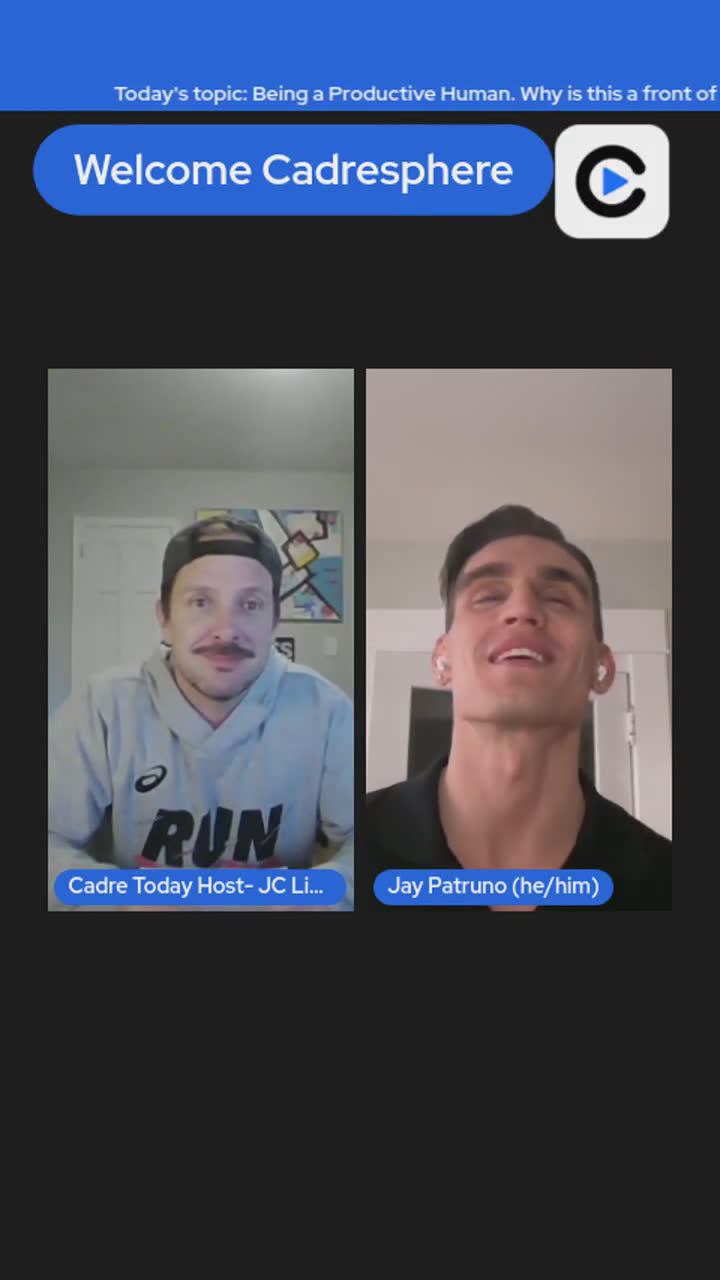
Jay Picciuno discusses identity beyond job titles, navigating conversations about health and work, and reframing productivity to include rest and varied forms of contribution through a candid interview on being human in wellness spaces.
Our guest Today contributor, wonderful human, Jay Petruno. As I always say, surviving, not necessarily thriving. No matter how you're doing right now, we are glad that you are here.
Jay Picciuno is a registered dietitian and certified personal trainer. He says the last thing he wants to do is tell someone what he does for a living. He asks: How do you answer those questions in those situations?
Please check out Jay's prerecorded content. Reasons why I think Jay has a voice that is super on the level of the person listening. It helps people understand not only who I exist in by myself, but how I exist with other people.
The second part of these interviews moves into this idea of we all have things that we want to talk about. How do you manage to do a lot of things at once? For people who are attempting to be able to do that, how do you figure out how to do it?
Jay Ellis: Who are you when you're not doing that thing? Ellis: My career is caretaking and helping others. I feel like my only identity has been the things around me. Ellis: Our existence is still purposeful no matter what.
Jay Parini: How do you be a productive human being? He says you have to know your limit first. The idea of being productive is producing, he says. Parini says there's a balance that needs to be struck.
Cadre: What would the take home prize be for for people? Jay: The idea that productivity does not have to be creation. Would you like to do a Cadre interview about the idea of the variability of being human?
Foreign. Oh, hey, Cadre. Nice to see y'all. This is our Cadre Today Happy hour edition. So rather than it being bright and early in the morning, we're coming to you from Minneapolis and Boston area with a little interview. So first things first, we hope you're doing great, but if you're not doing great, that's. That's okay too, right? We always say it's like, if you're here, we often feel like that's where we're supposed to be open and ready to rock the world. But in the Cadre sphere, we acknowledge that life looks like this and there's many ways to be well, so no matter how you're doing right now, we are glad that you are here.
Our guest Today contributor, wonderful human, Jay Petruno. Jay, how are you, friend? As I always say, surviving, not necessarily thriving. So maybe I'm one of those folks on the upward swing. Yeah. And again, even to have a human say that with a smile on their face and also pain behind the eyes of like, I'm doing what I can do. And that's the reality. So. Hey, Sarah. Hey. Dream big. Nice to see y'all today. So, yeah, Jay, you just, you mentioned before you hopped on, you may get the tattoo on the forehead saying, yeah, Ivan, not thriving, which saves you from having to answer what our first question is each time we jump into the Cadre sphere.
And that is on purpose, how are you or who are you and what do you do? And even more importantly, whenever you ask those questions, how do they make you feel? So introduce yourself in that way. I love the latter. I am Jay Picciuno. I use pronounce he, him, his. I am a registered dietitian and a certified personal trainer. And how it makes me feel. So it depends on the context. And something like this, I take a lot of pride in what I do. So I love talking about my, you know, my industries and my lived experience related to that.
But if I'm on, like a day or if I'm meeting someone new, the last thing I want to do is tell them what I do for a living. Because everyone feels the need to ask for free advice or to apologize for their food or their weight or something and then judges my what I order or eat and then also feels like they're judging themselves for what they order or eat. Yeah, two, two big things to call out. Number one, as a person who has lived in the wellness space and the fitness space for so long. But again, and Jay, like, like, you're exactly like this, too, you know, Both you and I are people who, who preach the, the change of systems of going.
We live in a world where health, wellness, fitness, food is, is inundated with, with shame and not enoughness and all these things we talk about. But no matter what we do, we still are looked at as the people who are right, the people who are going to judge. But the second thing, you know, the second thing that you shared is there's this relationship between being proud of what our vocation and our purpose is in the world, but also knowing that any conversation we enter into we have to code switch first.
How do I have to show up in this moment in order to be seen as how I want to be seen? So, so, so I have a question. If you, if you are entering one of those conversations where you don't want to say registered dietitian and certified personal trainer, how do you, how do you answer those questions in those situations? I typically will say something super vague like I work in healthcare or I work in sales, depending on whatever my role is at that time. Or like I'm a manager of people, potentially something that kind of deflects it from a topic of conversation or it's seemingly sensitive.
Right. Because people I think have more of a personal connection when you talk about food, movement and body versus if I were to say, oh, I'm a bank teller or I work in finance or I'm a manager of a grocery store, like something that's a little bit more operational, I think people don't have that like connection to so they don't really care. Yeah, we seek connection but also we protect ourselves from having to enter the conversation that, that may brand us with the scarlet letter of what makes people feel, feel less than.
So as, as we bump in everybody. This is your first time tuning into a Cadre Today interview. The intention of these is you know that you can find pre recorded content. Please check out Jay's prerecorded content. Reasons why I think Jay has a voice that is super on the level of the person listening but also unlike me, very quick moments of being able to go, here's a few minutes of something that's going to provide some daily bread, provide some, some nourishment, some perspective where I'm all my videos are like 20 minutes long, so buckle up.
I was told short and sweet, so I really focus on short and sweet. But, but, but. So we have the prerecorded content, we have the community feed where in real time you can communicate and share and then you know that you have these lives but this is a, is a newer way that we're communicating and that's, it's using conversation to maybe inspire that verb or that, or that progression in your mind as you hear us talk about, about real things. If you've been tuning into other interviews, you've heard other people answer that first set of questions with a, you know, I try to not talk about what I do when I answer the question who I am, or so and so forth.
And other people have gone, no, like, like, like what I do is, is, is part of my vocation. It helps people understand not only who I exist in by myself, but how I exist with other people. The second part of these interviews moves into this idea of we all have things that we want to talk about, not only our contributors when they're an interview guest, but, but, but, but everybody. So I'm very vague when I, when I invite someone into this interview space and I go, so what do you want to talk about?
Jay said, being a productive human, which I love it because there's so much fruit on that tree. But also what I mean, you could go so many different ways. So when you wrote this down in the Google form, why did you. Because I have the biggest foible of being really good at doing a lot of things at once and then also never not being able to do a lot of things at once. And it's almost debilitating to an extent that you can't. I've even posted content on the idea of like, stillness or like taking a pause or slowing down.
And it's so simple, but it's so challenging to do. We, I mean, we have our wonderful medulla oblongata, the part of our brain that, that deals with automated repetitive manual movement. And the more that we get into, I mean, how often do we talk about, and we, meaning like humanity as a species who are attempting to perform better. We always talk about forming habits. It's like form habits all of a sudden. You do all these things efficiently and effectively, but it also gets us in the routine of not being able to not do so.
So, so, so give it, get, get, give an example of, of like show off for a bit. And I know this isn't, isn't easy, but talk about, talk about when you, like when you're in your, your wheelhouse of going, I'm doing so many things right now, and it seems like I'm juggling all the balls. Well, like, like, what does that look like? Like, like what are all the things that you do? And you figure out how to do it. And for people who are attempting to be able to do that, how do you manage to do a lot of things at once?
Yeah, I'm going to tee it up in a way that has a better segue to my current practice. I'm really trying to challenge this more recently. So I spent a lot of years when I became an adult legally alone. And then after some like interpersonal discourse and trauma, I spent a good chunk of the last 10 years, like really isolated some to buy choice because that's habits build, right? You. You get blinders up. You sort of go tunnel vision through life. So in this, in this isolation or in this loneliness, I was responsible for everything.
I had no family nearby, minimal, like super close friends, wasn't really dating. So I would be working 50, 60 hours a week between two, maybe three jobs. I have two dogs, attend to all of the lifestyle stuff like grocery shopping, cleaning, commuting. I think my only hobby was I would take a few hours throughout the week since I was living in Florida and go to the beach. But even there I would be doing work or preparing for a class or a lecture on my phone, getting some like, purchasing that. It was just never.
It was never. It was never not like it was always something. So the ability to multitask and just feel like at the end of the day that exhaustion was worth something became the norm and also became really validating. Almost like I was identifying with the idea of being tired and overworked. So fast forward to where we are now to answer the second part of your question. For folks that are either in that position or who are desiring to not be in that position, like I've been really trying to pull back on.
It's almost like an identity crisis because I have never existed in this world not doing more than nothing. Even as a kid. I got my first job at like 13 athletics, after school programming, great grades, great social life, you know, divorced parents, a multiple family household. It was just always chaos whether it was controlled or not controlled. So, you know, being. Being in a position where you want nothing other than to rest and yet the only thing in your way is honestly yourself is such a weird paradox.
It makes me think. So I spend, I spend, I spend very much like old you. I spend a lot of my time in very. Wearing very many different hats. And two hats I wear right now is I direct youth theater and I direct senior citizen rock singing. So I'm working with two different groups of people in very different stages of life, but both using music as part of their Craft. And the number one thing that they all struggle with doing is making silence. They start singing, they don't honor. They aren't okay with being crisp on the out and crisp on the end because they think singing is making sound.
And I always say, no, singing is two things. It's making sound and it's making. But they don't know how to be A, making silence or B, being comfortable making silence. So it's, it's, it's the thing. Like they go, I am a singer, therefore I sing. And singing is making. So who are you when you're not doing that thing? So I'm going to reframe that first question one more time because I'm curious what your answer will be when you are not doing right now. Who are you in those moments? That's fantastic.
I'm still me. And that's the part that I have the disconnection with. And even my therapist read me for filth last night on some mental exercises that I do that are actually relatively toxic to myself, that are really similar to this non stop work mode and that like, not by not doing something, I feel like I am wasting my space, my existence. Like there's something internally that I can't, I have yet to understand fully about, about being okay, not being, producing in this world. Like, I feel like I've identified so much with my existence is to be here.
It is to take care of people on all fronts. Right. My career is caretaking and helping others. I've always wanted to be a parent. I've always had, you know, my family, my mother, my sister, like super close to me. So these like ideas that like, I'm a nurturer, whether it's a person or a thing. My dogs take up so much of my time and energy. So I don't know, I feel like my only identity has been the things around me. And I've not really had a sense of like just focusing on me, even if that means doing nothing.
Okay. Okay. But then you just in turn read me for filth. Like, like my bio starts by saying I am a professional homemaker. Like, like, like my job, my, my identity is to take space and make it something for everybody, no matter what's going on. A quick comment here. Oh, Sarah Monahan says, and Sarah, I cannot wait to see you on, on the Mac. Q and A coming up, I think later today. But Sarah says, we are all celestial beings, Jay. You will never be wasted space. Like even when you're not doing. C.
we all know that like we can and we share with other people, but it really is this process of going, how do we. And maybe part of the answer is we place ourselves in proximity to those people, like each other and like our therapists who can read us for film going, oh yeah, right, I need to recalibrate again. You know, I, I wrote down, I love writing down quotes in these interviews. And like when you said I was never not like, like that, like that is, that's four words that speaks dictionaries. So.
And part of it too, I feel like a spirit base, like even hearing her, like positive sort of affirmation to response to what I said. I think part of that, like, you know, our existence is still purposeful no matter what. How, how we play that card though, I think is where like my struggle is, right? Because I feel like there needs to be an attention to it and then like the subconscious side when it's not intentional. Like you, you know, I've surrounded myself in the past with people who are energy suckers because all I'm used to doing is giving.
So I put myself in the positions to kind of foster that cycle. And even recently to my, to my partner, I had said to him, you know, my fear about like him doing me favors or not tending to a particular routine is if I fall out of that habit, will I be able to go back? Yeah, so if you were going to. And this may feel. So Ms. Shannon Paul and I yesterday, the conversation topic on that interview was imposter syndrome. You know, you know, and Ms. Shannon, you know, like, I'm a, I'm a, I'm a gay man.
Ms. Shannon is a, is an autism mom and a black woman. And, and da da da, da, da da. You know, and we spoke about no matter what, we are always imposters in a cultural dominant world. So, so I'm inviting you to maybe enter into that imposterous space for a second. And you know, you, you help people for a living. If you were going to provide the low hanging fruit, even though it may be far to reach or far or hard to pick, what are those things that either you are currently working on, the tactical and practicals, those sticky things that if you're going to say, if someone said, jay, how do I be a productive human being?
First of all, what does that look like? And second of all, how would you guide someone to do that? I think, well, through my own mistakes. I think the right answer from me for this would be you have to know your limit first. You need to, I think you need to know what your boundaries, your. What the characteristics of your boundaries should be. You know, I posted. I posted a video before for Cadre on this idea of, like, the concept of ghosting and, like, can we reframe ghosting as being something that's actually beneficial if it needs to be?
Not that, you know, the malicious and sinister version is okay, but in the idea that energy in, energy out is a thing and there's a balance that needs to be struck. Like, it's. Whether it's a romantic relationship or it's a boss and superior type dynamic. You know, you give, but you should also be getting. So the idea of being productive is producing, right? It's an outward momentum of energy, but some of us also gain a lot from that. Like, I. My love language is acts of service. So I do receive this, like, validation by being able to do something.
So for me, I have to learn the limit, though, to when I'm pushing myself to burnout before I, like, continue down that cycle. So I think if people are trying to actually be more productive and get into a space where they're. They're tackling more things, you got to make sure your cup stays filled first. So as long as those things are there, then producing an externalizing things, I think becomes more appropriate and easier to manage. I mean, a thousand percent. I mean, and to hear. To hear a dietitian, personal trainer who in essence is speaking to know your specificity.
We always say a Cadre, right? We are. We are inviting the world to feel better by. By swimming in this space where there are many ways to being well, meaning what you need is not what someone else needs. I went. My partner was in a performance last week, and I had zero energy to give. So I snuck into the theater, I sat in the back row, and then I left before I could because I probably knew 25 people were in the audience. And I'm like, nope, I don't have anything to give to them. But I can walk into this space and be present for and hold space for while I'm respecting what I have to give.
And when people are like, you were there? I go, yep. Oh, why didn't you say hello? I just. I just didn't have it in me today to socialize. And it also helps other people go, oh, got it. JC's one of those people who needs to XYZ. So that's. But not being apologetic for it either, right? I think there's, like, there's. There's been a part of me that's also had A harder time to, to do that and trying to do that more now, but also feeling this like level of guilt for not attending to all of the things around me, but not in trying to just do the minimum that I can handle at that time.
I think that's awesome. Yeah. Okay, Jay, let's, let's bring this home. So the last question. If you've been on these interviews, you already know it, but if you're new here, hopefully what you take away in Cadre is something tactical and practical, something sticky that you can go, wow, that 20 minutes left me with this, with this idea or this thought. So if you're going to give a take home prize to people who've been tuning in, I want to say hey to Jules. Jules, how's it going up north? Michelle, a 101.
Nice to see you as well. What would the take home prize be for for people? Either something you already had pre prepared or something from this conversation that you may be taking for yourself. I think just the idea that productivity does not have to be creation and that's something that I'm actually just trying to figure out is like can I still have the same level of validation of doing less than or nothing than I would if I was running a million miles a minute before I laid my head down at night.
So just taking away the idea of like energy in, energy out. And that's probably a good place to start when you're thinking about how to either produce more, produce less. I could swim in this conversation always selfishly and I think selflessly, anything. If you are someone who cares for other people. You know, there's so many people who enter the Cadre space because they are caregivers or they are people who, Jay, like you shared their love. Language is, is acts of service. You, you can give what you have.
You, you can't give what you. So being sensitive to knowing what you have to give is the name of the game. Jay, thank you for wrapping up your day out there in the middle of the New England snow with the community. Everybody next week, let me go and hop in my calendar and see who we're going to be chatting with next week. One week from yesterday, me and Gene Mitchells dream big. You were listening today. I don't know if you are still there, um, but me and Gene will be bopping on next week, which is always a great conversation.
7:30 in the morning, Sarah's got the last word. Sarah says thank you. C. and J. Let's keep normalizing the variability of being human. Sarah, if you are. Would you like to do a Cadre interview about the idea of the variability of being human? Send me a message, if you would. Let's get on the schedule. Everybody needs it. Jay. Have a good one, everybody. Have a good one. We'll talk to you later. Thank you.
Reactions and comments are for members. Joining is free and takes a minute.