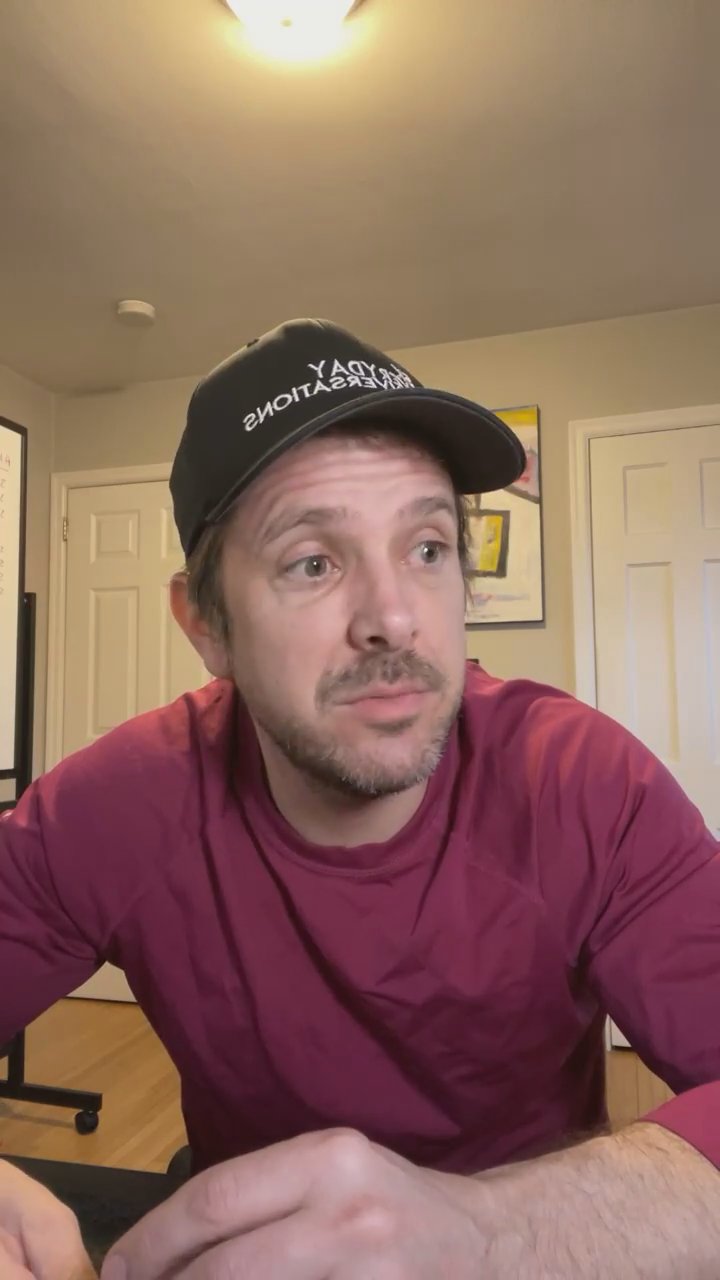
A livestream explores building community through movement and conversation, checking in on a one-to-great scale, reframing running as communal rather than exclusive, and recounting the 5K Everyday Conversations social movement.
Cadre: How are you doing on a scale from one to great? Are you blech or are you great? Tuesdays we talk about building community. If you're not doing great, know that being not great is okay, too.
In Minnesota, we are currently in the heart of third spring. Most people feel that they can't run or that they're not supposed to run. Running as a community is an inward facing click. It's a mechanism for how to build community clicks.
5k everyday conversations was a social movement that I started back in 2019. People would hold space for people to attend a conversationally paced 5K. When people move together, really cool things happen. You don't get to decide if someone else should feel safe or welcomed.
Good morning, Cadre. How we doing? This song drops. You're gonna feel like you're running, y'all. Little running on a treadmill. Running on a treadmill. Get ready, y'all. When this song drops, you're gonna feel like you got a whole week's worth of energy. Okay? I can't stop chasing you, y'all. How we doing, Cadre? That's a song by Ben Platt, who. If you ever saw the. What are those acapella movies called? Whatever those acapella group movies are called. He was the. The guy with the. With the. With the magic tricks.
The Star wars fan. But that song came out just a couple years ago. But it's got very much an 80s vibe to it, right? And the theme is running. But so often our theme on Tuesdays is how do we bring people together? Ray. Ray, Jules, Shannon, Robert, Speak, Wonder. We've got a crew here today. So many people came on in so quick. I didn't get to get to say hey to y'all. But I got a reminder for you. We really hope that you are doing great. So check in with yourself. How are you doing on a scale from one to great?
Are you blech or are you great? I always feel like I'm Tony the Tiger. I love me some cereal. All cereal. But if you're not doing great, if you need, like, a second, third, fifth bowl of comfort cereal this morning, know that being not great is okay, too. Why? Because you're doing something good for yourself right here. You're showing yourself that you are on your side. Tuesdays we talk about building community. So, you know, you see Betsy later on today, who does such a great job in this world of going, wow, here's where we are.
Here's what we can do on a global, worldly scale. Then later on, you see Dr. Leslie, who talks about that one on one ability to build community. An update on the Shannon scale for the day. Shannon says, I'm going nine today. This beautiful weather is amazing. Yeah. In Minnesota, we are currently in the heart of third spring. Fourth winter comes up tomorrow with some more snow, but today we are basking in third spring. Nine days before spring actually starts. So why did I play that Ben Platt chasing you song?
Well, so often, as, you know, if we've spared time, if we've shared time together before, I open my Spotify and I type in a word that's kind of thematic for the message today, and I typed in the word running, and there are not a lot of songs that have been written with the word Running as the focus point. Why? Because most people feel that they can't run or that they're not supposed to run or that they don't run. Right. Think about your world. Think about yourself. How often do you hear people say I am not a runner.
Run the verb. Like simply the word, the verb, the action is placed on such a high shelf. You'll never hear anybody say, oh, I don't, I don't sit. You'll never see anybody go, oh, I don't snap. 7% of people go, oh, I don't run. I. I'm not a runner. Why? Because it's been placed out of people's reach. As you see in the title for this live stream today. It says the outward facing click. The outward facing click is a concept. It's a mechanism for how to build community clicks. Often most of the time, by definition, make people feel on the outside of why?
Because the click faces inward. We go, oh, we love this thing. Like if I would say, ooh, I love this little heart. You love this little heart. You love this little heart. And then we protect ourselves around loving this little heart. An outward facing click would be like, whoa, we love this little heart. Let's face outward and invite other people to know that this heart exists and to invite them to love this little heart as well. Running as a community is an inward facing click. Over the last couple of weeks, actually over the last about 18 months, because I am in the running world and I'm a part of a Facebook group called not called, but all around the world major marathons.
So there are people who try to run all of the major marathons. And if you do, you can see behind me there's some marathon medals back there. Those are all the world marathon medals. Tokyo, Boston, Chicago, New York, Berlin and London. If you run those six, you are part of a small group of people who have done the physical task more so spent the money or raised the money to accomplish that. Well, there are more and more and more and more people running in the world. I'm curious, tell me about your relationship with running, everybody.
Do you run? Do you like running? Do you consider yourself a runner? Do you consider yourself not a runner? Do you remember elementary school where you were told that you're not a runner and you couldn't run the mile or you couldn't accomplish the pacer test or the presidential whatever fitness test that ruined so many kids lives? Tell me about your relationship with running. So back to this Facebook group. All of the runners in that Group like the people are like, I'm a part of it. Inward facing click runners.
They hate that so many more people are running because now every single course is crowded in their minds. To get into a race is a lot harder. And they're like, we like this better when there are a few of us doing it. Because they felt more special, but also it was an easier experience for them. I'm wearing this hat that says 5k everyday conversations. This is like a marathon lead up to the point today. 5k everyday conversations was a social movement that I started back in 2019, where every single day we, meaning the outward facing click that created this group, would hold space for people to attend a conversationally paced 5K.
So people who didn't know each other yet would show up at a random place together and they would say, hey, all right, we're here, let's start moving. And we would move at the pace that would let everybody be in the conversation. So in other words, if someone was not fast enough to stay with the people they were talking to, we weren't accomplishing our goal. So then we'd have to slow down. If you had two people who were engaging in a conversation and they could move fast and be in conversation, then they'd move fast.
We did this for, well from 2019. It actually still lives on. We had a 5k every day conversation yesterday. Actually happen in Bali, but still to this day. So that's six years. Thousands and thousands and thousands of runs, Tens and tens of thousands of runners. We still have people all of the time go, you know, I've always wanted to show up, but I'm afraid I'll slow people down. Back to how 5K everyday conversations works. We move at the pace of conversation. So we have people show up with strollers and walkers and canes.
People who the most distance they can move is maybe a tenth of a mile. And they with courage show up and they participate in the 5K everyday conversation at the pace of conversation. So if someone's talking to someone who can move a tenth of a mile and they have a walker or a cane, guess what the pace, what the actual like miles per hour pace is. 5 miles per hour and other times you have some pretty fast people who are going 8, 9 miles per hour. But the focus is not on the running. The running's not the main dish.
The running is the agitator or the inspirer for the moment. When people move together, really cool things happen. But still to this day, with all the great marketing, we've done. And the annoying voices that keep saying, no, you. You can't slow us down because we're moving at the pace of conversation. People don't believe it. So they go, yo, I'm not going to show up because I'm not going to be the person who ruins the experience for others and makes myself feel bad. Here's the point. Today you can say that you are creating a safe, welcoming space for other people, but you don't get to decide that.
You don't get to decide if someone else should feel safe or welcomed. They get to decide that over time, they may. With your consistency and persistency and welcomeness and outward facingness, they may go, okay, cool, now I believe you. Now I'm in. And they may never. They may never believe that, and they may never show up. If you want to create a welcoming, inclusive, included space, that's something that you're doing. They get to decide. They have the autonomy and the agency to go, yeah, now I feel like I'm ready to walk on in.
And that's the marathon that we walk or run whenever we're trying to create space for other people. We don't get to tell people if they should be safe or welcome. They get to decide sooner or later. Yeah, you know what? Okay. They have finally got me to a place where through all my experience and trauma and history, I'm ready to be curious or courageous and walk into that circle and see what there is to see. So my invitation for you is, if you're like Jules and you love running, great. Run the way that you run when you run, how you run and give yourself the grace that you attempt to give other people with the outward facing click.
And if you're on the outside looking in of that thing, if you ever feel like, yeah, you know what? Now I want to walk into that circle. Now I want to be a part of that thing. Test people's invitation, test people's welcomeness. And that's the gift you can give to people. Because if others think that they are creating a welcome, inclusive space and you don't feel it, the best gift you can give them is to be like, hey, I didn't feel it, but I'm a part of it. So what can we do to make people like me feel a part of it?
As they say, the outward facing click. It's a marathon, y'all. So settle on in as Ben Platt keeps playing for us. I hope you have a great, great Tuesday, everybody. This afternoon, Colleen and I will be back for our second session. Of youf can't say that on social media, where we talk about the civil discourse and how we use social media in a positive, inclusive, outward facing click way. So have a great day. We'll see you this afternoon. Bye.
Reactions and comments are for members. Joining is free and takes a minute.