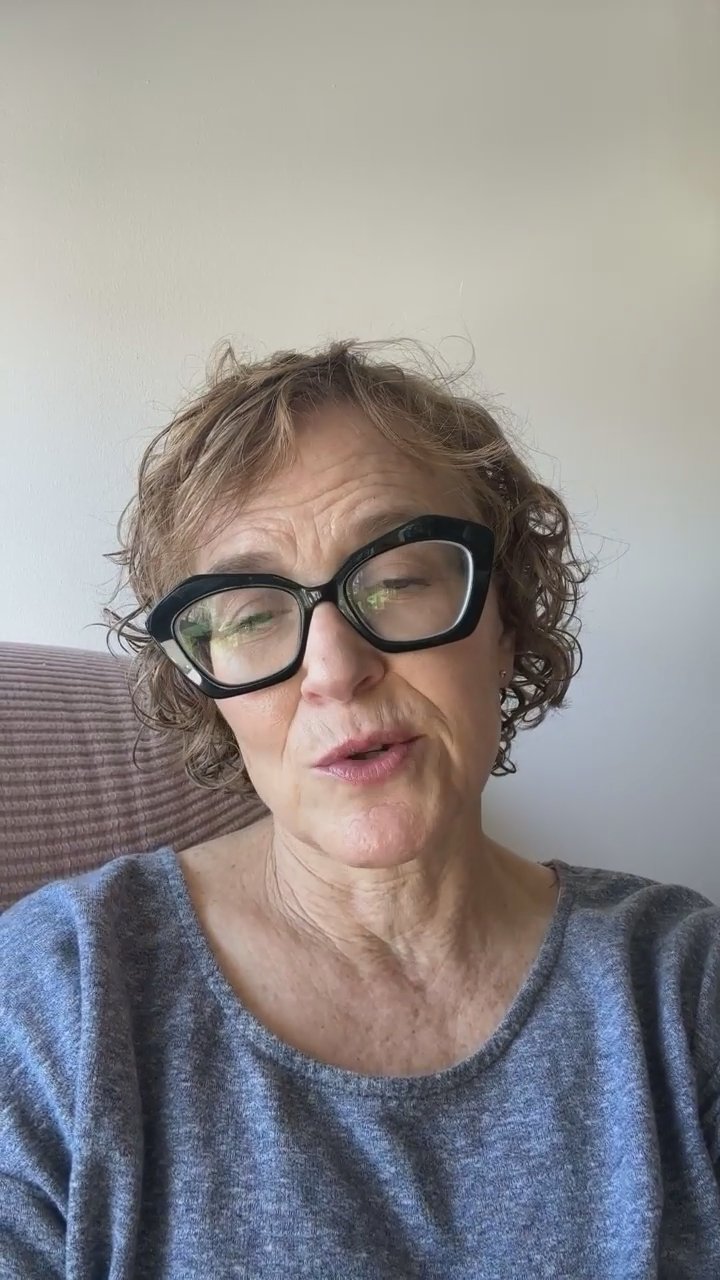
Host outlines Rule of Engagement #4: trust the decisions made when thinking most clearly, and shows how planning and if‑then prep—illustrated by choosing healthy meals during travel—helps stick to those choices.
Dana Wessel: I just spent a few days in Minnesota. My friend Dana got married. We became friends because he used to basically troll me on Twitter when I was an elected official. So I'm hanging out with all of you this morning, which I'm excited about.
It boils down to trust the decision you made when you were thinking most clearly. The better we know ourselves, the easier it is to make decisions that will work for us. Set up our lives to support those good decisions.
Rosie Nest: Trust the decision you made when you are thinking most clearly. Nest: When we get overwhelmed, we are tempted to run around like a chicken with our head cut off. Plan your work and work your plan, she says.
All right. Cadre, it's been great hanging out with you today. There is an isle of conclusions off the coast that Milo is driving in the Phantom toll booth and jumping to conclusions gets you off your path. All right, everybody, see you next week.
Well, well, well. Good morning, Cadre. How is everybody doing? I just spent a few days in Minnesota. My friend Dana got married. If you Listen to the 93X Morning show, it's Dana Wessel. And we became friends because he used to basically troll me on Twitter when I was an elected official. And I didn't know if it was a bit or if he was really, like, complaining because he wanted a water slide in downtown Minneapolis, which it turns out was entirely a bit. And, you know, when I was talking to people at the wedding, he's like, how do you know Dana?
Well, you should show me on Twitter. And now I'm at his wedding. It was very sweet. Good morning. Show enough. So my return last night. I was supposed to be back at home by about, say, 10:30 or 11, but I got home at about hello, speak, wonder 2:30am so I'm running on about four hours of sleep, which I'm not gonna, you know, sort of rehearse my complaints about being tired. I'm just gonna either rest or turn my attention elsewhere. So I'm hanging out with all of you this morning, which I'm excited about.
C. so it was not a bad thing. But I was thinking about my rule of engagement number four, and I think we talked about it here before. But you know what? Some of these are worth talking about again, I think. So. My number four is, and I don't have an elegant way of saying it yet I've tried to word this a whole bunch of different ways, so bear with me. But it boils down to trust the decision you made when you were thinking most clearly. That's what I've gotten it to so far, and we've talked about it before, but it just comes in handy so many times if you go back upstream from that decision.
For me, what it means is that it's very helpful to do some planning and to do some thinking and to do decision making when I am not in the crucible, when I'm not in the moment to do some if then planning. Like, you know, I could have done a better job planning my food yesterday, but because I have been prioritizing getting at least one mixed vegetable salad in my diet every day, when I was at the airport, it was like, all right, well, and I certainly know the Minneapolis airport better than most airports, I was like, well, it's time to go to People's Organic and get a salad.
For dinner, and I had had one for lunch as well. When I was out and about running errands on behalf of my dad yesterday, I was like, well, I need some salad. I will feel better if I eat. And when I was thinking most clearly, I decided that micronutrients were important for me. So I went to a place called Crispin Green. I just found the nearest salad place on the route I was doing for all these errands. And lo and behold, I had a whole bunch of vegetables yesterday, which means I feel better today than I would have felt if I had just done the travel.
Let me get something that tastes good and is fast, as opposed to something that tastes good and is fast, but a vegetable instead of fried. So trust the decisions you made when you were thinking most clearly. I think for those of us who struggle with any kind of addiction, that's a really important one and a really, really, really difficult one because I, you know, I'm an alcoholic, so I can decide not to drink, but that doesn't mean I won't drink. So I guess the asterisk on this is get into a place where you have the help and support you need to maintain the decisions you make on your own behalf.
And tonight, as a matter of fact, you all have heard me talk about Gretchen Rubin before. She has a new book coming out today called Secrets of Adulthood. C. about four blocks away from where I live right now, maybe five. So I'm going to walk there tonight with a friend. We got tickets weeks ago and talk to Gretchen, but she's. Her book Better than Before is really. It isn't like James Clear. Here's the best way to build a habit, which I love. Atomic habits or even BJ Fogg. Same thing. It's not like that.
It's. Here are things you get to learn about yourself so you know how to set your life up in a way that will succeed in the direction you want. And so I recommend that book Better than Before. If you say to yourself, I struggle to maintain the decisions I made when I was thinking most clearly, then I recommend going and looking up your tendency. The Four Tendencies is a useful one. Also, Gretchen Rubin. It's part of Better Than Before. And then it was so popular, she wrote a whole book called the Four Tendencies.
And I'm not here to do an ad for Gretchen, but I am here to say, the better we know ourselves, A, the easier it is to make decisions that will work for us, and B, the easier it is to Set up our lives to support those good decisions. And because I'm an addiction, I have to think about that a lot. My life for the rest of my life, I hope I'm doing the best I can today. I cannot promise tomorrow. But my hope for myself is that the rest of my life, I will be in community with other recovering alcoholics in one way or another.
Because I know that those are, you know, and the things that we do together in sobriety meetings and elsewhere, those are the things that help me keep thinking clearly about how to not take the first drink. Once I take the first drink, there is no stopping me. And so the really important thing is not to take the first drink. When I'm thinking clearly, I know how important it is to not take the first drink, Right? So how is my life set up so that I can continue to honor my clear thinking? Trust that decision.
Like yesterday at the airport, I made a decision to eat salad. So even though I wanted to stop at a different fast food place and get a different kind of food, I also thought, ah, but I have made a decision to actually eat salad. Let's do a little experiment and see what happens if I get a salad at the airport, if I can find a good one. And I was at an airport where I knew I could find a good one. So I was trusting the decision I made when I was thinking most clearly. Now, one of the things that happens to me is if I want to do something that I know is not great for me, I don't set aside time to think clearly about it.
That's the loophole. That's the workaround, right? Is, oh, I don't want to plan my week because X, Y, and Z. Because I really don't want to do the thing. The most important thing that needs doing. I'm either scared to do it or I don't want to do it. And if I don't plan time to do it, maybe I can avoid it. It's just a procrastination technique. But if I sit down because I do my planning on Friday afternoons, but I'm gonna do it today because I was out of town on Friday afternoon. So I did provisional before I left, and I'm gonna do more closely today.
If I wait and I don't do it, then maybe it just aids and abets my procrastination. And one of the aphorisms Gretchen has in her book, because I've been reading some articles about it, I haven't read the book, is that it just lost my mind. Something about oh, that perfectionism. Perfectionism is fear. It's not high standards, something like that. Perfectionism is not fear, is not high standards. Perfectionism is. Is fear. And perfectionism is a really great procrastination tool. The expectation to do it perfectly is a really great way to procrastinate.
But part of the reason we procrastinate is perfectionism. I mean, it's a whole closed loop keeping me locked in place. So when I'm thinking most clearly, for example, I know that done is good. I know that Apple is not embarrassed that the iPhone 15 is way better than the iPhone 4, that you just can put something out there and then make it better over time. I applied for a job a couple weeks ago with a resume and a cover. I haven't. I haven't job hunted in 25 years, right? And so I was like, you know what, done is good.
Let's just get this first one out of the way, see what it's like, and then maybe learn some lessons from there. Hello, Rosie Nest. Welcome. I'm very glad you're here. I'm talking about rule of engagement number four, which is not elegantly worded yet, but is trust the decision you made when you are thinking most clearly. And so, because often we also want to switch horses midstream, right? I am going along, but then I hit some resistance. Either because internally I'm scared to do something, maybe circumstances change, but.
Or I don't want to do it anymore, or something shinier comes along, or I get scared and so I get freaked out. Or this happens a lot. Other people get scared and they come at me with their urgency, and that is a surefire way to get me a little rattled. And so then I'm like, well, maybe we shouldn't, you know, maybe we shouldn't look for apartments in Silver Spring. We should look for apartments in wherever we're moving in a few weeks. So those are all top of mind and we're moving to Silver Spring.
But, you know, maybe we shouldn't do that. Or, oh, my gosh, you know, I decided that it was smart to invest in someone to come clean the house for an hour every once in a while. But now I'm scared because XYZ makes. Maybe I shouldn't. Maybe that shouldn't happen. Maybe I should create some chaos and like, cancel last minute or something. What is the decision I made when I was thinking most clearly? I'm gonna stick with that. Like, the commencement of overwhelm. The commencement of urgency is usually a sign for me to slow down and remember what I know and remember what I've decided.
When I wasn't urgent and I wasn't overwhelmed. That's all this is. It's like when we get urgent and overwhelmed, we are tempted to run around like a chicken with our head cut off, just doing this, doing that. Will this fix it? Will that fix it? And if we stop and say, what did we decide when we were thinking clearly? Often for me, what did I decide when I was talking with someone else about it? When I was talking with my sponsor or. Or my therapist or my best friend or my husband or anybody? Like, what decision did I make when I felt connected with someone else?
That helps ramp down my urgent thinking as well. When I was, you know. And underlying all of this, of course, is my anxiety. I mean, I guess that might be a spoiler alert for some people, but underlying all of this is my anxiety that when I get anxious, I get ramped up. I get scared active. That's the first phase. Often I get scared active and, you know, thinking most clearly. What did I decide when I was thinking most clearly was born out of the fact that I get scared active. So when I get scared, I think the solution is to take action.
And of course, anxiety is a great, I mean, action is a great antidote for anxiety. Another Gretchen Rubin aphorism. But action for the sake of action, just to try and make myself feel better, that I'm doing anything that's not useful, that has gotten me into more problems than it has solved. And so I have a whole other set of tools in my toolkit to deal with that fear, that anxiety, when it comes up. You know, we've talked a lot about it here. So the actions I decided on when I was thinking clearly are great antidotes.
Stick. Plan your work and work your plan. That is an old campaign motto, right? Plan your work and work your plan. And maybe that's how I'll word number three. Plan your work and work your plan. But trust the decision I made when I was thinking most clearly. It happens on campaigns all the time, right? You have your campaign plan. You know how you want to do outreach for people. You know how do you want to as a you and your whole team? We know how do we want to raise the money. We know how we want to do our voter outreach.
We know what our campaign message is. We know which events we've decided to go to. And then what will happen is your opponent is at this event and your opponent is doing this kind of outreach, and all of a sudden you're like, oh my God, then I have to be there and I have to do that kind of outre. And that is the kiss of death for a campaign. Plan your work and work your plan. Trust the decision you made when you were thinking most clearly. That is my rule of engagement number four. That is rule of engagement number four.
Let's see. Speak wonder. This is really helpful for me. I often make decisions spontaneously and this renders unpleasant consequences. Yes. I'm not saying there's not room for spontaneity. In the immortal words of Daphne Zuniga's character in the movie, say anything, not say anything. The sure thing. Another John Cusack film. Spontaneity has its time, its place. I may over identify with Daphne Zuniga's character in that film, but anyway, yes, it's like, oh no, you know, if I know I'm going to be out of the house for six hours and I know that I get hungry at two and I know that I'm not going to be anywhere near any food at 2:00, well, if I know all that ahead of time, it might be useful to bring a snack.
You know the value of planning. But it's not just planning. It's also trusting the decision I made when I was thinking clearly. Now, if I'm not planning, planning while I'm clear in my head, that's a whole other thing. But. But often I can either the planning I do with myself, the conversations I have with other people. Trust the decisions you made when you were thinking most clearly. And no one has perfect clarity. Just the best version of you, the best, most thoughtful version of yourself. Whatever that person decided.
Let's go with them. Let's go with that. All right. Cadre, it's been great hanging out with you today. I was a little worried when I my flight got rescheduled that I might be on a plane about now. But it all worked out for the good and I am so glad I get to spend this time with you this week. And we'll close on if you've read the Phantom Tollbooth, Milo, there is an isle of conclusions off the coast that Milo is driving in the Phantom toll booth and jumping to conclusions gets you off your path. So.
All right, everybody, see you next week. Cadre, have a great week. Thank you so much for being so awesome and I'll see you in the app.
Reactions and comments are for members. Joining is free and takes a minute.