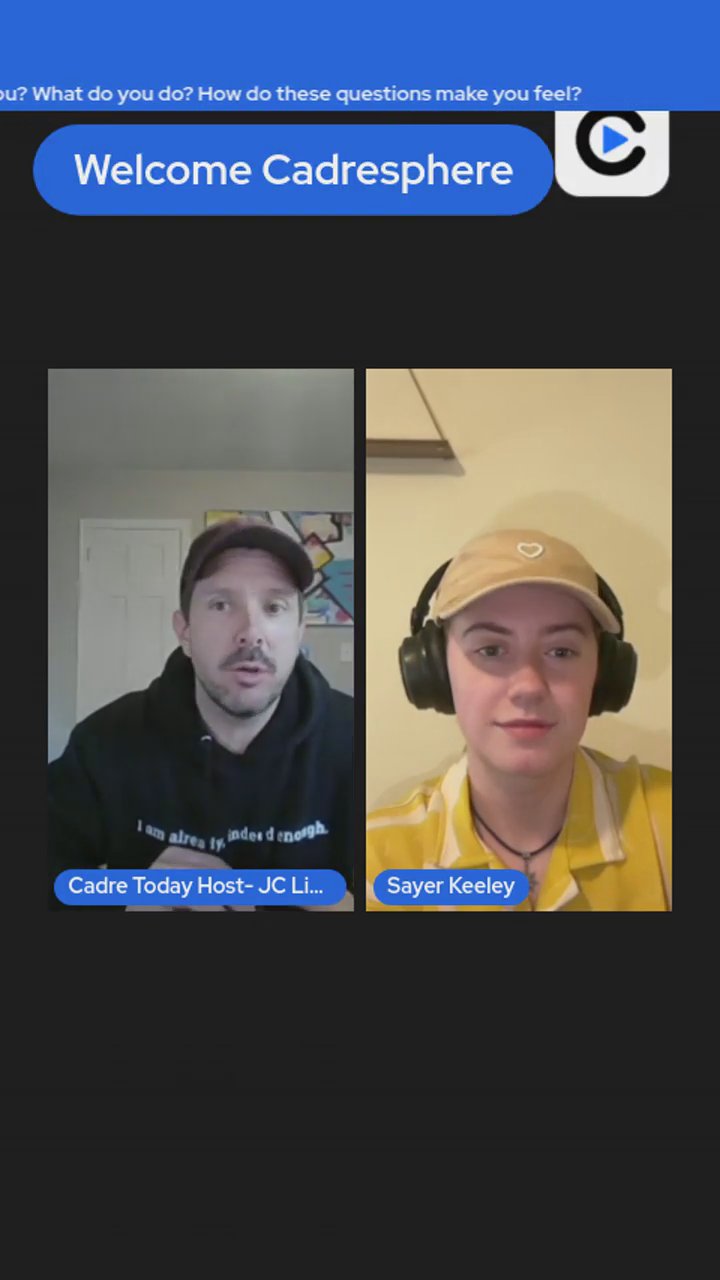
Sayer Keeley discusses work as a Twin Cities performing artist and student, sharing passion for using art and social media to amplify marginalized voices and reflecting on creating learning spaces and community for youth.
Well, hey there, Cadre World. I hope you are well. As I said yesterday, when me and Betsy Hodges were live, it's fun to go ahead and watch whoever is, like, getting ready to be in the interview chair just kind of grooving along.
This is another Cadre Today interview, back to back days. I have my friend Sayer Keeley here with us today. You're gonna be able to catch Dr. Leslie Davis later on today, top of the hour at noon.
Sayer was one of our panelists at our World Teen Mental Wellness Day at Big Brothers, Big Sisters Twin Cities a few weeks ago. We need to introduce Sarah to the Cadre sphere. So let's get started with exactly that.
Sayer Keeley works mostly as a performing artist and creative person in the Twin Cities. But she's also passionate about education in non educational settings. She has a passion for giving voices to marginalized communities.
Sarah Spring comes from a family of educators. Her focus is to help kids like herself feel confident enough to educate others. She and Sayer are co creators of a production at Stages Theater Company. How do we shift and change so that we're all getting the learning space that we need?
Sayer: One of the biggest things was the conversation around social media. Social media is another tool that we can use to do really good things and really bad things. And for marginalized communities, we need to be bold to be seen.
Sayer: The culmination of everything is finding your way of learning and growing. He says it's little moments like that that change the way that you move through the world. If Cadre is the space where you can learn and grow, jump on in.
Well, hey there, Cadre World. How are you doing today? I hope you are well. I hope you enjoyed the play in music. As I said yesterday, when me and Betsy Hodges were live, it's fun to go ahead and watch whoever is, like, getting ready to be in the interview chair just kind of grooving along. So this is another Cadre Today interview, back to back days. I have my friend Sayer Keeley here with us today. Sarah, how you doing? I am good. It is early and I'm ready to talk. How are you, Jesse? I'm good.
When all of a sudden I'm like, hey, can we do 9:00am? You're like, yeah, that sounds great. I go, does it? Because you're, you're, you're not a morning person. Not. Not super. It depends. Sometimes when I wake up at like 7am I'm like, I'm ready. Let's hit the road. But then I wake up at eight and I go, there's no way. There's no way I could get up this early. Okay, so, so, so I had rehearsal until 9:00 last night, which is a very late night for me. So I was in bed by like 9:15. Sayer, when did, when, when did you go to bed?
Oh, I was, I went to bed at like, I had an early night and I was asleep around 11:30. Okay, okay. That, that, that, that, that does sound early to me. Dr. Leslie Davis, how are you doing? Thanks for tuning in today, y'all. You're gonna be able to catch Dr. Leslie Davis later on today, top of the hour at noon. But today, as you can see, it is a Cadre Today interview. Cadre. As you know, you have prerecorded content that you can consume whenever you want. You have your community feed where you can throw up your thoughts, your, your photos, your words, your conversations.
And then obviously contributors are going live all throughout the day. But we have this platform where all of a sudden you can engage in a conversation with some of our contributors. And Sayer isn't technically one of our on platform contributors, but Sayer was one of our panelists at our World Teen Mental Wellness Day at Big Brothers, Big Sisters Twin Cities a few weeks ago. And we're like, we need to recap this event. We need to introduce Sarah to the Cadre sphere. So let's get started with exactly that.
Sare. Every single time we do an interview, we have the contributor answer this set of questions. Who are you? What do you do? And how does it make you feel whenever you're asked these questions in this world. So what do you got? Well, I'm Sayer Keeley. I use he, him pronouns. I work mostly as a performing artist and creative person in the Twin Cities. I'm also a student. And one of the biggest things about, like, who I am is being a transgender person and having. I have a lot of passion for giving voices to marginalized communities and the philosophies around art and the way that it can get community together and educate and help especially youth grow into who they actually are and have a space where they can do that.
And when I answer that kind of question, it always depends on, like, what situation am I in? Yeah, who am I talking to? What am I talking about? Because I, I tend to meld myself to the people around me. And so there's always a, there's always a question of right now, what am I feeling the most passionate about? It's always changing. There's always something new. And I think right now I'm just, I'm feeling so passionate about education in non educational settings and the way that we can help young kids grow to be something more than they are on track to be, if that makes any sense.
Oh, 1,000%. I mean, again, like, and you, you, you didn't say it in the. Who you are and what do you do in that? Like, yes, you're a performer, storyteller, but you're also an educator. Right? You spend a lot of time in space with people who generally are younger than you. You know, whether it be at Spring Studio Institute Educational House, whether it be at Sages Theater Company, whether it be anywhere that you are. And I love that you said, like, doing education in non traditional educational spaces.
Sarah, the other thing you raised up made me think of. So Ms. Shannon Paul, another one of our contributors here, we had a conversation around navigating imposter syndrome, and Ms. Shannon Paul shared that she is always code switching. She's always in the space because of who she is, who she represents and who people think she needs to be. So I just think of the courage that you just shared and maybe the perspective shift because so often we go, who do I need to be right now in order to be right or to be safe or to be seen versus what am I passionate right now in this situation?
I think that's a really big switch and shift. So talk about you as an educator. Like, why are you called to that space and what do you end up finding in that space for sure? Well, I come from a family of educators. My mom is a ballet teacher and she now Owns her own dance studio, which I work for as an educator. You just mentioned Spring. My grandpa was middle. Middle school science teacher. There's. I've just grown up around all these different people who educate in so many different ways and in so many different forms.
And so I grew up seeing the power that good educators can have on kids and the way that they feel about themselves. And once I started being more into the theater world and more into the, like, activism world, it became something that quickly melded together and became my focus of how can I help kids like myself, who may have been in my same shoes, get to the place where they can feel confident enough to educate others as well. And so when I go into something, I always think about, what can I learn from this?
And what can I help someone else learn from this? Yeah, it's been such a long journey to find my way of being an educator, but also just a person in a space with other people. I always hate when teachers or, like, authority figures are like, well, I'm the. I'm the authority, so you learn what I give you. That's never been my thing. I know that my way of teaching, my way of giving things may not be the way that the person receives things. And so how do we shift and change so that we're all getting the learning space that we need?
Yeah, I mean, I just think so right now, Sayer and I are co creators of a production, the Lightning Thief at Stages Theater Company, opening up in a couple of weeks. You know, but I always say it's like the job of the actor is to make choices. The job of a director is to go ahead and say, hey, how do these choices fit in what we're creating together? But the paradigm is so often, you know, from whoever the. The younger person is most often is, tell me what I'm supposed to do, because you're the one who has all the answers.
And then when all of a sudden people. People like us go, there aren't any answers. We're making all of this up. And by we, we mean you. There's a. There's a liberation, but also an anxiety or a fear of, oh, gosh, now I can mess this up. But when all of a sudden they realize they can't mess it up, that's. There's something really beautiful that happens there. Yes, for sure. And it's. It's interesting because especially when it comes to the theater world, like, I'm also choreographing. Well, I'm just opened up a middle school show that I choreographed that I'm also choreographing another middle school show right now.
And the. The biggest thing I saw was it wasn't necessarily that their dancing got better, but their confidence rose in being willing to learn the dance and try the dance to ask questions about it. And so, I mean, I felt incredibly honored that by the end of the run for, for one of the shows, they were able to get up on the stage and I would just give them something and they would just try it. And so now they are allowing themselves by just trying it to learn how they learn. If that means that they have to go over it in their head a million times and then put it in their body, that's how they can do it.
If that means just doing it and doing it and doing it, that's how they can do it. And so being able to open up that door to what is your. What is your passion when it comes to learning and how do you learn it? Yeah, I mean, and obviously, everybody, like, we're talking, we're talking about, you know, the journey of the young person, but as we know, most of us old people out there and say, you are. You are an old person. Oh, no, I know. Like, like, like we aren't good at these things. Like, we won't let ourselves try, we won't give ourselves the opportunity.
We won't potentially fail or whatever we perceive is going to be failure. Which is part of the reason why, you know, Cadre created this space for World Team Mental Health Day a handful of weeks ago, where there in Minneapolis, we held space for conversations and then a panel led by younger people to be able to say, hey, here's what the landscape of having a brain and a heart and passions and perspectives looks like within the younger generations today. So one of the reasons why, Sayer, I think you're going to be able to change lives today is it's probably four weeks since, since that event.
I'm really curious, if you think back to that day, what were the ahas that either you ended up sharing when you were kind of poked in the right way with the right question, or what did you hear? What did you feel from. From that event? Throw out some. Throw out some headlines. Yeah, sure. I, I had an incredible time just being able to, like, talk and talk about all these things that I have so many thoughts about. What was so incredible to be surrounded by so many other people that wanted to hear and also were giving their own thoughts.
To have this big group discussion was just a dream come true. But I think for me One of the biggest things was the conversation around social media. Myself growing up, when I was 15, 16, maybe a little younger, 14, I gained some pretty big popularity on social media on TikTok, and that caused a lot of damage for me. And so the conversation around social media and how incredible it can be with all these creative minds and all these people sharing and giving the world what they, what they want to give is incredible.
But then, you know, we always say it's easier to. To be mean behind a keyboard. Right. And so the ways to balance out social media that's good and social media, that's bad, and then at the same time, education from social media. Because I think a lot of the time right now, especially kids my age like Gen Z, are getting information from Instagram, TikTok, Twitter, X, whatever it is, how do we sparse what's true from what's fake and then build opinions off of that. Yeah. So that was a big conversation that we had around social media as well as when it comes specifically to, like, mental health for teens.
It was a lot about the ways that school can help or should help, but maybe doesn't have the reach to, as well as the impact of being in a marginalized community on your ability to access resources, but also just the fact that you are more likely to get bullied to have the people around you misunderstand you and not take you seriously and the ways that that impacts your mental health. Yeah, well, I mean, again, and. And everybody listen how sayer did not innately make assumptive statements that social media is.
Is innately bad, but we can do good things with it. Like say. Or like I heard you say, it's like social media can be a tool used in bad ways and can be a tool using good ways, but it's not innately one thing or the other. And I think that was one of the powerful moments for. For everybody in the audience would say, you're like, yo, people, your perspective that social media is bad is because you did not grow up in a world where social media was your normative. You know, I often when I'm keynoting on topics like shame or anxiety or so and so forth, I'll ask the people in the audience.
I'm like, hey, how many of y'all lived in a world before social media? And normally 80, 85% of people raise their hands and then I go, okay, how many of you felt just as bad about yourselves before social media as you have after social media? And those same 85% of people reluctantly raise their hands and they realize in that moment, oh, social media isn't the culprit. Social media is another tool that we can use to do really good things and really bad things. But in terms of marginalized communities, I mean I was a, I was a gay kid in the 90s and in the early 2000s, it's like, okay, where did I find my community?
Well, if I was walking down the halls of a building and one out of every very many people were felt safe to be seen. But even in that time, I mean I'm not a, I'm a pretty nuanced and a pretty internalized person. And whenever a marginalized community starts to say we're going to be seen, normally the first people, those first adopters are people who are saying, we need to be bold, we need to be out, we need to be present. And I wasn't that. So all of a sudden I'm going, okay, am I gay enough? And in reality I wasn't.
So where did I find my space? It was in the less closeted worlds of social media that allowed me to not hate myself, to not hide myself, to not. So again, like social media is, is in a lot of chapters of my life a savior. But then as you're speaking, you know, when, when all of a sudden you had your, let's call it, quote, fame in the social media world as you were finding that, that fame or that following, there's good, there's bad. You know, I, I even just think of our, our, of our shared musical theater background.
How many times have we seen in the dear Evan Hansens and in the proms and in these worlds where we go, wow, we're singing a song right now about being seen across the world by someone. And all of a sudden like the interweb is what's making people feel seen together. So that in the construct of a mental health conversation, how great that we can provide, provide people who feel a very lone and very under resourced resources through tools like this. Yes, exactly. And it's funny because social media has also been such a beautiful gift to me because I've had people who have reached out to me, whether through comments or through like private messing, messaging me on a different app, saying that like they had the confidence to come out to their families because they saw me and how confident I was or I actually had in the summer of 2023, I was in next to normal at theater La Di Da.
And one of the people who came and saw it was from a different state. I think they might have been in Like Wisconsin, Illinois, somewhere around here. But they had just been exploring being non binary and they ended up reaching out to me a couple months later and saying, hey, I just wanted to let you know that I've actually decided to go by the name Henry because I was so moved by your performance and seeing a transgender person on a big stage, doing a big role and having that space. So it's things like that that kept me going and keep me going now.
I still post, I just kind of post every so often, just whatever I want. And so there's, there's so much that I learned and gained from it, but it came at a cost. Yeah, it came at the cost of my mental health at the time and the way that I interacted with others. And that's actually another thing that I brought up at the panel was the way that we think of mentally ill kids, kids that are struggling with depression, anxiety, and how we have a very specific like, yeah, this, if someone looks like this, I know that they're depressed.
But when it came to me, I became, I, I had to compensate for such a low self esteem that I pretended to be like myself so much that like, I almost acted better than everyone else and was like, seemed stuck up. But the whole point was for me to try and convince myself that I'm good, that it's okay to be who I am. And now I'm very confident in who I am and the way that I show myself to the world. But it, I didn't get there without being forced by people saying, you're a girl, or like, they would. I actually got like death threats and things and these impacted me a lot.
But now I've built the layers on top of those old scars. And here I am today talking about it and acknowledging the hurt, but also the beauty that comes from coming out of the ashes like that. Yeah, well, I mean, again, like say, I'm certain many, many adults who are listening to this conversation right now are going like, oh my gosh, here's a young person who's talking about overcompensating. And I'm a 55 year old person who's a C suite individual. And I've been overcompensating for the last 40 years, ever since I made varsity basketball as a freshman in high school.
But I still have no idea how to deal with the demons or to take steps to loving myself, which if you are that person, you're doing it right now by, by going, huh? I'm going to engage in conversations of curiosity and courage. I'm going to, you know, listen to professionals and peers and see that there's many ways to take my journey forward, you know, because I'll say that the last thing that, that, that I think sticks with me a lot from that, from that event was when Marie, another panelist, said, you know, you can get rid of social media when, whenever you want.
Like, you can just delete the thing and then you can redownload it again whenever you want to again. And I think, I think that's was one of those aha moments where it's like, oh, yeah, you know, it's like, let's say I'm building a house and I have a hammer in my hand and all of a sudden my arm starts, starts to hurt. Well, you can put down the hammer and go do something else in the house. Like you can, you can build the house in different ways at different times. Then all of a sudden when your arm starts hurting, you can pick up the hammer and start, start hammering again.
And to the point, I think so many times we live in this binary world of you need to do this because this is good and you can't do this because this is bad. And that may make people feel good because it's like, here's what's set up as this right or wrong pathway. But I can't think of anything in the world that actually works that way. There's always a situation where something is the right pathway and another time when that same pathway is not the right pathway. So, Sayer, as we wrap up today, because these conversations always, once they get cooking, we go, all right, and let's let it sail away because now there's life to live.
And then we come back and we do it again and again and again. So say if you think of the last 22 minutes and 20 seconds of conversation, either something that was, that was said or shared that you brought up, or something that you're just like, gosh, this is now in my head. What's the take home prize that you would give to people listening? In other words, what's the thing that you want them to kind of carry with them as they go in with their day after listening to your conversation today? Yeah, I think for me, the culmination of everything is finding your way of learning and growing, whether that's through actual, like, education, if that's being in an educational setting, or for myself, being in an art setting where I can teach others who then teach me, if that's staying in, reading books and enjoying your time on your own, whatever that is giving yourself that time to sit and say, this is the time that I am going to work on growing myself and recognizing that your own mental state, your own physical state, going into it and saying, this is my time to just be me, Just be me.
Nothing else. I do it a lot when I'm eating. I'll sit down and I'll put on like a YouTube video or a Netflix show or something and I'll eat and I'll watch and I'll allow myself to just take in the information from this video. Just that's all I need to take in. So that. And oftentimes I'm watching like video essays or something, or I'll just be watching like a video game, you know, But I am learning new information about something that I'm passionate about while also recharging myself. And it's little moments like that that change the way that you move through the world.
That time to recharge and to say, okay, here I go, I have a moment. And that's what's been getting me through, is taking, taking those moments. And even if that is scrolling on social media like, I love a good little social media scroll straight up. Yeah, well, I mean, again, like Sarah, like you just said, you know, I. I say it all the time, do little things often and, and as you said, find your way to learn and grow. It's like the little things that you do often may not be the things that the person sitting next to you are going to find nourishment in.
And that makes a lot of sense. So everybody follow Sayer in this world. You'll see more Sayer in the Cadre sphere to come. But as we move on with this day, you know that you always have opportunities here that when the snaps of the brain says, huh, I need that thing. If Cadre is the space where you can learn and grow, jump on in. And if you know someone who needs something like Cadre, share it with them as well. Sayer, have a great rest of your day. I will see you soon, my friend and everybody. Enjoy the day.
We'll talk to you later. C. bye.
Reactions and comments are for members. Joining is free and takes a minute.