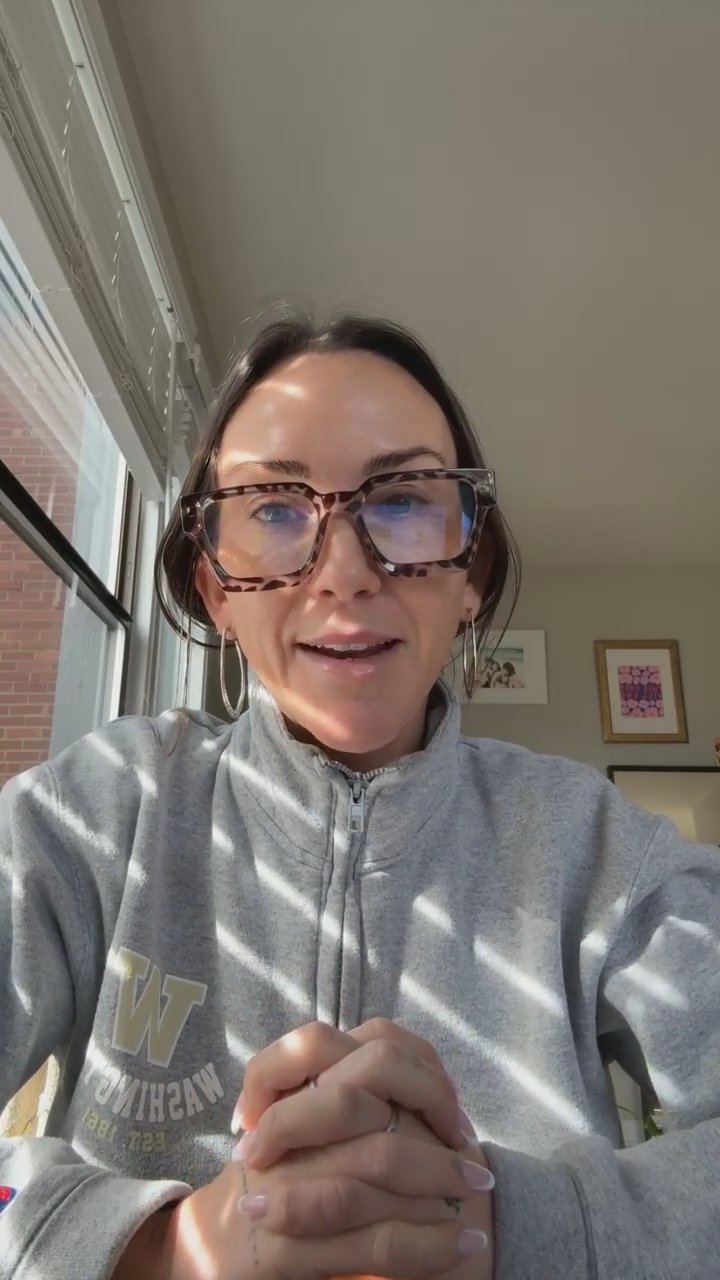
Rachel explores why expressing needs feels scary, tracing fears of being gaslit or ignored back to upbringing and offering reflections on asker vs guesser family patterns and overgiving in adult relationships.
Happy Wednesday. It's sunny in Seattle. Yay. Cadre Crew. Hello. It is Wednesday.
We have been working a lot on needs. When the time comes for me to express a need, I get this overwhelming feeling of panic and fear. I sort of almost begin to gaslight myself internally. And then I don't ask for what I need, which builds up into resentment.
A lot of people grew up in homes where they asked and they talked and they hugged and they cried. As an adult, a feeling like we are constantly having to assess everybody else's mood around us. This has manifested a lot for me as an adult in the sense of I often am over giving in my relationships.
And I also have to temper my urge to take care of everyone around me. A lot of millennials, I think it's very common for that generation, our generation or that generation to have family members who were not really emotionally checked in at all. I think we're fortunate right now that these things are so accessible.
Happy Wednesday. Cadre Crew. Hello. Hello. It is Wednesday. Hello. It's sunny in Seattle. Yay. I will give folks a moment to trickle in. I realized I did not label my live stream. I apologize. Today I wanted to pull up, if I can find it, an article that my therapist sent me, which I found very interesting. We have been working a lot on needs. In my sessions lately, we've been working a lot on needs and me practicing, asking for my needs, as well as identifying them and figuring out what I. What my needs are, both personally and in relationships.
And so today, we are kind of working through, like, what some of the sources are and were for me, perhaps struggling to identify my needs, perhaps struggling to verbalize or vocalize my needs, perhaps why I get afraid to vocalize what I need in relationships. So these are things that we've been working on. And today, today we were talking a lot about in the moment. When the time comes for me to express a need, I get this overwhelming feeling of panic and fear, and I sort of almost begin to gaslight myself internally, and I oftentimes really shut down.
I get very overwhelmed. My nervous system is on high, high, high alert, and I really struggle to express my needs. And a lot of that is because I am internally fearful that if I express my needs, the response I'm gonna get is either denial of my needs being real or existing, that I'm gonna get gaslit, which is pretty similar to that, that someone's going to misunderstand me or mishear what I say when I'm expressing my needs or placate me and tell me that they'll provide me with the thing that I'm asking and then not actually follow through.
And so a lot of times I kind of. All of this is internally happening in my mind very quickly, which leads me to then filtering myself and not saying anything when I have a need come up because of that fear of that response. And then I don't ask for what I need, and then that builds up into resentment, which creates other problems. So, anyways, she asked me today. She said, I wonder if you came from an Ask or a guest family. And I thought that was very interesting because I, you know, I'm aware of the fact that my upbringing contributes to a lot of my behaviors as an adult, as it does for many of us.
We are children. We are sponges. We absorb what happens in our upbringing, and then that's. That formulates a lot of our life views and our perspectives, and it doesn't mean that those aren't things that we can't work through and change. So what she meant by this, like an ask versus a guess family. And I have this article here if anyone's interested. If you just google are you an asker or a guesser? And then it's on the Guardian. So if you just search are you an asker or a guesser plus the Guardian, the article should pop up.
And it talks a lot about this concept of if growing up, if you were in a family where your caregivers or parents or whoever was your primary adult figure, if that, if those people or that person was typically quite vocal with their emotional world, was quite forward with telling you what they needed from you when they were upset, and vice versa, encouraging you to do the same. Chances were if a family member was expressing some kind of emotional, some kind of emotional thing, like let's say you walk into your kitchen and your mom or your brother or somebody looks visibly upset, did you ask them, hey, are you okay?
What's going on? And vice versa, did they ask you, hey, are you okay? What's going on? Or did you walk into the kitchen and see a family member upset and think, I don't know what's going on here and I have to figure it out myself. So if you find yourself saying I actually I had to guess quite often or my or my family members didn't ask me how I was doing or if I was okay, if I was visibly upset or maybe more removed or etc. That means that we were a family of guessers. And that can lead to, as an adult, a feeling like we are constantly having to assess everybody else's mood around us.
So being hyper aware of other people's emotional worlds and maybe being hypersensitive to it to the point of thinking it's up to us to make sure other people are okay because we assume that they aren't going to ask us. So being hyper aware of other people's emotional worlds and maybe caretaking or people pleasing or trying really hard to make sure everyone around us is okay, and also having this internal assumption or belief that other people are going to be doing the same for us, so that other people are also going to be hypersensitive and alert to our needs and that we don't necessarily need to ask for them.
So this has manifested a lot for me as an adult in the sense of I often am over giving in my relationships because I'm over attentive to my friend's needs, to my family members needs, I can tell if something's wrong so I'M constantly checking in or maybe showing up more or providing more care and more love. And my assumption is that the same will be done for me. But I cannot make that assumption because a lot of people did not grow up in the same household as me. A lot of people grew up in a household where when something was wrong, they said, hey, I'm not feeling too great right now.
I'm a little bit upset and I need to talk to somebody, or, hey, I'm really sad because I broke up with my high school crush and I need somebody to hug me and tell me it's going to be okay. A lot of people grew up in homes where they asked and they talked and they hugged and they cried and they felt and they expressed, which means they would expect that if I'm upset, I'm going to tell them, which means they're not living their lives being hyper attuned to my needs and feelings. This can be pretty upsetting to discover because it would be nice if people were hyper attuned to my feelings all the time.
I would love that. And maybe ultimately I build certain friendships and relationships where someone gets to know me at a very intimate level after a long period of time, to the point where they are aware of those things because they know me so well and because we've had enough of a relationship and conversation over time to develop a relationship where I've expressed enough times who I am and what I need and what certain cues mean that they can be attuned to that. But for me to expect that from everybody on a regular basis is not actually a really good expectation for me in terms of getting my needs met or feeling loved?
Or is it a good expectation for those people to feel like they're being a good friend to me because I'm constantly setting them up to be at this bar. Being hyper attuned to me when they aren't, they're not. They're not built that way, and they don't. They, nor should they be. So now my job as an adult is to a figure out what are my needs as a human being in relationships. Both in my friendships, both in my family relationships, both in my. In my intimate, like, romantic relationships. What are the things that I need?
And of course I'm not going to know them all. Like I told my therapist today, I was like, I feel like everyone's walking around with a list of like, the things that they need and I don't f****** know what I need. I often don't know what I need until I'm not getting a need met. So it's also about learning what our needs are and then. And then practicing how do I express those needs to people so that they can learn how to care for me and how to show up for me when I need something. And that's been, that's been a big thing for me right now.
It's very uncomfortable and rocky. And I think something that I'm gonna do sometime this week is I'm gonna set aside some time to make a list or like a column breakdown. You guys know I love columns. And journaling. In my journal, I'm break it down into different kinds of relationships. So friends, family members, partners, lovers, whatever, those, whatever relationships I have, whatever types of relationship categories exist in my life, and then write down known needs, things I know I need. So in the same way, like, I'm apartment hunting right now, right?
So when we're. When I'm apartment hunting, I have a list of things that I desire and that I want in an apartment. And then there's things that I would like, but I'm negotia. Are negotiable. And then there's things that I really just don't care about, right? So in the same way, like, in a relationship, there are certain things I know I need, right? There are certain things that are like non negotiables in relationships. And making a list with those and then making a list of things that are like, it would be really nice to have these needs met in this kind of relationship.
And if they didn't get met, it's okay because I can meet them in another way. And I think that that will be helpful for me to sort of identify and name and label, like, oh, I actually do have. I do know what some of needs are in relationships, and I am comfortable asking for that. And also here are some things that, like, I. I need. And if they don't happen, like, those are, those are the places that I don't have to. What is the. Wait, what's the saying? I've always wanted to say this phrase, I don't have to die on that hill.
Is that how I do it? I don't know. I don't have to die on those hills. I didn't say it right. Whatever. It's okay. And, and I think that that will give me a bit of a clearer idea of when I am entering into new relationships. Some moments that I can make more clear for myself, like, oh, like this is a moment where I could express, like, hey, I need xyz because I'm aware of the fact that in these kinds of relationships this is something I need. So anyways, one more time. com and it's called are you an asker or a guesser?
So again, you can Google that and see it for yourself. I'm gonna just check in on the comments really quickly. Hi Speak Wonder. Hi, Amazing human. Hi Luke. Hi Rach. Rachel says, I was just about to say, I think not being able to express needs stems directly from past experiences. Yeah, for sure. Speak Wonder. My family members rarely talked about needs emotions. Yeah, I think that's really, really common. Rachel says, I always wanted to know what I could do for everyone else, but don't think anyone asked me.
Yeah, so that was. Yeah, we talked about that for sure of that assumption of like, well, I'm doing everything for everyone, but no one's doing anything for me. And, and I realize now that that is coming from a place of me compensating and overcompensating for being in a household where I was not asked what I needed and also needing to assess what everyone else needed. So I again, like, it's unrealistic for me to expect that other people are going to be that hyper attuned to to me or everyone around them, which means I have to bring down my expectations of other people's attunement.
And I also have to temper my urge to take care of everyone around me. Like, I have to remind myself, like, other people are autonomous, responsible adults and if they need something from me, I have to let them ask instead of trying to figure out what they need. Because that only reinforces that cycle of look at how much I'm doing for you and you're not doing the same for me. So if and when a friend or a person I love says, hey, I need this from you, you know d*** well I'm dropping stuff to and help you if I can.
Right. And I don't have to drop things before I'm asked because that's what builds up resentment and that's what also builds upon that feeling of like, I do so much for others and no one does it for me. So trying to also, like, pull back and not in a way where, like, I'm not providing care and love, but in a way where I trust that the people in my life are going to ask me for something if they need it. Jen says, a rare prompt for my family members to ask, are you okay? It's very, very common. It's very common.
And I think a lot of millennials, I don't assume that everyone in this room is a millennial, but I'm a millennial. I, I think it's very common for that generation, our generation or that generation to have family, family members specifically, are in parents or caregivers who were not really emotionally checked in at all. And a lot of that is a product of their upbringing and a lot of that is a product of not having the Internet and all this access to information about our emotional well being and therapy being really stigmatized and mental health being stigmatized.
I think we're really fortunate right now that these things are so accessible and are seen in a light of these things matter because we're having an opportunity to rewire, as hard and frustrating as it is alongside a lot of other people and with generations below us who also really value this stuff. So I think it's really cool too to go out into the world and realize how many people are in therapy and are like, yeah, I think that's really cool. And to start to have these new tools in this new language and be able to share that with people that are also practiced practicing those things.
So we are not alone. People out there are also doing all this work too. So we get to practice together and learn together. And it will not be perfect, it will be messy, but here we are. Okay my loves, I'm proud of you for everything that you do for showing up here. There should be some new videos on my profile so please go give those a check out. They're all about self love and I am myself practicing particularly self respect right now. So if you are someone who struggles with self sabotage or just a general feeling of self worth, I highly recommend that video.
And as always I'm so happy to hear your comments or get your feedback and I will see you same time, same place next week. Ta ta my loves. Have a good rest of your day.
Reactions and comments are for members. Joining is free and takes a minute.