From behind the safety of your handle or screen name, you get the courage to say the thing that you'd never say, in the way you'd never say it knowing that you'll never have to face a face, or own up to a repercussion... Social media is a funny space. And yet, it is one with great power and potential to positively impact and change the world.
Sa Cadre. How are you doing today? I hope you're doing great. But if you're not, that's okay, too. Behind the scenes of Cadre, there's a countdown. There's some fun music playing. What you don't get to see is me and whoever I'm with.
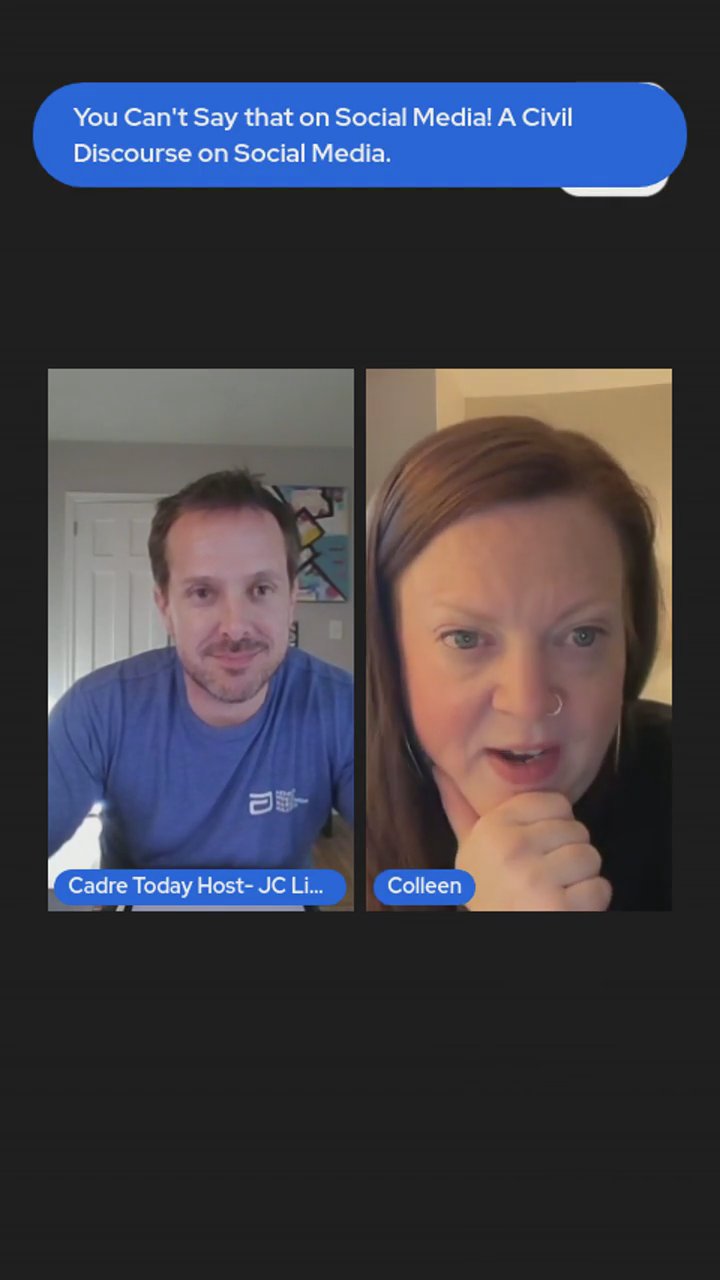
This is our second edition of you can't say that on social media. What can we say and what can't we say? And how do we say the things that we feel like we need to say? The Cadre sphere is one of those places where you can have the space, the autonomy, the agency to share.
We're talking about the mosquito and not the itch of the bite. If we focus on our bites, we can have a lot more open conversations and clean. Both of us are going to share an example of where we saw civility in social media.
What are the things we don't talk about on social media or in church? Sex, religion and politics. Health is like our, our well being and our perception of how people should be. What are we really saying and how do we put that into a perspective that can be shared?
More than one of our teenagers on our teen panel said that social media is actually a social place. As adults we have a tendency to decide for teens on their behalf whether or not something is healthy. And social media can be not great, but it also can be great for them.
T North: Social media is the paradigm of normalcy. Sometimes we need social media to teach us that what our parents tell us about ourselves is not correct. We forget that we don't have to be in a space that doesn't make us feel good or comfortable. We're learning how to use the tools that we have for good.
Sa Cadre. How are you doing today? I hope you're doing great. I really do. Colleen does as well, but. Yeah, but. But. But if you're not, that's okay, too. I'll tell you right now, a little behind the scenes of Cadre. Whenever we do these lives, as you just saw, there's a countdown. There's some fun music playing. Well, what you don't get to see is me and whoever I'm with. Actually, no, Most people don't do this, but me and Clean did. We just started dancing, and I was like, cleen, how are you doing today?
I'm great. I'm doing great. I'm coming at you from a hotel room in the Windy City that is also known as Chicago. So I'm here with my honey just for a quick little getaway. And you got to do that every once in a while. Yep, you do. Now I'm trying to think. So I'm. I'm coming to you from the less windy but very sunny mini. Well, I'm in St. Louis Park. Let's say Minneapolis. Does Minneapolis have a. Have a name to the city? Like, Chicago is the Windy City. What's Minneapolis? The land of 10,000 lakes?
No, that's of Minnesota. I don't know. Minneapolis doesn't really have a name. Why not? I think we're gonna work on that. Yeah, we should work on that. Okay. Well, hey, everybody, you already saw me this morning, and if you're going like, wait, why do we have another. Another Cadre today? Today? Because this is our second edition of you can't say that on social media. Civil discourse on social media. Right. We know how hard it is to walk into the social media world and go, well, what are the rules?
And what if other people don't adhere to the rules that maybe we live by in social media? What can we say and what can't we say? And how do we say the things that we feel like we need to say? So the Cadre sphere, we hope you find, is one of those places where you can have the space, the autonomy, the agency to share the things that you need space to share. So that's what we're doing here, Colleen and I. If you check out two weeks ago, just scroll back in your live streams. You'll see our first edition of this conversation.
But to kick things off today, each of us are going to share one of the highlights from that conversation. Cleen, do you want to go first? I will go first, because I'm afraid you're going to take mine. C. one of the things, and actually you're the one that taught me this, and I love this, is that oftentimes when we find ourselves in a sticky place in social media where there's maybe some vitriol or anger or frustration or we're getting at each other, it's because we're talking about the mosquito and not the itch of the bite.
Right. And that's part of the, like, that's part of where we get ourselves in trouble is because we're not talking about the human experience. We're talking about the thing that is our. The thing we're targeting. And I just. I loved that. I've been thinking about that a lot lately. I've been thinking a lot about how different our conversations are when we come together on the human experience that we can relate to, which is sort of the itch of the bite. Yeah. You know, like. And I'll dive in because this is a space where we can talk about the things.
I get ready to move my parents back to Minnesota in a couple of weeks, and all of a sudden, rather than me being able to separate myself from the conversation of politics with my parents, it's a little bit more in front of the face. But I go, I totally understand why my parents believe what they believe. It's because of their experience. It's because of their lens. Their reaction to the mosquito is very different than my reaction to the mosquito. So, yeah, I think if we focus on our bites, we can have a lot more open conversations and clean.
So for. For. For. For my. Aha. From a couple weeks ago, remind me your. Your. The. The. The. The way you enter into relationships. I. So this came from a seminary professor of mine, and she said, always assume welcome and extend welcome. And I love that because sometimes one is harder than the other. For. At any given time. Yeah. And, and, and it. Like you. And, and that's why I love it. It gives you. It gives you different pathways. Right. Sometimes we can move forward by assuming. Assuming that the space that we're going to be in is one that we can be safe in, that we can be welcomed in.
And if we hit a brick wall and we go, whoa, all of a sudden we can be the one who's extending that for others. So often people will put up the fight because they think they need to. Sometimes when they don't need to, what happens? We can go ahead and invite other people to move further into a conversation that we really need to have and that they really need to have as well. Yeah. So if you're going, okay, this sounds. This sounds great cleaning, jc but, but, but really, what are you talking about?
I. And if you are this person, please let us know because I would be surprised if one of these people exists that has had the sour or the negative or the scary interaction on social media, like in conversation and comments, or you saw something that just hit you in such a weird way. So now both of us are going to share an example of where we saw civility in social media. Clean. Just because we got the routine going. I don't think I could take yours this time, though. But no, I don't think you could.
And again, like, like, clean. You have such a rich history being in. In social ways of communication, whether it be radio or television or social media in the pod world as well. So does anything come to mind about a really cool example of civil civilness in the social world? You know, it's interesting because I. I also have a history in religion. We both do. You and I both do. But when I was in seminary, I used to get real fired up because I was deep into text. I was deep into biblical text. And as you may or may not know, I'm sure you do know, the Bible creates a wonderful experience of.
Of different perspectives. And so oftentimes I would get real fired up if I saw a piece of text in one way and somebody else thought in a different way. And I got into it one time, me, with somebody on Facebook, of all places, who also had a theology degree, and it was somebody who I didn't really even know all that well. And we got deep into an interpretation of Old Testament texts. And what I loved about that conversation is that we did not agree with each other. We did not see eye to eye, not even one lick.
But we both came with every single bit of knowledge that each other had. And we had a moment where we both were looking at each other's arguments and going, that wasn't my argument. But, boy, you. Your argument holds water. And it was a lovely moment of recognizing that many things can be true all at once. We can all contain multitudes. Even ancient text can sometimes say many things all at the same time, depending on how you're. How you're approaching it, where you're walking at it from. And that was a big lesson for me because I came into that conversation thinking, 100% I'm going to win this, because I know things turn out, this guy knew things, too, and he knew different things than I knew, and he had different ideas than I had, and they weren't wrong.
I didn't agree with them from like an opinion standpoint, but I learned from him for sure. I often say word and I can't say it without putting my hand up, but words are vessels. Yeah. It's not until we place something in that word that it has meaning. So when someone else says something. So again, also theology degree here, I always talk about cultural linguistic interpretation. Big words that mean something. Really simple. People communicate in a certain time to a certain other party in a certain way to make them receive a certain information or a certain feeling.
So at the end of the day we could say a word like, like wellness or health or right or wrong or happy or moral or whatever. And one of my favorite tools to use in the social media world is, hey, first of all, thanks for being in this conversation with me. Exciting welcome. And number two, can you tell me what you mean by that? Because I don't want to dig in until I go. Okay, so what are you really saying here? And one of the things I'm really saying here is, hello, Jules, you are our sunshine as well.
Jules just popped into the chat. Jules. So I was also going to go with a, a, a school of belief social media situation because I think so often, what are the things we don't talk about on social media or in church or with our neighbors or their family? You said it last time. What is it? Not sex, drugs and rock and roll, but sex, religion and politics. Three things you talk about. Yeah. So I'm going to, I'm going to add a fourth one to that for, for, for my example of civil discourse in the, in the social media world.
One of the other things that I think more and more people are getting into the realm of not talking about is, is health is like our, our well being and our perception of how people should be. Well. So, so I also have a background in movement. I've been the coach or the trainer in a lot of worlds. And I approach it not from a show up and suck 1% better. Everybody has the same 24 hours, 60 seconds, you can do it, whatever, blah, blah, blah, blah. I approach it from a no, actually we don't all have the same 24 hours.
Being 1% better every single day is unrealistic because I've never met the person who's gotten 1% better every single day of their life. Like those things that we say sound really simple and easy at the end of the day. They normally lead people to feeling shame and guilt and to being in this relationship of I need to hate myself first in order to love myself. So, so often one of the things that I will throw into social media is, hey, let's say I need heart surgery. I don't care if my heart surgeon has a healthy heart.
I simply want them to be good at doing heart surgery. In the same way, I don't care if my trainer at the gym has six pack abs that can run a marathon. I want them to be really good at caring for me, understanding the body, providing me space and autonomy. Guess what I always get, I'll use the word attacked, which if that's a vessel, what I mean by that is people come at me for saying, so what are you saying? You want, you want, you want your trainer to be telling you to do things that you can't or that they can't do?
And my response is, yeah, I actually do. Because at the end of the day, I am inspired and moved by people who are, are living a life that is taking into consideration how their life is not like other people's lives. Those are the people who go, wow, you're different than me. So let me start from that place and in that place so often because why do people become physical trainers or coaches or yoga teachers or whatever? Most of the time, at least 1% of why they're doing it is because they have a great care for considering other people their reality and their growth pattern.
When I share that with them, they go, okay, I get what you're saying. And I can see those people, I'm not discrediting their, well, I have six pack abs and I'm fast, therefore not me, them. And they're going, well, so you're saying I don't matter as much as the differently abled coach. I go, no, this is a question of equity. This isn't taking something away from you, but it's giving more access and visibility to everybody else. So again, it comes back to that. What are we really saying and how do we put that into a perspective that can be shared and understood?
I love that, I love that it's all about what we believe and the bodies in which we live in. So true things that should be like, hey, we all, we're all together with that. No, because our perspectives are different. Well, and to your point, I mean, to your point, like I've, I have a former co worker who used to always say to me, and I, I, I, I used to hate it, but now I kind of love it, she'd always say, you know, we're just a bunch of energy walking around in meat suits. And I always Thought that.
What a weird way to say it. But it's true. We're just balls of energy walking around in our meat suits. And when we equalize ourselves in that way, it's a lot easier to approach relationship because we see each other like we see kind of the grittiness of who we are. When the meat suit falls off, it's really hard to judge people for, for, for the things that really bring us together. Again, what does social media do? It highlights now, again, I also don't like the blanket statement that, oh, social media is just people sharing the best parts about themselves.
I go, I don't know, I love sharing the not best parts of myself. And the people that I follow and I'm called to are the people who share. Like, think about the old days of MySpace and the Facebook. Just had a really good apple. Like, that was the status in the 90s and early 2000s. Now it's here's this big thing. And again, big, small, all these things fall away when we go, who's the person? So if you're at home, Colleen and I had a really great opportunity to learn from some of our younger energies walking around in meat suits.
Let's call them teenagers. A few weeks ago at our event for World Teen Mental Wellness Day, we had four wonderful young people. Kales and Sayer and Marie and George. And they were on panel sharing with everybody in the room what they thought that people should know about teen mental health. And of course, because they are tech generation, individuals that came up were all about social media. So we thought it'd be really helpful and interesting for you to get some, some perspective from people who are living in a different stage of life on where social media lives.
So, Cleen, do you want to share a highlight from that day? Okay. Well, I have two highlights, and one of them has nothing to do with social media. But it was like my favorite thing. I wanted in on a T shirt. Marie, one of our wonderful teenagers, was talking about learning how to take a deep breath. And she said the funniest thing she said. At first she thought, what? What is breathing going to help? How is breathing going to help me with my crippling anxiety? And I thought, I want that on a T shirt.
Do we not like everybody? I want that on a T shirt. But that has nothing to do with social media. So that's. I just wanted to share that because I thought it was a spark of brilliance. But what I really appreciated and more than one of these young people said this. And I am the parent of three Young people who all are on their own version of social media and they all use it a little bit differently for different reasons. But, but more than one of our teenagers on our teen panel said that social media is actually a social place.
Now that seems obvious, right? But what I appreciated about that is as adults we have a tendency to decide for teens on their behalf whether or not something is healthy or not healthy or good for them or bad for them or good for their mental health or bad for their mental health. And we're very binary in our thinking about that, when the truth is that social media is just the reality of the world that they live in now. And so teens are learning right now in real time what we don't know because we did not live with social media, but they're learning in real time how to hold both the bad parts and the good parts of social media together.
And so that was actually really helpful for me to hear their perspective on it and to also say, you know, sometimes social media is a break for my brain. It's not, you know, because as adults we're thinking, oh gosh, what a terrible, awful place. People are bullying there. These kids are learning about how the world views them on social media and that's not good. We don't want that. We want them to learn from their parents how they're viewed in the world. And all of those things can be true all at the same time.
And social media can, can be not great, but it also can be great for them. When you think of that generation that was raised in the time of COVID in a lot of ways, social media was the only way that they could relate to each other. Well, like, I'll say like I was, I was enlisted by District 279 to be given a teaching license to do a long term choral and piano teaching sub because they didn't want, you know, the gym teacher sub teacher, you know, substitute teacher teaching choir online. I had 50 adolescent teenage boys in choir who all had to sing by themselves in the rooms with headphones in.
Imagine having to do something like that in pubescent boy body with voice changing if they didn't have someone or, or others to be in that with. Social media was, was a savior for them. Yeah, okay, so you just, you, you just took me on a whole different course and I'm just going to piggyback off everything you just said. So first of all, first of all, first of all, junk food junkie T North, how are y'all? Nice to see you jumping in as well. And t North. Yes, breathing. Like I always love to say, breathing is always a good idea.
Choosing to not breathe is a bad idea. Yeah. I always say breath is medicine. Don't forget it. So, first of all, the power of social media, like, these young people clapped back at us saying, hey, your paradigm of understanding is that social media is this weird, odd alien that is coming into to get you. But their reality is social media is the paradigm of normalcy. So over the last couple years, I've been working on the first comprehensive research ever done on food, body and fitness shaming. And whenever I'm presenting this to people, I always ask because we'll be like, okay, so what do you think is causing this movement of shame in the world?
And shame being this mechanism to get people to do stuff they don't really want to do? Everyone goes, social media. And I go, okay, cool. Yeah, let's talk about social media. And they ask everybody in the audience who in this room lived previous to social media coming into existence? And about 80, 85% of people will raise their hands. I go, okay, how many of you felt just as awful about yourselves before social media existed as you do now? And slowly and reluctantly, that same 85% of people raise their hands.
I go, okay, so if you felt just as awful before social media, how can you be blaming social media for being the problem? And all of a sudden they go, oh, gosh, because guess what? Sometimes we need social media to teach us that what our parents tell us about ourselves is not correct. Sometimes we need social media to be the. To be the motivator or the connector, so on and so forth. But I think the number one thing. And I'll go back, I'll go back to Marie again. There's one time when Marie said, you know, you can delete social media if you want to.
And Marie every once in a while will be like, yeah, you know what? Instagram's not serving me right now. I'm gonna delete it from my phone. And then in the future, when I'm ready to have it again, I'm going to download it. I'm going to download it back, and everything is still there. Yeah. C. that was such a. Such a simple but really important statement because it's so true. We forget that we don't have to be in a space that doesn't make us feel good or comfortable. Yeah. If it is a toxic space for us or if it is a place where we're not able to show up in the way that we Want to show up?
It's okay to say, guess what? That's not my space right now. Yeah. Social media is a tool. A hammer, right? A hammer can, can build a house or it can knock down a wall. Now, again, this is not to say that, that, that some tools are, are innately more positive or productive than others. It doesn't mean that we shouldn't lay some tools down. But when we live in a world where social media is loudly seen as the bad thing, what do we end up doing? If we get rid of social media, the problem will go away.
And what we know is that that's not the case. If we take social media away from person A or person B or the child or the grandparent, the world they live in still exists. So what we're continuing to do here in the Cadre sphere is helping you and helping us, right? We learn from you. We are all the Cadre sphere. We're learning how to use the tools that we have for good. So when you hear you can't say it in social media or social media bad, hopefully you go, huh? And you think about it, you enter the discourse.
Just like clean and I did today. I will say it's always a really important exercise that I do to go before I leave a conversation or a group or community or an event, I go, what's that one thing that I'm going to be nourished by for the next 3, 612 hours that then I can make sure these moments stay sticky. Thing I'm taking away from this is that I need to order some T shirts that, that have the, you know, breathing like, like what? How is breath going to help with my crippling anxiety? It's so good because how many people need to hear that thought and then to have a conversation about it?
Just like you said, so good. Yes, breathe, all in capital letters. We know this breathing has become this pop culture phenomenon. And everybody's box breathing and everybody is, is, you know, plug a nostril, da, da, da, da, da. But if we don't remember the power of the body we're given. We're the boat without the rudder. Yeah. Cleen, what would you take away from this conversation today? You know what? I'm going to just. I'm going to repeat the same thing that I said earlier that my, my former coworker Holly told me, which is just, we're all energy balls and meat suits.
And the truth is we are. And when we can just start regarding each other as, as human as the other, and again, it goes Back to that extend welcome and assume welcome. Everybody's going to show up to the party with a little bit of a different outfit on and it's okay for us to just be together with our weird outfits and our different meat suits as balls of energy, meatballs, breath, all the things. Junk food junkie, you get the last words you say when asked by my 13 year old niece goddaughter about the pros and cons of social media.
She told me there are bullies, but it's just like at school. You avoid the bullies on social media because they bring nothing but negativity. But I love social media because it has so many positive things. Again, from a 13 year old. Yeah. I'll tell you, our young people are teaching us if we're ready to listen and learn. Yeah. Open up to that for sure. So we will be back again, y'all. But in the meantime, you know, you get pre recorded content here. You know, you got the community feed that's going through your own words, your own images into.
And we will always be right here with you every single day for some lives to jump into. So junk food junkie T North, Jules, y'all, we are right here with you and we are grateful for you, Colleen. Have a great trip in Chicago. We'll see you when you get back. All right, bye, everybody. Bye.
Reactions and comments are for members. Joining is free and takes a minute.