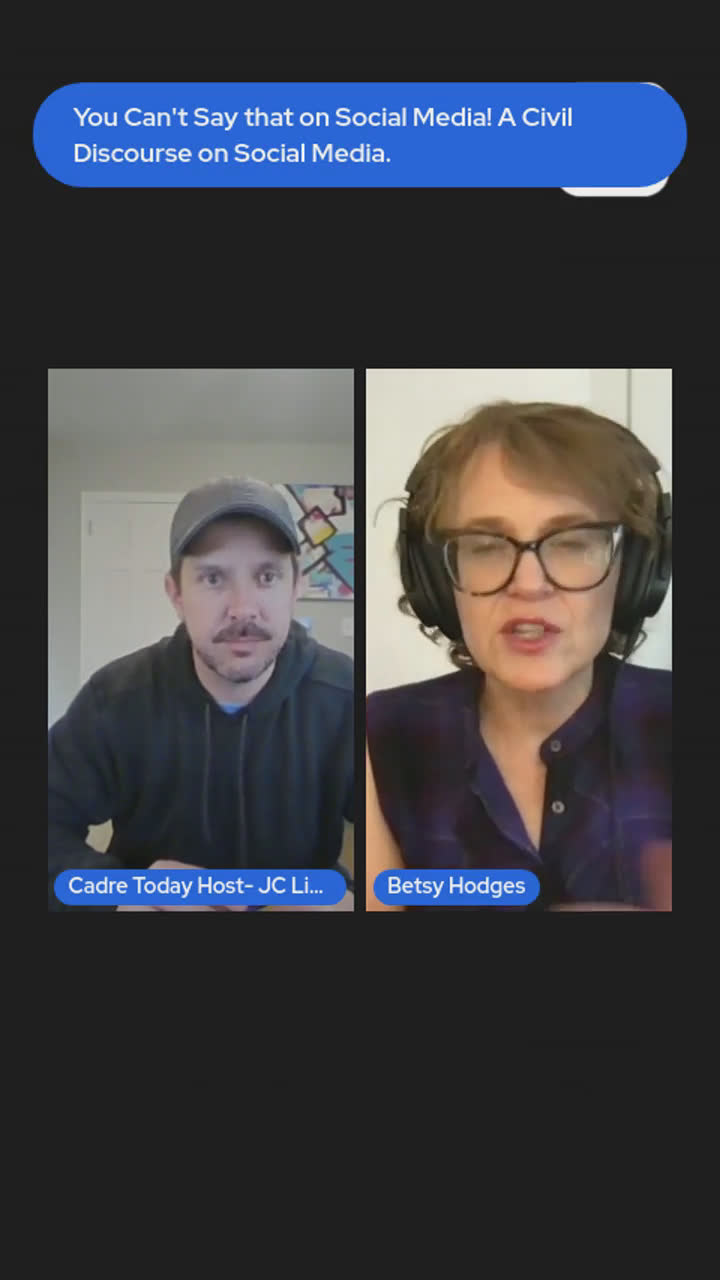
Join Betsy Hodges and JC Lippold for another conversation on how we make the most out of social media in this crazy world. 🌎
Third edition of you can't say that on Social media, A civil discourse on social media. The intent of this time is to show the world that there are many ways to being well in this pluralistic world. Where do you go when you think about social media as a conduit for connection and conversation?
Betsy: When I was mayor, I didn't do my own social media for the most part. After I left office, I began to be able to reclaim my social media. She says social media became a very magical tool for her to make real, honest connections with people.
I miss, the thing I miss about what Twitter used to be is that you could really interact with people that you wouldn't interact with any other way. Just the magic that can happen there is amazing.
One of Betsy's favorite pastimes is to thank people who have meant a great deal to her. Those opportunities present themselves in social media in a way that they didn't before. What do these connections mean in your world?
Who I choose to be in the space is important. Early on, I made the decision, I could just do nothing but add positivity here. It's very, very rare that I will say something negative. You can choose not to engage. If you do engage, who do you want to be when you show up there?
A few weeks ago on World Teen Mental Wellness Day, we held an event in the Twin Cities of Big Brothers, Big Sisters Twin Cities. In social media, you can create the platform in the way that you want to experience the platform. But don't forget that there's a huge undertow.
We always do a take home prize, so you know that we're also being impacted by this conversation. Create lists of who you want to interact with. Jen Varale is going to be jumping into the Cadre sphere with sober happy hour. Hang out with Jen in seven minutes.
And Betsy and I have just been dancing to the best playing music. And I got my fidget spinner, my Cadre fidget spinner flying. Y'all. Welcome to Cadre 3:30pm Central Standard Time, 4:30pm Eastern Standard Time. Betsy, how are you doing on the east coast today? I'm doing pretty well on the east coast today. I got back late, well, early this morning. Late last night. I was at a wedding in Minneapolis and. And feeling tan, rested and ready. I love it. Well, hey, Speak Wonder. Thanks for joining this afternoon.
You are getting double shots of both myself and Betsy today. I kicked off Cadre today. Betsy had rules, engagement. And now we are here for the third edition of you can't say that on Social media, A civil discourse on social media. The intent of this time is as Cadre attempts to show the world that there are many ways to being well in this pluralistic world with different aspects of agency and privilege and autonomy and region and ethnicity and age and all these things that separate our perspectives on the world.
We know that social media is one of the main conduits for how different individuals connect and communicate. So we decided that it's very important to create space for this conversation. Cleen, nice to see you as well, my friend. So a quick little recap on our first two sessions that Colleen and I conversed through. And then, Betsy, I'd love your first take on when you think about social media as a conduit for connection and conversation, where do you go? So here's the recap from the first two conversations.
This analogy kept coming back of a mosquito and a bite. So often we refrain from talking about things on social media because we think that we need to talk about the mosquito. But of course, we all have our own individual bites. So, Betsy, when we had our conversation last week about fun and its purpose within dealing and moving through life, there was a couple of times where you very consciously and clearly addressed the state of the world and said that we have perspectives on the reality of state of the world.
And you didn't talk politics and you didn't talk religion, you didn't talk sex and you didn't talk rock and roll. Well, you did talk rock and roll. You talked Springsteen, but you wonderfully talked about your bite, your perspective on the things that are happening to you. That's been kind of the overhead view of how do we talk about the things that are really affecting us. We talk about that we're effective and that may be the starting place for conversations as we talk about really personal and poignant Topics.
So, Betsy, when you hear about, you know, social media as a conduit, good, bad, right, wrong here, there, where do you start this conversation? Well, I mean, I have a varied history with social media, as you might imagine. But it's funny because I started by saying I was in, you know, I was out of town. I was in. I was in Minneapolis for a wedding this past weekend, which is why I was traveling. And the wedding that I went to was somebody who I would not be friends with but for social media. Because when I was mayor, when I was governing.
His name is Dana Wessel. He's on the 93X Morning show for folks who listen to that. And when I was mayor, he would occasionally tweet at me that he wanted a downtown water slide, he wanted a water park in downtown Minneapolis, and I had somewhat of a tumultuous term. And I didn't do my own social media for the most part. As mayor, you know, I would be on it, but I didn't post as much. But I would occasionally see these. And I was like, is this guy just a trolling me or is. Is this just a bit? Right?
I just, I didn't know who he was. I didn't know what was going on. And I just, I never. So I just never really resp. But when I left being mayor and you know, the bi weekly newspaper of blessed memory City pages once did an entire article about how terrible my mentions were on social media because I was, you know, the left and the right were coming after me. You know, if I'd post something like, hey, it's Friday. And they'd be like, why do you think you should call it Friday? And why do you. You know, with death threat, sexual assault threats?
And I would go for months where I didn't even look at social media because it was too toxic. There was no point to it. My team would keep track of trends, so if they. If something needed handling, we would handle it. But I just couldn't even be on it. And when I left office, I began to be able to reclaim my social media. When you're an elected official and you only have one account, at least the ethics rules in Minnesota, you can't block or mute people. Yep, yep. Because everybody needs to have access to.
To me as a public figure. And I understood that the day I left off. Bye, bye. And it started to be this incredibly important force in my life. So that's the background. So all of a sudden, Dana starts tweeting at me again, and I'm like, what's Going on. And at some point, I mentioned that I'm going to see Springsteen on Broadway, because I left office January 2nd. I saw Springsteen on Broadway April 7th, 2018. And Dana was all over it. He is a huge Springsteen fan. And all of a sudden we were doing a back and forth about Springsteen, which led to back and forth about all sorts of stuff, just texting each other, meeting in real life.
You know, I have photos from the first day that we met in real life, and we have been like, you know, very good friends ever since. I was at his wedding this past weekend, if that tells you anything. And the gift that I got him was a Lego water slide. There it is. Yeah, well, and I will say, you know, like, I. I removed myself from social media before I got the offer to open core power yoga studios all around the country. And the prerequisite was, jc, you need to get back on social media because.
And this is what the COO said. The first thing she said is, we're going to miss you. We need a way to stay in contact with you. And then she said, also, you're going to be connecting people who don't know each other all around the United States. And as a. As an introvert, as someone who panics and worries about everything, very easily, I can compartmentalize that. All of a sudden, social media became this. And I don't want to glorify, but it became a very magical tool for me to make real, real honest connections with people who I may not never spend time with in person.
And like you said, it's like your beautiful story started with this water slide idea from someone who you did not know. And it's like, is this person for real? And it connects back to you being within this integral moment of their life. So how much of that is. Is perspective versus reality? How much of that is. Is your. Is a. Is a Betsy ability to go, well, I made lemons. I made lemonade out of lemons. Versus, like. Like, is. Is. Is there something that everybody should consider or that. No, I. I agree with what I just said.
Should everybody consider at least how social media can be a. A powerful tool in a world that's moving faster than ever? I say your mileage may vary. What might make sense for one person might not make sense for another. You know, my relationship, you know, different seasons, different scorecards. As John Acuff would say, you know, when I was an elected official and there was somebody else who was in charge of all of that, there were moments when I said, I, you know, I'm gonna respond to this, or I could have fun with it in a variety of ways.
But for the most part, you know, I, I, I wouldn't post something if I hadn't run it past a team eventually just because. But it, you know, and then when I left, it became, it did become a very magical place. And I do recommend there's the, there's the material things you can do to make your experience better. It's understandable to me that lots of people have left Twitter if you decide to stay there for any reason. Recommendation I got from a guy named Rusty Shelton, who's a great brand and platform consultant, is create lists over there of this is who you want to interact with.
And then when you go to your list, that's all you see are those folks and you can speak directly to them. You can make smaller neighborhoods in the very large city that is Twitter, if you choose. If you choose. And I certainly have done that, and I did that. You can also. I have hacked the algorithm on more than one social media, meaning I only like and keep my eyes on things that I want to promote more of in my feed. So eventually my Instagram became nothing but cute animals. Bruce Springsteen, Star wars, and Taylor Swift.
You know, it's just, and that's fine. You know, the whole conversation about not being able to leave the social media, like spending too much time there, that's a different conversation. But if what you want there is great. I miss, the thing I miss about what Twitter used to be is that you could really interact with people that you wouldn't interact with any other way. You know, I've had long exchanges with Mark Hoppas, who is the lead singer of Blink 182, about whether or not Die Hard is a Christmas movie.
To the extent that he gave me and one other person credit when he finally decided to agree that it was a Christmas movie. Me. When am I going to talk to Mark Hopus? Right when I wrote, I wrote a piece for an online site called the Mary Sue. I wrote a piece called How Star Wars Saved Me. Because Star wars is one of the, like the, the movies that came out in the 70s and early 80s. Those first three in particular were one of the most important are have been some of the most important art of my entire life and helped me get through some very, very difficult things as a kid.
And I wrote a piece about that. And in the back of my mind, I thought and I want, I want Mark Hamill to see this. He's very online, he's very on Twitter. And so I Wrote it, put it up, tagged him. He didn't. He liked it because he likes a lot of stuff. I'm like, okay, well, at least he knows it exists. And then like, Minnesota business, or somebody picked it up and retweeted it. And he saw that and replied to it. This lovely response. I mean, I have it. I have a printout of it, like, right over here.
I could grab it and show it to you. But he tweeted something very lovely to me directly about it. And where else is that going to happen? Just the magic that can happen there is amazing. So I'll reflect a similar story, and then I'm curious if both of us could share what do those magical things mean? So there's a composer, Jason Robert Brown, musical theater composer, written things like the Last Five Years and Parade and, you know, just as. As a pianist and a. And a musician who sits at a piano and sings.
Like, he's. He's always been very integral to my life. And on one of his solo albums, he wrote a song called Hope. It's been a song that I've used in. I mean, I've used it in a lot of keynotes. I performed in a lot of different settings, and I placed a version of me singing it on. On Facebook and Instagram, and I share it quite often. And Jason has, on Facebook and Instagram, liked it, seen it, commented on it, and it could be like, okay, so this is like, you know, Betsy and jc, you know, fanboy fangirling over there, the people.
But. But for me, that connection over that song, it's me getting to say to someone who I appreciate in the art that they've created to say to them, hey, your art is reaching. As an artist who sometimes wonders or as a communicator, as a person who cares about other people, how often do we wonder, am I making any connections or impact anywhere? And that exchange was me knowing that Jason saw that his music was working when he wasn't. So that's the magic for me. I'm curious, you know, the. The Blink 182 in the stories, like, what.
Like, what are these moments? Because I'll also say, Betsy, you are. You are a magical being for so many people. So for you to even like or comment or share or see somebody, that's a magical connection for them. But I'm curious, like, what do these connections mean? Mean in your world, in your work and your play and your vocation and your passion, all of it? Well, you know, one of the. One of my favorite pastimes is to thank people who have done things that have meant a great deal to me. And, you know, those opportunities present themselves in social media in a way that they didn't before.
Social media. Right. I read a book last year, Martyr, by Kava Akbar, which was, you know, as a person in recovery, he. The character is. Is in recovery. I read this book, and I was stunned by it in general. As you know, I could tell he was a poet, like, right away. I've since read every book of poetry he's released, but. Because I read poetry all the time as well. But I just DM'd him on Instagram and I just said. Because his were open and I didn't know if he'd see it or not, but I just said, hey, I'm 35 years in recovery.
I just read this book. It's. It really stunned and amazed me. Thank you for writing it. Thank you for writing it and describing so well those not first days of recovery, but, you know, you're two, three years in, and it's just a very special recovery time. And he replied, you know, short and sweet, but he replied. And so that that capacity to add and to say thank you is. Is a big one. But I also made decisions at various points that who I chose to be in the space. Yeah, is. That's important. Whatever space you enter into.
Who do I choose to be in this political space? Who do I choose to be on Cadre? Who do I choose to be on Instagram? How do I choose to comport myself regardless of what other people say or do, you know, who do I choose to be? What do I want to bring to the party? And I remember deciding in 2008 or 9, I'd never been on Twitter, and I just said, you know, it would be really useful for me to really learn how to be good at Twitter. And I just started. But early on, I made the decision, you know, I could just do nothing but add positivity here.
I did a quote every morning because that helped me for years. I just did a quote because in the morning I'd pick it out, and it was a way to put my brain in a positive space first thing in the morning. And then it was an invitation to other people to be in a positive space as well. Eventually, of course, when I became mayor, that became very weaponized, and people thought that I was doing all this code with my quotes. And eventually I thought, I'm done here, but. And chose to pursue that positivity in other ways.
But I don't. It's. I Won't say never, but it's almost. It's very, very rare that I will say something negative, that I will criticize someone. I will criticize policies but not people. I will criticize policies but not someone's appearance if they're a national figure. Just having been there myself, you know, and that it's just possible to bring more positivity to a space that doesn't have as much as would be useful. And some of these sites don't have as much as would be useful. But your mileage may vary.
You can choose not to engage. If you do engage, who do you want to be when you show up there? And what I find is that that intention of spirit calls in that intention of spirit that other people bring as well. Yeah. And it's been great. So, two. Two thoughts. A few weeks ago on World Teen Mental Wellness Day, we held an event in the Twin Cities of Big Brothers, Big Sisters Twin Cities. And there's a panel of young people, you know, talking about what do people need to know about the mental health wellness reality for teens.
And of course, social media came up and one of them said, always remember, you can get rid of social media whenever you want and you can come back whenever you want. And this very, like, unveiled statement made everybody go, oh, yeah. Because it reminds me in a. In a world where people don't have agency equitably, people don't believe that autonomy is something that is safe to express. But in social media, to your point, you can create the platform in the way that you want to experience the platform.
You can connect with who you want to connect with in the way you want to connect with them. But in a world where we're so used to going, I don't get to make those choices. I think it's a great reminder to go, hey, this social media world, if we choose to use it, and it's beneficial and positive for us, we can create kind of the atmosphere in a world where we don't get to create that very often. So I think everything you're sharing is making me think of social media in that way. Yes. And I would say you can ride those waves.
But don't forget that there's a huge undertow. Yeah. That there are thousands of people getting paid hundreds of thousands and millions of dollars to finely tune capturing and keeping your attention. Yep. And there are times, you know, because I spent almost two years really delving into my anxiety and how it plays out and what it looks like. I was talking today on rules of engagement about how often I've been scared, active. And what really scared me is there came a point where I was scared, passive, where it just became so overwhelming that I just felt locked in place.
And I've done an inventory of what those behaviors look like, and I have a whole range of strategies about what to do in those moments when that happens. But one of the key things that lets me know that I might be in a freeze state is that I am just scrolling. And sometimes I'll even think I don't even want to be here anymore, and I'm still scrolling. And that behavior is much, much, much reduced since I really did that. Full, full court press on what my anxiety looks like, what my freeze response looks like.
Because technology is great until it's not. You know, technology is great when it works for you, and it's not great if it's working against you. And there are people who have degrees in how to cap, keep your attention. And all of those apps are based on how to capture and keep our attention because they translate that into money. Yeah. And so. And so if it's hard to leave, if it's hard to imagine leaving, that's part of the reason why, right? Instagram does not care if you have, you know, if you want to go touch grass, it does not want you to go touch grass.
It just wants you to stay scrolling. And so, you know, doing what you need to do to have the relationship you need to have is key. And for some of us, that means we can't be on it at all. For some of us, that means, oh, this is a source of relaxation, fun and joy. And for some of us, it means, oh, I keep showing up and I don't want to show up, and what do I do now? So, Betsy, what a gift. And I agree with Speak Wonder who, who says you are truly a renaissance human being in the life that you live.
But, but, but, but also in the way to be able to constantly step back and again, scroll when you want to scroll, touch the grass when you want to touch the grass. I mean, like, like what, what. Whatever that song was, however many decades ago. It's like life really is an opportunity to consistently check oneself and go, what? What is guiding me right now to where I'm going? And if where we're going isn't where we want to be going, that awareness and going, what's bringing us there? So as we wrap this up, everybody, as you know, we always do a take home prize, so you know that we're also being impacted by this conversation.
Right? So whether you're at home and going, hey, here's my Take Home prize. But Betsy and I will share ours right now and you may see us think in real time. Betsy, do you have a Take Home prize From the last 22 and a half minutes? Create if you're, if you're, if you're on platforms that allow you create lists to really curate your content for yourself. And my post it note for my Take Home prize says Rusty Shelton, create lists of who you want to interact with. I think that's so great because again, at the end of the day, I think of my layers of chosen family and so many of them are built into the engineering and infrastructure of my social media world.
Yep. So everybody at home, your Cadre sphere is one of those things. You have communities here that you can tap into on topics contributors to follow so take our Take Home prize with a grain of salt and really cater your experience here. As we wrap up in seven minutes, Jen Varale is going to be jumping into the Cadre sphere with sober, not somber, a 4 o'clock central standard Time happy hour where you don't need to go ahead and have alcoholic libations to go ahead and have a good old time with Jen.
So hang out with Jen in seven minutes. Check out Betsy on Tuesdays. And Betsy, thank you, thank you, thank you for this civil discourse on social media. We'll see you later. Thanks so much. Yeah,
Reactions and comments are for members. Joining is free and takes a minute.