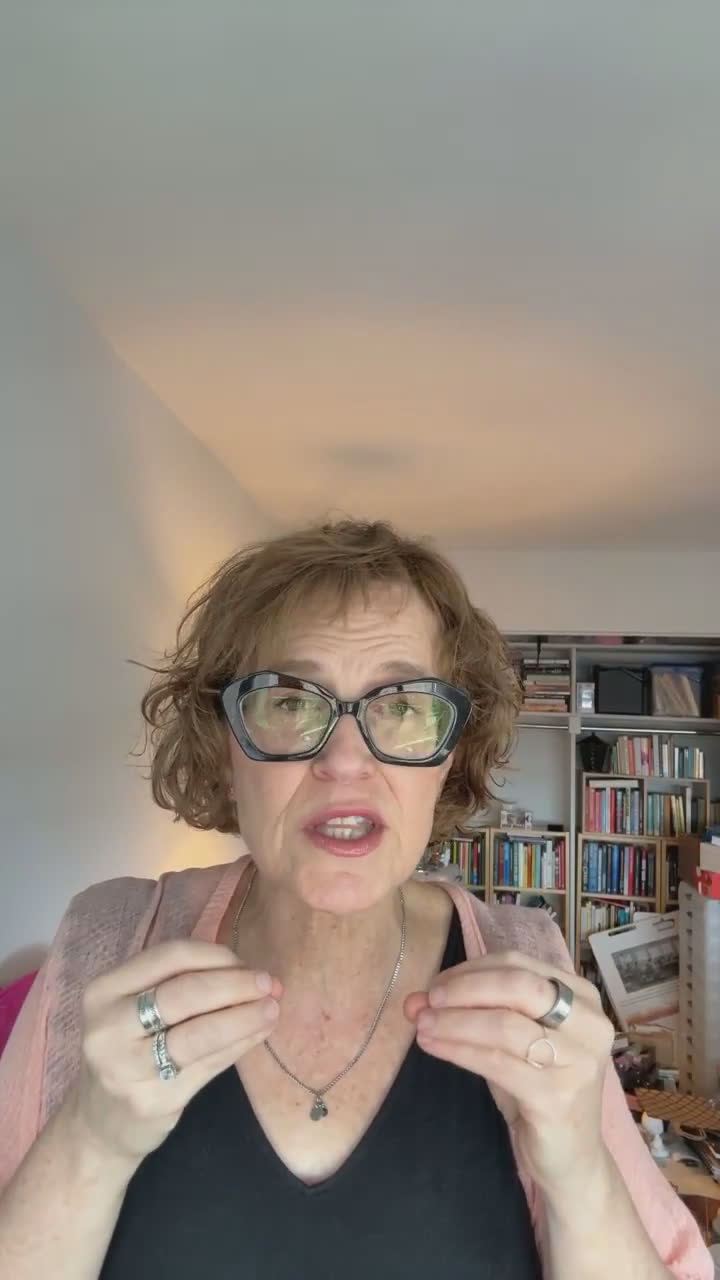
Betsy guides a brief talk from her under-construction office about treating data as a compass rather than a grade, exploring how feedback and urges can signal useful course corrections and linking to her city work.
Betsy: Welcome to Rules of Engagement. From my new space, I figured I would just let you see that it is still under construction. I work with an organization called the Mayor's Innovation Project. I have a fun rule of engagement for everybody.
Aaron: Data is not a grade. It's a compass. How are we doing? How can this help steer us in a new direction? I immediately added it to my list of guideposts and guidelines in my life. We don't have to judge ourselves for the information we get about ourselves.
Our worst self always gets a bad grade, but we don't need to grade our worst selves. The urges of my worst self are a really fine compass. The sooner I can recognize and make a course correction, the easier it is for me to.
Next week, my space will probably look a little different. I'm gonna figure out what to do with various backgrounds for meetings. At any point, I would love to hear what your rules of engagement are.
Hey, team. Welcome to Rules of Engagement. I am your host, Betsy. From my new space, I figured I would just let you see that it is still under construction. I moved here, gosh, a month ago now, but my office is still under construction. But I figured I'd just be real. And I have a fun rule of engagement today for everybody. Hi, Brianna. Welcome. Which I'm very excited to talk about. It's a new one. It's not a rule of engagement. It's a guideline. It's a guideline, and I am excited to talk about it.
It's about information we get. And I think I've talked about it a little bit before. I think I've talked about it a little bit before, but I have not, I don't think, done a full live stream on it. And I've just been thinking about it so much, and it's just such a rich thing to think about. Good morning, Luke. Good morning. Nice to see you here. If you weren't here. I am from my new space. We moved about a month ago. My office is still under construction, but the kitchen is done. The bedroom and my closet are, you know, the shared spaces are done my person, because I love my husband.
So I've been working on my office the last couple days. It'll look different the next few times we talk. I think I have been thinking about this one a lot. It's new. I do a lot of work with cities and organizations that work with cities, with mayors, with city councils, with organizations that work with mayors and city councils. And I was on a zoom, talking about a summer meeting I'll be going to later this year in Albuquerque. Now, I used to live in Albuquerque. Little known fact, I think in the early 90s after college, I lived there for two or three years.
It was exactly where I needed to be exactly at that time. It helped launch basically the rest of my life. And I loved it there. And I work with an organization called the Mayor's Innovation Project. I'm a senior advisor there. And it was started by someone I was a teaching assistant for when I was in graduate school for sociology. He started it long after I worked with him, about 15, 20 years after I worked with him. But he called me up when I was mayor and said, hey, I started this thing. And this is the professor who encouraged me to go into local government in the first place.
He said that local government is a very powerful place to do social change work. And I believed him, which is why I didn't do my dissertation and instead ran for office long Story short. So he called me up to say, I have this organization called the Mayor's Innovation Project. We would like you to be involved. And I said, of course. There is a bright, straight line between my relationship with Joel, working for him, admiring his work when I was in graduate school. He's a MacArthur fellow for those who are interested in that sort of thing.
To me, being mayor. And so I worked, I was a member, and then when I left, I came on board and became a senior advisor. So our summer meetings in Albuquerque, very excited about that. And Aaron from Albuquerque, we are talking about different things that the Albuquerque team might want to talk about in workshops. We're putting together the workshops. And Aaron said something, and I'm guessing he got this from somewhere else, but I'm going to credit Aaron from Albuquerque with this. He said, but they have a really great data dashboard, really great data dashboard in Albuquerque.
If you're a city nerd, or even a data nerd, organizational data nerd, Albuquerque does a lot of great stuff with their data. And he said, data is not a grade. It's a compass. I think what he said was, data is a compass. It's not a grade. In other words, when their department heads bring them data about how something is functioning, it's not used as an assessment for the competency, skill, or effectiveness of the staff or even the program. I mean, I'm sure they use it on the effectiveness of the program, but it is a compass.
It's a guideline. How are we doing? How can this help steer us in a new direction? How can this help steer us in a new direction? And I immediately added it to my list of guideposts and guidelines in my life. Because think about that. If we use that concept with ourselves, if we give the grace to ourselves, that information that we get about how we're doing or something we're doing is a compass. It tells us, you know, if we're heading, if we have goals, if we have values, if we have a north star.
Let's say all of those things are the lighthouse and we're in a boat. If we use, you know, and we get off course and it's all of a sudden it's like, why is that island over there? And then we look at the map and we say, that's because that island is not the island we're going to, Right? We're going to the lighthouse that's over there. We're trying to avoid this island as we travel to this lighthouse. If we take that information as a grade, we just stop Rowing. And we're like, well, we screwed up.
I might as well stop rowing. We're not going to get in the right direction, right? If it's a grade, it's like, oh, God, I'm so bad at rowing. I'm so bad at getting to the lighthouse, because when I tried to get to the lighthouse, I got to the island instead. It's like, well, if we treat it as a compass, if we say, oh, look, this bit of information, that's a guideline. Now, we know we have to adjust ourselves this much to keep going exactly where we want to go. It's a compass. It's not a grade. We don't have to judge ourselves for the information that we get about ourselves in our lives.
About I'm going to tell a recent story and I'm going to tell on myself. About three years ago. Somebody gave me a bit of information and confidence, and I knew I had a way. And I can't give too many details here because it would be. It's not just my story, but my part of this story. I knew I could use that information on this person's behalf if I gave it to someone else. That if I gave this information on someone's behalf to someone else, then that someone else could take some action that would benefit the original person.
But I did not ask the original person if I could give that information to this someone else. I just did it. I just did it. I hadn't done something like that in years and years. Literally. That is not who I am. I'm not sure what possessed me or I wasn't sure at the time what possessed me. So what did I do? I immediately, like, curled in on myself and I immediately started grading myself and I gave myself an F. And I just really wanted to not do anything. I just wanted to hide away. Like I said, I'm a person in recovery.
I am a sober person. I don't like to do things that I have to make amends for. Good morning. T. North 66. Welcome. I just am telling a story about myself where I was given information and confidence that I gave to someone else for good reasons, but there wasn't a good enough reason to do that without talking to the original person. And I felt terrible and ashamed and embarrassed. And I really wanted to grade myself because the guideline is, data is a compass. It's not a grade. But I thought to myself, first of all, at that point, I had maybe over 30 years of sobriety.
I was like, okay, call somebody in recovery and just tell them what happened. Even if you don't want to, the sooner you deal with this, the sooner you can stop feeling terrible. So I called my friend and. And we talked, and she immediately was like, well, you know what to do. And I was like, oh, I do know what to do, and I don't want to. And I called up the original person, and I told her, and I apologized. I made an amend. I didn't just say I was sorry. I asked her, you know, what can I do to make this right?
And she said, you know what? It's actually fine that you told these other people. I guess you know a little bit more than you knew now, because I used a. A pronoun. But it's okay that you told this other person, and we'll see what happens. And she forgave me. Like, we've never talked about it since. And this person, it actually brought us closer in our relationship. It brought us closer in our relationship that I was honest. It wasn't the breach in the relationship that I feared that I had betrayed that trust.
And what it allowed me to do was then use that in. Because once I made it right to the best of my ability, then it was easier for me to. I mean, I'm tense. Just talking about was easier for me to take in a deep breath and say, why did I do that? Let's pretend this isn't about me being a bad person. Not pretend. Let's act like, even if I couldn't quite tell in the moment, let's act like this isn't about me being a bad person. And let's act like this is an important data point. What is going on with me?
And I got to do a deep dive about why was that particular situation so set up for me to break my integrity, for me to violate my own integrity. And I got a lot of useful information from that data that I was willing to use as a guideline to my better self. Right. I was willing to use it as a compass to my better self rather than grade my worst self. Right. Our worst self always gets a bad grade, but we don't need to grade our worst selves. We all are a mixture of a whole bunch of things. I could use that data as a compass.
The urges of my worst self, of my shadow self, are a really fine compass. And I learned a lot. I learned a lot. There was something going on in my life where I was sitting in some resentment about something that had happened in the past that was very similar to the situation this person was facing in the present. And I wanted to make my past situation correct and right by trying to correct and write her current situation. There is nothing I can do in the present that will make the past have turned out any.
Any other way than it did. I can change the story by changing my own life, by changing how I think about it, et cetera, but I can't change that. What happened, happened. The past is always the past. That's actually another guideline of mine. Everything that has ever happened has already happened up until this very moment. There's nothing we can do about that except acknowledge it as what it is and make decisions about who we are in relationship to it. So I got to use that data as a compass back to myself, right?
What is going on with me in that moment. And so then I could do some more healing work about what had happened in my past. And so I didn't have to mess with her present anymore. I didn't have to mess with her present anymore. Oh, bless my heart. Honestly, it had. I had. I was shocked by my own b. I am still shocked just by my own behavior. I don't want to be that person. I want to keep confident. I'm a very good confidence keeper. So the fact that there was that breach, and it's very hard to admit to all of you, but it's as real as it comes, right?
That was data that I used as a compass once. I. Once I was able to not use it as a grade and making things things right. As I'm talking, I'm like, well, making things right is part of what allowed me to use that bit of data as a compass and not a grade. And one of the things that I have at my disposal as a person in recovery is if I want to drink or I want to smoke or I want to eat an entire chocolate cake or any sugar at all, Those are signs. Those are data that I can use to guide my behavior. I no longer have a judgment about the fact that I want to do any of those things.
I am. I get addicted to anything I try, which is why I don't gamble, because I just. Why would I play with fire like that? So when the urges come up, when I, you know, when I notice. And this has happened the last few days, actually, I've noticed people smoking, and I'm like, ugh. I'm never shocked that I miss smoking, but it is data for me that some. I think something's going on in my life that I could use a little tune up. And I. The last. Yesterday I reached out to my sponsor and I Was like, I need a little time with my person to talk about what's going on and whoever that is in your life, if you're in recovery or not.
What are those red flags for you? What are the behaviors that if you engage in them, that's a compass moment to help guide you back to yourself as opposed to away from who you would choose to be. And the sooner I can recognize and make a course correction, the easier it is for me to. Because one little. As an alcoholic, I know this one little jog off your ship's destination, it doesn't matter right away. It's only a few feet. But very, very quickly, you know, you end up in, I don't know, you know, if you're coming from Europe, you'll end up in Canada instead of South America.
I'm not very good with geography, but you get what I'm trying to say here. The sooner I can course correct, the sooner I can, you know, if I wait to course correct, I'm going to get further and further off course, and it's going to compound itself. It's going to compound itself. And so having these data points, recognizable data points for myself that I can use as a compass as opposed to a grade. If I use it as a grade, I will just keep going in the negative direction one way or the other. If I use it as data, I can course correct.
So that's the guideline for today. Data is a compass. It is not a grade. From Erin from Albuquerque. So, everybody, I really enjoy the time we spend together. I'm so grateful that you're here. Let me know, you know, if there's anything you want to hear about, anything you want to know about, let me know. And T. North is saying, I did this recently, sharing something with my wife said to me about a situation, confidence, and. And she shared with the person what had done. I think she was okay that I had talked with the other person.
Yeah, yeah. And then the question becomes, so why didn't I ask first what was going on with me that I didn't ask first? That's a compass moment. That's data that you can use as a compass, not a grade. So, all right, everybody, I am so excited to be here with you, excited that we'll get to be together. Next week, my space will probably look a little different. I'm gonna figure out what to do with various backgrounds for meetings. Until then, have a great week and ponder what are your own rules of engagement and share them with me if you get a chance.
At any point, I would love to hear what your rules of engagement are. I always learn a lot.
Reactions and comments are for members. Joining is free and takes a minute.