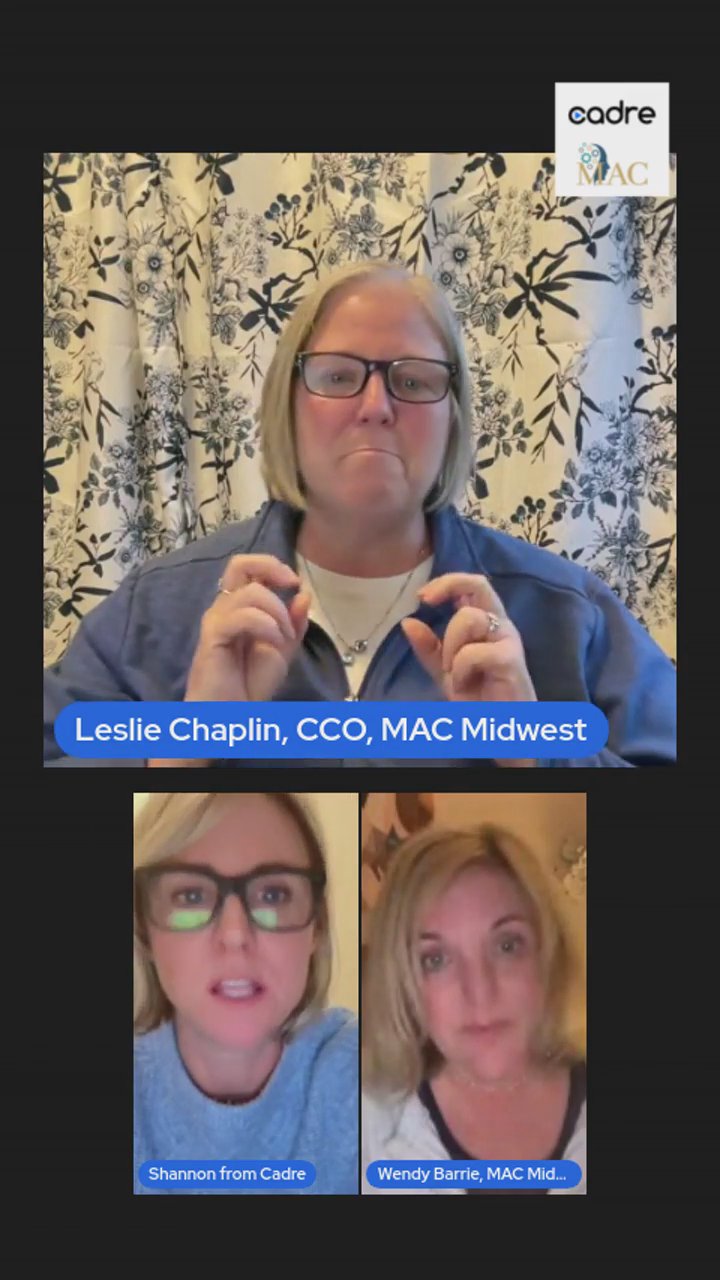
Join Wendy Barrie, Licensed Marriage & Family Therapist, and Leslie Chaplin, Chief Clinical Officer at MAC Midwest, for an insightful discussion on how talk therapy can support individuals living with autism.
Cadre is doing a Q and A tonight with our beautiful friends at Mac Midwest. We're talking about talk therapy and how it's integrated into the lives of people living with autism, neurodiversity of all kinds.
Wendy Berry is a licensed marriage and family therapist. Recently she pivoted into this role of doing outpatient therapy. It's really great to be working from a different lens and a different perspective and yet pulling everything in from the autism world as well.
There seems to be like one thing is the wait list. People are on waiting lists and they're waiting and waiting for services. One of the things that I'm focused on is trying to get folks in sooner. Anything we can do to support those moments in between is so scientific.
Leslie Chaplin is the Chief clinical officer at Mac Midwest. She's had about 30 plus years in the field of children's mental health. She says she has a passion for building new programs to fill gaps in services.
We have so many people on the wait list. The gaps that you have in caring for the person with neurodivergence and then also caring for yourself, you don't know how to fill them. Talk therapy or psychotherapy is one of the choices.
Wendy: Could you talk real life experience where there's been a gap and helping someone see there's an opportunity there to fill it and then you could just roll right into a success story. Being able to give the tools to get yourself present in the moment allows you to then make better decisions.
Leslie: What do you see that's unique to those with neurodivergence? Leslie: One of the big gifts we've been given from this is to really understand what's going on. I wonder if parents struggle to find that point of view of it being destigmatized.
The stigma that is still surrounding mental health. I like to view it as wellness. We're all on a wellness journey. The normalizing of it is what just feels so different when we have a question.
Can you speak to finding a good match between therapists and family? Sometimes it's scary to try therapy once you have had a pairing that wasn't beneficial. But in the end, it can really be worth it to find that person.
Pretty clear about what she's asking me to do or about what we're talking about. If it's not a good fit, it's always okay. Our goal is to have whoever we're seeing get the most out of therapy.
Is there a point in time when it's. better to have a therapist than not? When your first session is going to be like a diagnostic assessment. Think of it as preventive medicine.
But I've never in 30 plus years had anyone parent, child, whatever that I have said, you don't need to be here, you're fine. Even if they don't have something that's diagnosable immediately, there's, you know, there could be something there. And again, be vulnerable with us.
We got a comment that said classy flower said wellness feels more like a lifelong and personalized journey. It is a lifelong journey, whether we call it mental health or logical health. We continue to learn and, and figure things out.
For some people, therapy feels maybe more accessible in general and honestly, just generationally. Gender. There's different elements that play a role in people's comfort level with the idea of therapy. Just, you know, really building rapport and, and trust with that person that's coming in.
Tracy: Sometimes it can feel a little weird in therapy because when you go in, it's really more of saying, what do you think you need? She says at the end of it, you're the one helping yourself. Tracy: It's cutting out to let them see that.
Mac: What we certainly we do at Mac is what we call solution focused. A strength based approach is when did you actually get through that in a good way. Most of the time it's about, what are you struggling with? What's going on? Let's be in the moment.
We're calling it an integrated neurodevelopmental wellness model. Moderate to profound impairment with ABA services that need repetitive skills training. Most general outpatient psychotherapy services have never worked with folks on the spectrum. There's a huge gap for kids and young adults in that transition age.
Wendy: We have an integrated neurodevelopmental wellness model that's that's our framework for. what we're putting together. Leslie: We also are doing what we call support now. Right now, Wendy is our only one, but we have up to potentially 12, 12 offices.
With it. And it'll be just, hey, guys. Happy Thursday, June 12th. Welcome to the Cadre sphere. You are live. We're doing a Q and A tonight with our beautiful friends at Mac Midwest. And we're here tonight talking about talk therapy and how it's integrated into the lives of people living with autism, neurodiversity of all kinds, and affected by neurodiversity of all kinds. And so what we do is, is we partner with our friends at Mac Midwest, and so we bring some clinicians who are both human beings, which is great, and also clinicians to bring their lens to this conversation around how talk therapy can be integrated into the lives of those affected by neurodivergence.
So welcome to this live Q and A. I am Shannon. If I have never met you before, I'm part of the Cadre team. I have a son with autism, a caregiver for a son with autism, and I myself live with anxiety and cptsd. So I've had all the talk therapy in the world for eight years, and I integrated into my life so I can share that experience as well. But we're super happy to welcome Leslie and Wende. And so we're going to just start with an introduction. Wendy, do you want to go first and just tell us who you are, what your job is at Mac, and just a little bit about, you know, I guess, why this is an important topic to you.
Sure. Yes. My name is Wendy Berry. I'm a licensed marriage and family therapist. And I have been. Actually, two days ago, it was my year anniversary, so it's been one year. Happy anniversary. So I'm excited about that. Yeah, thank you. And so I started with Mac in at some of the centers, so doing some of the center work and providing support there. And then recently I pivoted into this role of doing outpatient therapy, and I felt passionate about that because that is sort of the. The background that I.
That I have. Right. And the experience that I have and my expertise is, is largely around working in the outpatient world. And so that has kind of what led me to this. This role now and to this present space. So it's really great to be kind of working from a different lens and a different perspective and yet pulling everything in from the autism world as well. That's awesome. That's beautiful. And so do you have a feeling fundamentally about talk therapy when you think about it as a. As a service or as a.
As a practice related to folks with neurodiversity? Like, do you come with a certain like point of view or passion around that. Is there anything you want to share on that? Yeah, absolutely. So I think that they're like, from my perspective and the work that I've done with the autism community, there seems to be like one thing is the wait list. Right. So people are on waiting lists and they're waiting and waiting for services. And that can be really frustrating. Right. And frustrating for the families, frustrating for the children who are waiting.
And so one of the things that I'm focused on is trying to get folks in sooner and kind of trying to create the time that they have that intake to the time they start receiving services. And so sometimes talk therapy, doing some family skills work, doing some couples work, working with the entire family can be really integral as they're waiting for that next step to move into perhaps ABA therapy services. That's amazing. And that is such a hot. Not. I mean, it is a hot topic, but it's also just, it's such a pain point.
So I know I can speak for myself again. I've lived through that. And so I think anything we can do to support those moments in between is so scientific. Scientific. Yep. That's not a word. Significant. Okay. Leslie, do you want to introduce yourself? It's a word now. It's a word. We're gonna make it work. It's great. Yeah. Hi, everybody. Leslie Chaplin. I'm the Chief clinical officer at Mac Midwest. I joined Mac on July 1st of last year. So I'm almost at my one year anniversary. Wendy and I started near the same time.
Yeah. And I am up in Duluth, Minnesota and I've had about 30 plus, I don't know, 34 or five years in the field of children's mental health. I'm a licensed independent clinical social worker and also a PhD in organizational leadership. And so my career path has been working in residential treatment and day treatment in school districts directly with kids who are struggling with mental health disorders, behavior disorders, trauma, all kinds of things like that. And then as, as I moved up, you know, in my career, learned more, I started to do more and more administration and found I have a real passion for building new programs where we see some real gaps in services and some real needs and communities and being able to create something that will be able to fill that gap that's.
That can use sometimes link, you know, two different sides and of where some services do exist. But then kids are falling and families are falling into these cracks. So that's really what I love. Mac is an incredible organization and there's so much potential and opportunity. And so I'm just super excited to be able to be here and be working with folks like Wendy to create some new services. That's awesome. Well, and I think that's the thing. So when we think about. We already have a question and I'm going to get to that one second because I think one of the things that's so exciting.
It's exciting. I mean, it's a problem, right. Is that we have so many people on the wait list. And Leslie, you're talking about these gaps. And I think when I think about again, I'm always going to speak from the lens of the parents because that's me. The gaps that you have in caring for the person with neurodivergence and then also caring for yourself, you don't know how to fill them. And I don't know that people think I never thought first about talk therapy or psychotherapy as, as part of, of the, of the choices.
Right. Like, oh, that's the thing that I would go to because you're so hyper focused on those clinical services for your loved one or yourself. So Wendy, would you mind sharing a little bit about just sort of parents who are in that moment in time or sort of, you know, patients or folks that you've worked with, where you've really seen. Because the question is you have a success story that you can share, which is awesome. So could you talk real life experience where there's been a gap and helping someone see there's an opportunity there to fill it and then you could just roll right into a success story.
Absolutely. For sure. Yeah. I think I'm going to share the success story first because something just popped up today and it just seems to make sense here in this moment. So I have a parent grandparent working with a kiddo. I've been working with some with this grandparent on finding additional ways to support their child so that they can manage and feel just better about how they're responding in those moments so that they have some new tools and skills to be able to try themselves and also to teach, you know, the child in the moment.
Right. And so, and this is what I have often experienced is that, you know, like, ah, we get it, but we don't, you know, understand what the skill is. But then to apply it in that moment can be a really tough thing. Right. So I've had these moments where we've been able to do that kind of in the moment and then also to really just walk them through, like, oh, okay, now you're noticing this did you. What do you think? Like, what was going on before that? Kind of looking at some of those antecedents and, and, you know, looking for possible triggers.
Like, what about vulnerability factors? Did they get enough sleep last night? Are they feeling sick? Did they eat well? Right. And so with this particular family, we ended up, you know how you just all sudden have this light bulb moment and it seems like that's kind of what happened. Like, oh, my gosh, yes, that's the thing. Like, this is it. And so once we got to that, now parent grandparent is feeling more confident, right? Because they have some agency. And not only do they have agency, but now the child has some agency too, because now they have choices, right?
Like, oh, do we want to do this or should we try this? And then great, great choice. Like, I love that. Right. And so being able to do some of these things in the moment has been really amazing to watch. And I don't know if I answered the other part of your question. You did, but that's no, because I think you absolutely did. Because I think, I think part of what people. And again, so part of why we do this, this series is so people who don't have access to resources might get some help. And so I think one of the things is that often your struggle to calm yourself.
A caregiver might struggle to be able to access their most resource part of their brain in the moment to be able to then support. Right. Or to notice the things. And so I think what you're saying is like, being able to give the tools to get yourself present in the moment allows you to then make better decisions. And I'm not going to say better decisions because you're still doing your best, but to make, you know, more effective, more decisions. Right. In those moments. And then also, you know, to remind ourselves that it's okay to not get everything right.
I mean, I don't know as a parent, I've gotten so many things wrong every day. Right. And. And so it's okay. And we can kind of work, work to. And this is a skill too, but to let go of the judgment of, you know, around ourselves and the way we're parenting and around other things, right. Like, it's okay we're gonna fall and then we get back up, as Brene Brown would say, right. And then we try again and we fall again and we get back up and then we get support when we need it. And yeah, I mean, it's hard.
It is not easy and we can do it. Of course. Yeah, I love that Leslie, do you see. Do you see specific sort of. Not behaviors, but judgments or thought processes that folks that are living with neurodivergence in their life bring to how they think about therapy or how they. Do you see a difference versus, you know, I know you said you worked with children over the years in many settings. Yeah. What do you see that's unique to those with neurodivergence? Yeah, you know, I think it is such a growing area where people are discovering, oh, all of these things that I've sort of felt off with throughout my life or as I watch my child now.
It's sort of. There's a context to put it in. And I think in. In the past, we didn't see as much of that. A lot of times it would be about behavior and be looked at as like a disciplinary issue or you're, you know, this is a bad kid who doesn't listen. So I think that's one of the big gifts we've been given from this is to really understand what's going on, to really look at it in terms of a learning opportunity and a way to figure out what is maybe the stimulus that is making this response happen.
And how can we change the environment, change our reaction? Sometimes it's just give it time and space, and that's such a different way to look at it than when we think someone's being defiant or someone is intentionally trying to misbehave and cause trouble or intentionally even hurt someone. Especially, you know, whether it's in school districts or working in treatment centers. You know, sometimes behaviors get to the point where a parent alone isn't able to manage all of this and keep everyone safe.
It. You know, it takes. It takes more than that a lot of times, no matter if you're the parent of the year or not. And so being able to get that help and understand that this isn't a failure on your part as a parent or as a caregiver. This is a circumstance with a child that. That. That needs a whole. Kind of. Needs a village, you know, needs a whole bunch of viewpoints and maybe different areas of skill to come together. And then to have that the. All of those folks work as a team to say, okay, here's how we can.
How we can help make things be the best they can be right now. And then hopefully, as we're able to teach and learn, all of us together, that those. Those moments can get better and better, that it isn't a stuck. Oh, once you have this diagnosis, once this has happens to you, this is how you are forever. And there's never any opportunity to kind of grow and change and develop. And I think we're. I think we're busting that open now. And I think that is really exciting. Do you think that's awesome, do you think?
Because I think. I wonder. Actually, I shouldn't say. I think. I wonder if parents struggle to find that point of view of it being destigmatized and being like, within the current system. And I know that's a sort of like a weird thing or it's a weird question, but, like, where can they go to know it's okay? I think that's a great question. And, you know, we hope that a place like Mac is a place they can go to know it's okay. The reality is this is the way our society is structured. It's disease based, it's medical insurance, it's.
You need a diagnosis of a problem to be able to actually get the support and care that you need. And. And that's. That's something that we all have to kind of push back against. And so looking, using words like wellness and using words like learning are just what we do at Mac to make things so much more open as opposed to, like, treatment and services. Like, we're. We're trying to broaden that out a little bit and really understand that we're not necessarily trying to change anybody. We're trying to broaden out being more of who they are and living kind of the.
In their best life in the moment instead of the struggle and pain. Okay, so that just triggered. And we have another question, but this just triggered another thought. Wendy, I know when you and I talked that word wellness just was like, oh, I remember, I remember that. Can you talk a little bit about that? Reframe? That's awesome. Yeah. I mean, I think it's so important, like Leslie mentioned, you know, the, the stigma that is still surrounding mental health. Right. And I like to view it as wellness.
Right. We're all on a wellness journey. We're all different places on our wellness journey, but we've all experienced struggle, difficulty, trauma, some of us. And it's so. It's, I don't know, the whole, you know, psycho and everything. Right. It just kind of feels heavy sometimes and it's sort of misleading. It's really about wellness, like emotional wellness, you know, spiritual wellness, if that's something that speaks to you, and, and physical wellness and just kind of like whole body wellness.
And so that's kind of the lens that I always try to to. To always, you know, approach my. My clients with or from. And that's so different. I mean, that just feels so different. Even just, you know, I think it's. The normalizing of it is. Is what just feels so different when we have a question. Can you speak to finding a good match between therapists and family? Sometimes it's scary to try therapy once you have had a pairing that wasn't beneficial. So, like, ooh, how do I go back when I had a bad one?
Yeah, that is scary because. Right. You've already made yourself vulnerable by stepping in and you're taking that step, and now it went, you know, badly or not the way that you wanted it to. So to get back in there and take a risk is. It's scary and it makes you vulnerable yet again. And I think that so often it happens that there's just that mismatch, right. Like there. It's just, oh, we. We're just not a good fit. And although we don't like to hear that on either end, it's. It's just the reality.
And I think that the more that we can kind of embrace that, the, The. I don't want to say easier, but it can be maybe less stressful, right. To. To. To go back in and take that risk again. And it is about exploration, right? Just like when you're. I don't know, this is probably not a great example, but, like, you're gonna buy a new car, right? You test drive and like, oh, this one doesn't feel so good, right? And, oh, I am loving this one. I love everything about it. Or this is adequate, right? Like, it just.
It does take some time and, and time and energy, right? And, and, and I think that in the end, it can really be worth it to find that person that's. That you feel connected with and that aligns with your values and your belief system and is willing to just kind of walk alongside you. Right? Yeah. Leslie, would you add anything to that? Yeah, I agree with you completely, Wendy. And, and what I would encourage folks to think about is the therapist wants it to be a good fit too. And like you said when you introduced us, we're just.
We're just humans. Like, every therapist has their own personality, their own issues, their own preferences, right? They're not going to be the best fit for everybody. And so if it isn't working for the client, for the family, the therapist should want to know that and be able to say, totally hear ya. Here's some other folks you might want to try that are different Than me in whatever way. And when people ask me, like, oh, who do you think I should see? Because that's the other thing. Find people that like their therapists and say, who do you think you should see?
You know? And I always ask, well, I don't know. Do you feel like you connect more with man or with a woman? Do you want someone older? Do you want someone younger? Do you want someone who's kind of silly and casual and fun? Or do you want someone who's very sort of medical, serious, diagnostic? Because we all have different styles, and I think you can find those things, but don't hesitate to try. And even the minute you go into the first session, say, I'm not sure. I've tried therapy before. I need to feel a connection.
We'll do this first one, but then I'm gonna need to, like, just put it out there. They won't be offended, and they'll probably actually be grateful that that person has that much investment in finding the right person. So true. And, I mean, I'm gonna do two things. One is awkward. This is like dating. I'm 49. I'm dating. Listen, I know what I want now, and I'm gonna try. And I think it's very similar where you are, like, with your therapist. You are, like, especially as a. If you're a caregiver or, you know, you're advocating for that person, like, you know, your person.
I think that's the other thing I would say is you know your person, and so start to make a list. I mean, I'm trying to get to some tactical, practical things. Like, I really care about this. And you said it was like, is it. Is it more clinical? Is it more, you know, is it warm? There's all different types of folks. And I love that you're saying, don't be afraid to sort of own what you need. And also, I do agree. And Wendy, would you agree, too, that the therapist, like, if it's a bad match, I'm sure it doesn't feel great on the other side either.
Correct? No. Right. I mean, for sure. And like, Leslie spoke to. It's. It's so helpful, though, for us to know, because sometimes, you know, if. If you don't share with me, I. I'm not quite sure. Right. Because I can't read your mind. And so it's helpful to know what your thoughts are. If you're thinking, like, well, you know, I kind of want my therapist to be a little more bolder and sort of, you know, not just nudge Me, but really be, really be, you know, pretty. Pretty clear about what she's asking me to do or about what we're.
What we're talking about here, right? So sometimes you just need to know that it's like, okay, well, now that I know that, I can adjust my style a little bit, right, to kind of fit your needs a little better. So, yeah, it's really great to know that. And it's always okay. If it's not a good fit, it's always okay. And our goal, right, is to have whoever we're seeing get the most out of therapy and get the most out of whatever service that they're seeking so that they can achieve that wellness and balance in their life.
That's great. Is there a point in time when it's. When it's better to have a therapist than not have a therapist? I know this is a sort of, again, a weird question, but I'm thinking about folks who might think like, I don't need that, or, oh, we're settled in, or are there times where you'd say, it's really more valuable? I mean, I know in a perfect world we'd have therapy. Well, I would have therapy all the time. We would all have therapy all the time. But is there any sort of. I don't want to say best practices, but moments in time or triggers where if, you know, whether that's seeing a behavior, whether that's coming up on a transition time in life, maybe like, transitioning from.
You know, I know with my kids it was like going from elementary to middle school or those transitions of settings. Are there things like that that people should think about ahead of time or is that. Is that a thing? Leslie, you want to. Oh, sure. Sorry. I was thinking that was for Wendy. I'm sorry. Yeah, absolutely. So. So especially talking about kids on, you know, folks with ASD or, you know, neurodivergence, or if, you know, transitions are rough, then kind of getting ahead of it. Think of it as, like, preventive medicine or like, you know, you're gonna have a.
Do a lot of physical labor that day, and maybe you take the leave at the beginning of the day instead of wait till the end of the day for it to hurt. Yeah, it's. It's, you know, but a lot of times for that to happen, people have had to have some experiences of that first. Okay. And then they realize, oh, we're going to get ahead of it this time. And so knowing that that is absolutely okay to do it before the problem comes. I think sometimes to Know too, when you go in to see a therapist, your first session is going to be like a diagnostic assessment.
And so the first session is always hard because people have waited, you know, if you made the decision to go and make that appointment and then you wait for that appointment and then you get to that appointment and, and you're like so needing this right now. But they have to ask you all this stuff that they have to write in this report and you have to tell the whole story and the whole history and you just want to get to the point. And unfortunately, again, that's just our system where the therapist has to get that initial diagnostic assessment written because that's what is going to get your insurance to pay for it.
Got it. Okay. Back the second time. There's none of that. Once that's sort of out of the way. And a lot of times a therapist would prefer not to have to do that either. But that's our system of payment with insurance that has to be done. And then, and then. So if you. So if there hasn't been a problem yet and you're going to see the therapist and you say, I'm pretty sure there's going to be a problem, then it's possible that some therapists might say, well, I can't help you until there is a problem.
But, but I think if you're able to explain, well, here's how I know it's coming. Here's what's happened in the past. Here's what we've done and it didn't work. Here's what we did and it did work, and we want to do more of that, but we need help figuring that out. Or as a parent, I know what I'm going to need to do to support my kid, and it's going to make me. I'm going to have to. I'm going to get called by the school. I'm going to be maybe at all hours of the night, I'm going to be dealing with, you know, whatever kind of things that are going to stress me out.
And I need to be able to be in a solid spot myself while, While my. This starts to happen to my kid. And so all of those are very legitimate reasons. And so making sure you just expl all of that in that first appointment because then that clinician is going to say, okay, no problem, I can then make sure I get everything your insurance company needs. And then. And then we're good to go for a while. Got it? Yeah. So the only time I'd say that like it's you really can't or wouldn't go to like an official therapist is when there really isn't sort of that diagnostic.
Like an example would be depression. Right. So depression. You've had an impact on your eating, your sleeping and your mood. And it's lasted two weeks. Okay. That's all the therapist needs for depression. Oh, wow. Okay. You know, and, and so, and some people think it needs to be much more extreme than that. But, but if it's only been like yesterday I felt really down and now I'm here that they're gonna say, well, we, we. I don't know that I would. Would say that that's medically necessary. And again, that's our, that's our model.
Right. Is when you're in talk therapy and we're billing insurance, it has to be like a medically necessary intervention. But I do think that's even a surprise like when you. I did not know that two weeks counts because I would also argue or I would posit. I'm not going to argue. I'll posit that. I bet a lot of people don't think like as care. As caregivers. We live with so much. Right. I bet there's a lot of people who just think like this is how it is. Do you hear, do you guys hear. Do you hear that from folks?
I would say all the time, you know, but it's sort of sort of the boiled frog analogy, you know, it's just little by little by little and, and you just learn to cope and manage and you just, you know, and, and then you kind of get down on yourself of feeling like, well, why do. Why is this how we are? You know, nobody else is like this. This is so exhausting. What's wrong with me? You know, and you, and you just sort of kind of pull yourself up and power through and, and that's even where going and, and having an appointment and talking to somebody.
You can get that kind of reference point of like, no, this is a lot. This is, this is more than you should have to handle on your own. And we can help even that. I mean, even if you go and they say, you know what, that's not that severe. You're fine. I guess that's good information too. But I've never in 30 plus years had anyone parent, child, whatever that I have said, you don't need to be here, you're fine. Yeah. Yeah. Wendy, do you want to. Would you like to add to that? Yeah, I'd love to hear.
Yep. You agree? Yeah, I just I, I agree with that. That's. That's never happened. Right. Like, there's. If they're coming to therapy, if the seeking support. First of all, we want to validate that. Right. Like they're coming for a reason and probably for some pretty good reasons. Even if they don't have something that's diagnosable immediately, there's, you know, there could be something there. Right. And yeah, if people are at the point where they are making that call, which really takes a lot of, you know, that's a huge first step, too.
And so if they're in that place where they're making those calls, setting up an appointment, we know that there's something going on that's motivating them to actually come in then. And again, be vulnerable with us. I just set off the balloon. Hey, balloons. We got a comment that said classy flower said wellness feels more like a lifelong and personalized journey. And I think that's probably going back to using the word wellness versus, you know, versus psychotherapy. And. Oh, my gosh, I have this thing with wrong.
But wellness is our lifelong. I mean, we're human, so we're always going to have it. Yeah. No, I love that. I love that comment and that perspective. Right. It is a lifelong journey, whether we call it mental health or logical health. Right. Or emotional health or what? Right. It is a lifelong journey. You know, we're, We're. We continue to learn and, and kind of figure things out and. And yeah, it's a, it is a lifelong adventure. For sure. It is. So what could someone who's never been to therapy before, and I think for some people, therapy feels maybe more accessible in general and honestly, just generationally.
Right. Some generations are more open to talking about it. Gender. There's different elements that play a role in people's comfort level with the idea of therapy. So what could someone. Like, what's it gonna happen? You know, and I've. I've been in it for eight years, so now I don't remember the first time it's been so long. But can you talk a little bit about, like, you get through that first onboard? I'll call it an onboarding, but the, the intake where you get that piece like. Yes. And you. You meet a criteria.
What happens next for someone who maybe is a little more dubious about. About talk therapy? Can you talk? Yeah, sure. Just, you know, really building rapport and, and trust with that person that's coming in. Right. And then asking questions. Not questions that are, you know, like the, the intake, but questions more about like, you know, what's like more, more intimate details. Right. Like what have you been going through? Tell me a little bit about your journey and, and really being mindful that they're always in the driver's seat.
Right. It's about them. So this is their journey. I'm, I'm curious about your journey and I'm also really honored that you are sharing this with me because this is really personal intimate and, and, and again from that, you know, working from that trauma informed space. Right. Because I don't know what they've gone through, I don't know their experiences and I have to assume that they've struggled in their lives in some way, shape or form. So really being mindful and attuned to that and, and you know, just bringing a, a gentleness and a sense of humility.
Right. Like, I don't know. I don't. You are the expert of you. I don't know at all. I'm here to listen and I'm going to hold your hand if you need me to for a little while and I will walk alongside you. Right. And join you in this, in this wellness journey and whatever that looks like for you. So now let's talk about what it looks like for you and kind of starting to carve out what, what that path looks like for them. Like this is where I want to be because it doesn't do any good them if I tell them, oh, you get, you should do this and this and this.
Right. So really, again, providing that the opportunity for, for my clients to share their story as much as they are. Feel comfortable sharing and, and then allowing them to start articulating this is how I'd kind of like to maybe re. Narrate my story or make it so that it's more meaningful for me so that I can work on these things that are. These things, A, B and C are going to help me to get to a better place. Right. So really joining them on that journey. So it's cutting out to let them see that.
Sorry, sorry. No, no, it's not your fault at all. It's great. I think I, I think we got what you were saying which was to, to go alongside with them. Yes, I think. Oh, go ahead, Leslie, go ahead. I just wanted to add one piece because as I'm thinking about this especially. Oh, maybe she's gonna log back on. Yeah. Thinking about some folks that I have, that I have encouraged to, to seek services and things like that. Not that were in my personal life. Yeah. A lot of times, especially when People haven't been to therapy before, but they have been to a lot of doctors, you know, or the school people or all of that.
What folks are kind of sometimes used to is you go in and they tell you what's wrong with you, and. And then they tell you what you're going to do about it and what you need to do and what they're going to give you so that you can go use. And sometimes it can feel a little weird in therapy because when you go in, it's really more of saying, what do you think you need? And it's a lot of questions, and it's a lot of like. And so what I share with some folks in my own family is it's like, this isn't that the therapist isn't the one doing the work.
You're the one doing the work. They're going to help you figure it out. They're going to ask you questions. They're going to, like, test out different things and see what you think. But at the end of it, you're the one helping yourself. It isn't someone else giving you something that. Like a medication or a plan or a behavioral intervention. It's really you going, oh, wow, I never realized that before, but now I see it, you know, and it takes that process. That's why it's called talk therapy. It takes that verbal dialogue that.
That goes on and on and on. And then in between your sessions, which might be a couple weeks or even a month in between, maybe only a week, you're kind of chewing on it in your mind, and little things kind of pop up, and you're like, oh, that's what I bet she was talking about. And then when you come back the next time, you kind of say, well, here's kind of one thing I realized. And then they go from there. So. So that flip of. I think in our society, we're so used to being given the treatment or, I'm going to do this to you, and this is not that.
This is you doing the work yourself with assistance. And that's this. This term of walk with you through this process. And I think you're 1000% correct. I'll speak to my own lived experience. And I know I. I know now, I've gone to my therapist for so long that I just say, oh, my God, you're going to tell me I have to do. You're about to tell me that I have the answer. And she's like, come on, Tracy, just once, give me the freaking answer. She never does and that's fine. But I think you're right.
And I think that is, you know, from an outsider point of view, from just a regular human who's not a therapist. I wonder if that's sometimes why it's hard for people to go to talk therapy. Because I think. And would you say that you see or have people say, like, oh, God, I don't want to. Like, do they. Do they have to go back and relive their traumas? Are they like, are you going to talk about my childhood? Right. And I think those might be some of the fears people bring into it. And we can do that if that's helpful and you want to do that and you need to.
I think what, what we certainly we do at Mac and what I think is much more common these days is what we call solution focused. Okay. And it's a shorter term. So back in the day when you'd go and you'd lay on the couch and you go back to your childhood and talk about all the terrible things, though, people would go to therapy for like a decade and just sort of commiserate and all this stuff. And there are clinicians who still do that. And sometimes that is the appropriate treatment. But most of the time it's about, what are you struggling with?
What's going on? Why do you think that's going on? When did it start? When has it been better? That's what we call strength. A strength based approach is when did you actually get through that in a good way? Like, when did you succeed in that? When did it actually not feel so bad? And then we do more of the good stuff, but then we look for the solution and we like, maybe six, eight sessions would be a typical course of treatment because we're looking at what is the stressor, what has got you kind of messed up?
What can we do together to help you reframe? And then you go out and try it, and then you. And then you get some little progress and then we keep talking and then pretty soon you're like, you know what? I'm good. Like, I personally myself have. I love going to therapy. So when I. When I have something that I'm like, man, I just can't quite figure this out. Go talk through it with somebody. Six or eight sessions later, you're like, I got it. Now we're good. Thanks. I love that too, because then it's like, it's like.
And kind of like, Wendy, what you were saying too, of like destigmatizing it, I think even that reframe of its solution. It's a, like, it's a moment in time. Solution focused. Situation focused. Is that what you called it? Situation solution focused and then strength based. Yep. It's just a different way to even think about it. It then is a. It's almost like a coach at the gym or with like, oh, you want to get bigger biceps. Here's how you do that. Do you think that's true, Wendy? Would you agree with that?
Yeah, absolutely. You know, like Leslie said, there. There are certain situations that would, you know, call for a different type of treatment and a different type of therapy. But, you know, when you're. When you're coming in and you're just kind of stuck and, um, and you know, like, you're going through a transition, something's going on with you and your. Your spouse or your partner or, you know, with the kiddos. Whatever it is, it's. It's great to be able to jump in there and kind of just get to it right away.
Right? Like, here's what's going on. All right, let's work on some stuff and, you know, now that we've identified what it is and let's try these things. Right? And then being very, I think, mindfully based, at least that's what's been helpful for me too. And the clients that I work with, like being. And solution focus, actually kind of speaks to that. Right. Like, you're very much in the moment. This is what's happening now, like tomorrow, that hasn't happened yet. No matter how much you worry about, it's not going to change.
It hasn't happened yet. Yesterday already gone, already done. Let's be in the moment. Can we be in the moment and think about what we can do right here? Because every time we're in yesterday or tomorrow, we. We are losing the opportunity to be in this moment right now. Right? So being in the moment, think, you know, really being mindful of how we're experiencing the moment. And then when we think about that problem, that issue, being able to come from that present moment place, right. And do the work from that space, I think can be helpful.
I think that's amazing because then it is again. It's like, okay, here's a situation. We're going to solve for it. And then it's, I'm not flawed. It's not. I'm this flawed human who's now broken and all the things it is. I'm living life and there's this thing and I need to help. I need to solve for it. And that's it. Right. Such a great reframe. So we have just a couple minutes left. So who is Mac talk therapy for? If I. Someone's watching right now, who is the perfect person to contact Mac and say, I need this, I need some support.
And you, either one of you can answer that. Yeah, I'll jump into that. So, so we're, it's, we're just, we, it's not even on the website yet. We're just getting it all ready to launch. And Wendy is our, is our, is our, you know, pioneer who's, who's leading the charge here on the front lines. But we're calling it an integrated neurodevelopmental wellness model. And so really what we're doing is we're looking at what Mac has been an expert in for 30 years, which is that moderate to profound impairment with ABA services that need repetitive skills training.
Kids are usually out of school for a half day or a full day and they might, you know, and they'll get this ABA service, the compassionate ABA services for a long time. There we have that. And then the other side, which is kind of where most of my career has been, are level one asd, neurodivergence, anxiety, all of the adhd, Tourette's, all those things that go with that. And looking at this giant sort of cavern in between. And so when we're looking at our, our new wellness model that's primarily outpatient with some with talk therapy is sort of bridging these and sort of bringing this together because we know this is a spectrum and, and we've really focused on one end of the spectrum.
And now we, there's so much need. But when you go to most general outpatient psychotherapy services, they've never worked really with folks on the spectrum. And at Mac, we've got clinicians who've been here for a decade who know how to do this talk therapy. We call it insight oriented with folks on the spectrum. And typically it's been, you guys are over there and you guys are over there. And so we're really looking at where people meet in the middle on all these different things. So we can do a little ABA behavioral in our outpatient therapy.
We can do all talk and all insight oriented. We're also focusing a lot on nature based and animal assistance assisted. So we're not necessarily just going to sit in the office and look at you and talk. We might go for a walk around the trails at our Minnetonka location up here in the north. I have, we Have a whole clinic on a horse farm and we do equine assisted interventions. I have a therapy dog that works with me and I can bring him wherever he needs to go. And just really looking at all of that full sensory integration with a number of different types of, of healing and wellness.
And you can talk and have conversations in any of these settings. You don't have to just sit in the office. And we absolutely sit in the office too. Wendy's got a beautiful office. We just want to expand this out from this sort of. This is the only thing it is. And so you know somebody who's in that. We know there's a huge gap for kids and young adults in that transition age. So like 16 to 25. Yeah. All kinds of transition in life there. And trying to figure out kind of where do they fit, what. What's their anxiety doing, what kind of judgment do they have to make these decisions?
Caregivers. Do you become a guardian? Do you not become a guardian? Do they go to a group home? Do they not go to a group home? What about school? I mean, IEP in college, like all of these things. It's like, come. This is the time to kind of check in for a bit and say, I gotta figure all this out. And, and we can help with that. And whether it's about your own symptoms as a parent. Yeah. Or whether it's your kids. We can do parent sessions without the client present. And so that would mean you as the.
Maybe you as the adult and caregiver. You're not the one with the symptoms that's getting diagnosed. And we're billing the insurance and all that. It's the child. Yeah. Or the. Or the soon to be adult. But we can do the session just with you. Just with the parent. It doesn't have to be all together. Yeah. Yep. A lot of options and opportunities. It's so big, you guys. I mean, I. And again, this is. I have a just turned 16 year old. Oh. So, you know, so my, my panic is rising as we're doing this.
But also it's going down because I am now because it's true. The options have been. You call it traditional therapy. Office. And it's like, it's not, it's not the right. You're like, ah. There's so much to articulate, you guys. This is so exciting. Not to just nerd out on it, but can you say the model one more time with the name of the model? Leslie? It's an integrated neurodevelopmental wellness model that's that's our framework for. For what we're putting together. Yeah. And it will be on the.
When will it be coming to the website? Oh, I think we have a meeting Monday. So I think Monday we meet with the website people and then hopefully it'll. It'll be rolling soon. We also are doing what we call support now. And this gets to the original. Way back at the beginning of this, we talked about the wait list. And we know when it comes to that moment where someone is like, oh, I gotta. I gotta log onto their website. I gotta get some help, and then we say, okay, we're gonna put you on a list.
We'll call you in six months. Not the opposite of helpful. Right. So the support now model will mean, like, within a week, within days, you will get a phone call, you will get scheduled. Whether it's virtual or in person, all the different options. We will talk through what's going on. What do you need? We make other. We have a. We have a number of different avenues now that we can look at immediately, and that. That's what we're. That's what we're putting together. And there will be many more. Right now, Wendy is our only one, but we have up to potentially 12, 12 offices.
We're looking at filling in that particular location. And then we're going to do up north in Duluth. We're going to do south and Rochester. Yeah. Because there's such a need and we have the people who have this expertise to bring these kind of two sides together. I love it. Wendy, any final thoughts? Any parting words for. Because your door is going to. Or your. Your office is going to be full. Yay. Yeah. No, that's. That's great. I love that. That's the goal, for sure. No, I just really appreciate the opportunity to.
To chat with you and. And to share about what I'm doing. And what about. About what Mac is doing. And. And yeah, it's just been fabulous to. To be here with you in this space tonight. Well, you guys, thank you so much. And thank you to everybody that shared your questions. And I just. Again, we just. At Cadre want to shout. Wendy and Leslie, thank you so much for being here. And Mac has been such a fantastic partner for Cadre. We couldn't love them more. And every time we do one of these, we're like, they're such amazing people.
So check them out. They are on our. They're on the Cadre app. And thank you so much for all you're doing. For everyone living with and affected by neurodiversity you guys are amazing, so thank you so much and have a great night. Thank you, guys. We love Cadre, so thanks so much. Have a good night. Bye.
Reactions and comments are for members. Joining is free and takes a minute.