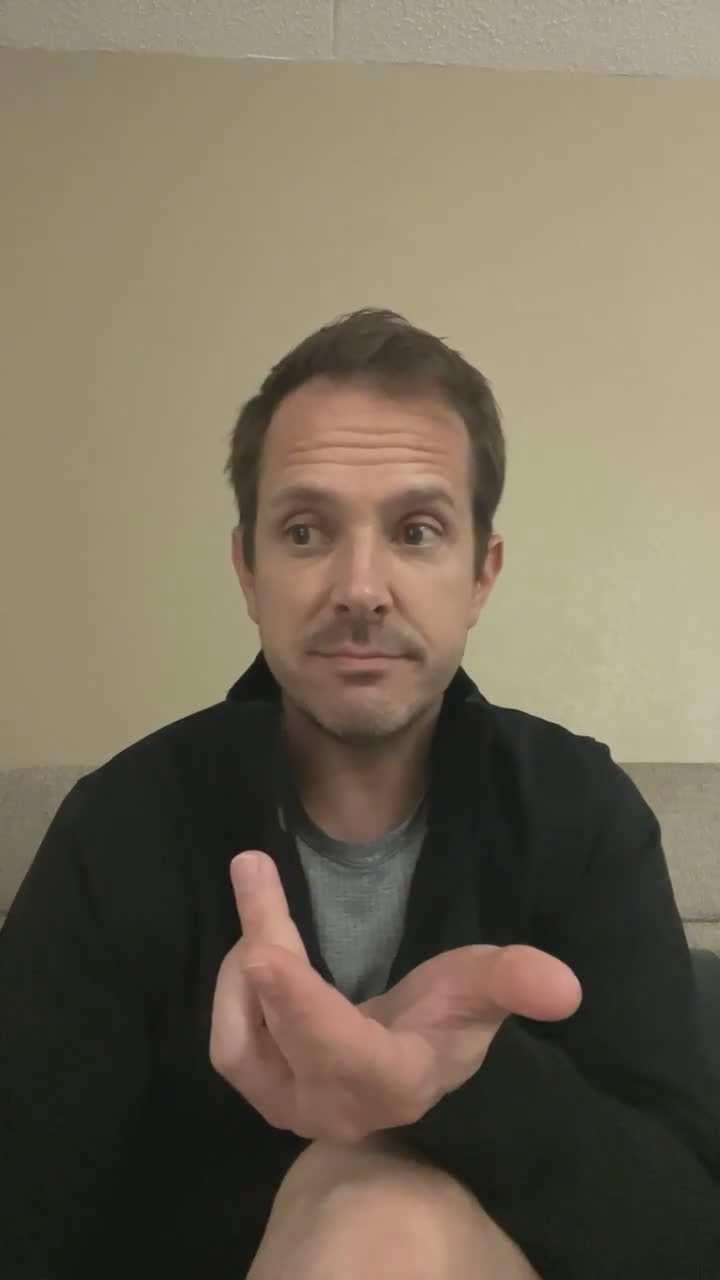
JC explores opportunity cost, healthy accountability, and balancing routines while reflecting on caregiving, detachment from outcomes, and choosing purpose when scheduling and imbalance arise.
JC: Thank you for the opportunity to spend some time with you right here in the Cadre sphere. There's a lot of different energies in a three day marathon of watching grandkids. What a great opportunity to balance why we do what we do and what we get from it.
One of the. ideas or levers or tools that I love talking about is opportunity cost. How often can we get into routines? There's routine that we can get into that may be less than satiating. What do you get out of what you put in?
In the midst of that, this healthy accountability conversation really resonated in this idea of opportunity cost. Because it's good doesn't mean that it feels good. The opportunity cost is high enough that we're okay feeling less than good in order to move forward.
Can we live life with observation, with awareness, but not attach our worth to the outcome? Learning how to detach is a lifelong process with the ups and the downs. Balance and scheduling mean that imbalance is also okay. My invitation is always do with great purpose.
Hey, hey, hey. Good morning, Cadre. How are we doing? I hope you are doing great. And if you're not, I want to remind you that that's okay too. My name is JC if we've never shared time and space together before, thank you for the opportunity to spend some time with you right now, right here in the Cadre sphere. I am currently in Ann Arbor, Michigan, sitting in my dark hotel room. What about you? Where are you? What's going on? Hey, Amara, nice to see you. My friend. Maffy, nice to see you. Someone else popped in there.
Hey. Speak Wonder. Our stigma. How are you doing, brother? What a crew. T. Brown. T. Brown. We got a good streak on here. I feel like I've seen you a lot this week. That makes me happy. Mel Myers. All the things happening on the couch. I'm on the couch. I am on the little hotel couch. Well, hey, I'm glad I'm here. I'm glad you're here. I know what I know and I care about you. Be a bit. That's. That's the name of the game, right? Gratitude that we could spend time together risking the courage and the curiosity to.
To think that our perspective merits conversation and output. We experience things, we input life, and then there's a reflection. And we also risk to say that we care about each other. It's a really good formula to have some really great moments right here. All June long, we're tiptoeing the tightrope and talking about balance. But also there's kind of a nice flow from day to day. And Thursdays we often talk about this idea of caring for other people. You know, like in Speak Wonders Message here.
There's a lot of different energies in a three day marathon of watching grandkids, right? There's exhaustion, there's joy, and there's memories and there's stress and anxiety and frustration and all those things. What a great opportunity to balance why we do what we do and what we get from it. One of the. One of my favorite kind of ideas or levers or tools that I love talking about is opportunity cost. What is the opportunity cost of any experience that we have? What's the opportunity cost of engaging in a hard conversation?
What's the opportunity cost of taking time off? What's the opportunity cost of pushing through, like our stigma says? Here I am balancing after a busy six months. Yeah. What's the opportunity cost of slowing down or of pulling your stuff together or looking back and looking forward? Our sigma. What a. What a powerfully placed word coming back into A preferred routine. Right. How often can we get into routines? And the answer to the question of, hey, how are you doing? And the answer comes out like, I'm managing.
I got all the balls in the air. There's routine that we can get into that may be less than satiating or less than preferred. Which raises up the idea of the opportunity cost of. So what is opportunity cost? What do you get out of what you put in? Well, the opportunity cost of me taking the day off is I'm going to be behind tomorrow, but. But I'm going to have a lot more clarity and perspective and joy walking into said act. Yeah, the opportunity cost is high enough to go ahead and take the day off.
Yada, yada, yada. You know, yesterday I had a really, really long day at a training virtually in London at 3am my time. And then I led a session for people who work in food insecurity, and then I led a session for an organization on the idea of healthy accountability. Then I hopped on a plane and flew here, got here late, and now I'm up for a busy day today. In the midst of that, this healthy accountability conversation really resonated in this idea of opportunity cost. I often think we assume that if something is innately good, like, ah, wouldn't it be great if everybody in a system or a family understood that accountability was a way to stick together or a way to accomplish more as a composite of the parts rather than as an individual.
So we go, yeah, accountability is good. Accountability. Woo. I'm sitting in a room of leaders yesterday and I go, how many of you feel like, good, good feelings in your stomach or like you get really relaxed when you get ready to have a, a hard conversation about how we're doing together, having an accountability conversation, and not a single darn person raised their hand? I go, yeah, look around, y' all. Accountability, even though we know innately that it is a really powerful force for, you know, I always love thinking accountability is the glue that keeps us together as we're doing the things that we do.
But because it's good doesn't mean that it feels good. The opportunity cost is high enough that we're okay feeling less than good in order to move forward. I think a lot of people in the world, a lot of leaders, a lot of influential, inspiring people, sometimes lead us to believe that the hard stuff feels good because it's easier to sell it. It's like, yeah, do this and get in the routine and all of a sudden it's going to feel good. That doesn't have to feel good for it to have good in it. So if you live in this space of going, gosh, I keep doing the hard things, it never seems that they get easier.
I must be broken, I must be off. I must be doing it wrong. I must not be committing enough. No, I think you're living in reality. So often on Thursdays we talk about the idea of caring for one another. In those moments, you may go, I want to bang my head against the wall or I want to run away or I want to go ahead and live on an island by myself. And you go, gosh, I must be a bad person. Nah, caring for the people we want to or needs to care about is matched with a lot of stress and anxiety and frustration.
Yet the opportunity cost may be high enough. So many chats coming on in. Let's go ahead and read these on out. All right. Amar says I'm balancing learning how to detach myself from things and create balance. Yeah, the practice of non attachment in the, in the, in the, in the yoga world, non attachment is a really, really big, big piece of the pie. Can we live life with observation, with awareness, but not attach our worth to the outcome? Kind of sounds a little bit like our enoughness conversation on Saturdays.
And Amar, like you say, balancing, learning how to do that with creating balance in it. It's balance upon balance. Learning how to detach is a lifelong process with the ups and the downs. So if you ever hear the mentality of the hey, blindly be 1% better every day. Hey, tomorrow you're gonna be better than you were today. No, you may be worse tomorrow, you may be drastically worse tomorrow. Then two days from now you may be ten times better than you've ever been before. And the next day you may feel like you're not going anywhere.
Welcome to this so called thing life. Our stigma says balance is scheduling. Balance and scheduling mean that imbalance is also okay. Sometimes for me, we're saying the same thing at the same time. My buddy. If we are verbs and not nouns, which we are, we are evolutions. Balance exists in the imbalance. We train balance in the imbalance. We learn to appreciate balance in the imbalance. We learn to appreciate imbalance in the balance and vice versa. Mafy says I just went on vacation with 15 family members.
Oh my gosh, I'm not even going to read the rest of that comment until I say that. Sounds like an absolute nightmare to me. Okay, going on. I just went out of vacation with 15 family members that never learned how to relax and appreciate the Moment. That's part of the reason why it sounds like a nightmare to me. I was like, I don't know if I can make my morning coffee. I don't know. I can make my morning coffee and experience. I don't need all the noise. Right? Say, how many people go on vacation and go, okay, now we need to do the thing, or quite often vacation for many people is the absence of doing the thing or the amplifying of the little thing amidst the absence of the rest of the things.
Speakwander says we're okay feeling less than good in order to move forward. Love it. Accountability is big. And Amar, I'm gonna go ahead and say accountability also in our culture is relatively punitive. Accountability is a, yeah, be accountable, hold yourself accountable. And I go, bull. No, accountability is innately soft. It's innately vulnerable and ugly and weird and just ever changing. But so often we hear accountability as this. Like, you need to be accountable. In the work that I do. One of the big findings from research is accountability is not a character trait.
Accountability is fostered in an environment where people have autonomy and agency and access to the things they need and are given power. So how do we find that? It's in this conversation of balance. And Speakwander says, I dislike the punitive aspect of accountability, but again, even the reality, it's not a composite. Right. Accountability doesn't have a thread of it that is innately punitive. No, accountability is people risking to do something together that's not net negative or net positive.
It is what it is, and then life happens to it. But as I often say, words are vessels. They're empty vessels. It's not until we place things inside of it that it gathers meaning. So if you go, gosh, I'm going to redefine this in this situation, or I'm going to make sure that we create a shared understanding before we move forward. All these things play. I'm going to say, we'll see you tomorrow if you. And whenever you need a little bit of Cadre, love, perspective, spirit, weave it into your day. My invitation is always do it with great purpose.
You know, I think Luke shared in the feed a graph that shows it's like parents think social media is bad and that their kids would be better. I go, yeah, because we live in a culture that's made social media into this bad, evil villain that's responsible for a bunch of bad things. Again, I say, bull, tools are tools. What we do with them have great implications. And when we did our panel on teen mental health on World Teen Mental Health Day. Our young people on the panel were like, yeah, guess what?
Adults didn't grow up swimming in the ocean of social media. So innately, it becomes the boogeyman. We look at our world, and social media is responsible for many, many of the best things that we experience and the way that we can navigate life resiliently. In the end, social media can also be used for some pretty awful stuff. But here's the deal. Anytime that we share a binary sounding, simple solution to complex realities, we run into issues. The key doesn't fit in the lock. Words indeed, are vessels.
Y' all enjoy your coffee, enjoy your day. If you're in Michigan, say, hey, I'm back in Minnesota late Saturday night. I'll see you later. Have a good one.
Reactions and comments are for members. Joining is free and takes a minute.