We have freedom to chart our own course, and also freedom to YELL for HELP.
Cadre invites conversation for mental health and wellness, for assistance with some of life's issues. A harbor pilot is someone who comes to the assistance of others. Thursdays are caregiver days. If you could come into the conversation and tell me where you're listening from.
Andy Grove: There are practical ways to offer help to someone who is overwhelmed. He says tackle one problem at a time, remind them what's good and offer a break. The last one is just like abundantly simple, but it really, really helps.
Don't be afraid to ask for help when you're out doing your caregiving. Join the Live and the replay and I have had such a blast hopping into the Conversation Stream. Blessings upon blessings and I'll see you next time in the harbor.
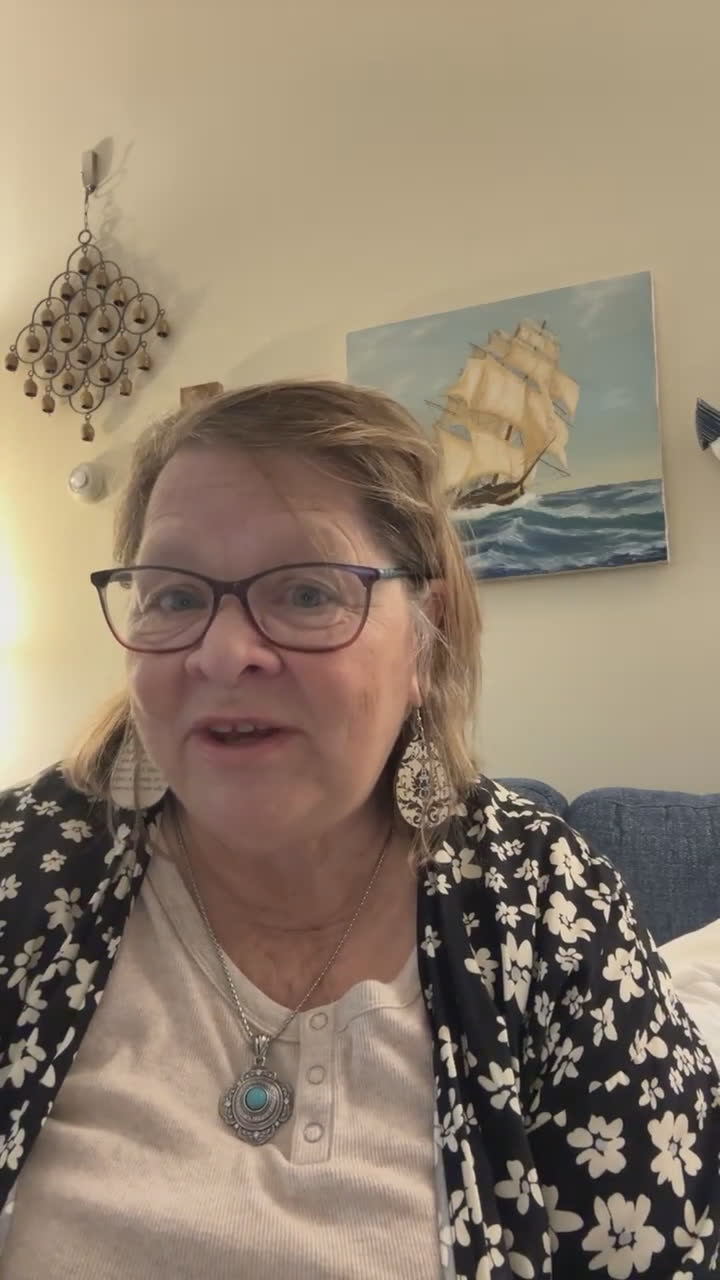
Well, hello, Cadre. How's it going? I decided to situate myself in my living room. I've got my little corgi here at my side and my harbor wall with the anchor and the tall sh. That ship painting was done by a high school friend when he was in the 11th grade, and he gifted it to my mom, June. Hi, Chrissy, everybody. Come on in. Pull up. Come on in. Welcome to the Cadre and another discussion. I love that at any given time we can be in a conversation with somebody because of Cadre and its mission and its creators, the wonderful cluster of people who thought this up and then invited conversation for mental health and wellness, for assistance with some of life's issues.
Just for connection. Especially for connection. My name is Speak Wonder. My real name is Kathy. I go by Speak Wonder in the Cadre, and my handle is Harbor Pilots. That is my frame of reference, my theme. If you haven't heard about the job of a harbor pilot, it's a real job, one that I don't think I could muster at all in real life. But we can do it figuratively for each other. And a harbor pilot is someone who comes to the assistance of others. And in the nautical world, in harbors all around the United States of America and the globe, in fact, there are people whose job it is to hop in a small boat and motor out to the large incoming freighters or ships, tall boats, particularly boats that are being sailed in by folks who don't know the harbor.
They don't know what's under the water. And in terms of hazards or sandbars or just things they cannot anticipate, so they can't come in safely in harbor without some help. So the harbor pilot actually gets on the large boat and sails it in to safe port. That is a harbor pilot in a nutshell. And we are that for each other in this thing we call doing life, right? Thursdays are caregiver days. There's Andy Mack. Morning, Morning. I think today for point of reference and for me to see who's on. If you could come into the conversation and tell me where you're listening from.
Where are you right now? What city? What town are you visiting? Are you vacationing? Are you working? Taking a break? And maybe. What's the weather like today in Erie, Pennsylvania? It's a little bit blustery. I'm looking out my windows and there's quite a lot of wind and breeze. We are looking for some thunderstorms today. I am just a hop and a skip from the harborfront, and I Am truly blessed to live where I live. Minneapolis. There you go, Andy. So I had the privilege of living in Colorado for 22 years.
You talk about a landlocked state. Most of the waterways in Colorado are man made. Dylan Lake is one of them. And there, there are some beautiful, gorgeous bodies of water and many of them are natural bodies of water as well, but no oceans and no great Lakes. And yet all during the time that my family lived there, I was just completely enamored with, obsessed with lighthouses. Still am love lighthouses. And I'll never forget one day at a staff meeting when I worked in radio, my boss in Denver said, hey, have you ever heard of a harbor pilot?
And it truly pivoted somehow in my mind as something I could definitely click onto and learn more about. And he was telling us about harbor pilots and how as staff members we are there for each other to navigate where our skill sets are. That's kind of what I wanted to talk about today. Sunny and cooler in Minneapolis after high heat and humidity. It's kind of relief, isn't it? Yeah, we'll take it, huh? You know, I spent. Sorry, I'm going off on a bunny trail talking about weather. I spent about three weeks in Seattle area and then I was down the coast a little to Snohomish and Whidbey Island Naval Base visiting friends and family and it rained every day.
But it was a fine mist and I finally got it. I finally understood intuitively being there for a handful of days that it's really okay and you don't need an umbrella in that kind of environment. It's not worth it. You just go out and you are well hydrated. Yeah, yeah. Wear a jacket. Sun comes out and then the mist begins again right there by the Pacific. How are you today? Today in the freedom template. Good morning, Nikki. Thank you. I wanted to remind myself and all of us that we don't need to navigate alone.
I'm just going to use the caregiving picture because today is caregiver day, although we can stray from that. Mental health includes many facets and asking for help is what I'm talking about. Today in the arena of freedom, we are free to chart a course, to name our destination and to sail there. We are also 100%, 120% free, 150% free to ask for help. If we need to, we can holler for help. And it's not a weakness to ask for help again. The reason I feel so passionate about this topic is because I'm one of the probably persons who is most challenged with asking for help.
I think in our world, we're often, from childhood on up, encouraged to be autonomous. And of course, we want to be independent. We want to be able to problem solve, learn our skill sets, and speak and navigate in them. We also need each other. We are built for connection and for leaning into each other for encouragement. And so when we ask for help, maybe it's a crisis, maybe it's just a minor bump that we've come across, and we just need to uncrease that bump and figure it out. I would like to submit that when we ask, we're not failing.
We might be flailing a little bit, but we're not failing. In fact, I would like to suggest that it's an act of courage to ask for help. It's an act of courage, and it's also a very honoring thing to ask a friend or a family member or someone in the cadmium or a coach for help. We're honoring what they can contribute to our situation. And so therefore, we're not withholding information, advice, support, encouragement. We're welcoming it. We're welcoming it. And so I think, and I think you probably agree that as we're sailing and we hit a rough patch, we can not only ask for help, but shout it out.
Now I'm going to shift it just a little bit. Oh, you have something to send me, Andy? Okay, very good. Ah. Now I'm going to shift it from when we ask for help as the person struggling, flailing, listing in the water, needing some direction. Now I'm going to pivot that around to the other side of that picture and talk about when you are the harbor pilot, when you are the one called in by a friend to get in the boat and come help me out. What are some practical ways? I wrote down three, maybe four practical ways in which we can offer help to one who is under the overwhelm, under the cloud of overwhelmed, and perhaps so close to the problem, they just can't really see a solution or a way out or way under or a way through.
One suggestion. These are very practical. Just so common sense. But it's good to be reminded, isn't it, once in a while. So the first suggestion I have here is to tackle one problem at a time. You, as the harbor pilot, you're responding to somebody's SOS and you are so hardwired to them and what they need that you can sort of intuit that, yeah, they're. They need help, but don't go under with them. Let's Tackle one problem at a time. Just pick it apart. Maybe start with the easy one or maybe start with the difficult one.
And then the second reminder I have here is to remind them what's good. This was so cool. I have a short story to tell you about this one. When our family was moving from Colorado back in the early 2000s, so it's a while back to Pennsylvania, where we now live, I was overwhelmed with packing. They say that moving geographically, divorce and death are three. Oh. In public speaking, moving, divorce, geographical. Let me do that again. These are not necessarily in the proper order, but in terms of stress, these are the four big ones.
Moving, divorce, death, and public speaking. Right. Public speaking is right in there as anxiety inducing moving. So I had boxes and boxes. My husband was at work. My girls were toddlers at the time, and I could not see my way through. I called a friend and she said to me on the phone, hey, can you stop just a minute and look around? Mm, sure. She said, I want you to tell me what you have accomplished. What have you done? And I started listing off the things that I had done and the rooms that were packed and the calls that were made.
The moving man that was reserved. She said, think of what you've accomplished. Wow. That just turned it around. And I felt a little lighter, a little more capable because this friend, this harbor pilot in my life said, what is good about today? Maybe we could do that for someone. Yeah. Ask them what is good and remind them what is good and what has been done and what they have been able to accomplish so far. The third one is offer a break. I. I know as a friend, sometimes I'll just suggest we go have a meal, take a walk, go to the mall.
I don't know, go, go view a sunset. We have epic sunsets here. I'm sure you do too. And not even talk about the problem. Just step away from it and do it in the company of someone you know and trust and with whom you are comfortable and do something. Just take a break, a respite. That is what a harbor pilot does for somebody, is they offer shelter from the storm. And then the last one I had here is just like abundantly simple, but it really, really helps. And that is to just show up. So many times I've been on both ends of this, I've had people say, can I help me?
Can I help you? Just let me know. Let's say the death of a loved one. When my husband died in 2008, I had. And I'm not throwing shade on this. This Is no way is this being negative because this is human nature. I had people call and say, just let me know how I can help you. Let me know if I can bring a meal, Kathy, just let me know if I can help you make some decisions. Well, when you're disabled by grief or by the burden of caregiving or whatever it is you're dealing with in the mental health spectrum, you're not going to reach out.
You are frozen, you are numb, you are not functioning. And so when your person can gets to that point, just show up, don't call ahead. I know that's the polite thing to do is to say, hey, are you going to be home? I. I want to drop off a casserole because I know you probably need to feed your family. No, just show up with the meal. But what if someone's allergic? There's so many variables. But you know what? Those can be overcome. They certainly can. You're showing up your face at the door, what that person needs.
Just get your things together that you're going to bring as encouragement and just show up. That's all. Let me list what the harbor pilot does again. I had four suggestions here by review. When your person yells for help, tackle one problem at a time. Remind them what's good, what they've accomplished so far. Offer a break, something that completely steps away from the challenge and offers respite, just time together. And then the last one is to simply show up. Gonna wrap it up, friends. Don't be afraid to ask for help and don't be afraid to give help.
Takes a little bit of courage and you might have to bend the societal rules a bit. I feel like we already have a big head start in the Cadre of being there for one another. And so freedom to ask for help. Freedom to offer help. So good to see you, Jules, Nikki, Andy, I saw some others hop in there. Yeah, you guys are great. Luke is here. Yeah. If you like my boat. I just love my boat. It's one of my favorite things about my apartment. Until next time, my friends, more your boat. Drop anchor and be well.
And when you're out there doing your caregiving, don't be afraid to ask for help and don't be afraid to recognize somebody else who needs help but perhaps has not raised the flag for help. We can sense it and we've experienced it. And so we can bring not only our skill set, but our experience, our life experience of having been there, done that, or still there doing that. You're the best. Thank you for joining and so many lives are coming our way. Join the Live and the replay and I have had such a blast hopping into the I call it the Conversation Stream.
There's. There's another name for it, but it's where we hop on and we make comments and we post pictures. Pretty cool. So many things to explore in the Cadre. Not just the lives, but there are some pre recorded deals. I mean you could just go all around in the app and find what you need. It'll usually call to you. Blessings upon blessings and I'll see you next time in the harbor.
Reactions and comments are for members. Joining is free and takes a minute.