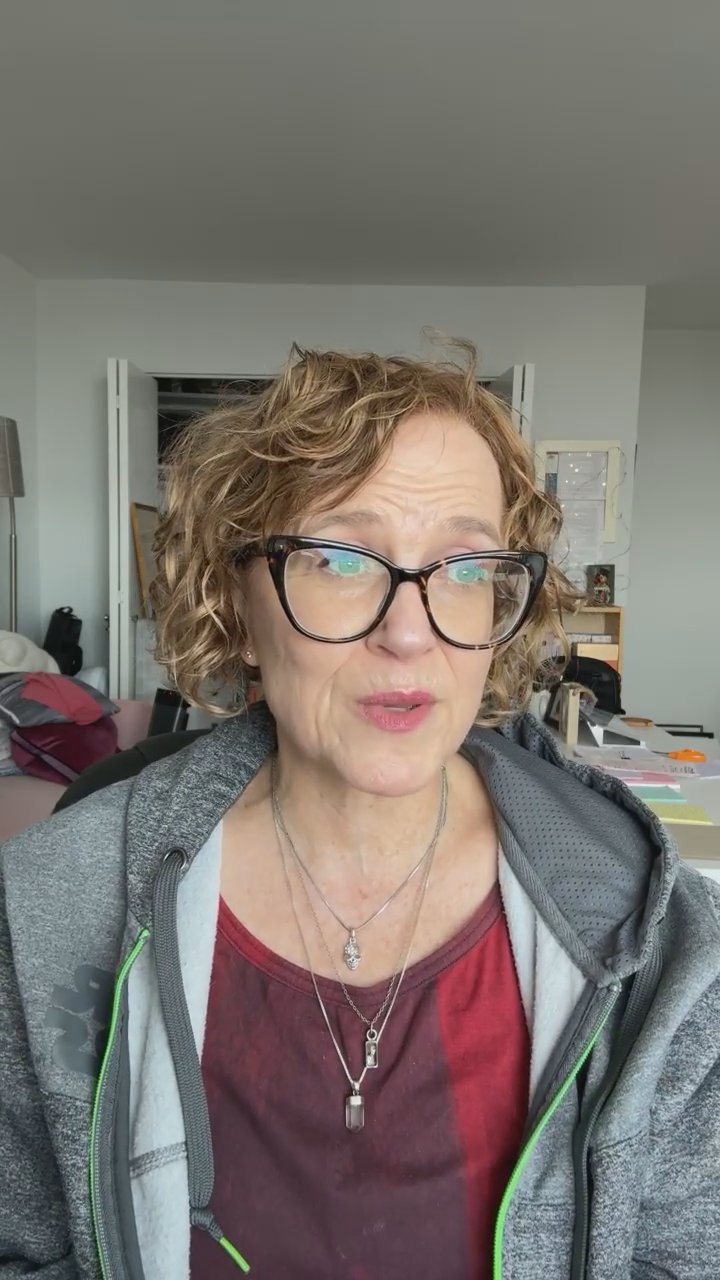
Host explores acceptance as central to recovery, focusing on abundance and gratitude, shares a daily abundance journal practice and emphasizes allow as a key rule of engagement.
Good morning, Cadre. I always think about playing a song to open and then I forget. Music would be lovely, would it not? I could sing, I suppose, but I won't.
Welcome to November. This is my first live stream in November. The topic as much as acceptance, which is the core of much of recovery. I wonder if it's the same way that you all think about acceptance.
Welcome to a month talking about acceptance. This week's topic is abundance and gratitude. If I want to know there's abundance in my life, I've got to allow myself to see it. There is always good in the world. All you got to do is look for it.
For a lot of us, for women, it becomes very hard for us to ask for what we want. This shows up in negotiation for salary. Sometimes problems are a sign of progress and abundance. Added one rule of engagement today from John Acuff.
The author is a recovering alcoholic. She says every problem she worked hard for at this point, right, it's new. The counterpoint is, go get that problem. Life will never be chore free.
Cadre: Rule of engagement number 16 from Gretchen Rubin. Choose the bigger life. Go get that problem. Allow the abundance. Another thing I love are nail wraps. For someone with short nails like me, it's a very fun way to handle it.
Good morning, Cadre. I always think about playing a song to open and then I forget to play a song to open. My apologies. Music would be lovely, would it not? I could sing, I suppose, but I won't. Welcome to November. This is my first live stream in November. I'm very excited about it. The topic as much as acceptance, which is the core of much of recovery. 12 step recovery. So I'm used to thinking about acceptance and I wonder if it's the same way that you all think about acceptance. Hello, T. North 66.
Welcome. Welcome to a month talking about acceptance. And this week's topic is abundance and gratitude. And it could not be more timely. I have been working a lot on abundance and the concept of it and what it means in my life. I've been keeping track of how much abundance there is in my life, in the world in a special journal every day. I'm like, there's an abundance of time of getting to see a cat sleep in my house, which is a delight to me is seeing a cat sleep. And so the fact that they do it so much is just extra delightful all the time or purring.
They purr a lot because they like me. And that's abundance, right? And plenty of air to breathe. Plenty of clouds in the sky, plenty of blue in the sky, plenty of leaves on trees. Like just what is abundant in my world. Plenty of notebooks. I got plenty of notebooks and plenty of pens, plenty of stickers, plenty of washi tape. I got all of that and I use it. I use it. I just did a project on my organizing wall over here. You can see these lines. Here are washi tape that I used to create different zones.
That's not about. I mean that is about abundance and gratitude. But I have. I was pleased to find a number of rules of engagement that are about acceptance and abundance and gratitude. And the number one and most important for me, how I live and what I struggle with, what my challenges are, is rule of engagement number 15, which is one word. I think it's the only one that's one word. It's one word and that word is allow. If I want to know there's abundance in my life, I've got to allow myself to see it.
I've got to allow myself to accept it. Acceptance. I've got to allow myself to let it in. I've got to allow life to be good, allow life to be easy. I have patterns and challenges and old thought patterns that try and convince me that life is difficult. Life is hard. It's hard to connect with people, you know, whatever. Your voices are yours, mine are mine. Your mileage may vary, but all of them play a role of not allowing the good stuff fully to come into my life. Because there's so much good stuff, and I would say in the world right now, as it is with all of these people, with so much agitation in our environment, I'll just put it that way.
There is always good in the world. And forgetting that is designed to slow us down. This endless stream of negativity, this endless stream of here are all the bad things happening. It's important for me. Again, your mileage may vary. It's important for me to keep track of what's going on in the world without diving into what's going on in the world. That was true when I was governing, right. I needed to keep track of what was happening, but I also needed to do what was in front of me. I needed to take care of what was mine and let go of what was not mine.
Information is important. Too much information for me is designed to slow me down and keep me feeling really bad, keep me feeling small, keep me feeling discouraged, meaning separated from my own courage, keep me feeling like I can't take action on things that matter in the world, Right? So when you're looking to abundance. Oh, I gotta make sure my door is closed. Hang on just a second. You'll get to see my room. Rule number one, love what you love. I love Star Wars. When you know there's plenty of good in the world, there's an abundance of good in the world.
All you got to do is look for it. Look for it. The negativity is going to find you. We've got to search for the positivity just given how we've structured our world for ourselves. But there's so much of it and there's plenty of it. And it's easy to forget that in the onrush of all the terrible things that are happening. And I'm not saying dwell in the positive, you know, put the blinders on and don't take action to make the world the way we would choose it to be. What I'm saying is if I delve too deep in the negativity, then I can't take action to help create a world as I choose it to be.
I figure out what's mine to do and then I do it. And I've been doing that in my business. I did that when I governed. I did that as a graduate student. I. I know. And if you don't know welcome. Lots of people don't. It's time to experiment, right? But you can do it with love and joy in our hearts. So the first thing I would just say is allow the good, allow the abundance, allow all the right stuff to be happening because it's there all the time. We can change our perspective, you know, change my perspective, change my life, really.
That's one of the things I learned. You know, when I was drinking, I just wanted an abundance of alcohol. And what I got for that was also an abundance of misery. There's plenty of that to go around. So rule of engagement number 15, allow. Hello, Rose612, welcome. So rule number 15, just allow. Just allow the abundance. And once it's flowing in, we get to be grateful for it. Everything I notice, the allowing of the abundance is. Is one form of gratitude is when I allow it, then the good feeling rises up and I appreciate that I have it.
If I can't notice it, I can't be grateful for it. So allowing is the step before gratitude. Allowing abundance is the step before gratitude for me, because if I'm not letting myself see it, I'm certainly not letting myself be grateful for it. Rule of engagement number 28. You don't ask, you don't get. So on the other hand, for abundance, sometimes one way to allow abundance is to ask for what we want. And often depending on our families, on our social conditioning, from the variety of identities we carry.
For a lot of us, for women, I think in particular, it becomes very hard for us to ask for what we want, ask for what we would choose. This shows up in negotiation for salary. Right? I've been on the other side of this. So I have. I've. I've been on both sides, you know, having. Now that I work for myself, I have to negotiate contracts. But I'm also married to someone who has negotiated every job offer he's gotten. And I've been the person hiring, and I've seen who asks for more and who doesn't. And I've instructed my teams not to take advantage of women's internalized sexism and to find ways to offer more and encourage them to offer more.
And on boards I sit on, you know, I'm thinking of one board in particular had a woman CEO, and we were discussing her compensation, and she had market studies showed she'd been underpaid for years. And in that meeting, you know, people were like, well, she wanted this, or she asked for. I was like, we are not going to take advantage of her internalized sexism. She didn't ask for enough. And that is a leadership lesson for her. But we're not going to make her pay the cost in dollars. Her family doesn't get.
That's not acceptable. And it was a learning moment for some of the men in the room in a genuine way. I don't mean that critically. For some of the men in the room, they're like, oh, okay. And they were able to follow my lead. You don't ask, you don't get. I guess that story I just told was an exception to that. But I asked and I got on her behalf. But somebody asked. You don't ask, you don't get. That's not always true, but the reason I have it as a rule of engagement is because I struggle to ask for what I want or what I choose for reasons that are personal to me.
My early life, my family, how it operated, lessons I learned, yada, yada. This is a reminder to me that abundance is available and sometimes I just have to ask for it to get it. Whatever it is, I would choose for myself. Just ask for it. Just ask. You don't ask, you don't get. Also comes from a political world and especially fundraising. Like, if I don't ask that donor for a $500 contribution, they're not going to give me a $500 contribution. You don't ask, you don't get. That was like the call time mantra, right, of just calling people over and over and asking strangers for money.
I do not miss that part of my job. My old job and then the newest. I added one rule of engagement today. It's from John Acuff. You've heard me talk about John Acuff a lot. I'm a fan. You can join his remarkable you community for next year. It's going to be opening up soon and I recommend it. I have had a very good experience there. But you do you the newest, you know. Drumroll. Go get that problem. Go get that problem. It's a corresponds to. So that's rule of engagement number 37 at the moment. I think I'm going to set as a goal next year to really go through my rules of engagement and my guidelines and do that reordering I always threaten to do because that way I'll be able to do more with them and I'll be able to share them more easily with people.
But guideline number 27 is, you worked hard for this problem. Sometimes problems are a sign of progress and abundance. I know that sounds cheesy, but stick with me. Let's Start with the guideline, you worked very hard for that problem. I'm a recovering alcoholic. My natural state is dead or drunk or obsessed with alcohol. Obsessed with my next drink. Like, I'm dead, hospitalized, you know, my brain rotting from the inside out or obsessing about what I'm gonna drink next, right? And then I get in recovery, and I'm not drunk all the time.
I'm not drinking. I haven't had a drink in 36 years. And let's see, July, August, September, October. Three months and 18 days. There comes a point when I had to learn the skill of applying for jobs. I don't know why that example came up, but I had to learn the skill of applying for jobs. And it was hard, and I was getting rejected a lot, you know, whatever it is, and it was good. I think I had a sponsor who reminded me, certainly people in the programs would say this in the rooms, and it would hit me, you work very hard for that problem.
The fact that my problem today is that I didn't get the job I applied for, like, that's a high quality pro. That's a high quality problem compared to killing myself with alcohol, right? That's a pretty high quality problem. You worked hard for that problem. I worked hard to get myself to the level of that's my problem. And I try and have that perspective on whatever I'm facing because I have been growing, changing, healing for 36 years. And however many months and days we talked about there and every problem I worked hard for at this point, right, it's new.
You know, people say more money, more problems. I'm like, well, maybe, but you're gonna have problems either way. Might as well have worked hard for those problems and have them be high quality problems. Problems I chose, right, so you worked hard for this problem. So the counterpoint is, go get that problem. Sometimes I think about abundance and I think, well, if I earn more or if I get the pet, you know, like, I want a dog, and if I get the dog, you know, then it's going to be a hassle because I have to walk the dog or I have to, you know, whatever, go get that problem.
Like, there's nothing I want that isn't going to have new problems that attend to them. Sometimes what I want solves a whole bunch of problems. But there will be other things there, right? I'm. Life will never be chore free. And if life were chore free, I'd be very, very bored. I have to be honest. Go get that problem, Betsy. It's A way. That rule of engagement is a way for me to lovingly address the voice in my head that's trying to say, because this is a potential problem from this course of action, maybe I won't do it.
Go get that problem. Like, I have a mission of sharing my experience, strength and hope with the world. But I get scared to post things on social media because I'm like, ugh, I've been there. The problem, you know, the trolls and then this. And it feels vulnerable and maybe I'll get a migraine. Sometimes I get migraines. The vulnerability hangover is real. Go get that problem, Betsy. It's a way better problem than feeling like I'm not fulfilling my life mission. That's a problem. You know, which problem do I want more?
Go get that problem. That's a way better problem. Right? And life doesn't have to be that hard all the time. I'm not saying that. But when my brain says life has to be hard and let's make it even harder by playing smaller than we actually are, go get that problem. And I'll leave with, we've talked about it before. Rule of engagement number 16 from Gretchen Rubin. Choose the bigger life. Choose the bigger life. Choose the more high quality problem. Go get that problem. Allow the abundance. Ask for what you choose and go get that problem.
And then I get to be grateful for the results and the outcome. So that's what I have for you this week, Cadre. So excited to be here with you. Oh, look, another thing that I love. What you love are these nail wraps. They're just little stickers you put on your nails. Super fun, super amazing. For someone with short nails like me, it's a very fun way to handle it. So, ah, go have a great week, Cadre. It's exciting and awesome as always to be here with you and I will see you on the app. Until then, take good care of yourself and figure out what problem are you going to go get.
Reactions and comments are for members. Joining is free and takes a minute.