A clinician and former patient explores how people with chronic pain and illness can navigate the medical system, use critical thinking, coordinate professionals, seek second opinions and advocate for their own care.
Welcome back to 15% better my series on managing chronic pain and chronic illness and today I'm really excited to talk about a topic that is well near and dear to my heart both as a professional and Personally, and this is a topic It's going to deviate a little bit from some of the nature of what I've been talking about before as far as mental health overall wellness strategies for managing chronic pain and having a different relationship with it with your thoughts and your feelings and these are things that we're going to dig in To more later, but today this is centered more around the physical conditions themselves now as a caveat I'm not a doctor right, but I am a mental health professional I work in the medical system and I'm there with you right I was a patient who had a condition and I had to find a way to navigate the medical system And that's what we're talking about today is how to navigate the medical system to try to find the best solutions for your Condition so therefore any advice I give you I want you to take it with a grain of salt But this is the spirit of what I'm going to be talking about is how to manage your own care in a way that best utilizes Professionals their expertise in their opinion, but also knowing yourself trusting your own body and the most important point That's going to be a thread that goes through this whole video is about using critical thinking about finding ways to get to the truth By utilizing your medical professional and medical team as well as other professionals about finding other opinions and Bringing those together to make the best decision for you just like in some of my other videos I'm going to break down some of the problems that people with chronic pain and chronic illness uniquely experience when it comes to them Navigating the medical or even mental health system and how adventure to say that almost every single person I honestly would not be surprised if it was every single person who has chronic pain or chronic illness has had at least one bad experience with the medical system or with their medical provider it is so frustrating sometimes and The crux of the issue is that with chronic pain.
It is an extended Almond right so it has to be at least experiencing something for six months if not years Therefore there likely isn't an easy solution if you've gone this long if you 've seen many different medical professionals and a lot of the experience that people have had Is that they've maybe seen many different doctors? they've been searching for solutions and perhaps they go see a new provider and At that point you know a lot about the condition You know a lot about yourself and your body and you go in and right away that doctor or provider may make their own hypothesis Right, they may not really look too deeply into it.
They may not always listen to you Right, they say, you know Well, I'm the expert here and you don't know anything that you're talking about right and that could be endlessly frustrating because Maybe that opinion they gave you you've already gotten you've already explored that and realized from other care professionals that This is something that doesn't work for you. So again that could be endlessly frustrating But I warn you the spirit of my video is not to crap all over the medical system or on medical professionals Heck I work in that system as well.
So what this is about is again using critical thinking to best Utilize the medical system because often this is the best shot we have right Unfortunately, we don't know a ton about the human body, right? We know a lot more than we did before but the people who know the most about it by far are Doctors and I have a ton of respect for doctors nurses other medical professionals I mean because of the rigor the training and everything they've gone through to get to the place that they are To specialize in whatever it is I have an immense Respect for and we should always listen to their opinion at least take it into account But we don't always have to take it as gospel So I'm gonna give you some of these suggestions on how to best weed through that how to take some of these opinions to again Make that best decision for yourself one example that I hear all the time is in regards to opiate medications A lot of people with chronic pain as I've mentioned before Relying these to have any quality of life now, of course There are a ton of downsides to this and sometimes it's hard to tease out whether that medication in the long term is actually having a negative impact so I Mean it's impossible at this point to not have heard about the opiate crisis, right?
So as of fairly recently a lot of these pharmaceutical companies that aggressively and even like bully providers into pain management and making sure patients experience no pain whatsoever and disregarding some of the negatives downsides and addicted potential of opiates has created this crisis, right and Over the course of last year, right? So about 2020 and 2021 right the opiate overdose deaths were over a hundred thousand Somewhere around there right way worse than we've ever had before so this is a real problem.
So Doctors medical professionals are reluctant to over prescribe these medications and sometimes to the point where they won't prescribe them at all Right? So there's a certain amount of people that may at least in that moment need those medications, but people patients Go to these medical providers seeking these medications that they believe that they need and they get dismissed right a lot of times They'll say hey, this is drug seeking behavior and a lot of times it may look like that because heck You may need these medications, right?
And if you don't get them it may seem like you're over advocating for yourself or you're again Just drug seeking and often that is not the case Like I've been saying one of the biggest issues here is patients not feeling like they're being listened to that they're not being heard That their concerns are not valid and that gives them a bad taste in their mouth when it comes to the medical system where often they need medical interventions to best feel better to best manage their symptoms that it's not all just Psychological and a lot of patients will go to doctors and this is It almost becomes a joke because there's something called like conversion disorder, right?
And that's basically a doctor saying well, it's all in your head, right? So this is like a mental health disorder and a lot of times when doctors cannot figure out a physical Reason for someone's ailment. They just say well must be a conversion disorder, maybe it's just stress Maybe it's just anxiety. Well, and maybe that is true But oftentimes that feels like them just giving up and saying well It's all in your head and then you further feeling invalidated And this is one of the things that we therapists learn more than just about anything and that is taking a client-centered approach And you'll start to hear that word more and more often and I believe that really comes from the mental health side of things And you're hearing it more and more as far as physical health because as a therapist I mean it is obviously so important that we need to listen to our clients We're not just telling them what to do you need to feel heard in order to trust us, right?
So it's a little bit of a different relationship and how important that is but we're realizing that is so Important when it comes to physical health as well as far as outcomes and as far as what research is showing this about how that Collaborative care leads to better outcomes not just for patients, but for the clinicians themselves and their satisfaction So without further ado here are my five suggestions for navigating the medical system in order to use critical thinking So that you could find the best outcome to utilize your medical professionals in the best possible way My first suggestion is financial in nature and that is that you need to understand your benefits You need to understand your insurance and any out-of-pocket abilities you have to afford these services because not everyone can Afford to go fly to the Cleveland Clinic or the Mayo Clinic and get the best possible consult, right?
So we have to be practical here and one of the things I find is that a lot of clients have insurance, right? Most people nowadays because you pretty much have to have insurance But it's important to know what your benefits are and what your out-of-pocket expenses are. Do you have a deductible? Do you have a copay? Do you have co-insurance? What is your out-of-pocket max? What are your total out-of-pocket expenses going to be? And those things are really confusing, right? And insurance, you know, there is that incentive For you not to utilize that for them not to pay out So they often make things more complicated or Disincentivize you to seek out the care that you need by making it less affordable So this is just an unfortunate fact But I find that a lot of people do not understand the benefits they have because oftentimes You may have more than you think, right?
And there may be other ways to utilize Finances or other supports out there or programs to be able to seek the care that you need So it's important to understand your benefits, right? You could talk to a benefits manager You could talk to the insurance company themselves. They could help you break it down a bit to know what your out-of-pocket expenses are A lot of times people with chronic pain they often hit their out-of-pocket max because they need so many different services and medications So when that happens you're able to get more opinions seek more care than you did before because you're not going to have any out-of-pocket Expenses after that so that's just one example.
So it's important to know again What your financial obligations are and what you can afford so that you can get as many opinions as possible in a reasonable way and we're going to talk a little bit more about that here soon My next suggestion is that when you go to see a doctor or medical professional to sit down and write out a list of questions before you go Right, this is really important to do because if you're just thinking on the spot You're often going to forget and once you leave the doctor's office It's often really hard to get those questions answered later because a lot of times with your condition.
It could be really complicated Especially if it's having a surgical consult or needing a surgery and Understanding the implications of what that is and what you could expect what the benefits are what the risks are So those are some of the questions I like to ask right so like for example with the surgery I had you know How long is the recovery going to be what kind of support do I need what kind of equipment do I need at home? What are the benefits of this surgery? What are some of the risks of this surgery?
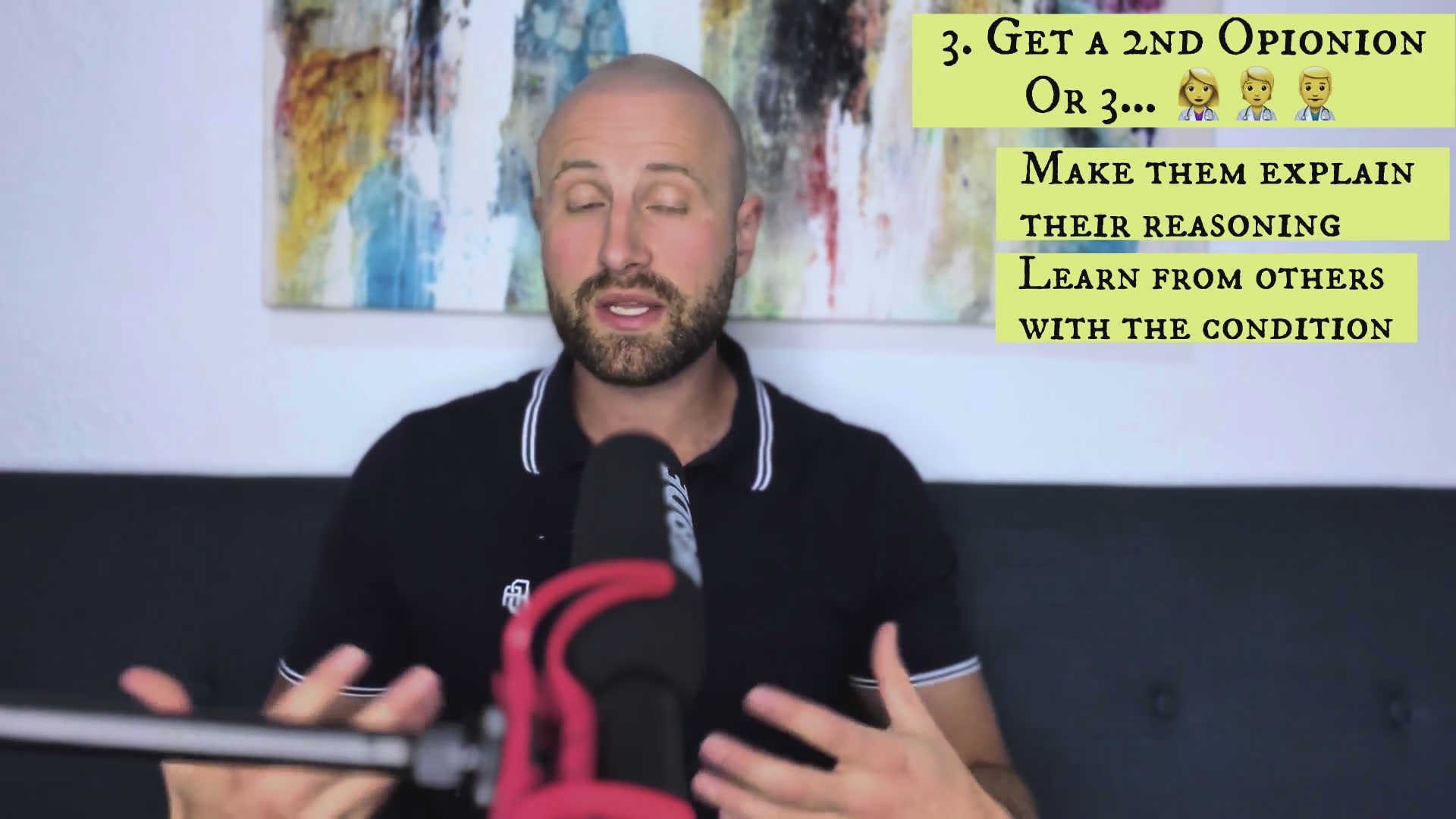
What are some of the medications that I may need to take are there different alternatives, right? So understanding the risks and benefits and just having any questions that you want answered present and with you And this becomes very valuable as well because when you get other opinions and you have a set set of questions Are you're able to bring those to other providers and see what they say and see if they have the same opinion and try to again Use your critical thinking to weigh what the best decision is for you based on the answers to the questions that you have for them My third suggestion I find to be one of the most important I harp on it all the time and you've been hearing me reference this throughout the video and that is getting Multiple opinions getting a second opinion maybe even a third opinion because I find so many people go see a provider a professional And they give them an opinion and because they're the expert They just go with it.
They go with the first opinion that they hear and just assume what they're telling them is the right answer a lot of times It is right because remember doctors. They don't know everything, but they know more than Your average person, right? They know more than anyone else. However, not all doctors are going to have the same opinion You could have two specialists in the same field and they may disagree So therefore someone has to be right or someone has to be more right But then the difficult part is how do I discern right?
That's where the critical thinking comes in That's when you bring in your questions and it is imperative for medical professionals and mental health professionals, right? If I am suggesting something to you It is on me to explain and make the case as to why I am suggesting what I am for your health Right that is on me now if I just say well do this because I say so I'm the expert. Don't ask questions. I'm the doctor that doesn't instill confidence in patients And again going back to that research When you do not have buy-in as a patient you're much less likely to follow through So again, maybe I'm giving this message to the medical providers out there But it is on you to explain Rationally why you're suggesting what you are also Explaining the risks and benefits, right if a doctor is just telling you one thing and they're not giving you an alternative Often maybe there isn't an alternative right but there always is an alternative and the alternative could be doing nothing, right?
So there's always positive and negatives of doing nothing like for my spinal condition Multiple providers told me that really the only option is doing surgery, right? And that was like a very hopeless feeling That this is the only thing I could do is get this surgery But I was able I was lucky enough to know how to manage the medical system and have the resources that I do That I was able to get multiple opinions from specialists, right? So it's important to do your research, you know, you could talk to different peers We'll talk about that later talk to other people who have had this condition Do your research online to the best of your ability to try to find the best specialist out there and maybe see more than one, right?
Now my specialists all basically said the same thing The only way that you're gonna get released is if you do the surgery, but luckily they were very conservative Right because back in the day often, you know surgeons will just say well, you know I have a hammer so everything looks like a nail and there's a lot of complications to surgery, right? There's risks and benefits to any surgery, right? Now unless you're in a life or death situation, you're on a stretcher and they have to Sautorize an artery or something like that, right?
You just you have to do it. There's no choice, right? But for any other type of surgery You have the option potentially to do nothing Right to not treat it right and there are advantages and disadvantages because there are complications to surgery So again in my situation I had to weigh what was the risk and benefit of doing nothing which I had been doing for many years So I kind of knew what that was already But there was that fear of the unknown of well, what's gonna happen if I get the surgery?
I don't know what the outcome is gonna be and they weighed that out pretty well for me and in my situation It was interesting because they all said the same thing however As I mentioned in my story, right? There was two options right I could get fused down to one level or a further level in the risk and benefits half of them suggested one The other half suggested the other right? So I was in this place where I had to decide right? So I listened to my provider's rationale I used my critical thinking I used what I knew about my body and What would make me potentially happiest or what risk am I willing to take to make the right decision?
And I went with the provider who made the best case to me Right who I felt was listening who I felt Understood my situation and who best explained why? He decided to give me the suggestion that he did another important thing to consider when getting multiple opinions is who you're getting that opinion from now I mentioned that you want to try to see the best specialist possible and a lot of people with pain with other Conditions find that there's a lot of quacks out there You know, there's people who will give you these homeopathic remedies now I'm not Craping on homeopathic medicine there are certainly things that people find to be helpful But a lot of times people will try to sell you the moon, right?
They try to tell you something that you want to hear that if you do this You are going to feel absolutely better, right? And it's really tempting to believe that right? It's why we fall for scams because we really want to believe these certain things So be very discerning about who you're seeing and use that critical thinking to best make choices So you don't get scammed or you don't get coaxed into doing an intervention That's actually going to be more harmful than helpful number four is using technology to your advantage I've alluded to this as well throughout the video But there's a lot of great resources on there including online now You I caution you because we don't want to have the web MD effect right where you start diagnosing yourself But there's a lot of good valuable information.
There's research articles now again We have to know our limitations, right? Am I gonna really understand this medical research? article and I trained to do that, right? So it's often good to get some of this background to read forums of other people who have had these conditions Maybe there are alternative treatments newer treatments that may be more experimental, right? So all of the best treatments that we have were probably new and experimental at one point until they gathered more evidence, right?
So we're using our critical thinking here when we're utilizing the internet and technology and we don't want to just base decisions off of that, right? But it couldn't it can be helpful to get some of that background knowledge And then you're able to take that and get context from your provider for example in my case I was able to find some newer surgeries out there some newer techniques that were less invasive That had less side effects, right? So I found these and I brought them to my doctor and he said well, yeah, these are newer things that are out there We're starting to learn more about them people are getting benefit from them.
I know about them I'm even excited about them. However in your case because of x y z you're not going to be a good candidate for it So under some weird circumstance If I was able to just take that info and just go see a surgeon and they did it for me that wouldn't have been the best choice Right, so I needed some context there. So utilize technology But again use your critical thinking and be discerning as you gather more information The last suggestion is to try to connect with other people who have been through the same thing, right?
I talked about reading online forums But there's also things like Facebook groups where there's Thousands of people who could share their experience on the exact condition that you've had some of them are maybe further along in the process People have tried all sorts of different remedies Interventions and they could share their experience now There's a huge caveat here and there's a big warning I'm going to put on this because this can be such a helpful tool, right? Also finding doctors finding specialists recommendations people find these to be so helpful But the caveat is that these forums these groups can also Perpetuate a lot of negativity As we've talked about with chronic pain and chronic illness It's really easy to feel defeated to feel negatively, right?
This is something you've experienced for a long time You've had all of these bad experiences. Maybe you've had these bad outcomes, right? Everybody's outcome is going to be different from some of these interventions So what you find is a lot of people who are on these forums tend to be people who have not had a great outcome or not in a good place Because for the people who have had positive outcomes who have found relief through different interventions Often just move on with their lives, right?
So they're not the ones who are most active on there So I remember when I found some of these forums I found them to be very helpful and I got a lot of useful information as far as recovering from surgery All sorts of other suggestions But I found that it was really difficult to be on them and it really scared the crap out of me to be frank, right? With the surgery because so many people with let's say my condition who have had spinal fusions There is a chance that you could you could be worse than you were before coming in now That's not the typical outcome, but there's a group of people that end up worse off or the same Some slightly better and some a lot better again I was lucky to have that but I was really afraid to do this surgery because what if I fall here, right?
And I have a lot of the complications after that some of these folks have had People who have had multiple surgeries, so it really scared me And so spending too much time on there probably Preventing me from doing it sooner now again. I talked about in the video how I 'm glad I took the course I did I don't beat myself up for not doing it sooner But that's something to think about when utilizing some of these resources, right? Is taking everything with a grain of salt and remembering that this may skew negative And this is something I spoke with my pain psychologist about and she confirmed that she said I She actually did not recommend for her patients to go on there Or at least to spend too much time on there.
So kind of what i'm saying is that It is a good tool to be utilized you could learn a lot but be discerning and try not to let it weigh you down So those are my five suggestions for my personal and professional experience and how to navigate the medical system again Take everything what I say with a grain of salt anything you hear from a medical mental health professional or otherwise Use your critical thinking right trust professionals, but also question them It's important for you to understand what they're suggesting and why they're suggesting it for your body It's always good to get other opinions.
That is why i'm going to be interviewing dr Carrie mankey who has experience in this area and the er working with chronic pain patients to get her suggestions And how to manage chronic pain and chronic illness and also how to navigate the medical system. So stay tuned and look out for that
Reactions and comments are for members. Joining is free and takes a minute.