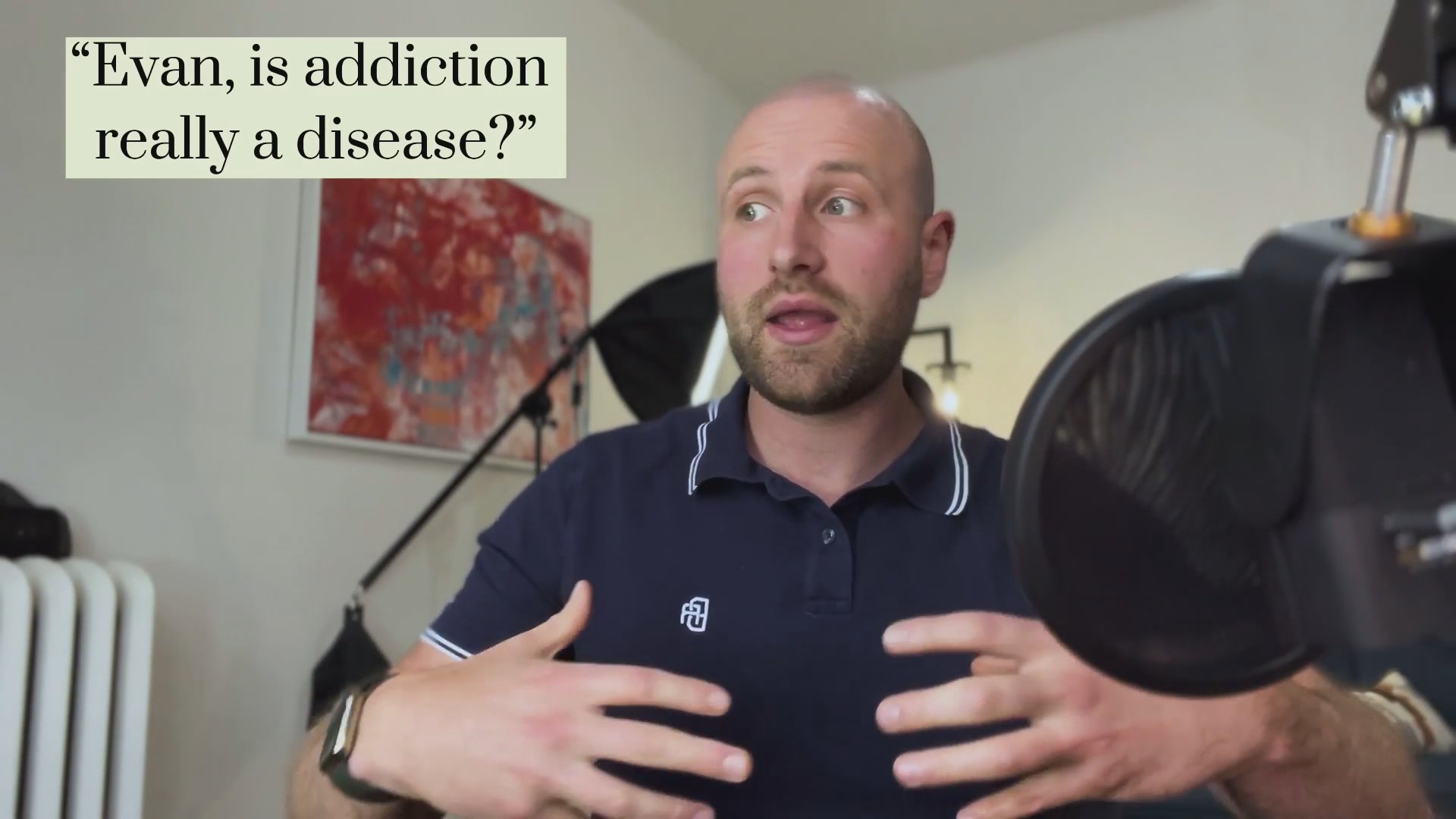
In this video, Evan Lieberman, MSW LICSW LADC, answers a question he frequently gets from clients and followers. Is addiction really a disease? A lot of work has been done to classify addiction as a brain disease to destigmatize the phenomenon and highlight the physiological processes happing in the brain. However, to say a blanket statement like "addiction is not a disease." would frankly be seen as heresy. Yet, many thought leaders in the space are pushing back on this, such as physician and author Gabor Mate, relating it more to a trauma coping skill. So watch this video from Evan, where he breaks down both schools of thought and his personal and professional opinion on the matter.
Evan: The prevailing idea has come that addiction is a disease. But some voices that say, no, it's not a disease, he says. For the most of the people coming in, Evan says, it is a coping mechanism. It's a huge, broad spectrum.
What's up, Cadre fam? Evan here, your resident mental health and addiction therapist, and I wanted to talk about a topic that I keep seeing. And look, this is going to be a little controversial, but I want you to bear with me and hear my take on it. And that is, is addiction a disease? Right. So we have a lot of narratives that form over time, and what's kind of happened is the prevailing idea has come that addiction is a disease. Most medical mental health professionals will tell you that, right.
But there are some voices that say, no, it's not a disease. And there may be some other explanations or better descriptors for it. And so sometimes that could be controversial to go against the grain. And so people ask me, well, do you think it's a disease? And I think one of the reasons why it's become really ingrained for people to say and have pressure to say yes, it is, is because for so long, addiction was looked at as a moral failing, right. And to be able to qualify it, to classify it as a disease, takes away a lot of the stigma, and that's so important, right.
But one of the things I noticed, right. So I'm someone who's in recovery, right, who had an addiction, someone who in recovery needs to always be mindful that this is something that is not just a temporary episode. Right. This is something I need to always be watchful for because of the risk. Right. And that's kind of the idea of the disease where it's a progressive illness. Right. So for me, as someone in recovery and then becoming a therapist and working with people with addiction, I always thought that all the people that are going to come to me with substance use issues are going to be folks with more severe addictions.
But one of the biggest surprises was, that's not what happened. I get plenty of people with severe addictions, but the people seeking individual therapy with me or even assessments, the vast majority do not qualify for a severe addiction. And I noticed that those cases are much different than the folks who I would probably recommend something like a residential or inpatient treatment for or detox or anything like that. A lot of times it's folks who are using chemicals, who are using substances in a way to self medicate.
And that's usually how it starts for people who are in severe addictions. But for a lot of people, right, if you're watching this, let's say maybe you don't have, like, an addiction history, but think of a time where you were using most. Maybe it was college, maybe it was after divorce or something where you maybe took it a little too far, maybe that's never happened. Right. But I think for a lot of people, they've kind of been through that, where there's an experience where maybe they took it too far and it got uncomfortable and was starting to have consequences, and then they pulled back, stopped, and it didn't become an issue after that.
So those are a lot of the folks who I'm getting who are coming to me in those periods. So it varies. It's a huge, broad spectrum. And that's why when we say, well, is addiction a disease? Well, I think it's a little bit more complicated. So my view of that would be that most of these people who are coming to me don't have, like an, I won't say incurable, but they sometimes say incurable because it could just go into relapse, not be cured. For some people, that's true. For the most of the people coming in, I don't view it as a disease.
I view it as a coping mechanism. Right. It is a coping mechanism to solve a specific problem. Now, when that happens over time, when you don't stop, when you become more and more dependent on it, even to the point where you're having withdrawal symptoms and having chronic multiple relapses, and it gets more and more ingrained, and your brain changes over time, and you start to develop those severe symptoms, because our diagnostic classifications are mild, moderate, severe. So I usually view people more in the mild, or what we used to call substance abuse range.
It's probably not necessarily a disease that is chronic, that is relapsing, but it still looks very much like an addiction. Right? It looks like often a severe addiction sometimes, but within a specific period of time where it doesn't necessarily develop. However, over time, it becomes more chronic, and it does look a lot more like a disease. Now, if you look at a lot of different diseases, they're not necessarily always severe chronic. They view addiction to be another mental illness, to be different wiring connections in the brain, things that are faulty or cause symptoms.
So I think it's just something to think about. And to me, at the end of the day, does it matter all that much? Maybe not. It's like, is it a disease? Is it not a disease? Whatever it is, it's something that's important, that deserves being addressed most of the time. And it's something that deserves to have that stigma removed, that it's not just all the fault of the individual. At the same time, I think it can't be taken too far. To say, well, you know, well, the person has a disease, so they could just do whatever they want.
And there's no. They have no choice. They have no autonomy, which is not true either. Right. Like if you compare it to a disease like heart disease or diabetes, right. Especially something like type one diabetes you never chose to have, but you can put those symptoms into remission by certain lifestyle changes and taking your medications, which is a choice. Right. So there is this dichotomy. There is an interplay of choice and lack of choice. Right. Even with addiction, we're often genetically predisposed because it's like, well, they could just not drink.
Well, how many people could say they've never had a drink? So that individual drinks and what happens, it turns on a switch that they have that other people maybe don't or they would need to drink significantly more. It does something different for those individuals. And those individuals often are the ones who develop a more severe addiction and therefore much more related to a disease than other types of substance misuse. So anyway, I hope you got something out of that. Some food for thought, maybe?
Look, do a little more research on it and just see what you think and what makes most sense to you. Anyways, folks, have a good day. Hope you enjoyed that.
Reactions and comments are for members. Joining is free and takes a minute.