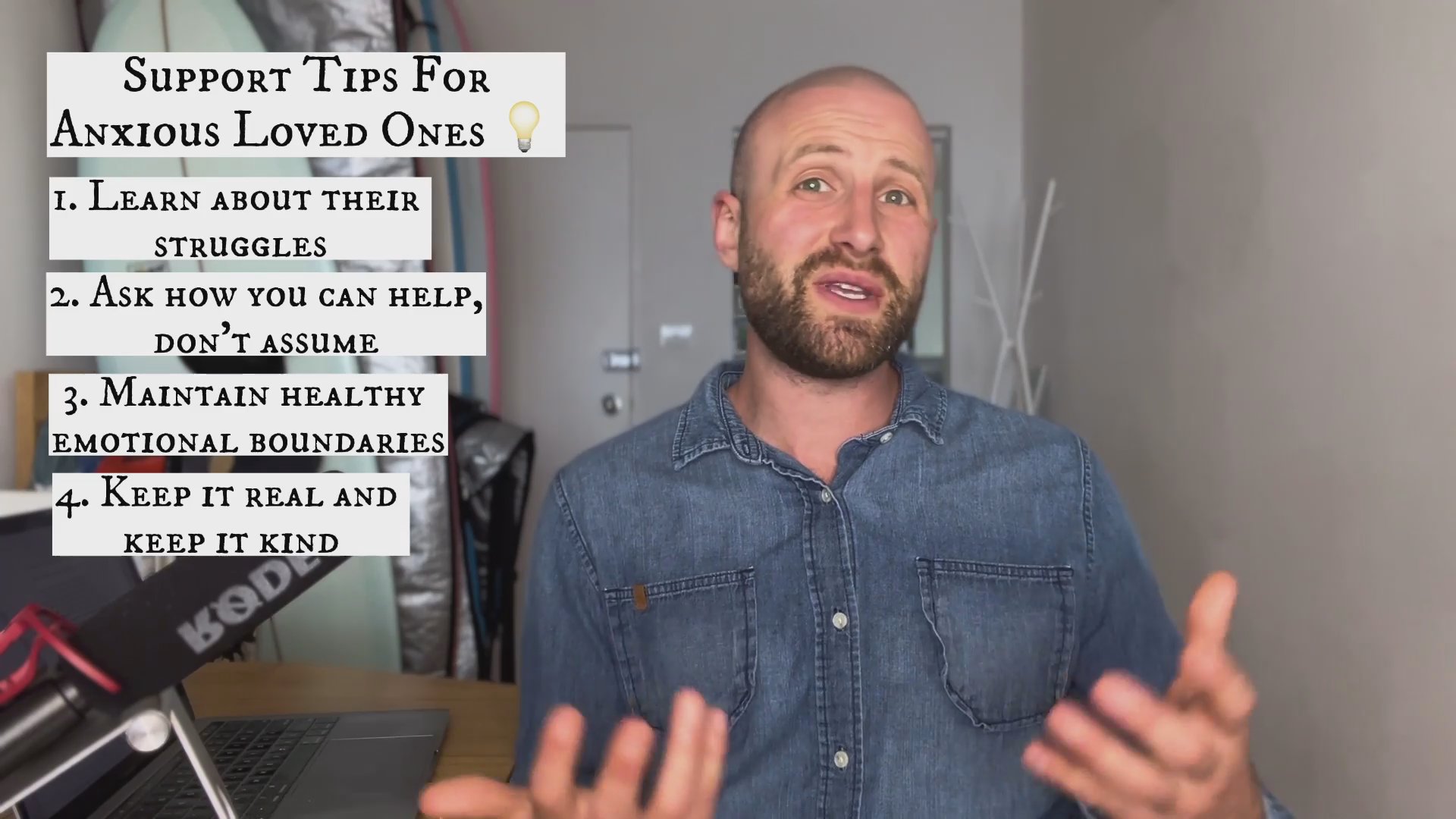
In this video, Evan Lieberman, MSW LICSW LADC, answers a question from a member of the Cadre family. Today's question was, "How do I support a loved one who struggles with anxiety? Evan breaks down his 15-20 rule on supporting friends or family who struggle with mental health or addiction, so if you are interested in learning how the rule provides a balanced approach to help vs. overstepping, check it out!
Evan: How do I support a family member who's struggling with anxiety? Evan: I created a rule that best encompasses how to support folks struggling with mental health or addiction. He says the 15 to 20 rule is all about striking a balance.
Hey, Cadre folks. Evan here, your resident mental health and addiction therapist. And once again, I'm going to be making a video answering questions from you all, the Cadre family, whether it be a coach, creator, user of the app, or anyone associated with us. Now, today I got an awesome question from a creator, and they asked, how do I support a family member who's struggling with anxiety? What do I do? How do I show up for them? Well, let's dive into it. So I was sitting here thinking about how to answer this question, and I was racking my brain a bit, and then I realized this is very similar to one of the most common questions I get as a therapist and content creator, and that is, how do I support friends and family members who are struggling with addiction, especially if they don't want help?
Now, with anxiety, it's going to be a little different, but a lot of the same principles are going to overlap. So I'm going to give you some of my suggestions in general, but also some specific ones geared towards folks with anxiety. So, as I was answering this question so frequently, I started to realize some patterns, basically, that all of my suggestions were following a similar pattern. So I created a rule that best encompasses how to support folks struggling with mental health or addiction, especially if they're a bit resistant to it.
And I call this the 15 to 20 rule. So you may be asking, why 15% to 20%? Where did that number come from? Well, I just made it up. Right. It's just a general guideline to follow. Now, some people are at different starting places. Maybe it should be a little bit more, maybe a little bit less. And some of us struggle to give more support, and that's okay. Some of us may give too much. That's okay, too, though. We want to work to finding more of a happy medium somewhere around that 15 to 20 minutes mark.
So some people ask, well, why not 100? Why not just shower them with support? Well, I have two main reasons for that. Well, the first reason is that if you give too much of yourself, if you go beyond that imaginary line of 20%, then that can negatively impact your serenity and your well being, because you do have the right to be happy, to be serene, and it doesn't help you, and it doesn't help them. So going too far also can breed codependent type traits, especially when it goes way too far. And basically, that means that you're putting your happiness onto that other person.
So however they feel is how you feel, so you're trying to help them. And really, in a way. There is a selfishness about it, even though it may not seem that way because you're using them to make yourself happy. So that could be a trap for both people. The second main reason is not only does it negatively impact you, it can be holding them back as well. And even worse, it could be preventing them from. From taking the steps necessary to get help. We call this enabling. Now, sometimes, let's say for addiction, it could be in the form of financial help, or bailing someone, getting them out of trouble.
Or in this case with anxiety, it may be tiptoeing around their triggers and so they never have to expose themselves to anything that's uncomfortable. Therefore, the 15 to 20 rule is all about striking a balance. It's how do I be helpful and supportive without taking it too far, without overextending myself? So I become exhausted physically and emotionally. So now I'm going to go ahead and give you some specific examples for folks struggling with anxiety. And the first one is to understand the person's anxiety better, learn what their triggers are, just so that you don't unwittingly activate them to a point where they get above their window of tolerance more than what they could handle in that moment.
Number two is to directly ask them how you can be supportive. Don't just assume they want special accommodations or to be checked in on all the time. Number three is make sure any reasonable accommodations you give to them is not negatively impacting you. That's not becoming a burden onto you. Remember, that 15 to 20 rule is so you don't overextend yourself. That holds them back as well. Number four is if you feel like your needs aren't being met, that you are overextending yourself, and that they're asking maybe too much of those around them to have a direct conversation with them.
Still be supportive, but be direct and to the point, because they may actually benefit, especially if you do it in a loving way, to hear how their behavior affects other people. And this really goes for the folks who don't seem to be doing anything about the problem. They don't seem to want help, yet they're still asking too much of other people and affecting others in a negative way. Next, if your loved one is struggling and they don't seem to be getting the help they need, you can go ahead and do a little bit of research and see if you could find some resources for them.
Now, the tricky part is how to offer those to them without prompting resistance. And I usually recommend coming from a supportive and loving place and just offering them the resources, but don't push it. Just leave it. Leave it at their feet and let them chew on it for a little bit and just let them know that, hey, if you want help accessing any of these, I'm here for you. Otherwise, I'm just going to let you make that choice and I'm not going to push you on it. So if you're even asking this question, that means you probably love and care for this person.
You're wanting to support them. And that's the most important thing. Just at the end of the day, don't overextend yourself. Don't unwittingly make the problem worse. Just show up, be there for them and let them take the lead.
Reactions and comments are for members. Joining is free and takes a minute.