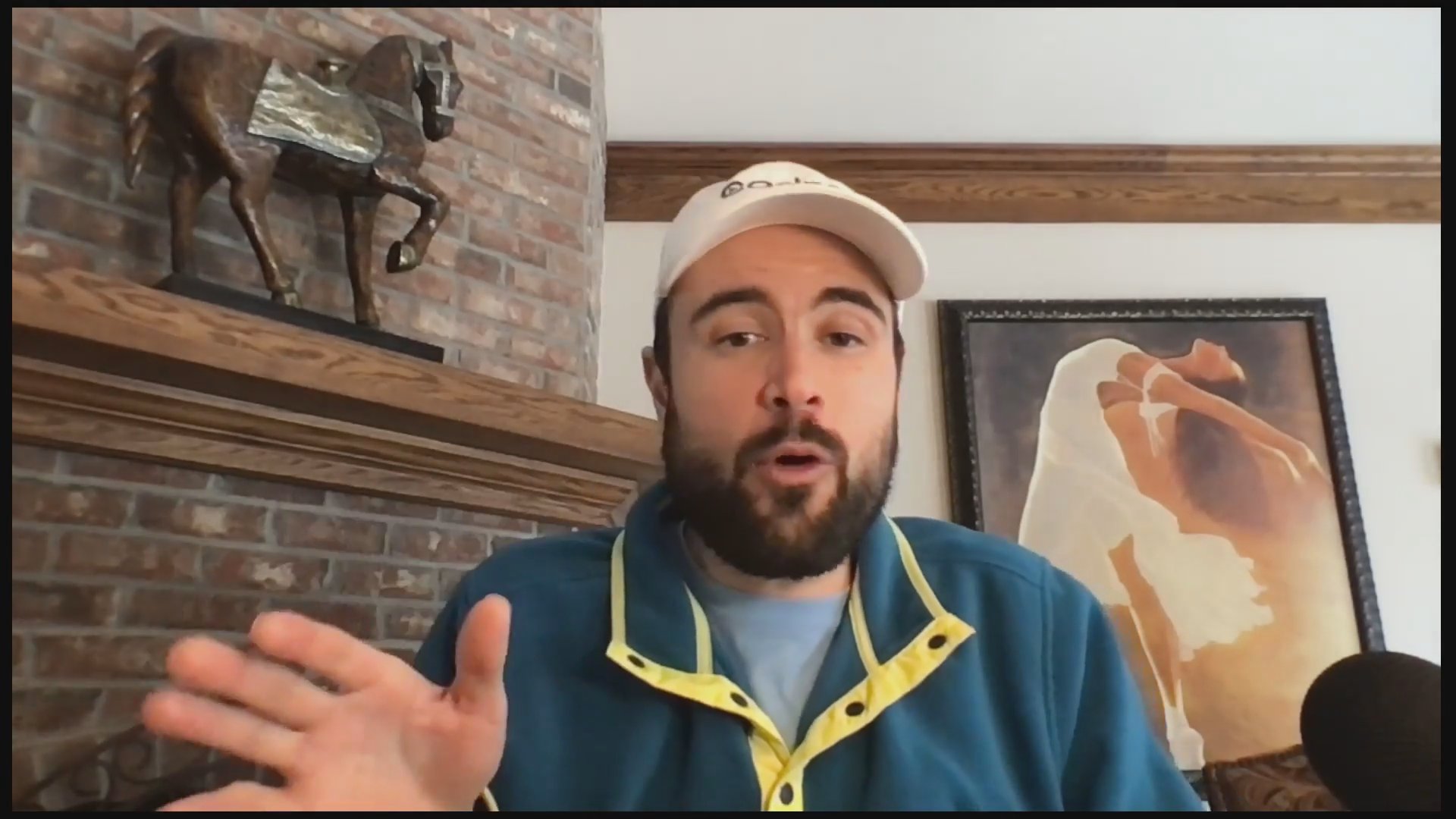
Nick shares about his sobriety and recovery, and shares new inspiration about giving and service. A popular term in sobriety recovery is "language of the heart". Nick explains how learning this language shifts his perspective and makes living a sober life easier!
Nick Hanson: We need to express. Lack of expression can lead to depression. This is my first time going live on the Cadre platform. We're here to connect and deliver real experience, experiences.
The first thing that I want to talk about is, what can I give? We have needs that need to be met to sustain ourselves. But I get miserable when I think too much about what I can take. When I shift that thinking from whatcan I take to what can we give, I'm so much happier.
In recovery, we talk about one moment at a time. I go back and forth between expansiveness and despair. By just solving today, I can appreciate the moments, the things that I'm supposed to be hearing. The progress of my recovery has been a slow journey.
Every day feels chock full of what I've been calling these holy moments. These are the moments that have been making my days beautiful. But it's equally important to acknowledge those tougher thoughts and those fears. I hope you have a good day.
Hi. Nick Hanson here from Cadre. How are you today? What's on your mind? What's in your heart? Those are the things that I want to share with you today, what's on my mind and what's in my heart. And I want to encourage you to ask those same questions and maybe do a little writing on them, maybe talk to your friends and family about them. But we need to emote. We need to express. Lack of expression can lead to depression. No man or woman is an island. We cannot keep it all inside. Right. We've got to let it out there in some ways.
And I'm so grateful for this opportunity to do that with you today. I'm just going to have my phone out here in case there's any technical difficulties. This is my first time going live on the Cadre platform, and we're here to connect and deliver real experience, experiences. And it's just an amazing opportunity. And I wanted to talk a bit about just some things that have come up for me in the new years and things that I've been thinking about. The first thing that I want to talk about is, what can I give?
So I heard this awesome speaker talking about this, and he had hit a crossroads in his life, and things weren't going well. And he realizes, I realize often, that he was thinking more about what he can take. And I'll think that oftentimes it can get in that mindset going into, whether it's going into a room or a work situation or a relationship or a friendship, what can I take? And we have needs that need to be met to sustain ourselves. But I get miserable when I think too much about what can I take?
When I get in that mind frame, it's like I start thinking, oh, this has to go right. And that has to go right. I forget that, you know, the world is abundant and the universe is abundant. So when I shift that thinking from what can I take to what can I give? You know, if I'm going into a Zoom meeting, what can I give here? If I'm going into a work conversation, what can I give? You know, if I'm going to a social event, what can I give? How can I be of service? I'm so much happier when I do this.
And like anything else, I think it's a practice, and I need reminders. And even though I know this, what can I give to be true? I'll oftentimes forget it. And so that brings me back to this kind of other point of just solving. Today in the recovery movement, we talk about one moment at a time. And, you know, I think to just solve today can be really, really important. And if you're struggling with overwhelm, you know, it might be just solve the moment, just solve the next hour. Just, you know, sometimes it might be just survive.
And, you know, something I've learned about myself, and I was actually talking to my psychologist about this last week, is part of my personality is that I have, I kind of go back and forth between expansiveness and despair, you know, and it's just kind of who I am. And that is maybe always will be the case. But I can learn how to live with that. And sometimes instead of trying to change, you know, myself, I need to accept myself. And that expansiveness might 1 minute thinking, oh, things are so amazing.
I'm going to be the president of the United States someday, or some other grandiose thing like that. And it's important to have those dreams and hopes while maintaining a sense of reality or the despair. But I can flip to despair very easily, too. I'm not where I want to be. This is not going right. I don't have this, I don't have that, whatever it may be. And so I can crescendo quite a bit in between those things. But I'm thinking about what can I give? I'm not so worried about what my personal situation is.
And I'm thinking more about what I can, as some twelve step literature says, packed into the stream of life. And so this expansiveness and despair for me before I got sober and entered recovery, looked more like the expansiveness could land me in the psych hospital. I went to the psych hospital three times with manic episodes because that expansiveness took over, and because I was using alcohol and other substances, I wasn't able to stay in the moment, and I lost track of everything. And also, you know, something I've identified as well, that I was living in so much fear and I didn't know it.
You know, I thought I was totally free as a bird in Amsterdam, but I was actually, you know, living in a lot of fear. I'm just gonna make sure that this live is working. So, yeah, and so I just want to keep on making progress in that, you know, and for me, that growth has been very slow. It has been. Sometimes I can make some big jumps, and I like to do that. But the actual, you know, progress of my recovery and my healing has been a slow journey. And by just solving today, I can appreciate the moments, the things that I'm supposed to be hearing and my experience, it all ends up coming to me if I'm open and accepting what the next person that I need to meet, the next person that I need to help, the next book that I need to read.
You know, if I stay open and I keep the channels open and I try to live from the heart, those things are going to come to me. I don't need to seek them. But once again, it's just a. It's just a practice, and I got to keep showing up. And it's like, you know, I was a tennis player, and we have to get a lot of repetition in. You know, you got to hit a lot of forehands if you're learning something new, you know, you might need help. You might need a coach, you know, you might need someone else to come in and help you, you know, and it can be frustrating.
You might wonder, you know, my forehand was always weaker than my backhand. My backhand, because I'm a lefty and I hit a two handed backhand. I right left hand, but played tennis righty, but I had the two handed backhand. I would. In big situations, I love hitting the backhand. Forehand would sometimes tighten up, you know, and we might have those areas in our life where we tighten up and we're wondering, how am I still tightening up here? How am I still fearful, you know, in this area? But it's just another opportunity to practice, you know?
And in my experience, these things take time, and that's okay. That's totally okay. So just take your time with it. Just solve today. And that's going to open up to these kind of holy moments. And I wanted to share a little bit of this, this writing that I did last week of something I've been noticing over the past few months. And in a way, I'm busier than I've ever been, but every day feels chock full of what I've been calling these holy moments, not wholly in a religious sense. I just can't find a better word to describe these moments.
Walking through a grocery store parking lot and looking at the sun and realizing suddenly what eternity might mean. And then it's gone in a flash. Or I'm typing on my computer, working on a spreadsheet, which is not my forte. 1 of them, maybe looking into a wooden bowl that they were washing in the stream, have this same thought that I'm thinking hundreds of years later, or I'm having coffee with a friend and I'm seeing their eyes twinkle in the sun while noticing a bird frolic on a branch outside the window.
These are the moments that have been making my days beautiful, while they are also filled with the usual hustle and bustle, the excitement of ideas and collaborations and work coming together, the fears and anxieties that we all have, both individually and a collective society facing a global pandemic and other existential crises, one thing is certain to me, we must learn to work and live and love together as one. Because, like the Beatles say, and I highly recommend the new Beatles Doc on Disney plus.
That was directed by Peter Jackson, who directed the Lord of the Rings films. This is a line from one of the Beatles songs. I am the walrus, I am he as you are he, as you are me, and we are all together. Or as I say, and I'm not comparing myself to the Beatles here. I just want to share this thought. It's all good in the neighborhood of your heart from the start, you know? So these are some thoughts, you know, that I've been having, and I don't feel these holy moments all the time. The past couple days, I've been stressed.
I've got work and projects and life and questions, and in the back of our minds, you know, we have this. This pandemic looming and all this. These major happenings. And so I like to share more about the good thoughts, but I think it's equally important to acknowledge those tougher thoughts and those fears. And I think it's a balancing act. Some of the times, the canoe is going to tip up to fear and worry. But if we stay together, if we stick together, we can bring that canoe back to the center, right?
And sometimes it might get tipped up too far towards, uh, for me, towards this expansiveness or to. Or whatever it is. But if I stay grounded, you know, that's been a big thing for me. I had a psychologist years ago talk to me about keeping it kind of within this. This realm of stability, right? Or we can think about, you know, keeping it in between the lines, uh, of the road. And this stuff is all just. Just practice, right? And a lot of times, I think we need to just step, if I need to just step just right with all this stuff, or the wheels are going to call fall off.
But my experience in the healing and recovery journey says that there is so much grace involved. We don't have to do it perfectly. Mistakes are going to happen. And that's something for me, too. I need to work on. I hate to make mistakes. I hate to be in the wrong. It's scary. But we need to accept that part, too, and let go of some of that perfectionism and release, you know, some of that, because the opportunity's always there to do that. So, as my. As my friend at Cadre says, I hope you caught, you know, some little tip in here that might help your day.
I hope that, you know, you have a good day, and, you know, I would encourage you to open that heart up. Right? And whatever way that comes naturally to you, it could be a walk, could be a meditation. It could be talking to someone. It could be writing. It could be anything. We don't have to do it perfectly. We just have to do it together and connect in whatever way that works for you. My name is Nick. I'm from Cadre. We're doing what we can to connect and deliver real experiences. Have an awesome rest of the day, and please share what's on your mind and what's in your heart.
I'll catch you on the flip side. Bye.
Reactions and comments are for members. Joining is free and takes a minute.