Join me to talk about life as a caregiver of a child with autism, and all that comes with it that can be hard to talk about.
Today is officially caregiver day on Cadre. What does it mean to be a caregiver of a child with autism? And why can it be hard to talk about?
Great job, Serena, for doing what you do every day and for everyone else. I know that you're all doing a fantastic job being who you are. Come back to the Cadres fair to remember that whenever you need to. It was great to see you. We'll see you soon.
Cadre. Hello. It is Shannon. All right, guys, I'm outside. I haven't been outside for a while. It's beautiful. Today is Thursday. Welcome to what will soon be officially caregiver day on Cadre, and there's more coming on that soon, but essentially, we're talking to all the caregivers out there, people who take care of other people. And as many of you know, for those of you who don't know, I'll tell you. My name is Shannon. I'm not a clinician. I am not a mental health professional. I'm a human who is a caregiver to a son with autism, a beautiful son named Wyatt.
He's awesome. I am also a woman who has generalized anxiety disorder. I have CPTSD, and I've been in therapy for eight years. And so I am here to essentially say, hey, humans, this is my lived experience, and I want to normalize it by talking about it with all of you. So I just was on a call with the team, with the Cadre team, and the Cadre team today was saying, shannon, be really real, because that's what we do at Cadre. Right. All right, so I'm going to be really real. What does it mean to be a caregiver of a child with autism?
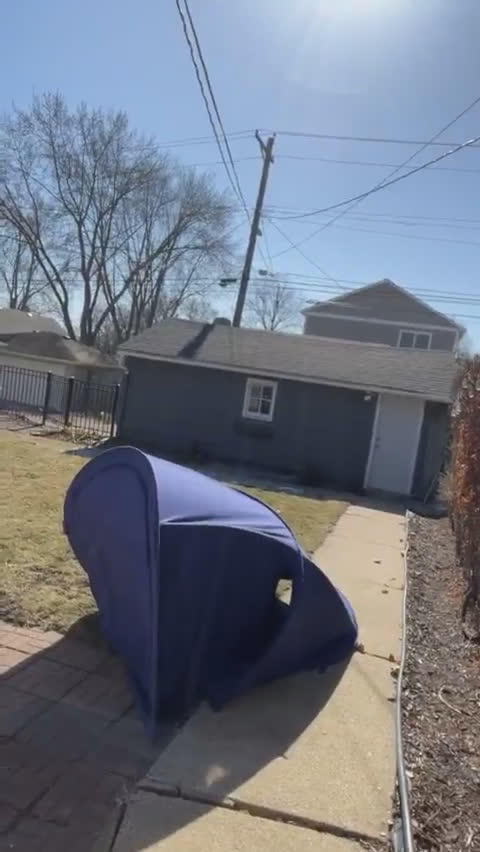
And why can it be hard to talk about? All right, I'm going to show you why it can be hard to talk about, and I'm going to do it by showing you something that's probably a little embarrassing, saying, I'm in my backyard. Let's see if I can. Let's see if I can do this. I don't know if this camera's gonna work. All right, so do you guys see this? You see this blue tent? Can you see it? I hope you can. This is a blue tent. Why is there a blue tent in my backyard? Here's why there's a blue tent in my backyard.
My son, Wyatt, has autism, and one of the things that he does that can be really hard to talk about is that he loves to eat food in his bed. So he eats bananas, he eats diet soda, he eats ice cream, and he eats all of these things after I go to bed at night. So I go to bed. My son gets up. He's 14. He's a teenager. Of course he does. He gets up, and he goes to the kitchen, and he gets something to eat. So my real life as a caregiver of someone with autism is that my son who eats all those things in his bed every day, no matter how much I take them out of the kitchen, try to hide them, do all the things that I can do in my mind to solve for that problem.
My son, who loves his bed tent, again, which you can see here in my yard, okay. He loves his bed tent. He eats in his room every single night. So what happens when people eat food in their bedroom? It gets smushed on their sheets, right? There's bananas smushed on his sheets. There's ice cream smeared on his sheets. There's all these things on his sheets. And I don't know how to stop it. And I don't know how to stop it. And so I tried to reframe it. I tried to reframe in my head and say, this is okay.
Every day I will wash his sheets. And I do. Every day he has sheets and blankets. He likes to have five spots specific blankets on his bed. So I take those blankets and what I say to myself as I'm doing it, and my friends, Ana knows this here on Cadre, I say, it's okay, it's okay, it's okay. And I self talk myself through the process of cleaning his sheets. His dad and I talk about it. How can we solve for this? Do we get rid of the food? Do we take away his bed tent? What do we do? And so why his bed tent is in this yard today is because it got so bad that I had to take it outside and I put it in the yard out of frustration, also to get the crumbs out.
And yesterday, I watched it blow around in the wind. So again, if I'm being incredibly honest, I watched the bed tent, which can honestly be a little bit of a source of anger for me because I know that within that bed tent, there's going to be all these sheets and they're going to be dirty, and I'm going to have to wash them. And that is hard. And I know it sounds like a littlest deal. It's sheets, right? It's sheets and it's hard. And I don't love it. And it is what it is, and I'll continue to try to find solutions for it, and it's something my son needs.
So if you are not a caregiver for a child with autism, if you don't have these kinds of things in your life, it can be really hard to tell someone who doesn't get it. So I am here to say that if you do have those kinds of experiences, it's okay. And if you put a bed tent in your backyard like I did, to float around in a windy storm. That's okay. I will bring it back inside. I will. And I'm also letting it sit out here for a little bit. So, friends, that is what I am here to say to you today. Being a caregiver can be hard.
Hi, Serena. I'm so glad you're here. Thank you. I'm so glad you're here. It can be hard to do this. It can be hard to do this job, and so the best we can. So kudos to you. This is a place where you can come and talk about whatever you're dealing with as a caregiver, whatever kind of caregiver you are. And you are welcomed and celebrated. And frankly, what's the word that's bigger than celebrated, right? You're kicking a**. So great job. Great job, Serena, for doing what you do every day and for everyone else, thank you for joining me.
I know that you're all doing a fantastic job being who you are. And come back to the Cadres fair to remember that whenever you need to. All right, guys, thank you so much. It was great to see you. We'll see you soon. Back in the Cadres fair. Bye.
Reactions and comments are for members. Joining is free and takes a minute.