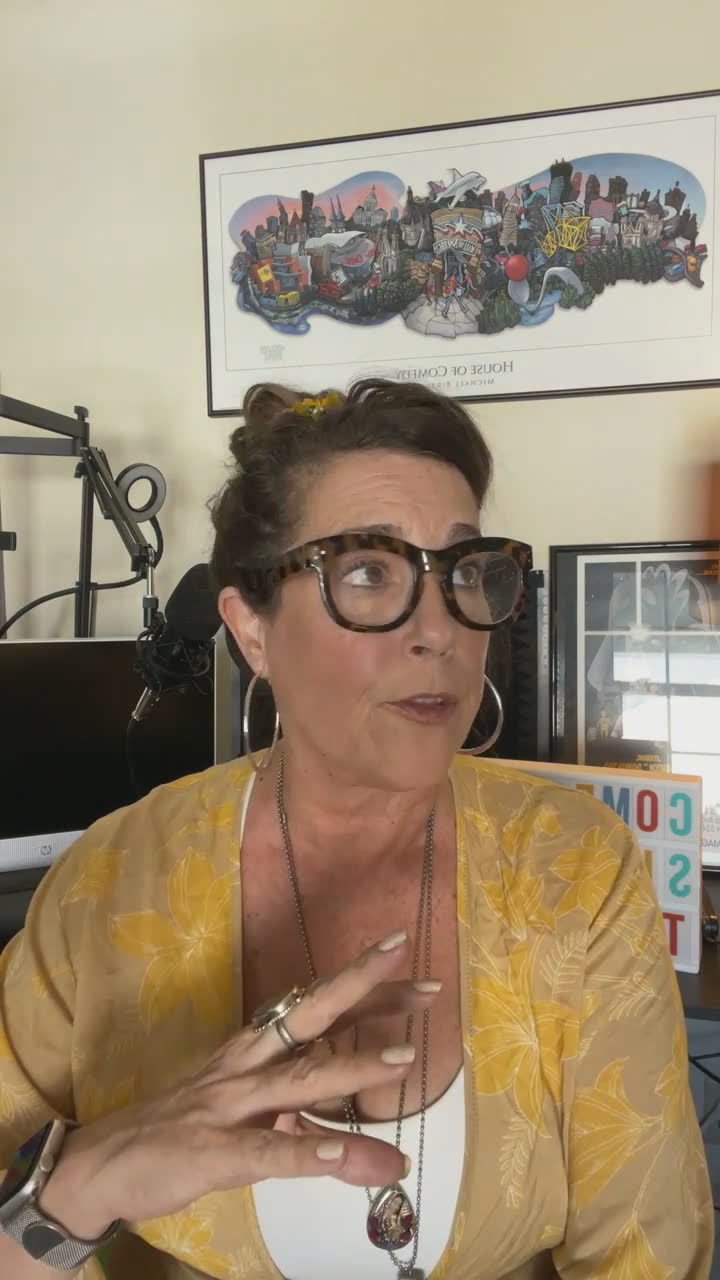
Comedy Centered is an open Topic + Share meeting where each week we take a lighthearted look at the not so funny side of addiction recovery, mental health, and family. Hosted by Comedian Tiffany Norton, this interactive meeting will engage and elevate, while providing a safe space to ask for help and make friends.
My name is Tiffany Norton, and I'm really excited to be here. This is my first Cadre live stream. Rounds and rounds and rounds of applause. I'm very excited to see what this adventure brings.
Tiffany Norton is a stand up comedian and producer. She's been working in the Twin Cities market for about 17 years. How do we use humor to diffuse tough topics?
In 2022, a Minnesota transplant living in packers country, he struggled with his mental health. He knew he had alcohol disuse or misuse disorder. He decided to try to perform comedy centered. He says he had to will himself to do it.
And I want to talk a little bit about willpower, too, because I kind of have beef with that word. The word I like to use is willingness. Willingness means you're willing to accept what is, and you are also eager to do something about it.
Comedian finds out he has attention deficit disorder and post traumatic stress disorder. Gabor mate explains that most people that have an overuse of anything are trying to solve their problem. It's a process to get diagnosed.
Bob Greene: One of the things that honestly, like, was one of my really babiest of baby steps was admitting I had a problem and that I needed help. He found just putting himself in the path of different conversations was so helpful. Greene: Be open and on everybody wanting to hear all your hot takes.
When we're talking about trauma, we compare trauma, Diet Coke, is life. What's deceptive is little t. Little t is just as real as big t, but it's not commonly recognized in others. Remember, too, you do not have to learn the source of your trauma.
This space will usually be about a half an hour on Sundays. What I want it to be is, like, a topic and share meeting. I also want people to use this as a safe place to check in. We're here for cheerfulness.
"I challenge you to name it. Um, you're all. You may have more than one alter ego, " he says. "She tends to come out when I. am doing something. "
All right, I'm live. I think I'm doing it. I hope I'm doing it. I welcome, everyone. My name is Tiffany Norton, and I'm really excited to be here. This is my first Cadre live stream. Rounds and rounds and rounds of applause. Yeah, I'm very excited to see what this adventure brings is. Hey, welcome, everybody. Oh, I see people. Andy and Julie. Welcome, welcome, welcome. Mimic. Oh, fun name. Fantastic. So let me introduce myself while people are, you know, gathering in our virtual space. My name is Tiffany Norton.
I am a stand up comedian and producer. I've been working in the Twin Cities market for about 17 years, and I've also worked in the radio business a fair amount, working in multiple stations here in the Twin Cities, which I love dearly. During the pandemic, I got laid off, which I think happened to a lot of people. And so that's a thing we're gonna joke about at some point, too. I got laid off again from a different job. So it's like, all the fun change, and, like, how do we. How do we use humor to really, you know, diffuse some of these really tough, tough topics?
Right. So. Oh, Shannon's here. Hi. Bronze metal life. Welcome, welcome. Speak wonder Kendra. Thank you, guys. Wow. I feel I was worried no one was gonna come. It's very beautiful out right now, and I know that not everybody is tuning in where I am. I'm in Hudson, Wisconsin. So. So I am a Minnesota transplant living in packers country. So there's that. I'm adjusting. But anyway, so kind of the background a little bit now that we've got some people gathered together for comedy centered. It's an idea I came up with, actually, a while ago.
So, basically, kind of how my journey started. And I told you a little bit about professionally what my background is. But in 2022, right. You know, kind of in the middle of the pandemic, I had, like, a lot of people really, really struggled with my mental health. I was living alone at the time, isolating, and quite honestly, I had known for a really long time that I had alcohol disuse or misuse disorder, for sure. We used to go around and use the label of alcoholic or things like that. Some people associate want to use that.
I I kind of. I kind of don't choose to use that, but I can get into the reasons for that later on. But anyway, but professionally, I make my living as a broadcaster and as a public speaker and figure, and it was June 2 of 2022, and there's a great comedy room in town called Sisyphus. And if you ever get a chance to go see a show there, do it. Great people run it. And I got, I was called upstage and I had, it had been, I had been in a really bad headspace, but I felt like I had to, right? Like I felt like I hadn't been on stage enough and I hadn't been trying and I just needed to get the willpower right.
Just do it. Just do it by force. Do it. Will yourself to do it. And that's kind of what I did that night. And it's strange because I've performed for so long that there are certain things, it's kind of like, you know, like exercising at first, you don't think you'll ever be able to do it for 30 minutes. You've been doing it for 17 years. And, you know, it's, it's old hat to you, right? So sometimes, I mean, you get a little lazy and you think that you can always fall back on your improvisational skills or you can pivot if you draw a blank on stage, right?
But I had nothing. I, they called my name and I went up on the stage and I stared at the lights and there was absolutely nothing, no one home I had. And all I could see was how horrible the audience felt for me, you know? And then I felt so horrible for myself. And I stammered some stuff, I said things I know I did, couldn't tell you what they were, couldn't tell you to this day what I said or whatever. And I left the stage. I was so embarrassed. It was like I, it was like, like, you know, having an accident in your pants in 7th grade embarrassment level, right?
Like it brought me to a very infantile place of rejection and I had put myself there. Cause I thought I could will myself to, right, I could will it to be the way I wanted. So I, you know, it's the whole sit anyway, and I won't bore you with the whole thing, but like, I trip and fall and I'm wearing a white skirt and my knees are all bloody and I'm bleeding and, anyway, anyway, but what do I do in that moment, that moment of like, like momentary, clear, momentary clarity? Um, I went to the liquor store and I bought two bottles and I sat at home and I drank by myself that night.
And I woke up the next morning and I said, that's it. That's it. I mean, you're having panic attack on stage. You're having an anxiety attack on stage. You know, you, whatever is going on in your head, this has to stop. This, this. This is not gonna solve anything. So that's really kind of when I embarked on a lot of this journey. And so I knew I had lacked. I lacked whatever willpower was. And I want to talk a little bit about willpower, too, because I kind of have beef with that word. If you can get mad at a word, I guess, you know, but willpower, when you think about willpower, willpower implies that you can force action, right?
Through restraining yourself or denying yourself in some way or restricting some behavior. Right? You can will. It's the power to will things, right? Oh, bronze, metal, life is in with me about willpower. You're right. Right. It's annoying. The word I like to use is willingness. Are you willing to live in the now and say, something's going on, something that needs investigation? Right? So it's funny, I was preparing for this, and I was looking at synonyms, synonyms for the words willpower and willingness.
And do this on your own, because the difference is so power is so different. Like willpower, everything is kind of negative. It has a very negative connotation. It also means, you know, self determination and drive and grit and so. But what does that say? Like, that's friction. It implies that you're acting against your own will in some way. Why? Why don't you want to do this thing? Why didn't I want to go up on stage that night? Well, in my heart, I knew I was sick. I felt terrible about myself, but I felt like I should show up.
I felt like it would say something if I didn't, you know? So anyway, so if you're having. Yes. Oh, someone's a thesaurus person, too, right? Words are very important. And so. But willingness. Willingness means that you're willing to accept what is, and you are also eager to do something about it. You have determination to do something. Okay, so to me, that's a much more positive word. So do you have willingness? Let's start there. Let's not call it willpower. Let's not shame ourselves. Now, I'm not sure if other people have spoken about this in other casts, or maybe you guys are familiar with this gentleman's work, because he blew my mind and I was aware of him, and I'd read some of his work.
His name is Gabor. Mate Gabormate. And he's incredible. He's do your own, you know, involve yourself with him as I have. But what was one of the real breakthrough moments early on for me about this, this, this idea of his? I always thought that I lacked willpower to quit drinking. I thought if I could just, you know, because I'd had consequences. It wasn't like there weren't negative consequences. Right. You know, but I just thought I lacked the willpower. And Gabor explained that most people that have an overuse of anything, right?
And these are his explanations. I am not a doctor. I do not offer medical anything like that. I'm a comic, right? But if you have a chemical imbalance, right, in your brain, for whatever reason, willpower is not going to get you out of that. You can't will yourself to have different brain chemistry. Okay? And we know that there's a high correlation between people that have substance abuse problems, eating disorders, shopping addictions, any kind of an addiction, right? What Gabor mate talks about is that that's actually in the early stages of you using that coping mechanism.
That's an attempt to solve your problem. That's. That's. That's actually you trying to solve it. And so what is that problem? Well, I found out through the course of all these kind of things and my own ex self exploration, I decided to go back into therapy and get assessed again. I'd had some therapy. It didn't go well for me. I never felt like it. I don't know if I didn't get the right therapist or not. And I'm not trying to discount therapy, but. And maybe I wasn't ready to hear it either. Maybe my willingness was I wasn't there yet either, right?
But this time, I was. I was willing to put myself in the path. So it's. It's. And it's a process to get diagnosed. It is a. And so if you're in the process right now, my heart goes out. It's not easy, but I found out that I had attention deficit disorder, and then I also had post traumatic stress disorder. And I'm not going to get into all the details about all that stuff, but one of the things that's in interesting, I found out about attention deficit disorders, that Gabor mate also suffers from this himself.
And so it's interesting to have a clinician write to us about our own disorder, and he has it as well. Right? So essentially, we hear attention deficit, and we think, okay, whatever that means. Right? But if you words are so important, linguistics are so important, it really can be traced back to in a deficit of attention. Did you have a deficit of attention as a child? Did you. Is there some kind of a deficit? Because if you're, let's say, for example, there's an instance where there's a baby born and the mother is very sick, and the mother cannot care for the baby right away.
The mom has to get taken care of first. So the mom and the baby don't get to bond right away. Well, that baby from a natural, because the. The human brain is very powerful and it will adapt to whatever it's given. And so if there is not the natural level of attention that the baby would require, the baby's brain will figure out a way to compensate for it, and it will change the brain chemistry, right? It will change how that works for the rest of your life. And no one ever checks us, right? When you get your.
When do you get your hormone levels checked? Do you know if you have a natural dopamine deficit? No, you don't. But, you know, you like stimulants, you know you like coffee, you know you like. You like things like that. Maybe it's not willpower. Maybe it's willingness to get yourself more answers and really to dive a little bit deeper. Because if you're trying to compensate for a chemical imbalance, you will chase your tail for the rest of your life trying to find an outside source to fix that if you can't really get to what actually is causing it, you know?
So. Yeah, right. Thank you. I'm getting all good. Some people are chiming in. I love it. Yeah. And it is the. I thought attention deficit was you just lost stuff. I'm like, I don't lose things. But then when I started, it blew my mind when I realized, like, how rigid I am about Shannon. Paul is on the podcast. She knows, like, I have to have everything in a certain order because it'll disappear. I don't know where it is anymore. It's gone. It does not exist. So I'm not even clean. I just can't stand constantly losing things, so I have to put them back the way they work.
It's. I. And it's nothing like being in your fifties to find this stuff up. But it's like, hey, and sometimes, too, when you start working on yourself, I mean, I got resistance from family members. I got pushback. That, like, that was not my diagnosis. That's not how I really feel. That can't be right. Those things aren't real. You know? And it's like, okay, well, maybe, you know, maybe not, but I'm willing to hear you. I'm trying to have willingness, but my willingness is also to try to just put myself in the path of something.
So what can we put ourselves in the path of this week? Right? One of the things that honestly, like, was one of my really babiest of baby steps was I still had a lot of shame in admitting I had a problem and that I needed help. I am. I don't know if you guys like movies. I love movies. I'm. If I was gonna cast myself in any kind of a role, I'm the, uh, I'm the. I'm the cop that can't work with anybody that's gonna go around and clean up the town on his own. I'm kidding. But. But kinda like, I think that I can just will myself out of it and use my willpower to get out of it.
And so I wasn't really willing to admit that openly that I had, that I was seeking. You know, maybe I wasn't right, maybe I wasn't 100% right about something. You don't want to broadcast that. Right? So I found a lot of great podcasts, and I found just putting myself in the path of different conversations, in the path of that, and just having that on in the background, going throughout my day, was so helpful. I found such a tremendous shift in the most passive of things. It was just listening, listening to someone else's story, listening to someone else's perspective.
Right. And it's easy. It's so much easier to understand things through, I think, through storytelling. And so if you're. If there's something that you're trying to maybe eliminate from your life, right, try to tap into your eagerness and. And from your own power and your own willingness, because it shouldn't. If it's. If it's coming from an outside force, if it's someone saying, this is what you need to do, with exception if it's a police officer or a doctor, maybe. Yeah, but I mean, a lot of people will have a lot of opinions, especially if you start to try to change things for yourself and you start asking questions.
And so be open and on everybody wanting to hear all your hot takes and, you know, be open on that journey. But, um, also, too, one thing I wanted to touch on as well, something that, um, I'm gonna take a little sway here. This is not brought to you by Diet Coke, but that is my transference. This is what I've transferred to now. I drink way too many Diet Cokes. But one thing that big tea and little tea, when we're talking about trauma, and we're going to use this kind of, in this forum, is that trauma is trauma.
But sometimes what we do is we do comparison trauma ing, or we compare trauma, Diet Coke, is life. It is. It is. I'm sorry. It's wonderful. Big T. Little T. Okay, so what's big T? And this is not my concept, but I think it's important, right. When someone has experienced war, when someone was, let's say, and trigger warning, let's say someone was a survivor of, like, the 35 w bridge collapse, or was. It was a near miss. That's one of those weird, you know, the, like, acts of nature, unpredictable things that are bigger than the person themselves, that it happened to a person.
You know, those get labeled under kind of big t. We see that in someone else, and we recognize, oh, you've got trauma. What's deceptive is little t. Little t is just as real as big t, but it's not commonly recognized in others. And you might find some resistance, you know, to people telling you that, you know, it really isn't even little tea, you know? And that can be as much as being, you know, like we were talking about earlier, those chemical imbalances that can get created if there's some kind of a deficit, you know, and this is not to make our parent or, you know, like, the parents in the group feel bad.
Like, oh, my God, well, I wasn't able to be with the baby, and, oh, my God, and what have I done? And, you know, you can. And it's also not to blame parents and. And to say, well, our parents should have known and they should have done this and that. Everybody's operating from their best, you know, patterns. Hopefully they are. Sometimes when we find out more adults, maybe they weren't, but you. I'm gonna. You know, I try to give people the benefit of the doubt, but. But big t and little t. So think about the big t's.
There's big t's in life, major deaths, all that stuff. But. But the little t sometimes is there, and it influences as well. Sometimes the little t is losing a best friend. You know, maybe. Maybe you said something regrettable, and because of that, the relationship has always shifted, and it's never going back the way it was. That might be a little tea for you, but those things are just as influential on your mood. And so it's being willing. It's being willing to kind of look at it. But also remember, too, you do not have to learn the source of your trauma if.
If you got bad vibes about something, if you have significant holes in your memory. I do. Your brain did that. Again, as protection, as a means to solve a problem. There is no reason for you to go back there and see that? You don't need confirmation from anybody. You don't need your therapist to say it's real. You don't need your spouse to say it's real. You don't. You don't have to. Sometimes you can traumatize yourself more trying to envision the source than just giving yourself the knowledge and the pat on the back that, no, someone down.
That wasn't right. That wasn't right. That wasn't right. And that's all you need to know. You don't have to get to any root. And. And the more they do, especially if you are. If you have PTSD and things like that, it can be very, very detrimental to do on your own, to do alone and to do without, you know, proper care. Like, there's some stuff that. That's your body taking care of you. That's your. That's. That's your. That's your mind protecting your brain. Protecting. Or maybe it's the other way around.
Maybe it's your brain protecting your mind. I'm not sure. That part, I don't know, but. Oh, good. I'm glad people are, like, appreciating it. And I'm going. But, yeah. So let's talk a little bit about what this space is hopefully gonna be. It's gonna usually be about a half an hour on Sundays, and what I want it to be is, like, a topic and share meeting. So we will talk about some stuff. Right. But my hope is that people will want to chime in on the chat. I also want people to use this as a safe place to check in.
I know that I used a lot of online resources, especially in those early days, because, again, I was filled with so much shame. I wasn't going to go and park at the church and go into an AA meeting where I might know people. I wasn't going to do it. I just. I was too embarrassed. And so online resources were so great and a lot. I mean, for months on this one, I didn't even talk. I just lurked. Just lurked. So even if you want to come and lurk, even if you don't want to say a thing, you don't have to.
But I want to be able for us to facilitate a place, especially on the weekends, there's a lot of pressure for the drinking. There's a lot of socializing. You can feel, um, at least I know I did. I felt very left out. And then you're like, just going to work on Monday, and you're like, well, I didn't do anything and, you know, and you feel really lonely, like. And so this is. This is here for. That. We're here for. We're here for cheerfulness. But I thought I would kind of start with. With that overview a little bit.
That's kind of the way that I'm coming at some of our stuff here. But I do have a fun thing that, and I challenge you to name it. Um, you're all. You may have more than one alter ego. I have one alter ego. She tends to come out when I.
Reactions and comments are for members. Joining is free and takes a minute.