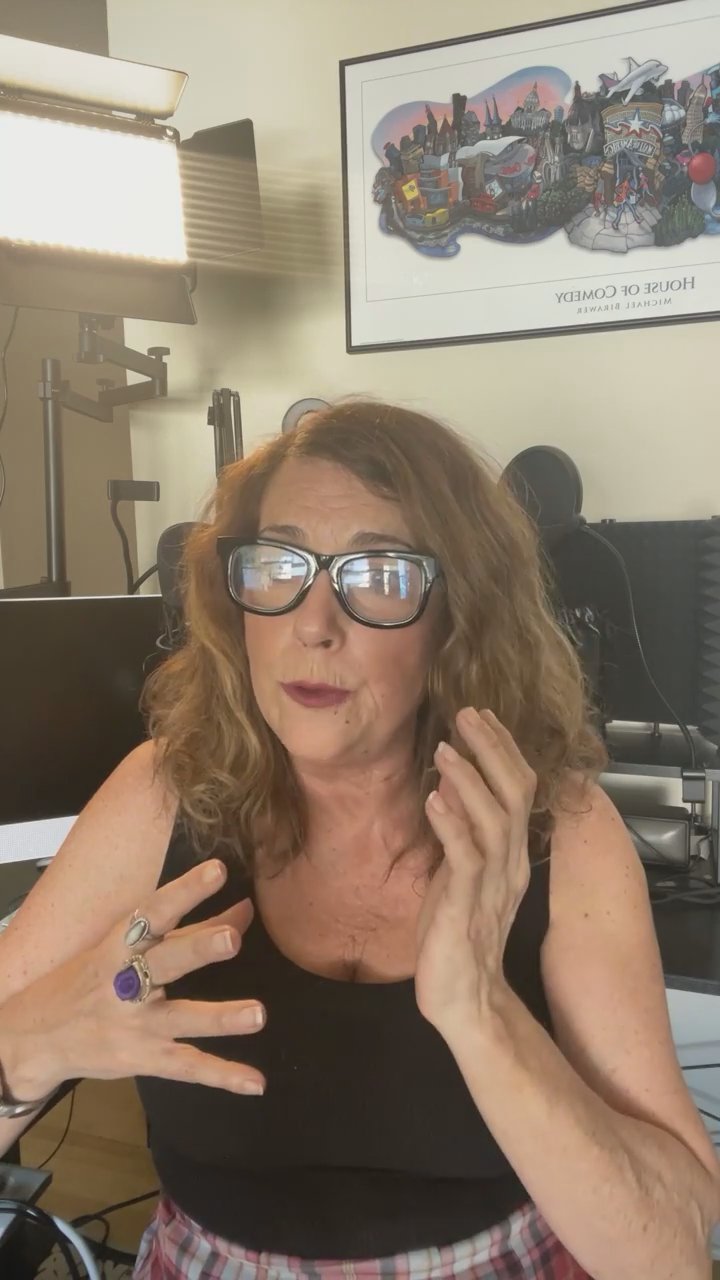
Ahhh Mother’s Day, a day set aside to celebrate the woman who gave us life. Somehow, it also became a day to celebrate “Mommy Wine Culture”? Comedy Centered is a half-hour topic + share meet up for the sober and sober curious communities.
Tiffany Norton: Happy Mother's Day. I got to spend some time with my mother today on Mother's day. My son was not able to be with us, and honestly, that's on me a bit. Trying to think of what we should call ourselves on this app.
The concept of mommy wine culture is a play on mother's little helper from the Rolling Stones. What I want to talk about is the social dynamic where we kind of enable each other through this idea that we're just bonding.
Motherhood is really tough. Maybe instead of us getting together over a glass of wine to discuss all of our stressful things, maybe pick a ball. Alcohol is a very, very effective analgesic. I share these personal experiences from my life in the hopes that it will at least make someone feel a little bit more at ease.
So I'm gonna keep this one short tonight. I hope you are feeling well wherever this message finds you. All right, happy Mother's Day, and we'll see you next week. We'll have a fun topic next time.
Hey, everybody, this is Tiffany Norton. How are you? Happy Mother's Day. Comedy centered. Welcome, welcome. I was trying to think of what we should call ourselves on this app. Maybe there's already a name, and I'm just not hip to the lingo yet, but Cod rights cadreans, Cadre codredites, I'm not sure. Oh, welcome. Hey, Philip, how are you? Happy Mother's Day. If you celebrated today. I got to spend some time with my mother today on Mother's day, which was fab. My mother is a retired school teacher.
Kathy is. I don't, you know, she doesn't like her age, age, being out there like that, but octogenarian. And, yeah, we had lunch, and it was nice, but it was kind of a bit bittersweet. My son was not able to be with us, and honestly, that's on me a bit, and I've got to be, you know, fourth rate about that. Which kind of brings us to our topic of mommy wine culture. Isn't that interesting that, like, something so innocent. And I remember this idea kind of popping up, like, I would say early two thousands or something like that.
Like, you know, the idea that, you know, you would bring wine to a birthday party, let's just say. Or a kid's party, or you would bring, you know, something to, like a softball game or something like that. And then everybody would buy, like, a cute little gift, like, you know, I remember one year, a friend of mine bought me a pair of socks that said on the bottom of the socks, if you can read this, then I need more wine, you know. And at the time, I really chuckled about it, and I thought it was kind of cute.
I wasn't gonna wear the socks necessarily, of course, but, you know, I chuckled at the idea. And then there were other gifts I got from my friends, like, oversized wine glasses, like this large, you know, and then ones that would say, I would see my friends with ones that would be like, mommy's juice. Or, you know, and I even remember, not that this is mommy wine culture, but I remember my grandfather always calling it his medicine when he was drinking his wine in the afternoon and the evening. Right.
So this it. I went on kind of a deep dive about where do we even come up with, like, this concept of mommy culture? Like, where. Right. Well, if anybody's a Rolling Stones fan, I. All I could kind of find online is that it is a. You know, it's basically a play on mother's little helper, if we remember that song from the Rolling Stones. Right. I know that's the lyric in, and whether that's the actual name of the song. It was, like, the seventies and the sixties when everybody just named things, things that didn't.
That weren't in this song, like cashmere or whatever. So. But it's the idea that motherhood is so difficult that you need some kind of chemical to kind of relieve the stress. And they might not be wrong, right? In some instances, you know, but it's this idea that over drinking is okay, responsible use of alcohol is fine. That's not what we're talking about. What I want to talk about is the social dynamic where we kind of enable each other through this idea that we're just, you know, we're bonding.
It's a social thing. And that's the part that's kind of narrow and, like. Like, not narrow, but hard to. Hard to pin down, because we. I remember being a young mother. I desperately needed other mom friends around me. You know, I desperately wanted to have someone validate that I wasn't doing a terrible job and ask all the questions and not feel, you know, like an outsider. And so when that was what everybody was doing and everywhere you went, then you just like, well, obviously, I'll bring some wine to contribute to the party.
I don't want to be like, you know, lame. And it became not just kind of a one off, though. Like, it was happening all the time. And. And, you know, it was kind of that slide. And I'm not saying that we should. That there's a stigma or there should be, you know, stigma around drinking or anything like that. I think we can all stumble into and out of unhealthy relationships at times with our drinking in life. You know what I mean? You go through a period, you're like. And some people are maybe more wired, like myself, where I have to abstain.
I have to fully abstain, you know, but this idea that it's just such a struggle to be a mom and to get through the day without wine. Well, you know, in our talks about stuff, you know, alcohol and alcohol abuse disorder, I try not to. I try to stay away from isms in general. Right. According to a lot of the research from Gabor mate, who is a, you know, a psychiatrist, he's done work and trauma for 40 years. I don't know him. I just read all of his stuff, and I think he's wonderful, and I think everybody should read it for themselves.
One of them, his most recent book, is the myth of normal. I get no plug or pay for paper play or plug, whatever that. But there's this idea that, like, maybe this drinking just kind of came out of nowhere. Like, why did all that. Why did that pop up? I haven't had a drinking problem before. I have a drink in excess. A lot of people said, like, COVID really kind of ticked it, right? So the idea behind why we overuse something, and it doesn't have to be necessarily, oh, hey, Jules. It doesn't. Thanks for joining.
It doesn't necessarily have to be overuse of a chemical like alcohol or it could be shopping. It could be, you know, whatever, you know, kind of a deal. But trauma, according to Gabor, mate. And when we're. When we're not dealing with something that is very tense and very emotionally fraught for us, such as motherhood can be right. Sometimes these overuses, these periods of overuse are actually an attempt to solve a problem. You're feeling so much internal anxiety. Evening. Oh, happy Mother's Day.
If you celebrate and hope it was, well. And hopefully, you know, I don't want to also to like and say happy Mother's Day to everybody just to see, you know, because sometimes people's moms aren't with or it's in a strange relationship. So not, not Mother's Day isn't necessarily always joyful for everybody. But. But, you know, if there's too much tension in your life or too much tension in your relationship or you're going through a period of extreme change and growth, and maybe some doubt that that overuse may be your way of trying to overcome that problem, and it is not a moral failing on your part.
It is not you being a bad mom. It is not you being a bad person. But let's be honest, alcohol is a very, very effective analgesic. Most of your problems will feel better after a glass of wine, right? But then not so much, at least for me. And I can't speak for others, you know, but I was. I was. I was always kind of a go a little too hard kind of a girl anyway, but this idea of the mommy, the mommy wine culture. So how can we kind of talk about that in a way that's not shameful? Because I don't like to shame people.
I don't think my journey's my journey. And if there had been a way to just moderate myself out of this situation and pull myself out of that nosedive, I try, you know, so that's my path. That's my neural pathway. Excuse me. The allergies are getting to me a little bit, but how can we break that? And how can we introduce a concept of, you know what? Motherhood is really tough. Maybe instead of us getting together over a glass of wine to discuss all of our stressful things, maybe pick a ball, maybe something, maybe the park and things like that.
Because what I notice, and I've seen myself and my friends, you know, go through this, you know, there's that period of time when your children are so young and you don't know what's ahead of them or for them. For you, you've got this marriage that's probably maybe newish as well, because the children are young. Not always, right? And then the bills and then just, like, getting them to daycare and getting all that stuff. So when you get home, you feel like, whoa, finish line. I made it. You know, I used to hear, I don't know the name of the sign, but I used to hear it in my head when I would start getting my car in the morning.
Like, how am I gonna make all of this happen? And that's the thing, because that glass of wine is. It is a very, very effective analgesic. Alcohol gives us tons of wonderful dopamine. It makes us feel very relaxed. It's very effective. And it's, like, one of the most effective and easily accessible. And, you know, and it works fast, right? It's not slow acting. And so that's where. When the culture kind of mirrors what your experience is now, you kind of get into a situation where you can use that culture in these little parties and stuff to kind of justify it.
At least I did. I don't want to project on anybody, but I used it a bit as an excuse. Well, it's like, well, it's 05:00 somewhere. That old Jimmy Buffett song. Or, you know, it's wine, wine o'clock or, oh, my God, after this day. Or, you know, and, you know, what used to be maybe going out for a happy hour with the girlfriends for wine once a month was turning into once a week, sometimes twice, you know, and then, you know, too much. Right. Box wine. So this isn't. This is a open. It's a topic plus share.
And I think it might, you know, I know that this is not something that I'm kind of, like, opening up as far as, like, a. Like, a real juicy topic for everybody to chime in on. But I will say this. I share these personal experiences from my life in the hopes that it will at least make someone feel a little bit more at ease, maybe with starting the conversation, if they feel that maybe the use of alcohol has become intrusive, because I will tell you right now, on Mother's Day, my biggest regret, um, is that I wasn't a better mom to my son, and I could have been more present.
I was tuned out for a lot of it. A lot of it do with a lot of unprocessed stuff on my own. Nothing that my child did. In fact, actually, my child was quite easy. I have very few problems with my child, you know? Um, but that's the work I have to do, you know, I have to grow, so. And, you know, admitting stuff isn't easy, so. But if I can do it, you can do it. So I'm gonna keep this one short tonight. I know everybody's very busy, and at least in the midwest, it is fantastically gorgeous, and I'm sure everybody's got brats on the grill.
I hope you are feeling well wherever this message finds you. And I'm blessed to have been welcomed in this Cadre family and super excited to be here. And you guys mean as much to me. I need this for my accountability, you know, so. Oh, my God. Thank you, Jules. All right, happy Mother's Day, and we'll see you next week. I'll figure out what. We'll have a fun topic next time.
Reactions and comments are for members. Joining is free and takes a minute.