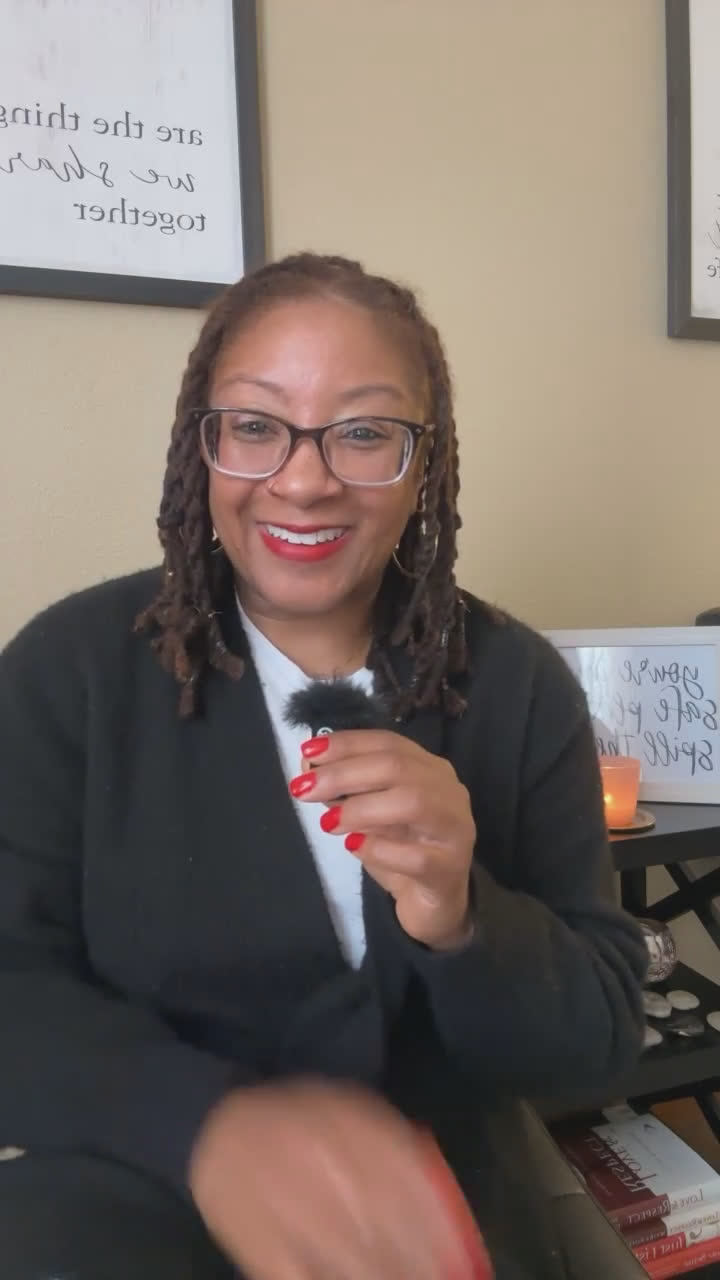
Do you struggle to communicate your boundaries? Let’s talk about it
It's been raining here the last few days, like, off and on, just kind of sprinkling. I don't have coffee today. I have some mint tea. Just because I want to try something different.
Today we're going to talk about boundaries. Sometimes we don't implement boundaries until someone has crossed our boundary. When there's violence in the relationship, it may not be safe to speak up about your boundary. And so sometimes the boundaries are implemented with silence.
When we communicate with silence, when we just kind of shut down and don't respond. In order to fix that, you have to clearly communicate what your boundary is and what you plan to do if someone crosses your boundary.
Some clients that I work with struggle to keep the boundaries. Until we take action to show them that this is enough, then sometimes it just never changes. It is tricky to implement healthy boundaries. If you don't know how to navigate that, that's what HR is for.
So I do want to thank you all for chiming in today. I might revisit this topic of boundaries in a different way. There's so many types of boundaries that we don't recognize that are boundaries. So if this is something you're interested in, please let me know.
Hey, Cadre. What's up? It's a beautiful day. I like it because it's cloudy and I like the rain. It's been raining here the last few days, like, off and on, just kind of sprinkling, but I'm enjoying it. I don't have coffee today. I have tea. I have some mint tea. Just because I want to try something different, I'm taking a little sip. Hold on. So today we're going to talk about boundaries. It's one of my favorite things to talk about besides attachment and all those other things. Hey, Jules. I do want to give this disclaimer today that I will highlight a little bit about domestic violence.
So if that is a trigger for you, please keep that in mind. Feel free to jump out of the chat if you need to or listen to it later when you're in a safe space and a comfortable space. But I want to talk about boundaries and how to communicate them and when to communicate them. So if any of you know about Cadre, when we got together, there's a few of us. It was Doctor Charisse, Rachel, JC, and Luke. We met in Charlotte back in March. It feels like it was so long ago, but I did give a presentation about boundaries and how to communicate them, and boundaries is a hot topic.
A lot of people are talking about that in different relationships, and there's so many new books that have come out about boundaries. And I've worked with clients I still do today that struggle to implement boundaries because of their safety. So maybe they're in a partnership that has some violence or there's mental abuse or verbal abuse going on, and it's tricky to navigate, you know, when should you implement the boundary? And my first instinct when I think about that, when should you implement boundaries?
Is from the very beginning of your relationship. But when you stop and think about, how does that work? Sometimes we don't implement boundaries until we notice that we need to. Hey, there. And sometimes that doesn't happen until someone has crossed our boundary. So we may not speak up about the fact that we have a boundary or what the boundary is until someone has crossed it. I can give you an example of what that looks like. So let's say. I like to use the boundary of time. Let's say, for example, the person that you're dating.
It's a new relationship. They call you after a certain time where you might have this standard for yourself that you don't want to talk to anyone that you're starting to get to know after 10:00 and they call you ten o, 110 30, they may not know that that boundary existed unless you told them that. So once they've crossed your boundary, you might notice that you feel something about that. And so you speak up about that, and hopefully that partner recognizes that's something they need to work with, and so they support your boundary.
Right. But then there are times when we engage in emotional abuse where we don't notice that there's a boundary for different reasons. So if you think about emotional abuse and mental abuse, sometimes it's happening to us when we don't recognize it. Or maybe we've seen it so much in our family or previous relationships that when it's happening, it feels normal, it feels familiar. And so we don't know when to speak up about that because we expect that behavior from our partners. So if someone is yelling at you or cursing at you or maybe they don't keep their promises, that's something that you might expect because you've experienced it before, and so you may not speak up about that boundary, that they shouldn't hurt you in that way until it becomes too much.
Now, let's enter the space of physical violence. When someone hurts you physically, that should be a clear boundary that they shouldn't do that. But again, if you've had experience with violence in your past, maybe you witnessed it with family members. You grew up in a household where there's violence. It may not seem like that's a boundary that should be in place because it's expected behavior. Violence could be shown, and we distort what that means. If we've experienced that in the past where no one has told us that that's wrong.
And so if we experience violence in the relationship, it may feel familiar, it may feel appropriate if someone is being aggressive towards us or experiencing jealousy because of something we've done. And so instead of us recognizing that that's what it is, we accept that behavior and we don't speak up. But then if the violence continues, so there is a cycle of violence, which I can get into another day, but if that violence continues and there's repetition, there's a pattern there, and you start to notice that pattern, and it starts to feel worse every time it happens, and it's happening more frequently.
When do you speak up about that boundary? Well, it can get tricky. When there's violence in the relationship, it may not be safe to speak up about your boundary. It may not be the wisest thing to do that. And so sometimes the boundaries are implemented with silence. When you stop talking, a person may change their behavior. When you stop responding to them, crossing your boundary, that might change your behavior, but sometimes it doesn't. And sometimes you have to call on others for help. Maybe your boundary comes in place when there's violence by developing a safety plan.
Maybe that involves talking to another agency to help you figure out, how do I do that? Or maybe you have to involve a family member or a friend to support you in setting a boundary. But the timing of that is very tricky. If you set a boundary with someone who has been violent with you, that might make them a little more angry, more aggressive, and so that will actually have the worst result and the opposite of what you want. And so they get more violent with you because you stood up for yourself.
So I don't want you to think this is your situation. It doesn't mean that, because if someone responds to your boundary with violence, that you shouldn't put up a boundary. In fact, that means that there is a clear need for a boundary, because no one deserves to be hurt in a physical way. We don't deserve to be hurt in any way, but physically, we don't deserve that. And if that's your situation, I do want you to know that that's not okay. That is toxic. I will call that out for you. It's toxic, and I hope that you're able to get to a safe space where you can feel safe again and implement boundaries in a healthy way.
But let's talk about boundaries and setting them with silence. That can happen with friendships, too. Where someone hurts you, they might say something, and you respond with silence. You ghost them, or you don't respond to their texts for hours. That might communicate something to the other person. But the problem with the silence as a way to communicate a boundary is it leaves things unclear. When we communicate with silence, when we just kind of shut down and don't respond. And we're doing that intentionally to let somebody know that they've hurt us.
It doesn't let them know how to change their behavior. It just lets them know, like, that wasn't okay. They didn't like that. But how do you fix it? And so in order to fix that, you have to clearly communicate what your boundary is and what you plan to do if someone crosses your boundary. I think there's other situations I'm thinking about some of the clients that I work with that struggle to keep the boundaries. So you may be in a place where you're able to say what your boundary is, but you might struggle to maintain this boundary.
So there's a lot of relationships that I've been working with that there might be a boundary of, let's say one partner doesn't like dog hair, and they get a dog that just, you know, sheds dog hair everywhere. And so there might be a boundary in place. Like, well, let's not have the dog on the sofa, but instead, what do they do? They let the dog on the sofa all the time. And so that becomes a of irritant to the other partner. And that person keeps crossing the boundary by letting the dog get on the sofa and not cleaning up after that dog.
And so what do you do? Do you just let that continue, or do you do something about that? And at what point do you decide, I've had enough. So we can implement boundaries. We can talk about them all day. We can remind the person, this is a boundary. But until we take action to show them that this is enough, then sometimes it just never changes. Workplace boundaries. Let's talk about that. I have a great example about a workplace boundary. So I don't know if you guys have ever experienced this where people eat your food.
Like, if you bring something to work and it's not labeled, and people just think they can just take what they want. So let me tell you, someone took my coffee creamer one time, and I got up. I was disappointed because I was waiting all day to have that nice cup of coffee in the afternoon. I saved that coffee creamer. I brought it from home. It was. I think it was like a white mocha from Starbucks. You know, it cost a lot, so I couldn't wait to have it. And one of my coworkers used my coffee creamer.
Okay. Messed me up. But here's the problem. Not once did I say, that's my coffee creamer. I don't want anyone to use it. Or if you do use it, please ask me. I never said that, but I got offended. I got upset because how dare she use my coffee creamer and not ask me. So, in my household, we ask permission before we take something from the refrigerator that doesn't have a name on it. Right? But not everybody lives that way. So my coworker may have had this bad boundary or not known that there was a boundary because she doesn't operate the same way.
Yeah. So what I had to do was I started labeling my coffee creamer. I put my name real big, like, this is my coffee creamer. But you know what? She still drank my coffee creamer. So I had to implement a stronger boundary. I thought I did right the first time, and I had to have a conversation with her and say, hey, you know what, I would really appreciate it. First, if you just don't touch my food. But second, if you want some, just ask me. And that's not a problem. And I think it got resolved after that.
But there's some other things that she did to annoy me at work, in our workspace that we shared together. But I had to be very strict with her. So if I just responded with silence, nothing was ever going to change in that situation. So it's hard sometimes, especially with, I would say with co workers, you don't want to say anything offensive to someone, you don't want to say the wrong thing, and then they report you to HR, whatever the situation is. So it is tricky to implement healthy boundaries.
But when I think about the workspace and boundaries, sometimes you just have to go to what is your work policy about certain things. What does your employee handbook say? And if you don't know how to navigate that, that's what HR is for. You can contact them or your supervisor if you feel safe with that. So I do want to thank you all for chiming in today. I might revisit this topic of boundaries in a different way because I think it's so important that we navigate boundaries and even know what a boundary is.
There's so many types of boundaries that we don't recognize that are boundaries, and we don't recognize how to communicate them. So if this is something you're interested in, please let me know. But I hope you guys have a great day. I'm going to grab my tea today, but y'all make sure you get your coffee.
Reactions and comments are for members. Joining is free and takes a minute.