You are probably familiar with conscious uncoupling, but there’s a lot to be said about conscious coupling. Just because you’re married doesn’t mean that you’re doing it consciously. I’ve been married for 20 years and I’ve learned a lot from the mistakes I’ve made and the mistakes that we’ve made. That’s what I’ll be sharing about every third week. See you there!
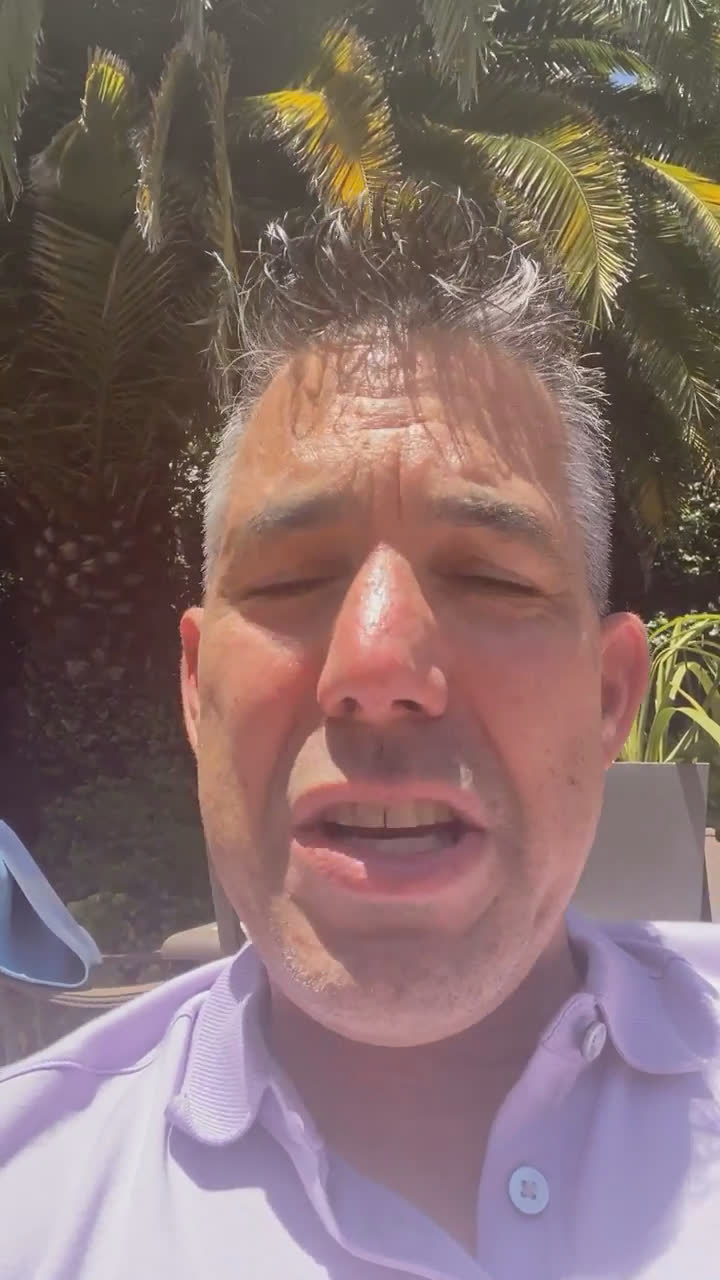
All right. It is a beautiful, sunny day here in southern California. Although I'm, I tried to get out of the sun, but the sun is, it's everywhere. So welcome.
This week's theme is conscious coupling. How do we bring the work that we're doing through forum, like Cadre, our personal work, twelve step community, other communities of growth and transformation into our relationships. The mistakes that we make that guide us toward our better selves.
Each week, I'm gonna present probably a different lesson that I've learned or a practice. The idea that relationships without conflict have no intimacy have no true intimacy. I'll be talking about every third Saturday in my conscious coupling segments.
All right. It is a beautiful, sunny day here in southern California, which is probably why if I'm squinting, that's why. Although I'm, I tried to get out of the sun, but the sun is, it's everywhere. That's a good thing. So welcome. This is my, I guess it's my fifth time, it's my 5th, 6th live stream, but it's my third as far as my weekly installments, my themes. Right? And this theme is conscious coupling. Now, if some of you are following some of my stuff, you're like, okay, so wait a second. The first week you talked about men, the second week you talked about fathers, and now you're talking about couples, like, geez, dude, like, are you just trying to, you know, dominate the market?
No, no. But what I'm talking about is how do we bring the work that we're doing through forum, like Cadre, our personal work, twelve step community, other communities of growth and transformation. How do we bring that into our relationships? Right? So what? You may be familiar with conscious uncoupling, which is a very, very powerful practice that some people developed to help people who want to divorce or end their marriages or explore ending their marriages or partnerships in a more thoughtful and healthy way.
So that's conscious uncoupling. But what I'm talking about is conscious coupling now. And some of you, you may not be like the couples folks, right? Maybe you have a different form of practicing romance and intimacy, but what I'm focused on is the more traditional coupling. But really, you can bring this awareness into any form of romance and intimacy and how you develop it. So I'm married 20 years, okay? Like, I can't believe it. And I have made so many freaking mistakes, it's ridiculous. And I think my wife would say she's made mistakes and maybe she'll come on with me sometime when I'm, when I'm doing this.
And, you know, it's the mistakes that we make that guide us toward our better selves. That's my belief. Right? In fact, I just saw a quote from Brene Brown that talked about Grace is when our mistakes become for our betterment instead of a source of shame. And I think there's some real truth to that. The idea of conscious coupling, right, is that what I learned a long time ago is that in every relationship, if it's a dyad, the mathematics is a little bit different because one plus one equals three.
So what does that mean? Well, you have the person, the other person, and the relationship. And all three of those are distinct entities. And so in my relationship, I have to do my work and my partner has to do her work, and then we have to do our work collectively. The marriage. Now if all you're ever doing is work, eh, that's probably not ideal, right? There's probably something missing in, in the marriage, in the, in the relationship. But if you're not doing any work, well, then there's probably just denial and delusion thinking that that suffices.
And, you know, look, everybody gets to do what they want to do in their relationship. But so many of us, we didn't grow up with great models for how to do this. So how are you supposed to do something you didn't learn? And so you have to learn that because not only do so many of us not learn how to do healthy intimacy and healthy patterns of relationships, we actually learned unhealthy patterns of relationships. And we actually learned unhealthy intimacy. Right. And so that's what we're going to likely bring into our relationship.
And I can tell you I was amazed at how incredibly inept I was at having a relationship despite how well I thought I was doing in my, in my life. There's a saying in the twelve step community that if you really want to know the quality of your recovery, get into a relationship. And, you know, so what I'm intending to really talk about, and hello to the folks that have, have joined what I'm intending to talk about on every third week. That's the idea, right? Every third week. Just what are some of the things that we've learned over these 20 years?
What are some of the things that I've learned? What are some observations and experience that I have? Am I a couples counselor? No, I'm not. But I've logged a lot of hours. I've read a lot of stuff, I've written a lot of stuff. I've reflected a lot. I've made, again, those mistakes that I've made, I've learned and have turned those into powerful practices. You know, one of my personal sayings is, you know, it's not about doing it perfectly. It's about doing it consciously. And what that also means is that all the imperfect things that we do lead us to greater consciousness if we're open to it.
And so that's a big part of the conversation. You know, things like, you know, there's this myth that is such a damaging myth, and that is that if you, if you have a healthy relationship, you don't have conflict where it's the exact opposite. The exact opposite. I'm not talking about yelling at each other, being disrespectful, or, you know, getting your trauma triggered and kind of having some kind of attachment reaction and then going off on your partner in some sort of way or just completely avoiding your partner.
But the idea that relationships without conflict have no intimacy have no true intimacy. And, you know, that's been a very interesting thing for me to learn, but I don't think we talk about that enough. Like, we don't embrace the conflict. The people who do are the Gottmans. If people are familiar with the Gottmans and the work that they've done, it's pretty amazing, amazing stuff. And, you know, so that's my kind of thinking that I'm gonna be doing. So each week, I'm gonna present probably a different lesson that I've learned or a practice.
And like I said in one of my live streams, a little bit, you know, my interest, quite frankly, is not in just kind of talking. I always want to give people something to practice to work on and always love when they, like, report back and share kind of what they may have gotten out of it. But it could be simple, simple things. Like, every time you see your partner for two days, every time you see your partner, like, within a span of two or 3 hours, give them some kind of affection. Just give them affection with absolutely no attachment to sex or any other thing.
Just affection. You know, those are the kind of things that I'll be sharing and that I do and that I practice and that, you know, have been transformative. Transformative to me. So, you know, all the personal work that we do, it's not that you have to be in a relationship, but if you want to be in a relationship and if it's meaningful for you, you know, to do all the work that we do, and then have the opportunity, the opportunity to bring that work into a relationship and connect with somebody in such an amazing, amazing way.
So, thanks for watching, and that's what I'll be talking about every third Saturday in my conscious coupling segments. All right, so thanks so much for watching, and.
Reactions and comments are for members. Joining is free and takes a minute.