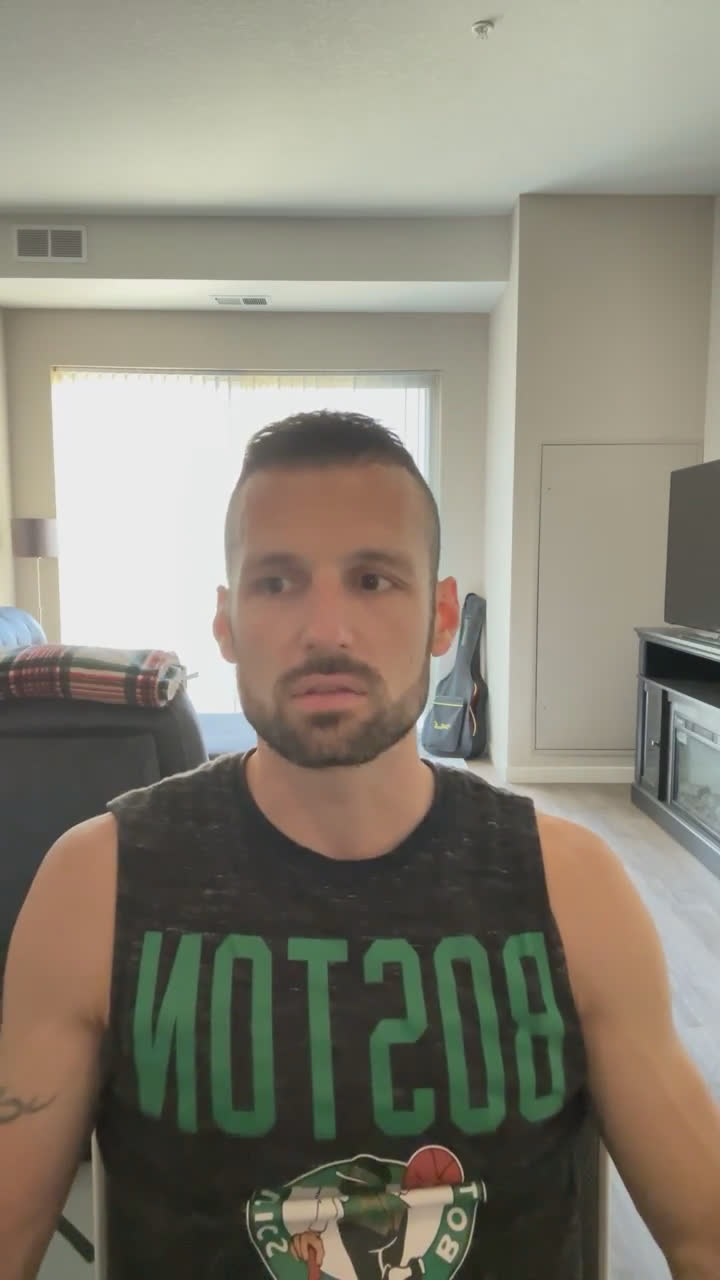
Join me every Sunday evening to set the tone for the upcoming week, with stories that bring out the serenity inside all of us!
Jason Lennox is your resident recovery champion. His Sunday Serenity series is really about how do we find things in ways and habits and practices that keep us in a space of being serene. Happy Father's Day to all the fathers.
Father's Day has not always been the greatest day for me for two reasons. I'm going to share a story with a couple lessons. Addiction can just take us in our minds to a place that we never even intended.
Jason: I need to be careful about the things that I say and the way that I look at people. He says gratitude might very well be the fastest way to forgiveness. Jason: diving into forgiveness requires much more than this video.
Gloria Borger: On Father's Day, focus on gratitude and forgiveness. She says if we look at people in a different light, forgiveness doesn't even have to happen. She suggests a list of 15 things to be grateful for. Borger says gratitude might replace forgiveness.
My life isn't perfect today with the whole father situation on either side. But you know what? I keep showing up, understanding, practicing forgiveness and expressing that gratitude even when it doesn't feel like it's possible. I hope you all have wonderful weeks.
m. my name is Jason Lennox and I am your resident recovery champion. And I'm here on my Sunday stream, which is Sunday serenity every week, usually Sunday at seven. Pushed it to eight this week as I was with family. Grateful for that opportunity and so thanks for your flexibility. You know, I'm, like I said, resident recovery champion, and my Sunday Serenity series is really about how do we find things in ways and habits and practices that keep us in a space of being serene and having peace and, you know, being aligned with who we are.
Because I believe when we're there, we're our healthiest. We don't have all those things floating around. We can sleep better, all the things. But it's especially critical for those in, you know, the recovery space because I think what, what, you know, is behind so much of the disease of addiction and even some of the mental health struggles is that lack of alignment, lack of peace, lack of serenity, and seeking something to kind of feel that. So that's who I am. That's what I'm here to talk about.
Happy Father's Day to all the fathers. Anyone who is able to celebrate their own father, be celebrated to the mothers, to everyone in between. Hopefully you got some good time today. Jules, great to see you here. Sherry, always good to see you as well. I'm grateful for all of you that stick it out and show up even when times change a little bit. So one of the things I want to talk about, you know, it's father's day today, and Father's Day has not always been the greatest day for me for two reasons.
One, I'm a father, but first, I have a father. I had a father. He passed away when I was young. I was in high school. He died from cirrhosis to the liver at 39 years young. And I didn't get to spend a lot of time with him because he really struggled with drugs and alcohol for most of his, his life, at least as long as I was alive. And, you know, that impacted me in a strong way. I just didn't have a lot of time with him. Maybe a few years when I was younger and then a little bit as I got older. But then on the flip side, being a father, I made a promise to always be there for my child so he didn't have to experience that.
And I broke that promise over and over and over because of the disease. Of addiction. And of course, I need to take responsibility for some of that. But I know that that was a disease. And I'm going to share a story with a couple lessons, and that story will really illustrate just how baffling this thing can be and how addiction can just take us in our minds to a place that we never even intended. And I've told this story before, so if you've heard this, bear with me. It's going to go a little bit of a different direction.
And again, I'm going to pull a couple lessons. But in twelve step recovery and the Alcoholics Anonymous, Narcotics Anonymous, any of the anonymous programs, one of the things, and actually in religion in general, they have what's called confession. In the twelve step program, it's called the fourth step and the fifth step. The fourth step is kind of the written material. The inventory of these are all the people that I've hurt. These are all the things I'm afraid of. These are all the people that I'm mad at.
And then the fifth step is I come to somebody and I share those things. I share my life in my deepest moments in hopes that I can be released from some of those things. And the second time through, when I was in a fifth step, it was with an older guy named Rich. He's still alive. He's been in recovery for, he's got to be close to 50 years at this point. And, you know, we sat down and we opened up my inventory that I had written out, and he said, okay, well, let's talk about who you're mad at first.
Who's on the list. Number one on my list was my father. He said, well, why are you mad at your father? Let's talk about that. Well, he wasn't here. He didn't do this. He chose drinking and drugs over his children. And then he died. And I didn't get this and that, and it impacted me in all these ways. And so I go on and on. And, you know, and then he looked at me and he knew enough about my story to know that I had actually been absent from my own son's life for quite some time, for the better part of five years, from the time he was born, one, until he was five and a half, six years old.
And so he looked me square in the face and asked me, where's your son on the list of the people you've done harm to? Let's fast forward to that. And I look on that list, and my son wasn't on there. And the point I'm illustrating there is his point was, look, you're so upset about what other people have done to you that you can't even realize that you've done the same thing. That's how sick we get. That's what addiction and drugs and alcohol can do to us. They can take us so far from reality in that I was so upset with a man who I believed chose drugs and alcohol over his own children, yet I had done the same thing, and I made every effort not to.
There was no conscious thought in my mind in those five years. That boy, my son's over here missing out on a father, and I'm just gonna, you know, continue to go down this path of partying. And so the point being, again, like, I can get so sick that I don't see that I'm doing the same thing. And the two lessons I want to pull from this, first, we have to be careful what we're, what we're, what's. What has the saying, go, don't throw stones from a glass house. And I wasn't necessarily throwing stones at my father.
But, you know, I see this all too often in life. I need to be careful about the things that I say and the way that I look at people and the way that I judge people and, you know, lack of forgiveness. Forgiveness is what I really want to pull out of this, but I need to be careful about those things, because here I turned out to be in the exact same situation that my father was and didn't even realize it and still held on to all this resentment toward him. And I give you another example. I was going through high school.
High school was. The first few years were great because I was really growing into somebody that I wanted to be. I had all the friends. And then after that, I got into some heavy drugs and methamphetamines and things like that. And then I got, you know, ridiculed and picked on, and people would slide notes and, I mean, there was always just poking fun at me being into these hard drugs. And, you know, now I've been in recovery for, you know, 13 and a half years, and I still see and interact with some of those people that I went to school with.
And, you know, now they're going through some of the same struggles. They've outlasted my struggles. And, you know, so it's my point, again, is we really need to be mindful where we're throwing stones from, because we all have glass houses, we all have things inside us, and we just really need to take a step back before we're judging people before we're coming to conclusions, before we're, you know, poking fun at others and making statements that we might regret someday. We really just need to think about the fact that we all have the glass house.
We've all got the skeletons. We've all got the things that other people could come to us about. So that's the first lesson I learned. The second was, and I'm taking this as we go here, gratitude might very well be the fastest way to forgiveness. And I want to specify something here because there are certain things in this world that happen, and there are certain actions and behaviors that happen to people that diving into forgiveness requires much more than this video. So I just want to be very clear.
There are very traumatic events that people go through. I'm just going to share something that worked for me in the situations that I was in. So, again, just be mindful of that. Don't take everything I'm saying and run with it, because I'm not a therapist, and I can't give you that level of support. But in my instance, gratitude might very well be the fastest way to forgiveness. And I also had this man, Rich, who I told you, who's been in recovery for nearly 50 years, he very eloquently articulated to me, Jason, he very.
As good and clear as anyone could have said. Maybe instead of being mad at this man, you should be thankful. And I just looked probably confused at the time. Thankful. You just listened to all the things that I said that that happened. Excuse me. And he said, but, you know, you wouldn't be here to tell me about all those things that did happen that didn't happen if this man didn't literally give you life. He brought you into this world. It took him as one half of two that got you here. And so maybe you should just be thankful that you are still here.
He's not. He doesn't have a chance to make this life right. You do. And so, again, it was this idea that maybe if I was grateful for that, I could see him in a different light. And now I can tell you, 13 years later, I celebrate my father every father's day. His birthday is just several days after father's day each year, the day that he passed away. These are all big, important days. And I think about my father. He's sitting right back here in a little candle holder, hologram type thing where I see him and I get to know, blow him that kiss that he's doing in the picture there.
So I, because of gratitude, flipped it and was able to say, you know what? I'm going to be grateful for this man and for what he gave me. And, of course, now I understand that there's no way he would have chosen drugs and alcohol over his own children. He was suffering from something that I suffered through, that I understand in a much different light. And I give you one more example, because I know that, you know, we talk about forgiveness, and it's like, if we just forgive, if we just forgive, we just need to forgive people.
That's really hard to do sometimes. And so that's why I'm trying to give these tidbits, like, maybe it's gratitude. And I know that, again, keeping in mind there are traumatic things that I'm not trying to direct you into, something that's not healthy or that's not a good idea to go into here tonight, but gratitude, you might be asking, well, what if? And I want you to just think of one person, a couple people. It doesn't have to be anything significant. Who are the people in your life, life that are, you know, causing some of that resentment, some of that replay, some of those thoughts, like, oh, I just can't get over this and try just a little bit, because, you know, finding things to be grateful for with these people is not.
It's not often easy. It just doesn't come to mind. I couldn't just think, you know, in that moment, this is what I'm grateful about in terms of my father. But I'll give you one example of the way in which I dove and dug for gratitude. I was at a treatment center, and I was given a task. It was a little sheet. It was a meditation. And the director had left on my bed and said, it said, if you make a list of 100 things you're grateful for every day until you feel a difference. And I looked at that thing and thought, this woman's nuts.
I can't think of 100 things in general. I just can't even think of 100 things that I could name, let alone 100 things to be grateful for. But you know what? Challenge accepted, because I'm not gonna fall. I'm not gonna back down. And so I sat in that room, and I'm getting to the point here. I sat in that room, and I just stared around, and I looked because I could write probably 2025 things I was grateful for in that moment. And then I got stuck, and I looked around, and I saw the toothpaste up on my dresser.
I was in a room with several other people, and then I saw the lights up top. And I realized if we didn't have those, that would be tough. And then I saw the, you know, the toothbrush and then the shampoo and the heater, and what would it be like without the sun as I see it beam through the window? Anyway, point being that if we sit and we spend a little time with it, we can think of the things that we have to be grateful for, even in the people that might not necessarily make us the happiest. And I was thinking about this on my drive home and actually trying to practice it with some of the people in my life that I feel like I might be struggling with a little bit right now.
And dang it, you know, these are people that made a real difference in my life. And when I start to view them in that light, it's almost as if forgiveness doesn't even have to happen, because I'm not looking at them in a way that makes me need to forgive. I'm looking at people in a much different way. I'm looking at them for who they are, who they were. And, you know, I still need to address some of those things and maybe some of those reasons I'm getting upset. But I'll say that again, if I can look at people in a different light and I can find the things that I need to be grateful for, I might not even need the forgiveness.
Do you get that? It was a beautiful thing as I started practicing on the way up, and I just think it's very important. So two lessons again, that come from this idea of forgiveness and Father's Day and that I've learned is one, I just need to be mindful that I have all my own stuff, and I don't know what the future holds. So I might go and condemn somebody for something today, as I did with my father, that I might very well end up doing down the road. And so I really just need to keep that in mind and remember that none of us are perfect and that we all fall down and that we need to be here for each other when we're ready to get back up.
And so that was lesson number one. And lesson number two, gratitude might be the fastest way to forgiveness. And I just said it. You maybe just had a liner, a one liner that I never thought of and wasn't planning to talk about, but it might not even be that gratitude is the easiest way to forgiveness because gratitude might replace the need to forgive. It's a beautiful way of spending it. And I hope that you've grabbed something from this and that you can take this and implement this. Truly think about a couple people in your life today that you might be struggling with even a little bit.
Put that to play. Put the pen to paper. What are the ten to 15 things you're grateful for? If it's somebody that you've had a relationship with for a while and you're in this place and things are upsetting, there must be something. There have been some things that have kept you in relationship. So hopefully you can take some of these things, put them into practice. I'm going to get running here because, you know, it's Sunday evening. Time to wind down and refresh and get ready for this beautiful week.
We're in Minnesota. We have a little bit of weather coming, I think the next few days, but summer is here. Life is good. And again, forgiveness is a big part of that. My life isn't perfect today with the whole father situation on either side. But you know what? I keep showing up, doing what I can, understanding, practicing forgiveness and expressing that gratitude even when it doesn't feel like it's possible. I spend time with it, I sit with it, and I make sure that I can write those things and I can get to those things that I am grateful for.
So I'm grateful for all of you for being here, for joining, for watching after the fact. I hope you all have wonderful weeks. And as is always the case, we'll see you next.
Reactions and comments are for members. Joining is free and takes a minute.