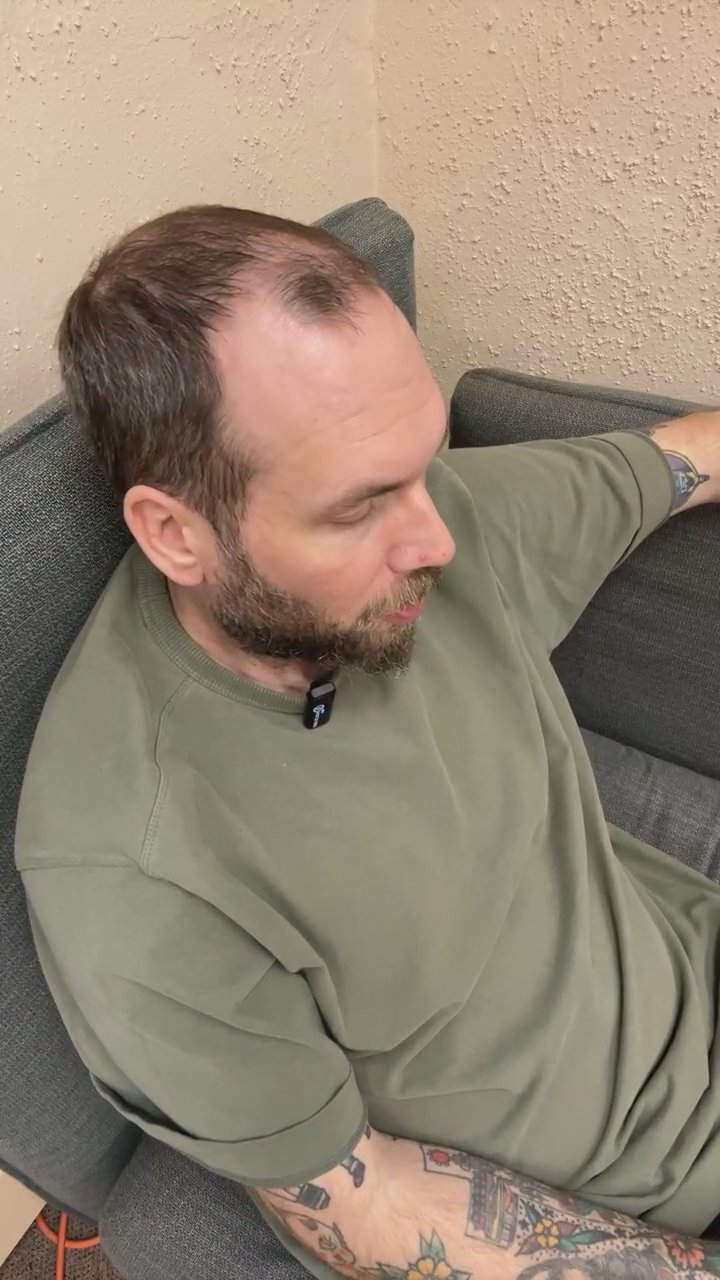
Pastor Seth Perry discusses making spiritual spaces more accessible and inclusive, shares his experience living with bipolar disorder and addiction recovery, and reflects on how personal spaces like a reading nook support changing needs.
Seth Perry: I want people to guess where I am. This is a little corner unit that I have here. It's a reading nook that has traveled with me for three moves. Perry is a pastor in addiction recovery. He says the best place for this nook is in his office.
When I grew up, there were not a lot of safe spaces, public spaces in my church. Another aspect of this is accessibility. A lot of church spaces still struggle to catch up in terms of accessibility.
There are invisible disabilities on the whole spectrum of neurodiversity and mental health. Are our spiritual spaces inclusive? The biggest thing, I think, is the education piece. Educating people that folks with other needs exist is the heaviest burden that I carry as a pastor.
Pastor: The first step has just been educating people. He says it's been 1819 months since he became public about his bipolar diagnosis. Pastor: I have to be gracious about being in a stance of constant education.
Hi, everyone. I'm gonna wait for a few people to get on, and if you didn't see my post earlier, I'm gonna let you consider and maybe, maybe guess a little bit about where I am. I posted earlier this week, so maybe if you're just watching this on replay, you could think, where am I sitting? Where is this guy at? This is a little corner unit that I have here. It is a place to sit. It's a reading nook. It's a place that's traveled with me for three moves. And here's the story behind it. This corner unit has been in my wife's office.
This corner unit has been in our living room for a while. And would you believe that this pulls out? This is just a reading hook. It pulls out into a couch. Hi, Jules. Welcome. I'm glad you're here. Good afternoon to you as well. I'm guessing. I want people to guess where I am. If you didn't see the post, Jules, I posted earlier this week, and I said where I put this new corner unit, this wonderful chair, this reading nook. Uh, so I was just saying it. It actually pulls out. So for a while there, I was using this as my primary bed because actually, interesting story.
I moved to the US from Canada, and I had to wait five and a half months for my wife, uh, to get her green card. So I ended up sleeping on this as a pull out for a while. So it's served as that purpose. Um, my wife did her morning reading and stuff, and. And, uh, had a yoga room with this for a while. And this was our guest lodging for a while as well. So, I mean, it's had many different purposes. So again, Jules, if you have a guest of where. A guess of where I am. So I was thinking today a little bit, I'll talk about having things like this that are conducive to your life as it changes.
That's where I'm going. So if you don't know about me, Seth Perry, I'm a pastor. I'm in addiction recovery. I have bipolar disorder, and I'm living in ongoing recovery. And I'm treating that from a. On a day to day basis. Always looking at where my mood is at, making sure that I'm taking my medication and that my blood levels are getting checked for my mood stabilizer. So I'm in active recovery in that way. And just making sure that I check in with my support group to make sure that I am where I need to be.
And it's. I'm never perfect, right things are never perfect in that regard. My recovery from addiction is never perfect, and bipolar recovery is certainly something that is never, ever perfect. So I guess the wait's over. I am in my office. I've just moved this into my office. Just this last week, I had a move. I moved out of a house where I was living for the last two years when I moved to the United States, and now I live in St. Paul, Minnesota. And so my wife and I downsized into a loft space.
And I'm happy about that. It's been a good move. I'm keeping my job, but I'm just commuting and living in a different spot, which meant that we had to take this out of my wife's yoga room and downsize it. And so, honestly, the best place for this reading nook was in my office. And I've used it a bunch this week. I've taken a few calls on this. I've worked on some stuff, some writing, some emails, some office work. It's nice to have a space other than my desk and other than my standing desk, which is right over there to just do stuff.
And sitting in. This has been kind of a relaxing break for me. It's added an additional aspect to my office. And so it got me thinking about how we intentionally create spaces for spiritual growth. So the antithesis anticipated. I can't speak right now. I've already done church and a sermon and every everything. So the opposite of that is like how we build spaces, how we used to build spaces that were inhospitable. I can think about ways that spaces used to be inhospitable, public spaces, but also specifically church spaces, because that's how, you know, what I focus on.
I talk about the stigma of mental health conditions as they relate to our faith communities. That's a lot of the work that I do. So I was thinking about that because when I grew up, there were not a lot of safe spaces, public spaces in my church. There were a lot of dark hallways. There were a lot of rooms that you couldn't get out of. And the serious side of this is that, you know, those are places where abuse can happen, and those are places where, you know, people feel trapped. Can feel trapped.
And a lot of corners were cut in church architecture, I think. And I think that people who came to churches suffered partially because of that. Another aspect of this is accessibility. Can you think back to churches in the eighties? Did they have elevators? Did they have ramps? Eighties and before, right, there would always be a huge flight of stairs at the front of the church. Right. So accessibility really didn't become a thing, really, until my early childhood. You know, that's when I started to realize that accessibility was.
Was an incredibly important thing. And then, you know, churches started. But even to this day, I think that a lot of church spaces still struggle to catch up in terms of accessibility. But then, on the topic of accessibility, there are invisible disabilities, which is a lot of what is talked about in the Cadre sphere. You know, things that challenge us that we don't talk about traditionally or things that, you know, bother us that really we can't really express to other people, I would say. So, invisible disabilities on the whole spectrum of neurodiversity and mental health.
So are our spiritual spaces inclusive? And again, that's the work that is getting done here on the quadra sphere. We see on the Cadre sphere a variety of inclusive voices that can talk about accessibility, that can talk about envisioning a new spiritual space that's really welcome to all people, because I'll be the first to say it, a lot of christian communities like to say all are welcome, but are we really following through on that? And I know that one of the things that I'm trying to do more as someone who's a pastor is lead with a greater awareness of inclusion, accessibility, and providing just welcoming spaces that are truly welcoming.
So what do you have to do about that? The biggest thing, I think, is the education piece. Educating people that folks with other needs exist is the heaviest burden that I carry as a pastor and a leader, because I always feel like I'm catching people up to speed and bringing people out of the past. So that's my reflection today here on this reading nook that I'll be using. And you may see me here from time to time. You know, I used to live really close to the church, so I'd pop back to my office space in my house and.
And go live from there. But I think I will be going live right here from this seat quite frequently. Now, I do want to just acknowledge that Juul has said something incredibly important as a part of this, and thanks for that note. Juul education is key, along with understanding. Yes, I mean, great point. And this is why I think that the first step that I am taking, and I have been taking since I became public about my bipolar diagnosis with my spiritual community, with myself as a pastor, the first step has just been educating people.
And you think you would be able to do that in, like, one to three months. But now here I am, you know, still, like, 1819 months after I'm still at step one. And I have to be okay that I'm at step one, that I'm working with a community that is moving the needle very slowly, and I'm trying my best to move people along. But I have to be gracious about being in a stance of constant education, answering any question, even the ones that offend and hurt me and certainly could offend and hurt new people that come into my physical space, which is the church that I welcome people into.
So, yeah, it is a journey, and it's tough. So with that, I really want to thank everybody that's tuned in. Jules, so much. Awesome, and I appreciate it. Thank you.
Reactions and comments are for members. Joining is free and takes a minute.