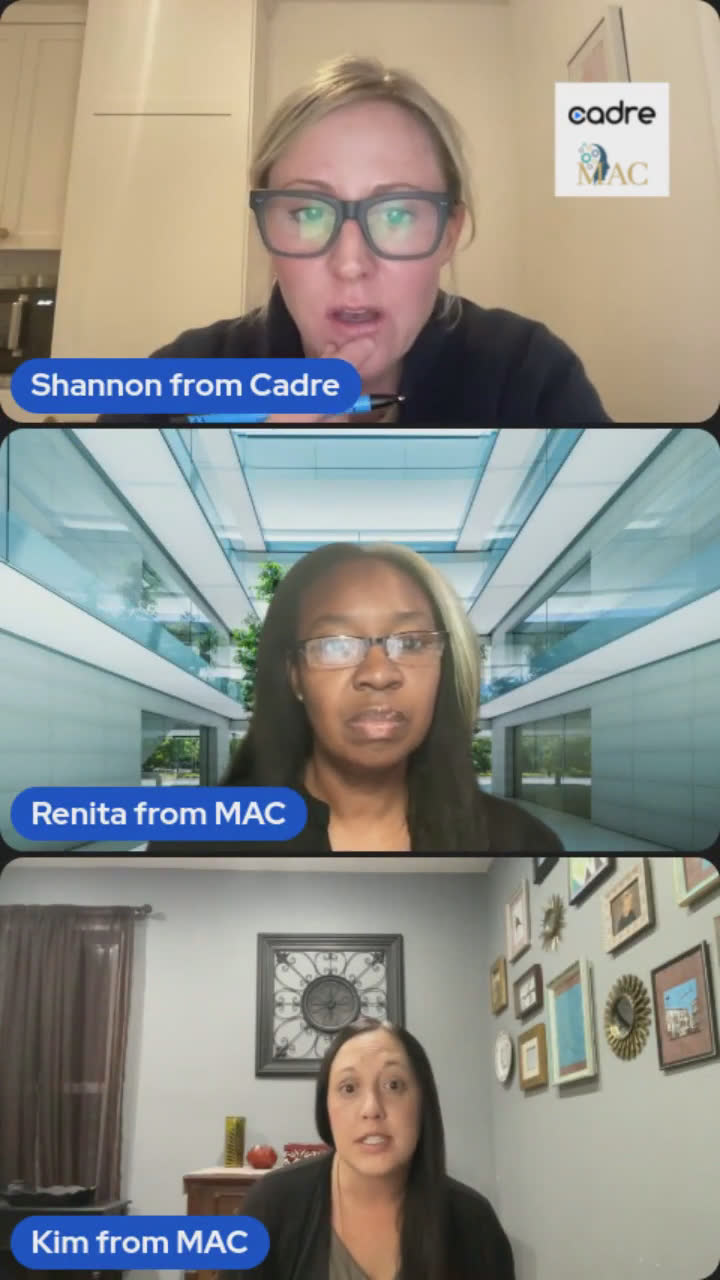
Join us for a Q&A session featuring MAC's Renita Ware, Certified Revenue Cycle Representative (CRCR) and Certified Specialist Payment & Reimbursement (CSPR) along with MAC's Kimberly Clippard, Operations Analyst. The session designed to help families navigate the complexities of covering autism-related care. Whether you're exploring private insurance or Medicaid options, our experts will break down the details and answer your questions to ensure you're equipped with the knowledge to access the support your child needs. Don't miss this opportunity to learn about available resources and how they can be leveraged to fund essential care and services!
Shannon: Happy Thursday in the Cadre sphere. We're here to talk about how do you pay for care when you are dealing with an autism diagnosis. How do you navigate the system and all the parts that go into paying for it?
Renita is the revenue cycle manager at Mac. She is also an autism mom to an awesome, awesome 31 year old autistic adult. Kim is a clinician who has worked with Mac for 11 years. Both bring different experiences to the table.
We're here to talk about all the parts that go into paying for autism. When you first get that diagnosis, number One is overcoming the shock because it's shocking. Where can we get treatment? How do I, and how do I cover treatment?
Apply for Medicaid. It's not just for low income, it's for disabled. What comes along with it is a caseworker. They can help you find resources in your community. The guidelines surrounding what kinds of plans that you can get through that will definitely vary.
When your child has been given the diagnosis of autism, find out what their insurance covers. Request a copy of the transcript from the phone call with your insurance. Make sure the benefits that they can receive are the same or that they don't change.
Mac: We're talking about all the things that people deal with when they're paying for care and how to navigate that system. Best practice is to get organized as much as you can in so much that you have. Request a transcript to have a record of what's been covered and authorized.
What are some other steps as you're starting to get services in place? Just trying to keep it organized and knowing which ones are covered for you is very important. I would say sooner rather than later.
Is there anything for parents that as they're navigating that to be cognizant of? Or do you see it as a separate system that's not tied to insurance. The educational. I mean, you know, when you're going to like a public school. It's a whole nother thing.
When you apply for Medicaid, you're assigned the caseworker with Medicaid and they're there to step you through the entire process. All insurance companies and insurance plans are going to cover different services and different amounts and different levels of services. Do parents need to be aware of anything in that journey financially with you all to transition from service to service?
Renita: Do you get annoyed when you're asked to help understand something as a person? She says she would be happy to answer any questions and help a family along that journey. Don't be afraid of the word autism, she says.
Apply for Medicaid. It's going to help with your out of pocket costs for any kind of treatment. How long does it take to go through that process? It does vary by state. You need to keep up with renewals.
Renita and Kim from Mac talk about billing, insurance and payment. When you think about the landscape of payment for paying for services and care, that is sort of something people should know. Is there anything else?
Kerry: Know CO pays, deductibles, know what they are. Renita: My son lives in a community home. It is covered by Mississippi Medicaid. Do you ever run out of money? Kerry: Can that money be used for things beyond the services themselves like housing.
Like whether it's in the school district or it's through the county or just in your community. Your pediatrician's office. Start there. Advocate and ask questions.
Apply for Medicaid. Know your insurance. Understand the words that are associated with your insurance and the implications. Don't be afraid if you get on a call with Renita or Kim to ask them a lot of questions.
Mac: Thank you guys for asking questions and for joining. I'm going to shout Mac out in the Cadre sphere. They exist to improve the lives of people living with autism. So this was so fun.
Awesome. Colleen is going to close us down here, I think. So see you in the Cadre sphere. Thank you for being here and I hope everyone has a fantastic night.
Hi, guys. Happy Thursday in the Cadre sphere. Welcome to our live Q and A here today. Oh, I think we still got our countdown going, so I don't know if they can hear us. We're just going to talk like they can. Two, one. Okay, the live is going. There we go. Okay. Hi, you guys. Happy Thursday. Welcome to the Cadresphere. Super excited tonight for a Q and a with our friends at Minnesota Autism Center. We are here tonight to talk about something that can be really confusing for people, including myself.
So we're here to talk about how do you pay for care when you are dealing with an autism diagnosis? How do you navigate the system and all the parts that go into paying for it? How do you navigate the healthcare providers? How do you navigate, you know, the different resources that are set in place for all of us when we don't. We don't have an education in doing that. So tonight I'm going to introduce. Actually, I'm going to start with introductions. I'll start with myself, Renita and Kim and that way you guys can pop in and share who you are as well.
But I am Shannon. I am part of the Cadre team. Nice to meet you all. I am not a clinician. I am not a professional, a mental health professional. I am the mother of a child with autism. I work at Cadre. I have anxiety. I have cptsd. This is how I introduce myself in all of my Cadre lives. Just to say, like, this is who I am and this is why I'm here. And I'm thrilled to be here because part of what we do at Cadre is we want to have these kinds of conversations and help people who don't have access to understand stuff.
We want to help them do that. So thrilled to be here and thrilled to welcome our friends from Minnesota Autism Center. We call it Mac. Okay, Rena, you want to. I'll make you go first since you were here first and just say who you are and if you want to tell a little bit about both your role at Mac, but also like about you as a human as much as you're willing to share. Okay. I am Renita from Mac. I am the revenue cycle manager. We deal with all the insurance aspects of autism treatment. And I am also an autism mom to an awesome, awesome 31 year old autistic adult now.
So which can we just call out for a second? That Renita definitely does not look like she has a 31 year old child. I just want to acknowledge that because I'm guessing a bunch of People will agree with that, but that's awesome. Thank you, Renina. And you're newer to Mac, right? I'm newer to Mac. I've been with Mac since early August. Beautiful. And you live in Mississippi? I live in North Mississippi. Love it. Awesome. Kim, you want to share a little bit about you? Yeah, sure. So my name is Kim.
I have actually been working with Mac for 11 years now. I do currently assist in the insurance and payment world, but I've had quite a few different roles here. And actually I've been a therapist in the past, so I kind of started out with that and I've been in, in some capacity. I've been working in the mental health field, I would say since about 2002. So. So a lot of different kind of experiences with different kind of diagnoses, but definitely very heavily experienced, more on the autism side.
And I think what's so unique, what's cool about this is that oftentimes. And I'll put on my parent hat. And so you might hear me say that during this live tonight, one of the things about Cadre is we def. We talk about people with lived experiences, and then we talked about professionals and how they both are valid. So I'm going to talk a lot from my lived experience parent hat tonight. But what I think is so cool about this conversation and why we're so excited to have you guys in particular is because you both bring those other parts of you, like, Renita, you're a mom.
Kim, you're a clinician. And so oftentimes as a parent, I feel like sometimes when you go into the healthcare providers and especially when you go into billing or when you go into insurance, you're like armoring yourself up for a hard conversation. And so I love that you guys both bring, like, I think that's what's so amazing. Okay, so let's. So knowing all of this, I think let's start tonight. So we're here to talk about all the parts that go into paying for autism. And so I wonder if one of you could start with a fundamental, like, laying the base of either I, you know, I got a diagnosis and I got it, and here I go.
I think maybe that's a great place to start. I mean, there's different parts of transition, but I mean, starting there, like, one, two, three things like, oh, my gosh, I'm overwhelmed. What do I do? And just laying that foundation would be awesome. So I don't know, Renita, if you want to do that, basically, when you first get that diagnosis, number One is overcoming the shock because it's shocking. It is. You're, you don't know what to do. So you know, you want to ask questions. Ask questions to your doctor, to counselor, to whoever.
Don't be afraid to ask questions. And then when you start discussing treatment, ask more questions. Where can we get treatment? How do I, and how do I cover treatment, of course, is the number one. And if you're covered under commercial insurance already, you know, talk to that insurance. Number one, you do want to apply for Medicaid when you get that diagnosis, but you don't want to wait to put off treatment, if you can, until that because Medicaid can be a long process. Oh, sorry. Really quick just to ground us.
So tell me about Medicaid versus private pay. So if I'm a person and maybe I have my own insurance or maybe I don't, like, can you just talk to me sort of super basic of like maybe both of those buckets, if you would. Right. So if you're, say you get the diagnosis, you, you know, everything's going along and you, you, you're, you're a working parent and you have a commercial insurance, you get that diagnosis and you're thinking, you know, what am I going to do? How am I going to pay for this treatment?
Will my insurance cover the treatment? Is usually the number one question. Contact your insurance. Yep. You can contact your doctor's office or if you get set up with the center like Mac, you center and have them contact the, you know, to see if your insurance covers it. But you are your child's biggest advocate and call that number on the back of your insurance card and ask questions, ask is their coverage for autism treatment under my current plan, you know, get the ball rolling. But by all means, please do apply for Medicaid.
Let that be your next step. Apply for Medicaid. So tell us what, and I know this is going to sound so basic, but again, this is like, my experience is like what, what is Medicaid for someone who doesn't know it's a state, it's state sponsored. Yep. Insurance plan for. And it's not just for low income, it's for disabled, which, you know, we get the autism tag and we do see that as a, I call it a different ability, but it's labeled as a disability. So you would qualify, hopefully qualify based on your state for Medicaid services.
So I think that's great because honestly I didn't know until you shared that that it wasn't based on income. I've always had that assumption that it was. So that's really good to know that it's not necessarily. Not necessarily. Not necessarily. And it definitely is going to depend on your state that you live in. The guidelines surrounding what kinds of plans that you can get through that will definitely vary. But I mean, there's. There's like a straight Medicaid and then there's also like prepaid health plans that kind of go in there, or managed care plans in some states they're called.
So there's different levels that you could qualify at. Once you do that and you apply for those things, what comes along with it is a caseworker. Yeah, that. That caseworker then not only is helping you with your insurance, but they can help you find resources in your community. So they can also, you know, say you haven't found services yet. They can help you find wait lists to get on. If they. Or providers to see that maybe are available. They can help with those kinds of things. I've also seen them help with grants potentially for, you know, sensory needs.
Sometimes. Sometimes the children have sensory needs and you can get grants for that. It's definitely going to depend on your state, what you qualify for. But those, Those caseworkers can help to be a big advocate for you and your family, also to get the resources that you need and to help connect you with the people in your community that can help you. Awesome. And you don't. And I know again, you don't pay extra for that. That's part of the system. It's just part of it. Awesome. That's amazing.
So it sounds like step one, you go through this. It is, you have insurance. Call them. Call the number on the back of the card. Start there. Is there specific language that you would recommend? Like, is there a. You would recommend people know as they go into that kind of a conversation? I would basically just mention, you know, my child has been given the diagnosis of autism. You know, what does my insurance cover as far as autism services? And when you're talking to member services, ask questions, ask them, do you cover therapy?
Do you cover home visits? Do you. What is covered? And always. And I tell people this all the time. Request a copy of the transcript from the phone call with your insurance. Oh, interesting. Okay. It was a good trick. Okay, wait, so say that one more time because I wanted. This is where the tricks. And I will say you guys, as we prepped for this call, it was so cool because I was hearing things like, from both of you, where it is like the tips and the tricks, because you Wear multiple hats, which is awesome.
So this is like insider baseball or I don't know what the right phrase is inside baseball, whatever it is. Okay, so just say that one more time, if you don't mind. Yeah. So when you call that member services number on the back of your car, you know you're connected with someone at your insurance and they're going to ask you questions to verify who you are and all this. And so at the same time you ask them information, they're recording that. And you can request a copy of that transcript be emailed to you.
That's amazing. You can go back and reference questions you ask and the answers you receive because it can be overwhelming to take in all that information and go back and read it in that transcript. You know, you may have to read it a couple of times to understand it all. Yeah, absolutely. I love that. And I think even just to think about sort of like you were saying, like what's covered, what's not covered, a home visit of this. And so almost even saying tell me the things that are the choices, like, and then being able to get that transcript and then sort of have the thing to be like, okay, you know, as you go through it, I do have a question that came in from Stephanie.
She said, when my child becomes 18, are they responsible for benefits in their own name? Do we know the answer? Again, this is going to be where that transition comes. Because if they, if the child, you know, you, your child can stay on your insurance until they're 26. Even if they're disabled, they can stay on it even longer. So the Medicaid has to. It will be in their name anytime based on a disability, it's automatically in their name. So when they 18, it just, it follows them. Perfect. I would say to that point though, once they reach the ages of like 18 or 21, you might want to check back with your insurance agency to make sure that the benefits that they can receive are the same or that they don't change.
Like sometimes there's services that are only offered up to a certain age. Got it. So that's something you'd want to verify with your insurance. That is awesome. And then to that end, I know Mac today serves people up until 21. And so when you think about again, transitions and benefits and services, et cetera, does the Medicaid. And I'm guessing the answer is yes, follows them regardless of where they receive the services. So then it's just a transition. But you may have to then reprocess all of.
If you were to get care at a different place once that child is an adult, Obviously, I'm assuming you go through that process again with that new provider. You do. And whether or not that same type of services is covered may change. So they may only qualify for it up until the age of 21. And then it's really looking at what other resources are available, what other kinds of treatment do they qualify for now, and what is the best path for my child throughout this journey. Right. And again, it varies by state.
Yeah. So it's really important to follow through your state and the guidelines because what. What's good in Minnesota may not be good here in Mississippi. As far as the coverage. Yep. That's awesome. I'm going to ask. I know, again, one thing, you know, we're talking about how. And actually, I'll just reset the stage. If anyone's joining now, we're here with Mac. We're here with Renita and Kim, who are from. I'm going to get it. Is it like it's billing and insurance? Yes. Is that the right department?
Yes. Okay, perfect. Yes. Billing and insurance, Autism center. And we're talking about all the things that people deal with when they're paying for care and sort of how to navigate that system. I know, Kim, one of the things you talked about when we were prepping for this is like a tip and a trick that you've had is that. Is that you are. And you already said this as well, like you're the biggest advocate for your person. I know you talked about an example, Kim, where sometimes they want to talk to the clinician on the phone and then the parent on the phone.
Can you talk about that a little bit? Just. I can talk about that. So there are. I mean, certain times that we're. Us as a. As a provider, we've gotten on the phone actually with member services with that parent to help navigate that phone call with them. And that was usually at the request of the parent. It was, you know, for maybe a couple different reasons, but it was a parent that would reach out and just say, you know, hey, I'm not sure what to ask my insurance company. Would you join the call with me?
And some. Some providers might not offer that, but we have offered that in the past to. To people that have asked. So I've done that quite a few times for things like finding out, yes, what are they. What services are covered for them? Are they covered for them? And also, you know, sometimes, like Renita was saying, request a transcript, because they're telling you right now that these services are covered. And so if for some reason then we start to build those services and they're coming back not covered.
You have a transcript that you had a conversation that said, and then that's where we, as a provider. So that's kind of what I did to help advocate for those families when it wasn't coming back. The right way is. Okay, let me, let's get on the phone together, let's call them together and work through this. Because I'm seeing on your, on your portal that these codes are covered and you're denying them anyways. We do have a prior auth. They shouldn't be denied. And then we can get them all reprocessed and paid the right way.
So it sounds like. So that's awesome. That's really awesome feedback. It's actually bringing me back to all the days when I was beginning to navigate this. And so I think one of the things if you were like, best practice, again for a person who started to go through this is sort of get organized as much as you can in so much that you have, you know, it's hard because like you could get a million, you know, I have my child's iep. Like, there's so many documents, right. But kind of getting organized to your point, sort of starting from the beginning to say like, okay, get those calls made, it sounds like to the, you know, to the insurer, to the, to Medicaid, to whoever's going to pay for the services, and then request transcripts of the calls to your point, to have sort of a record of what's been covered, of what's been authorized.
So you can always have that thing to go back to. What are some other steps as you're starting to get services in place? I know for us, and again, I know that this was, this is not a one size fits all question. But, you know, let's say you might have OT and speech and then you have a therapist, and then you have this and you have this. Is there a way to. And there probably isn't an answer for this. Like, is there an easy way to navigate that? Like, are there any tricks or tips that you have to just to like, organize yourself so that you're not overwhelmed by like, even if it's like bucketed by this type of provider.
And again, maybe there isn't an answer. I'm just trying to think of you live in that you guys live in that world more. And so for us on the outside, it can be pretty overwhelming. And maybe again, there isn't an answer. Maybe I'm wishing on a dream right now, but I just wanted to ask the question. I think it's really going to depend on your situation. Everybody's individual situation is going to be different there. I do think it is important to know your options, where you're talking about, do they qualify for the therapy, do they qualify for this speech, you know, that sort of thing.
Having some kind of organization where you do save things and, you know, like, in a manner that helps you, you know, whether it's in different folders or if you have, you know, if in your email, maybe you have different folders for different things where you store there and you know, where those things are. It is helpful because they are. So I mean, it's similar, but it's different. Right. Like, you're going to have a treatment plan for your, you know, ABA services, you're going to have a treatment, a progress plan for your speech services, you're going to have a progress plan for your OT services.
And then those all come with, I mean, usually like the authorization piece of it that's going to be handled by the provider. Yeah. So that's not something that you would have to keep track of. That's something that the provider will do. But I think, too. Yes. Just trying to keep it organized and, you know, knowing which ones are covered for you is very important. Mm. If you have anything to add on that one. No. As far as, you know, the clinicians go, they. They do a good job of providing, you know, answering your questions and providing you with any.
Because we got all have questions. You know, when it comes to speech, it's like, how, you know, how much speech will my child need? How beneficial will this be to their treatment? And ot Some need. Ot and, you know, how much do they need? How much can they get? Because we want them to do as much as possible. I would say sooner rather than later. Yep. Yeah. We don't want to see that process drag out. We want to get them in immediately and just, you know, push it because totally, 100%, you're like, give me everything.
Give me everything you got. Like, let's. Let's do this. And then how do you. How do you. Yeah, for sure. And then we do have a question from James, but one quick question before that is. And then when you think about all of the services received from a provider, and then also when you think about the education piece of this, is there anything for parents? Again, I'm kind of thinking of under 18s here, but is there anything for parents that as they're navigating that to be cognizant of, you know, again, each child is different.
But are there, is there any, are there any financial implications around that that either of you can think of for parents to be cognizant about? Or do you see it as a separate system that's not tied to. I feel like it's, it's potentially separate. The educational. I mean, you know, when you're going to like a public school, you have an IEP kind of thing. I mean, it's definitely separate because that's not anything that's ever going to go into insurance. Right. So it's, it's kind of like a separate whole rabbit hole to go down, I guess, with the IEPs and because, I mean, at Mac, our goal is always, you know, to, to have the children learn the skills that they need to be successful and then to transition them into the most, least intrusive environment.
Right. So we definitely work with a lot of school districts and help families go through that process where now they're going from our treatment plan, now we're going to help them get that iep. But it definitely is, it's a whole nother thing. Yep. Awesome. Okay, so we have a question from James. He says, what does a caseworker do and how can I get one? So when you apply for Medicaid, whether you make a phone call and set up an appointment or do do your application over the phone or go to your regional Medicaid office, you're assigned the caseworker with Medicaid and they're there to step you through everything that you need to.
They're with you through the entire process. So you're not left alone trying to navigate, well, what do I need to get to get my child Medicaid? They're there to help you. So you would be assigned a caseworker upon applying for Medicaid. Okay. And again, I know very state by state, but there's, there will be some sort of support system in each state that's out there. It maybe means something different, likely the states I have dealt with. Yeah. Okay, awesome. What do you think about changes over time from a financial perspective?
Working within, with insurance and the claims and all the things meaning, let's say, you know, how do you see their implications when, let's say someone goes through a treatment plan and they have OT is approved for X number of sessions and then you go through the sessions and then you transition to maybe another like a social skills group or some other service. Are there, do People, do we need to be. Do parents need to be aware of anything in that journey, that process financially with you all to transition from service to service?
Or is it like a set it and forget it? It's usually a separate. It's usually separate qualifications. Right. So, like, you qualify for so much of this. You qualify for so much of this, you know, like, so you can. Like you said, you can get X amount of hours of speech. That's not gonna. You getting OT isn't gonna change the amount of speech that you're allotted. You know, you can. You can have both. And so, like, just gradually moving to different services over time. It's just a different service that you're going to want to understand.
It's not necessarily going to affect the other ones that you're. You're getting. You're currently getting, I guess. Yep. Okay, that makes sense. Question from Amelia. Can you talk about how. Can you talk about how to help get help? Understanding why something is paid for and why something is not. That's a good question. Right. But honestly, like, I think that's. It's really important, though. It is really important. You need to know. Yeah, yeah, it's a good question. It could be somewhat difficult to answer because evaluations, once you get that initial assessment, that's going to be the basis to set up.
Speech is needed, OT is needed. So it's. It's basically, it. It's determinant on what is. What is needed. It's so hard to explain that question. Understanding why some is paid and some aren't the most needed. And every child is different. Say your child needs speech. They really, really need speech, but they're functioning where the OT level is moderate. Yep. Oh, of course your speech is going to be paid for more because that is really what they need. Yep. And vice versa, if it's with the ot. So that's kind of based on what's determined during the assessments and during the treatment.
Because with improvement, if they're improving, then less of that service will be needed. I think, too, I have a couple things to add to that. I think, too. Another piece of it is that's why it's so important to call your insurance company, because all insurance companies and insurance plans are going to cover different services and different amounts and different levels of services. So it's really important to be in contact with them and know what they cover and what they don't cover. And on top of that, it's also really important to know what is your outer pocket deductible?
So, like yes, they'll cover to a certain point. Right. But there's always that deductible component. Or do you have a co Insurance? Because those are. Those are pieces where they'll cover a certain part and then they're going to expect you, you know, to pay the rest up to a certain point like that. So it's really important to know your insurance plan when you do. You as people who work in this, like, again, you're not. Your job isn't to help people understand insurance. Right. Like, I don't think.
But do you. And you can just be as real as you want. Do you get annoyed when you're asked to help, to help understand something as a person? And like, no. No, never. I would be happy to answer any questions and help a family along that journey is my stance on it. I've done it many times when. When asked those questions. Okay. Because I feel like there is a piece of a. Like, I know again, when I was going through this or having. It's like, you know, it's not. I know it's not your job and I don't know who else to call.
Like, you know, and if I get you on the phone and you're human. I remember, I remember, you know, in the beginning just being like, who's my human? Like, okay, because, you know, you get the intake line and it wasn't a Mac. To be. To be clear. It was a long time ago. But like, I got. I never got a person and I was like, where's my person? Like, can I just have a human to tell me things that I can ask? Human questions. And again, not your jobs, but good to know that you would help, I think to that end, is there certain, like, is there certain language or like, give us like, what tips and tricks would you give people who are in that boat to.
You mean to step off? Like, if they're first time, they're like, I don't know what to do. I don't know who to ask. You're. I'm. I found you, Renita. So I'm going to corner you and ask you every single question that I'm going to, you know, get out of you. But like, what could I do to not have to corner you and ask you those questions? That's like fairly accessible. Or that would help me, like, you know, that would be like a big help to me. Like, hey, if you just knew these five words or something like that.
Okay. The language. You mean the language? Probably the language. Yeah. And just getting it, getting your grounding and like, what's going on so that we're not. Yeah. It's kind of difficult. But don't be afraid of the word autism. Okay. And I say that and people thinking, well, what do you mean by that? Yeah. And I've been around, I've been in for so many years and I've been around so many parents that as soon as they hear the word autism, they just start crying. Yeah. But it's, it's not going to change because, I mean, I get it, it's stressful.
It's you, it's the unknown. I get it. Yep. But don't just go into a panic. And I know I'm saying, how do you not go into a panic? You know, I've been there. I didn't know what that meant when I first heard it. I asked questions. It was his speech therapist. Yeah. Who, you know, introduced me and she's like, ask me questions. You know, and you want that person. It doesn't matter who. If you find a person that's willing to talk to you and willing to ask them questions until they tell you stop asking me questions.
Okay. So we're allowed to do that to you. And I would also say too, if you are, if you have a provider for any, like maybe you have a speech therapist, but you haven't yet found an OT or other therapies. Ask that speech therapist. A lot of times they might have information for you and have an understanding of some of these other services too, or they would have people that they can put you in touch with to get those questions answered for you. That's awesome. That's beautiful. Okay, we have a question from Justin.
Maybe you talked about this and I missed it, but what's the first thing I should do to begin getting a waiver? Apply for Medicaid. Okay. So I mean, apply for Medicaid is like apply for Medicaid. It's, it's going to help you so much. It's really going to help with your out of pocket costs for any kind of treatment. And at any time of the, like, any time of the, the life of the child. Like, let's say you didn't get at the beginning, you could get it later. There's no, like, there's nothing that's going to keep us from getting it.
No, I mean, if you say my child is 12 and they were diagnosed five years ago and I never applied for Medicaid, go apply tomorrow. Oh, how long does it take to go through that process? Typically, I know there's not a specific answer but short or long varies by state. Okay. It does vary by state. I would, I mean, is it like a waiting list situation? No, I probably varies by state also, but I don't think so. No, I think it's, it's more like you apply, there is processing time for them to process your application.
A lot of, I mean, I guess it in Minnesota a lot of times they'll, they'll backdate like 30 days or if you know. So there's, there's some of that, that can happen too, to back date the approval starts and stuff. But I, I know that it's going to vary by state, so I don't want to get too stuck on the Minnesota specifics, but Medicaid all day long and there's a lot of different kinds of plans. Sometimes, you know, it's not always based on income, you know, a little. We kind of talked about that earlier, you know, but it might, that income level might shift which, which product you're offered kind of thing.
Because there's different kinds of plans. But yes, knowing like going to your, your county or state, there's websites you can go to, like your county website and find resources, call them, they can help you figure out where you need to navigate to apply for that. Just to take Justin through that journey. So then you get it, you approve, you get approved. Do. Do the providers get paid directly? Do I get a check as a parent and then I pay it to them? Is that sort of like. How do you know the answer to that?
I'm not sure. It's probably. I don't know if that one varies by state, but I, in my experience, the provider just gets a. Directly from them that you just don't. It's not something that you want to deal with. So then let's say you have a commercial insurance and you're going to keep that. Right. The claims can go there first. It depends on the claims, but they can go there first. And then if you do have that deductible or that out of pocket cost, that your provider will send that to that Medicare that will cover the rest of the balance.
Oh, wow, that's amazing. So then it's not a burden on you. Does it feel from your experience like it's an easy process for people? Meaning, like sort of like once they set up Medicaid, it's fairly seamless or. I don't know if you can answer that question. It varies. Yeah, I think it probably varies by, I don't know, just education level and knowing how to keep up with things. I mean there are renewals. You need to keep up with the renewals. You're going to have to fill out the paperwork every time, otherwise there'll be a lapse.
Right, okay. So I think that's one of the biggest things that I see is people, you know, just not paying it, like, oh, I got it. And then they don't pay attention when it comes up to renewal. That packet comes in the mail. You have to fill that out. You have to get it back into your case worker. So you don't have a lapse, I guess would be the biggest thing I would see. And that's annually, Typically annually. Annually. Awesome. That's Great. Okay, it's 8:36. We have about 10 more minutes. The time I feel like flies when we do these.
Just to reset the stage, we've got Renita and Kim from Mac talking about billing, insurance and payment and all the things we need to know. Is there anything else? When you think about the landscape of payment for paying for services and care, that is sort of something people should know. So again, we know about Medicaid, we know about insurance, we know about. You know again you talked about like interacting with your insurance company, getting those transcripts to sort of document it. So systematizing it a little bit.
Are there any other like big boulders or big parts of this financial journey that we haven't talked about yet from your perspectives? I mean, CO pays, deductibles, know them, know what they are. Oh, if only we could. No services are. Have what CO pay? Because you will see there, if you go to therapy, therapists, there, there's a co. You know, if you, if you're commercial, only if you go to physical therapy, speech therapist, occupational therapy, usually commercial insurances, the therapy may have a co pay, but know this up front and this will be in your benefit booklet.
Or you can call your insurance to find out. Okay, know your CO pay, know your deductible, know your maximum out of pocket. Those are your big, not those are your big words. Know CO insurance. If there's a CO insurance. CO insurance, yeah, deductible. So it's really the basics of insurance like understand, understand what your plan is and, and what services are affected by those. Right. You might have. Maybe for the therapy services there's a ten dollar copay. Maybe for the speech therapy, the speech therapy, there's a $50 copay.
Maybe it's the same regardless of who you're seeing. But you want to, you want to make sure that you know that going in so that you yeah. So that you can budget appropriately and you know, maybe they're offering you 30 sessions but you know, your deductible is this. Your copay is this. And then you can kind of maybe you only scheduled the 10 instead of 20 or, you know, I mean, you have a little bit more control then because you know what you can afford at that point, you know. Okay. And then do you ever run out of money?
Like meaning once someone gets on Medicaid or you know, obviously the insurance piece is connected to that, the job and then 26 years old and all the things for the commercial insurance. But like as people. And you know, Renita, your son, you said is 31. Does he ever. Does anyone ever age out of that money or is it. And. And can that money be used for things beyond the services themselves like housing, etc? Is that a whole different. I'll go ahead and give a little background on my son. My son lives in a community home.
Okay. With nine other autistic males. Oh my God, that's so cool. It is covered by Mississippi Medicaid. That's amazing. Okay, so he's good to go. So it's. Yeah. The home, the staff is paid by the state. They're around the clock. Nurses, therapists. Does he love it? Beach therapist there, he's a recreational therapist. So they get out and live life on the daily. That's so cool. Behavior therapist, they're all in house. So are you an anomaly in. Or is he an anomaly to have everything covered like that from your experience where I.
In here in Mississippi, it's common. Okay. People like myself, we go out and we talk to people. Okay. We talk and we tell, you know, don't be afraid to ask for services. And that can be a, a double edged sword because you don't know what service to. To ask for starting your schools. Because I found out about his services while he was in public school. Okay. I had no idea where he would go after school when he graduated. So. So that is a piece of the financial picture. Honestly starting to understand, like what are the choices if you do that?
Conduits. What are the choices? Which ones are covered right under the plans and what kind of residential settings, you know, if that's the. That you're looking. Are these ones covered? A lot of times they're going to be right? Yeah. I mean, I'm going to speak my truth is I. My body is feeling with anxiety right now because my son in a. In a great way, I'm actually hopeful also, Renita. And we did just get a Comment from Kerry, who said, thank you, Renita, for sharing your personal experience. It was so helpful.
I am also full of hope and just like it just feels so big. Like it feels. And maybe that is just fear that manifests as parents as we get to that place where you're like, I know what to do with this. Like, I know, I know what to do. Until he hit 14, he went through puberty. He's still going through puberty, but like he settled. And I'm like, okay, new normal. And then it's like, there will be another new normal that. That happens. Yes. And then will they'll be. Will there be more new normals or okay, I think that's the human condition probably.
But this is really good to know. So to your point, like if you are in that transition piece, like, seek resources from your school. Seek resources. And it sounds like you guys are both just saying, like, advocate and like, ask questions. Advocate, ask questions. Seek people out. Like whether it's in the school district or it's through the county or just in your community. Just find out what is in your community, what kind of services are offered, you know, what, what are the waiting lists look like, how soon do I need to get on them?
You know, that kind of stuff. But yeah, advocate and ask questions. Your pediatrician's office. Yep, good source. Start there. That's amazing. Okay, so it sounds like a big takeaways actually, I'll ask you guys each before we close. But like tell me if you had to give like final parting words. And you know, I am actually a parent who's stressed about money, but pretend you're sitting with someone who's like calling you up and they're like, what do I do? Like, what would be any final parting words?
And you may have already said them, but just sort of like, hey, one or two things. I would say this to you if you haven't apply for Medicaid. That's great. That's it. That's it. I was going to say the same. I would say know your insurance that you do have. Know what it is. Know what you're covered for. Okay, so apply for Medicaid. Apply for Medicaid. Apply for Medicaid. Know your insurance. Understand the words that are associated with your insurance and the implications. I co pay, deductible, co insurance, etc.
Start to know what those mean. Like seek that information out. Know the dollars associated with it for you as a human. When you, when you apply Medicaid and you get it, renew it every year, pay attention for the renewals. Don't be afraid if you get on a call with Renita or Kim to just ask them a lot of questions. Just kidding. Questions. So many questions. But advocate, ask questions. What? I think that. Did I miss any big things? That's pretty good, right? That's pretty good. Okay, well, I just want to say thank you so much.
We had Stephanie, James, Amelia, Justin, Kerry. Thank you guys for asking questions and for joining. And thank you, Mac. As always, I will shout out. I'm going to shout Mac out in the Cadre sphere. Everyone at Mac is fantastic. They exist to improve the lives of people living with autism. And so they are doing it and they're here in this Cadre sphere tonight. I want to, you know, I know people who are part of Cadre stuff speak Wonder, Kathy Joy, Colleen, who live this. And so thank you guys for being here and being a part of this community and just.
Yeah, it's been amazing. Thank you so much for having us. So this was so fun. I was so excited to be here and I had a great time and I'm glad that people had questions that we could answer. Yes, you guys, it's amazing. And we all know to apply for Medicaid, and so that's our biggest. Awesome. All right, well, thank you, guys. Yeah. Colleen is going to close us down here, I think. So see you in the Cadre sphere. Thank you for being here and I hope everyone has a fantastic night. So bye, you guys.
Reactions and comments are for members. Joining is free and takes a minute.