Join us for a dynamic Q&A session led by MAC's Vice President of Quality and Behavior Analytics Jen Diederich, MA, BCaBA. Jen will dive into practical strategies and key resources that help individuals on the autism spectrum thrive—from early intervention and school readiness to daily living skills and vocational training.
I gotta tell you, Jen, that countdown really gets you going. Like this is a real event that is happening tonight. I was tapping away. I loved it. Okay.
Shannon: It's actually caregiver day on Cadre. I am the mother of a child with autism. Jen: We are here to do a live Q and A to talk about the fact that it's never too late to get a diagnosis of any kind.
Jen Diederich is a behavior analyst. She fell into the field after her aunt was diagnosed with autism. She says she loves people that have it and the people that take care of them. I love hearing you talk about it from the space that you come from.
Mac stands for Minnesota Autism Center. We're expanding into other states. We do compassionate aba. It's trauma informed, not trauma inducing. I always want to encourage anyone listening too, if you do need a provider, do you practice compassionate care?
This is a Q and A. And so ask us questions as we go, please. Jen is going to be much more informed on this topic than I am. But please, please ask us your specific questions about this topic.
So tonight is here. What is early intervention all the way up to transition and independent living. And then I think it will go into a good conversation of awareness versus acceptance. All mental health and behavioral health is a spectrum.
And I think to the subject tonight of like a pathway for care. Part of the challenging part is that this is a communication like it's a communication disorder. Do you have a recommendation for how parents caregivers can start to educate themselves and even if they're older?
The majority of the research started 20 years ago with early intervention. If you can get your child in before three or as young as possible, you have the best outcomes. However, the problem is there's not enough providers for the need in the world.
After diagnosis, what kinds of services might someone receive? It all depends on what your actual diagnosis would be. Googling to find out who the service providers are in your area. Use the Internet for finding resources, but never apply any of that unless it's with a provider.
A theme that needs to come out in the world that we don't talk about enough is supporting families, supporting husbands and wives, supporting partners who are, who are caring together. And so that's absolutely something I think that we should just support and, and tell people is super important.
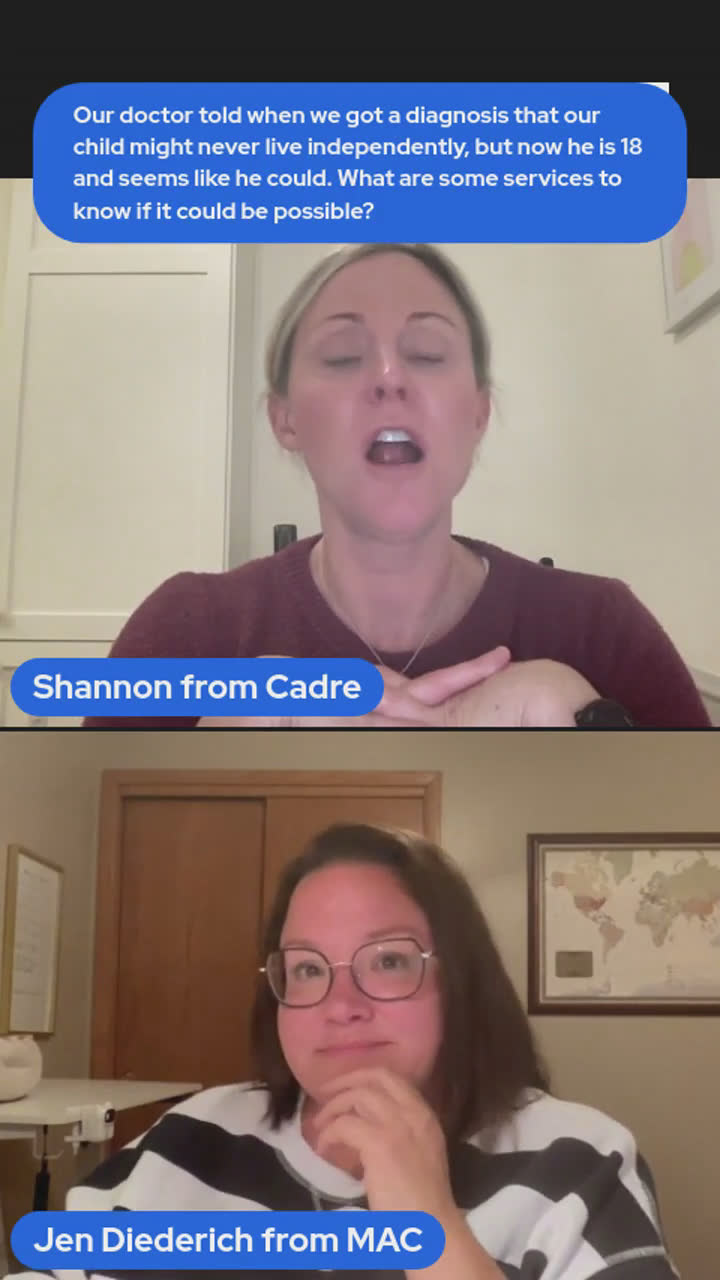
There are therapies that can help so for things like school readiness, daily living skills, and then transition living. We don't stop services at 8 years old and just leave them. There should be some transition planning. What are some services to know if it could be possible?
The sky is legitimate now. My son's 15, 16 and we're on the precipice of this. Two things. One, I think tech is amazing. That what we're going to be able to continue to do. There is also another organization local here called micc. They are building a community for people to live independently.
Mac or any autism service provider is there for behavioral and mental health services. A school is there to provide educational services. Is one better than the other or are both necessary?
Jen, we're actually at time right now. How much of your list did we actually get through? We actually got through. I want to plug to people that. have a purpose and they have a desire to be a part of the world. The world has to do better at desiring them.
One more last plug. We did cover waivers in our last Q and A. It was all about financial. How to pay for autism, essentially. Join us every Thursday on Cadre to talk about caregivers and support each other in neurodiversity and autism.
I gotta tell you, Jen, that countdown really gets you going. Like this is a real event that is happening tonight. I was tapping away. I loved it. Okay. Hi everybody. Welcome to Cadre. Welcome to Cadre at night. It's 8 o'clock Thursday, November 7th and we are here tonight at Cadre. Welcome to the Cadres Fair. I am Shannon. For those of you who don't know me, I am part of the Cadre team and we are here tonight. It's actually caregiver day on Cadre. And so on Thursdays we talk about all kinds of, all kinds of caregiving and a big part of that is caring for people who have neurodivergence and specifically autism.
So I am the mother of a child with autism. I have a 15 year old son who has autism, actually ADHD and anxiety as well. I myself also have anxiety and cptsd. So we have all the things, all the acronyms. So at Cadre, what we do is we talk about it from a peer perspective. That's me. And then we also talk about things from a professional perspective. And that's Jen. And so tonight we are here to do a live Q and A to talk about the fact that it's never too late to get supports for a diagnosis of any kind, but obviously, particularly autism, that there's always a path forward with support.
So Jen, do you want to introduce yourself and Mac and just tell us who you are before we start the. Absolutely, yes. So I'm Jen Diederich by trade, I guess by profession of bcaba, so known as, you know, a behavior analyst. But I kind of fell into this realm of autism. I've actually been in the field as of last week, 23 years. And so it was not anything that I thought in particular that I was going to do. I actually thought I was going to go into like law, immigration law to be specific. And then, you know, definitely glad that I didn't take that route.
I'm not smart enough to figure out all of those issues, but I always had an interest in it. My aunt, I was just actually thinking about it today. My aunt who's now 80 and back then we just knew her, her. Honestly, her diagnosis was mental retardation because 80 years ago they didn't have any other diagnostic tools. And so, you know, when growing up I just knew her as my Aunt Linda and that she had special needs and, and whatnot. However, now, you know, having gone back to school and making this really kind of like my, my passion project, my life project here, she absolutely has autism and is an, you know, an autistic adult, which is exciting that she now has a diagnosis that, you know, eight years ago they just, they didn't know anything.
So. Yeah, I myself am not neurodivergent. I don't have autism. But I love people that have it and I love the people that take care of people that have it. I love that. And you always have such an amazing story. Every time I hear you tell it or when I hear you tell it, I'm reminded that because you have such passion for it and oftentimes in a space like this, again I'll speak from the parent perspective. There's either a really personal connection while someone got into it, why someone got into it, or a really direct connection.
So I always love hearing you talk about it from the space that you come from and so tell us what you do. Well, tell us what Mac is. Yeah, yeah. So Mac stands for Minnesota Autism Center. Although we are, we're expanding into other states and we hire a lot of clinicians from even beyond Iowa and Wisconsin, where we're currently in, but looking into Michigan and we have clinicians also that live in California and Florida, Georgia, Texas and so kind of spread all over. But one of the great things about Mac is that we are a non profit organization and we've been around for 23 years.
I started when Mac started and we work with kids here in Minnesota, which has been our primary area for the longest time until we expanded last year. You can do services, Early Intervention Services 2 through 21 is really it. So that has been what we've done for so long. However, we are looking into getting different. There's always all these different technical licenses and everything you can get to go into advance, advanced, you know, adult services and things like that. So another really cool thing about Mac, so to speak to we provide ABA therapy.
That's our type of therapy called applied behavior analysis is our kind of main component that we do. However we do a different form of aba. Something I think it's important to talk about is that we do compassionate aba. It's trauma informed, not trauma inducing. Okay. And again we'll, we'll talk about early intervention. I mean, ABA is the most scientifically proven way, but I always think of it as like science is progressive and the way we did ABA 20 years ago should be different than how it is we do now, how we do it now.
So to that points for someone who might not know again. Right? So if someone's new to this world, just for context, just because at Cadre two, like we Want to talk about the things that people don't understand or don't talk about? Is that the way that. And to your point, which I love, again, is that science is progressive, is ABA is an approach that people took that has evolved over time and there's a negative connotation or potentially negative connotation in the way that it was practiced before.
Yeah, I think of it like chemo. Right. Like, so my mom, my mom was a nurse before she retired and she developed a lung cancer last year and she immediately was like, I am not doing chemo. Because what she remembers is taking care of patients 50 years ago that were so sick, that were ill, that died from taking from chemo, not even from what, you know, the disease that caused them to have it. And so when we talked to her, she ended up, you know, now she had two chemo sessions and a surgery. And also, thank God she's cancer free now, but she had two chemos and never got sick from it.
Right. Like, it just shows like science and the medical field and behavioral health, like everything, it's getting better. It always is. But that doesn't take away that in the past, you know, things were done that, you know, we learned from. And I think that's the thing. And the message is that what you practice today is trauma informed. And so you are very diligent and that is the intention that you have in the folks that you take care of. Yeah. And I always want to encourage anyone listening too, if you do need a provider, I think, of any kind of mental health services or behavioral health services to ask those service providers, do you practice compassionate care?
Do you practice trauma informed? And ask to see how they do that? And I think that's absolutely fair to ask any service provider to show that. What does that mean? If you had to define what that means for again, like, let's say we're applying it to just me, myself, and I don't have a neurodiverse diagnosis. What does that mean? If I were, if I were to be like, hey, do you, you know, if I ask. Yeah, I think you absolutely could just, you know, at your intake, say, just saying, like, do you comp. Do you practice compassionate ABA or do you provide trauma informed care?
And if so, tell me how you do that. Okay, so it's sort of, it's a way that they behave. It's a, it's an approach that they take. Right. It's looking at cooperation versus compliance. Right. We absolutely want, you know, the kiddos or the young adults or adults for, you know, when we get into that, we want them to engage in the therapy that we provide, but we want them to do it with cooperation. So we always, our gauge is something that's going on in the compassionate ABA field of hre, it's called, but happy, relaxed and engaged.
Right. We want that child or young adult or person to be happy, relaxed, engaged before we ever start doing therapy versus compliance, which is you will do what I say when I say it. Got it? Okay. Yes. Beautiful. Okay, so I want to set the stage for the conversation tonight also by saying, for anyone that's joining us, this is a Q and A. And so ask us questions as we go, please. That is what Jen is here for. Jen is going to be much more informed on this topic than I am. I, I tend to chime in on the parent point of view.
But please, please ask us your specific questions about this topic. And Jen, I want to just talk about this topic and could you share for us, like, how did you all come to say this is the thing we need to talk about? And like, just tell us what, tell us what people should ask questions about. Like, do you think, like, in regards to therapy or within regards to, like, trauma informed care? Just for tonight. Just for tonight. So tonight is here. We're here to talk about this. And here's why it's important.
And here's like, here's what I'm here to help you with. Yeah, awesome. So I think really starting out, love to go over and ask questions about, like, we call them therapeutic pathways. Right. What is early intervention all the way up to transition and independent living. What are your different options? And so I have some, just quick resources and little bits of information on kind of the different pathways. And then, you know, if you're looking for yourself or for, you know, maybe a child or a loved one, and you're like, well, can they just start here?
Where should I start? That kind of thing, having resources on that. And then I think it will go into a good conversation of awareness versus acceptance. And what does that mean? And not only for autism, but, you know, for any neurodivergency or behavioral health. And so I've got some cool things I think talking about with that too. So but I think starting with just kind of like those therapeutic pathways, the big things are looking at, you know. And so again, if anyone has any questions, you know, we're going to kind of COVID early intervention.
What is it? School readiness, daily living skills to transition living. So kind of the span. Beautiful. Yeah, go for it. So if you want to start, if you want to kind of start with that. What is that path for early intervention. That's awesome. And we'll pop in with questions. They come. Yep, great. Well, and I think too, I'll even back it up. Yeah. So important to understand again, autism, but also all mental health and behavioral health is a spectrum. And it's so important so many times. You know, one, one section of the spectrum might be the loudest speakers and you know, which happens in most parts of, you know, any discourse.
But I look at really autism as three spectrums. And I think if you can think of it as like this layer cake almost of these three different areas. So you have, you'll either have deficits or behavioral excesses. So you'll either do it too much or not be able to do it at all in the areas of socialization, communication, and restrictive and repetitive behaviors. And. And so again, this is why when you say you've met one person on the spectrum, you've met one person, because every kiddo, every person is so different.
And this is very similar for people that are very, you know, profoundly affected with their ADHD or, you know, you have some people that have mild anxiety to, you know, very extreme, you know, exact, you know, very, you know, intense anxiety. So is it fair to say to that end, to your point, like, liking it. So, I mean, I have general internalized anxiety disorder today. Just truthfully, today was an anxious day for me. So is it. And I know that I was more. I'm up here today right now. I'm a little calmer.
But is it fair to say that when you're thinking about your child and sort of that diagnosis, or is this a thing and sort of all of those parts as you're breaking down that cake of the different pieces, is it possible that some day, some. One day your child might show up with more exaggerated behaviors and another day the deficits might be more extreme? Like, can it follow that same sort of ragged pattern or is it going to be like a more consistent. Is it going to show more consistently for someone, for a parent.
Yeah, to get an actual diagnosis, it would be pretty consistent on where they, like, they will have, you know, great deficits maybe in communication and restrictive and repetitive behaviors, but maybe, you know, their socialization is fine. Got it. But that doesn't mean that any in any given day, much like, you know, someone that's neurotypical, they have a bad day and they all of a sudden they're not talking that day when maybe they can absolutely communicate. But like most of Us sometimes we shut down and you know, so as a loved one, I think when you're looking at this, I think it's just looking at, you know, no person is the same, no diagnosis as far as a spectrum disorder, which is what autism in particular is.
You know, so again had kiddos that they can communicate, they talk, they can communicate excellently. But you know, their restrictive repetitive behavior is so extreme that they can't leave the house, they can't actually talk to anyone because they're engaging in self injurious behavior of hitting their head. But they can talk to you while they're doing it. But you might flip that and you might have a kiddo that has no communication abilities and is doing those same behaviors. And you look at that and that's the same diagnosis.
And for autism I've specified one area of, you know, it used to be Asperger's but now high functioning autism. And those, you know, most that diagnosis tends to be deficits in socialization. So they can communicate. Their restrictive repetitive behaviors are, you know, well, really well controlled and maintained. But, and this is why suicide rates are so high. The older you get with high functioning autism them, because they know they're different but they can't, they can't be, get the friends right and they can't socialize.
And really that's, that's humans. Right, like that we create a human. Yeah. I mean I can speak again with my son again. He's in, he's a sophomore in high school and I know he's very fortunate to have, he has a group of friends. They've been together since I think like second grade. They're all on the spectrum and they've, we've been again, fortunate that they've been in the same school program and they're, they're collective. But he definitely, he has a neurotypical brother and I know he knows he's different and he'll say I'm different.
And so he does have a friend group. But to your point, it is a, it's an isolating, it's an isolating experience from what he shares with me. Absolutely. Yeah, absolutely. And you look at kiddos that or people that are profoundly affected and they don't have the awareness of the difference. And so, you know, we've had people just say parents and caregivers have been like, I think it's easier that he, he's so affected. He doesn't understand how he's different because it is, you know, each end of the spectrum deals with such different things yet it is all falls under the same umbrella.
My. I mean, I am not like a licensed psychologist, but is my deepest hope that they would actually put more labels into, you know, ASD so that it's better understood. Like, what kind of autism do I have? Because I didn't think it's. And I think to the subject tonight of like a pathway for care. I think that is so critical because I will again now I'm going to put on my caregiver hat. My parent hat. Yeah. If. If we can't articulate often again, depending on who the child is. And part of it is what their level of ability is to communicate.
And part of the challenging part is that this is a communication like it's a communication disorder. Part of it is. And you know, so if we can't advocate for them and we can't even understand how to communicate around the diagnosis or the language to even the words. Right. You're saying right now like, I know what a behavior or repetitive behavior is. My son used to stand when he was 2, he could stand at the end of the couch with his horse and go like this for five hours, five hours and not speak to anyone.
And he was happy as anything. So I know what it is from my lived experience. But to your point, someone else whose child manifests differently, like you don't know. And so with all these different definitions, as we're going out to advocate for care for our children or whoever that loved one is and getting on that path to support, do you have a recommendation for how parents caregivers can start to educate themselves and even if they're older? Because I think that's the other thing here. Sorry, it's a long, long, long narrative here.
I think there is a lot of. This is my opinion, there are a lot of resources for early intervention because we know zero to five is such a big important time. We also know that there are a lot of folks who are teens and older who are not diagnosed. And so I do wonder if it is harder to find resources and get on a path if Your child is 10, 11, 12, 13. Do you find that to be true? Right. I mean, the majority I and I often look at my own experience by this. My career is so reflective of the autism bubble, in a sense.
When I started 23 years ago and date me and I, you know, I know everyone's thinking like I was just when I was three because I'm so young. You did. Thank you. I like all I knew about autism was the movie Rain man when it came Out. And I was like, oh my gosh, like, absolutely. Right. And even now, though, that, that kind of idea persists. You don't see profoundly affected autism really represented much in television or in Hollywood. But you see Sheldon from the big bang, you see, you know, the good doctor, you know, like these absolutely, you know, cool representations of, you know, Asperger's or high functioning autism now.
But, you know, you don't really see the rest of the spectrum, which is the majority of the spectrum. And so I think as a parent and a caregiver, so important to. I mean, the nice thing is that there are so many resources out there that can help. And I definitely want to talk about each level, but. Yeah, so let's go into that. What are they? Well, I just want you. I do want to say for those younger kiddos, like, so the majority of the research started 20 years ago with, you know, early intervention.
And now those kids are starting to become that. They're 20 now they're 20 to 30. And then, you know, so. And I even think when we look at, I mean, here in Minnesota and Minnesota is so lucky in our, in the, our child health care system and the supports versus other states. So again, if you are. Oh, I think we may have lost Jen. Oh. Oh, no, there you are. You're back, you're back, you're back. We're good. Okay, good. So you're from another state. Yeah, perfect. Yeah, I'll give some resources too, but I'll, you know, come move to Minnesota.
But there, there are good resources everywhere, but sometimes it is very limited. But I really look at it like, so in Minnesota, you are from 0 to 21 great resources. The minute you turn 21, we call it a service cliff. There is nothing like you are in adult services then from 21 to 100. And that's crazy to have this part funded so well and supported so well. But then the rest of the life span is not at all. And so that's where society, legislators, you know, we've got to do better community in creating that.
But it also might mean really, you know, what does adult mean? Maybe it's even splitting the life cycle out better because there are not a lot of supports once you hit, you know, 21, which is unfortunate. Yeah. Yep. And that's probably a whole other topic we could get into deeply. Like, that's another topic. Okay, perfect. Yep. Absolutely. Absolutely. Yeah. So looking at it so early intervention, again, it is the most scientifically based. It is, you know, it's actually what the CDC recommends as treatment for autism and for other.
Any kind of, you know, developmental delay or disabilities. And it's easy. It's something, you know, I think cdc and I'm thinking like, Ebola and, you know, things like that. Not. Not. But they actually have a great, like, whole information on the CDC website. So if you go to CDC and Google CDC and early intervention, it will pop up with some early intervention. But what I also love is that per state and commonwealth, so it goes into Guam and Puerto Rico and the Virgin Islands, is a link to each state, and it will take you to kind of like their main hub to get services.
And you don't need a doctor's referral to do that or anything like that. So that part is awesome. So early intervention, if you can, you know, get your, your child in before three or as young as possible, you have the best outcomes. See significant gains in iq, communication and social interaction. And again, not just for autism, for any delay or, or, you know, developmental disability. So if it's a parent. So if someone's watching this now or later and they, again, don't know what that means, can you.
Can you articulate, like, what does it mean? And I know you're not a. I know you're not a clinician. So again, Jen is not a. I'm not a psychologist, etc. But so getting in early does what for the child? Yeah. So again, you start. You will see the most impact in the interventions being successful, meaning that they're able to gain skills in those deficit areas. And like, another good thing to think about is it's just about their neurons. Right? Like, it's. Yeah, I wish I would have been learning Spanish when I was 3 versus when I had to take it high school.
Right. Your brain is so flexible. Your neurons are so juicy in a sense. Like, they're all, like, they're firing. So you can learn things so much better in your younger years so that the data just shows how effective early intervention is. However, the problem is there's not enough providers for all the need in the world. And so people sit on waitlist. So we always say, because again, we're nonprofit. It's not about us, it's about our mission. We want every family on every waitlist they can get on because, you know, do I think we have premier services?
Absolutely. But do I think that the most important thing is that you get any kind of care? Yes. I don't want you to sit on a waitlist for our services when you could get in with someone else that will care. And we've heard everyone We've heard that from every person that's been on from Mac. You know, every Q and A we've done that's exactly the same message is get on, get on every, any, any and every wait list. You can get on, get on it. Because the faster you can get to care, the better. Yeah, absolutely.
You have a question here on the screen? I don't see it. Jen, after diagnosis, what kinds of services might someone receive? Yeah, it all depends on what your actual diagnosis would be. But again, if it was autism or related conditions, you would, you could get ABA services. ABA is also a broad spectrum. There's things called Early Start Denver Model, which is ABA and play therapy therapy kind of put together. There's the Greenspan floor play. There's. But you can get certain. You can get services meant for people with autism.
You know, if it is anxiety, you can start, you know, getting psychotherapy or talk therapy. So it all depends on what diagnose you get. But there are, you know, it also might be speech and ot. You know, you might have a speech delay. You might not need the whole range of mental health services. You might not need aba. You might just need to go and see a speech therapist for a while or in the same with occupational therapy or physical therapy. So depending on what your diagnosis is, I think going to that website or even just Googling, like whatever diagnosis you or your child or young adult gets, Googling it and saying, like, who are the service providers in my area?
But that CDC website I really like because it has the national information on it. So that's a good place to start. This is a question that's, I think, again, I'm coming from a parent point of view and I'm trying. I'm sort of like traveling back in time to the time when I got the first diagnosis because my son actually just. The ADHD diagnosis is new for us and that actually is a new set of learning. I think it's been obviously though, we're in the world now, so it's so much different from the first time around when we weren't in the world and we didn't understand anything about anything.
Yeah. And so even when you, you know, like the advice you just gave about like Google a diagnosis which is 100% true and 100% what we all do, of course, that's the first thing anyone does. Is it, is it a safe. Is it safe what's going to come up for us? Right. Yes. I would never, from Googling take any intervention approach. I would just Google to find out who the service providers are in your area. Right. Okay. And then going with people that are trusted. Things on the Internet, I think are so scary.
I mean, we've seen this in autism where, you know, people were told, take your kiddos out of all therapies and they should drink coconut water only. And just not scientifically based and, and even too, like, if you have them ingest bleach, I mean, it's just things that baffle the mind. But parents. And again, I love parents and caregivers and I feel for them. Because you are so desperate, you just want to help your kids because you love them so much that, you know, there were some that listened to that.
And even though common sense told them no bleach is so harmful, but, you know, they thought that would it. Or English isn't their first language also so hard if they think someone representing themselves as a doctor telling them to do this. Yeah. So I think it's good to use. I mean, use the Internet for finding resources, but I would never apply any of that unless it's with a provider, you know, or. I think Cadre is such a great thing too. You know, the people, the caliber of people you have on, On.
On the, in the Cadre sphere, on the tech platform, you know, it's a trusted source. Right. But I would say there's so much misinformation out there that it's so important. But another great thing is community groups for families. Right. Parents. That parents can help and support each other in a way that as a service provider, I can't. Yeah. And, you know, they're in it, feeling it. And I think that's like a diagnosis for a kiddo, I think, is obviously so vital to get the services. But parents should.
And caregivers should never forget themselves in it. And that caregiver is, you know, if your child's going to go into services, I would say you should have sister services in a sense. Like they're going to get therapy. Then you, you know, your partnership, you know, if it's not just you, but maybe someone else in that relationship with you going together. I mean, we see divorce rates for families with special needs is so high. I mean. Yeah, I mean, that's. Yeah, it happens because I think it's such a.
It's such a. It's such a fatiguing process. And I think that's the thing, like, even as you're talking about, you know, the pathway to care. And again, for someone who isn't listen or for someone who's not in this yet, and maybe they're watching this with wonder in their brain about their situation. Even just hearing all the different types of therapies and you're like, again, I'll travel back in time to like, what is speech? What is ot? What is play therapy? What is. That is so much information.
And so I do. It's such a, it's such a lift for every human involved. And. And Mac also does offer. Mac offers family therapy as well. Correct. Not to pump Mac up here, but they do offer that as a comprehensive service. Correct? You offer that? Yes. Okay. Yep. Absolutely. Yeah. If you can find an agency that provides the, maybe the main core service like we provide the ABA for the child, but then we offer family skills psychotherapy, which again, I always think is just an overwhelming term. And you know, my non clinical side is like, oh, scary word.
But really just talk therapy. But you know, it offers marriage and family therapy and social work services and case management help. And you know, there are so important. I would like shout that out. That is probably, honestly a theme that needs to come out in the world that we don't talk about enough is supporting families, supporting husbands and wives, supporting partners who are, who are caring together. Because it is a thing you don't know how to do together much. Honestly. It's the same thing as someone who receives a terminal diagnosis or anything that you start to live through as a caregiver if you don't have support in navigating that together, it's really difficult.
And so that's absolutely something I think that we, I mean, that we should just support and, and tell people is super important. Yeah, absolutely. Jen, we have a lot of question. Do you see that? And that. And actually I think that will kind of segue great into these next sections. So you have early intervention, but I never want people to feel. And this is from I again, not only scientific evidence that shows that, you know, therapies are absolutely, you know, effective for, you know, the older population.
And by older, I mean after eight years old, a lot of service providers are like, I'm gonna stop at 8 because, you know, you can't really make any gains. And that is something that, I mean, fundamentally for myself, I'm absolutely against that. But also, you know, my organization and most in the field are like, no, people can absolutely learn new things. People can change, people can grow through their entire lifespan. So we don't stop services at 8 years old and just leave them. So I think, you know, when you look at, you have early intervention, which again, awesome, because they're so Young.
But absolutely there are therapies that can help so for things like school readiness, daily living skills, and then transition living. And I think this kind of addresses the question that came into. I'm going to read it really quick, if that's okay, in case someone's listening in their car on repeat or whatever. I just want to read it out loud. So the question is, are doctors, doctor told now? Of course I don't have my glasses on. That's okay. Our doctor told us when we got a diagnosis that our child might never live independently.
Now he's 18 and it seems like he could. What are some services to know if it could be possible? That's a great question. Like, how do you know? Right? It's a, it's an awesome question and a little multifold on the answer. Right. If this child or any person is in a current service, receiving a service at the time, there should be some transition planning where that agency will work on independent living skills and be able to say, like, yep, ready to move on into this next phase? Or maybe we really need to spend more time on this.
If, you know, they're not in a specific service. Honestly, there are great resources out there. And again, it's called ADL's and so it's called Activities of Daily Living. And if you look that up, there's checklists. And what does ADL's mean? I know, I know it means Activities of Daily Living, but what's the concept mean? Yes. So it's, there's basic. So there's six basic daily living skills. That'll be dressing. I wrote them down actually, so I won't forget them all. But dressing, bathing, eating, toileting, that they can get in and out of a bed or a chair and walking, like, those are your core.
If they can do those things, you know that those are the core six ideas that you work on for like just enter anyone. Then you get more into more advanced skills such as can they finance? Do they understand budgeting, you know, financial management to some degree? Do they have med management skills? So can they take their meds on their own into like laundry and social skills? And then there's also like, can they drive? Can they not? So you know how independent they'll be. Awesome. Now that we have rideshare apps because that has opened the world for people to.
They don't need to drive to get around to make it to work and they still have special needs and, and get to work every day and not have to have a driver's license to do it to Drive a vehicle. Yep. So looking at those daily living skills or ADL's, is another way. And the nice thing is much like milestones for. For younger children, you know, walking at this age, doing this by this age, ADL's are also in there, like, to live easy, I think for parents, again, to make it really easy for the layperson just out a checklist and be like, got it, got it, got it.
Then either they work on the things that are missing, or if you are working with a service provider, be like, these are the. I want him to live independently. I would say thank you so much, doctor, for your service back then, but, you know, I see his potential and we're going to try something. Yeah. So that's your advice to this, to this question. And I think you're still right. And so it is. I love that idea of, again, it's just like not dumbing it down, but essentially, like thinking of it as the milestones you use when you, like, hang the letter, the words on the fridge, like, are they speaking?
You know, like when they're two, when they're babies and you're like, are they sitting up? Are they doing this? And it is. I love the idea, like, simplifying it to, like, all right, six ADLs. Check, check, check. Yes, no. And then finding that provider who's going to work with you, who both has the sort of, like, ethos to do it with you. Like, they have that same belief. And then also, you know, to. Yeah. To do. To do the work together. Right. And oftentimes, if you. Again, waivers are not my specialty, but most, you know, I think all the states have waiver, and most likely if you, if they were diagnosed with a disability, you were able to access waiver services.
So that way you could get a para or you can get a behavioral coach or a job coach, someone that maybe isn't with them all day long but is able to work on those skills in addition to the caregiver also, you know, you know, doing that as well. But I will say, I mean, here's a testimonial to what I saw. I'm on the board of another agency that doesn't do aba. They just, they do day services. And so their clients. It's not just about autism. It's also physical. And so they had a speaker there, and it was this woman.
I put her in, like, her 30s and she, you know, had to speak through a device and had. It was very affected with cp. And, you know, her mother was there, like, feeding her because she doesn't have access to moving a lot of her limbs and she lives independently. And I was like, how is this possible? And telling me like all. I mean, again, the smart home and the smart techniques that are coming that are helping and how the fire alarm went off in her apartment. He crawled and was able to, using these specialized tools, open this huge heavy fire door that slammed shut.
And I was just like, oh my gosh, this is amazing. It's. I don't work much in the field of CP or cerebral palsy, but just again, the sky is legitimate now. Agreed, agreed. I think the time. I think we're limited. So again, my son's 15, 16 and we're on the precipice of this. Two things. One, I think tech is amazing. That what we're going to be able to continue to do. I'll shout out Pacener center, they have some amazing tech tools there that you should check out if you're in Minnesota. Again, we're based in Minnesota.
I know everyone can be watching from other places. There is also, again, I want to shout out one other organization local here called micc. They are building a community for people to live independently. And when you're Talking about the ADLs, it was pretty cool. We went and toured for our son and it's essentially. It broke each of those down by so. And then there are supports to support each of these different levels. So I think for me again, it was the first time I was able to see and start to deconstruct how you get to independent living.
Because I think you as a parent, you kind of have to deconstruct it because otherwise it's this huge. Here. There we are. We're back. We're back. Anyway, so you have to deconstruct it. We have one more question. Yeah. What is the difference between the services or diagnosis that Mac provides? Ooh, great question. And school provided services. Is one better than the other or are both necessary? Yeah, great question. It's really two different aspects in a sense. So Mac or any autism service provider is there for behavioral and mental health services.
A school is there for educational services. So we don't teach, you know, science or math or, you know, things. We're working on the behavioral components that would really allow you to learn. And so we always say at Mac, like, we're here to create lifetime learners, not life, lifetime clients. And I think any good agency, and again, if you're looking at one for your child is one that's like our goal isn't to keep them until they max out of, you know, services until they turn 21. But as soon as they're ready to get back into the school environment, we do try to bring them into that less restrictive environment.
However, a lot of our clients are ones that they tried school and they got kicked out of school. They were unsuccessful. They just don't know how to learn in that group environment. So the hope is that Mac or any other agency would bring them in, give them the skills they need to get back into any less restrictive environment, whatever that might be. And it is usually a school, which is. And also the thing that's great about schools, why we love them here in Minnesota. I think most states have transition programming, and so in Minnesota, we have to stop serving at 21.
The school, however, has transitions, usually that goes 18 to 22, so they get almost an extra year, but they already have to be enrolled in school. And so I wouldn't say one is better than the other. I think the schools are awesome, but the schools are very limited in what they can do to address behavioral health. Yeah. And I think they're great at education skills. Yeah. And so I think maybe a reframe for parents. I'm just trying to. Again, I don't know if this is helpful, but through the caregiver lens.
Yeah. I mean, I think reframing it as. Because I actually struggled with this for. Struggled with this for a long time, too, because I'm like, well, I have speech at school and I have speech at the private agency. And I'm like, what is. What are they different? And for me, I really relied on the agency to. To your point, I. They were serving my. My child as like a human. Like his emotional self, his ability to regulate himself, like him. Himself as himself. I think when I think about him at school, it's about helping him cope at school.
So, like, speech was great to help him do better in class, like you said, or it was, but it was in service of whatever was going to happen in the classroom, not necessarily in service of, like, his greater life, Even though I know it adds value. But that's kind of how I separated in my head. So that I kind of just was like. And he definitely learns skills at school as well. But that's how I was like, okay, they're different because otherwise I got confused and I'm like. And the goals are very different.
So that's the other thing again, if someone's new to this, you do get to sit as a parent and say, all right, here's what we're trying to accomplish at school. Here's what we're trying to accomplish at the agency. And they're very different. Yeah. And again, a service agency model really is based for that, kiddo. So most ABA services are one on one. Right. Because child or young adult needs. That wasn't successful in a group setting, which is what a school is. So you're with a highly trained professional one on one, which is what you kind of want in early intervention or at the beginning of services.
But that's not life. Right. Like, we don't want them kids to become dependent on the one on one. So then we're, you know, we're able to go to a one, one therapist to two kiddos. And because again, jumping to group skills can oftentimes be way too much for some kiddos and just being able to go from one to one to one to two. So one other buddies with you learning totally. Moving to a group of 3, 4, 5. And now we're transitioning to a classroom of 18, 20 kiddos and they're able to learn in that way, which is just great.
The schools, however, unfortunately aren't set up that way oftentimes. You know, or they're with a para who I love paras 100. They are the lifeblood of the school. However, they're not trained in behavioral mental health services. Right. They still provide an amazing service. And you know, I paired for a little bit when I was in college, so I loved that too. But it is different having a, a very focused, intense like intervention versus, you know, making sure that they are having a good time, they're safe, and they're following what the teacher says a thousand percent.
Jen, we're actually at time right now. I can't. I could go on forever. We didn't even. How much of your list did we actually get through? We actually got through. We didn't focus as much on the, the transition. But again, if I can, I just, I want to plug to people that. Right? Do a plug. Do a final plug. No matter where you know, you or, you know, if it's you that has autism or is neurodivergent or really any mental health need or if it's, you know, a child or a loved one that people want to belong and they have a purpose and no matter where they fall on that spectrum, I would take the most profound kiddo I worked with.
They wanted to achieve things. They wanted to have a purpose. And I think that's what's so important to realize. Like try to not ever limit. And I love the question that the one person gave about, you know, their, I think, was their son being told he'll never live independently. And it's like, try it. Maybe he can. And maybe independence will maybe look a little bit different for him than it looks like for me. And that's okay. That is okay. They have a purpose and they have a desire to be a part of the world, and I think, you know, the world has to do better at desiring them.
And we all look differently. We're all different. We all look differently. Every single human in the world. So we are so grateful for you, truly, as our partner, but also I'm just grateful for you as a human because I love just hearing your passion and I love how you show up on Cadre and just in the world. So you're. You're awesome. We love you. Love you guys. You're awesome, too. So thankful for an app that does this. Oh, thank you. Thank you guys for joining us. One more last plug. We did cover waivers in our last Q and A, so if you go back and watch our Q and A on October, I think, was the fourth or fifth.
It was all about financial. It was how to pay for autism, essentially. So we went deep into all of it. So check that out on Cadre. Thank you guys for being here once again. I'm Shannon from Cadre. We're just thrilled you're here. You're doing a fantastic job. Thank you for joining us. We'll be here again next month and continue to join us every Thursday on Cadre when we are here in the Cadre sphere to talk about caregivers and support each other in neurodiversity and autism. All right, bye, Jen.
Thank you. Good night. Good night.
Reactions and comments are for members. Joining is free and takes a minute.