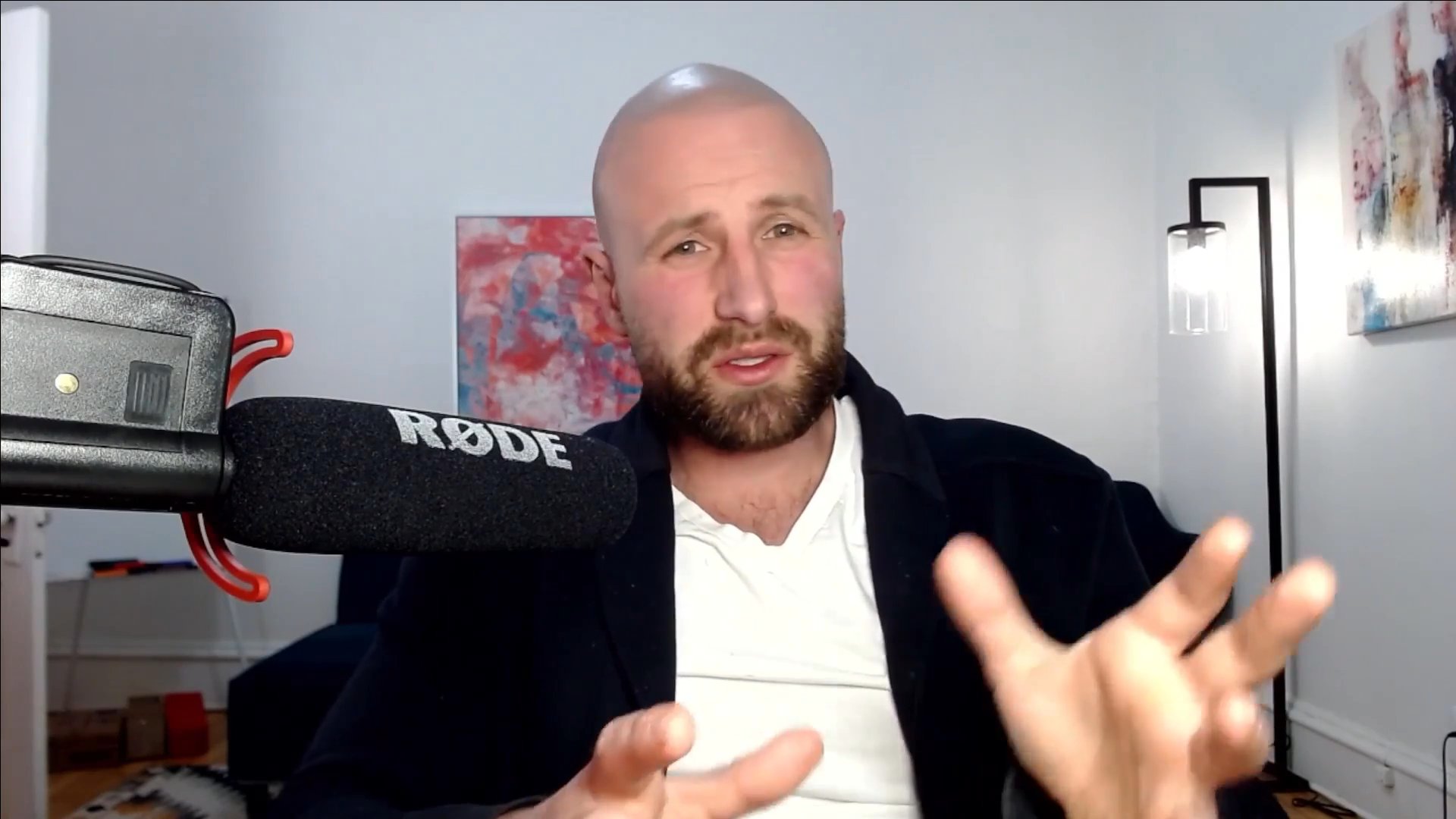
The speaker compares bipolar 1 and borderline personality disorder, explaining overlapping symptoms, distinct causes, and diagnostic context. He also offers coping suggestions for a parent, including seeking personal therapy and clinician resources.
The host welcomes viewers to his first live stream, explains the interactive mailbag approach, and sets expectations for the session. He prepares to pull up the first question to discuss.
The speaker reads Charisse's email explaining her daughter was diagnosed with bipolar 1 and borderline personality disorder and asks for guidance on coping with her own emotions. This question frames the rest of the video.
He reviews how bipolar 1 involves distinct manic/hypomanic and depressive episodes, while BPD is often trauma-related with ingrained personality patterns and high emotional reactivity. He highlights similar outward behaviors and notes the two conditions can be confused or co-occur.
The speaker cautions against seeing mental health labels as immutable, especially for younger people, and explains that clinicians treat the whole person and consider context when diagnosing. He reassures viewers that symptoms and labels can change with time and treatment.
He encourages the parent to get therapy for themselves, suggests finding clinicians who work with adolescents and adults, and mentions parent coaches and access barriers to care. The section offers practical resources and emphasizes acceptance and self-care for caregivers.
He expresses optimism for the daughter's future, affirms the parent's commitment by asking for help, thanks the audience for joining his first live, and signs off.
All right, folks, welcome to my first live stream. I'm excited to be here with you all. And I thought for my first live, what can I do? And I find that folks typically like live streams to be more interactive. There's only so many people here today. So I thought that I would go into the old mail bag. I get hundreds of emails from folks reaching out for help, asking questions, And I mean, there's only so much I could do. I can't be everyone's therapist, nor should I. Not right for everyone. But I found a question and I chose it because, hey, it's pretty recent, but also it is a question I commonly get.
And the more I do this, the more I see patterns, the more I am able to understand the needs of people when it comes to their mental health of the general public. Things I wouldn't know is just the therapist seeing people one at a time, being able to interact with a whole bunch of you. So anyway, let's dive in and I'll go ahead. We're going to pull up the first and only question for today. I was going to do 2, but I think for this one, we'll have enough to go on. So it says here, my daughter was recently diagnosed with bipolar 1 and BPD, which is borderline personality disorder.
For those of you who don't know, I need help. She's getting all the help I can get her, but I need help understanding and overcoming my own emotions. Thanks for the work you do. I hope to hear from you personally about this or through one of your live streams. Here we are. Please and thanks for being awesome and for educating me about mental health. Love forever a mom in need, Charisse. Charisse, first of all, thanks for the kind words. I really appreciate your question and I find it to be interesting for a few reasons, but let's talk about bipolar 1 and BPD, borderline personality disorder.
And I find that these two get confused quite a bit. And it's funny, I did a video on this and surprisingly, it's one of the videos I've gotten the most engagement about, which is disseminating differences between bipolar 1, BPD, and in this video also ADHD. because there's a lot of overlap. It's interesting for all those disorders, but for this, stick to bipolar 1 and BPD. The physiological phenomenon going on in the brain are quite different, yet the outward presentations, the symptom presentations are very similar.
So with bipolar 1 and bipolar disorders, the key indicator of this disorder is elevated episodes. mania or hypomania. You may be familiar with this, but it's these episodes where you have increased energy, your mind is going faster, your moods are heightened, you tend to be more impulsive, your mind's going 100 miles an hour. you're also going to have the presence of a depressive episode. So that's what differentiates it from depression. You kind of have both, right? Hence bipolar, used to be called manic depressive.
Then you have borderline personality disorder, which is more of a trauma related disorder. It's a personality disorder, which is a little bit different. A personality disorder is an ingrained pattern of thought process and behavior that deviates from the norm of society. However, it's really looked at is more of a trauma response. And that is often why people have these extreme forms of personality as it is a trauma response. So we're all born with a certain personality outside the box. For those of you who have kids, know that you could raise three kids the same way and they're all going to have their own little personalities that emerge pretty quickly.
Same goes for dog owners. Every dog has their own little personality. So we're all born with something out-of-the-box. However, then you have our environment. So if you have a lot of trauma, adverse childhood experiences, it takes whatever personality traits you have and ways you naturally cope in potentially unhealthy ways and exacerbates them. So usually folks with BPD have like an underlying sensitivity. Maybe they're a bit more emotional, sensitive, like I said. And then when you throw trauma on there, it makes it more extreme.
And what you see with borderline personality disorders, also some of those reckless type behaviors, self-soothing behaviors, excessive shopping, addiction, just things that are high risk, could be sex, risky sexual behavior. And you see that with bipolar as well, because that's what happens often in elevated episodes. And you also have the up and down in the moods. And that looks like bipolar. And the main difference is bipolar, those mood states are much more drawn out, like one, three, 5, couple weeks of these mood episodes or more.
Whereas something with borderline personality disorder, there's one of the key components is emotional reactivity. So you could be up one minute, down the other. So people often get those confused, but you absolutely can have both. So I'm not diagnosing your daughter from afar. I will say that Both of these are pretty significant diagnoses. And my guess is that is why you're having some trouble with it. And I don't know for sure because I don't have you here, but I thought this question was especially interesting because most of the time when people e-mail me about this, it's like, how do I deal with my son or daughter, my loved one?
They're exhibiting bipolar addiction, borderline personalities. I don't know how to. So you're not saying that you don't know how to deal with them. It sounds like you're saying you're struggling to cope. with the idea of her having these diagnoses. Again, I don't know how young she is, but the younger someone is, the more likely that this is not going to be a diagnosis that is going to be forever. You know, with mental health, we do have some objective boundaries for a diagnosis. However, a lot of it is open to interpretation and no one, no two people experience the same diagnosis in the same way.
right? Two people with borderline personality disorder, depression doesn't matter what it is, right? And someone with a personality disorder can kind of grow out of it, frankly. And if or with the right treatment, it could, you know, maybe they stay sensitive and that's okay, but it doesn't get to the point where it's causing all these consequences, right? Bipolar, we tend not to diagnose till later, especially for women. It's more typical in their 30s, mid to late 30s, whereas men it's, you know, early to mid, late 20s, right?
So again, I'm usually cautious about that, but go with what your mental health professionals are saying. I'm not her therapist. But the reason I bring that up is because the younger you are, the better chance that she's not gonna have these exact same symptoms and label by the time she's 40. It's possible though, you know, it is. However, it's One of the reasons I think parents and loved ones struggle when their loved one gets a diagnosis is because you view it like this label, right? It's like being diagnosed with cancer or a developmental disability.
It's not really, it's not the same thing. It's not always 100% objective. Right. And so you don't have to, I wouldn't look at it in that way. So that's the one thing I'll tell you is you don't have to look in that way. This doesn't necessarily just because there's the label doesn't mean it's forever, right? As therapists, we treat the whole person. We take into account what is going on in their life circumstances. How old are they? What are their specific needs? The diagnosis is important because we want to give the right treatment, right?
But a lot of times it really is taking into account the whole picture and what are the what are the needs of this individual, which may again be different from someone else with BP1 and BPD. A lot of BPs here. People get those confused too. So stay away from too many acronyms if we can. So it sounds like here, you know, the most difficult thing to come to terms with is the diagnosis. So I guess I would just encourage you to not take it as this life sentence. But What I think could be helpful in this situation is for you to get help yourself.
And one of the reasons I think this may be a good idea is because you took the time to reach out to me, a mental health professional, to get some help and guidance and advice. Maybe you don't know where to go. You just found this dude on TikTok or Instagram and you're like, he seems like he knows what he's talking about. I try to seem like I do. I'm gonna reach out to him. Right. And just because I'm a smooth talker on social media or whatever doesn't necessarily mean I'm the best therapist. But sometimes I may be the only exposure someone has to a therapist because one of the other things I've learned through interacting with hundreds of followers is one of the biggest needs in the community is access to mental health services.
Some people just don't have the means to access it. And I find that our system is just so complicated sometimes that people could access it. They just don't know how. They don't know what their insurance benefits really entail or what insurance options are available, how to find a therapist. So these are a lot of the videos that I post because of questions like this. So anyways, I digress a bit, but I mean, I think it's clear that you would benefit from help. And as I was thinking about the problem you're coming to me with, I think it could be really beneficial for you to find a therapist that works with both adolescents and adults.
Now again, I'm just kind of assuming your daughter's an adolescent. Maybe that's what I'm just coming to mind, you know, or young adults. I don't know, maybe you're 90 years old and your kid's 60. I don't know for sure. But you know, someone who is able to bridge that gap a bit. And what's nice about seeing a therapist in this situation is that, they're going to hopefully have a better understanding of what your daughter is going through and can maybe help advise you how to be most supportive, but also how to come to acceptance.
Because again, back to the diagnosis, there is this element of grief and loss when your kid is diagnosed with anything, right? Because mental health, we need to take that as seriously as physical health. And again, I told you about some of the nuances there and why it's not exactly the same. in some of these situations. But I think it's clear that you would benefit from having a supportive person, especially someone who understands mental health and hey, I'm a therapist, I'm biased. I think therapy would be a great way to go for you here.
So if you have access, I would really encourage you to do that. I mean, there's also coaches out there. We have some good parent coaches here at CADRE who work with family members of folks struggling with addiction and mental health, that you can get some help, guidance and support from. So look, I really appreciate your question and I hope that you're able to find some peace in the situation. And just from what I'm reading, I am hopeful. So don't give up hope on that and just By the mere fact that you're asking and you care, to me means that you're willing to be supportive and do what it takes to support yourself.
So anyways, folks, I appreciate you coming to the live, my very first live. And feel free to reach out if you have any questions yourself. And I look forward to seeing you next time. Peace.
Reactions and comments are for members. Joining is free and takes a minute.